-
-
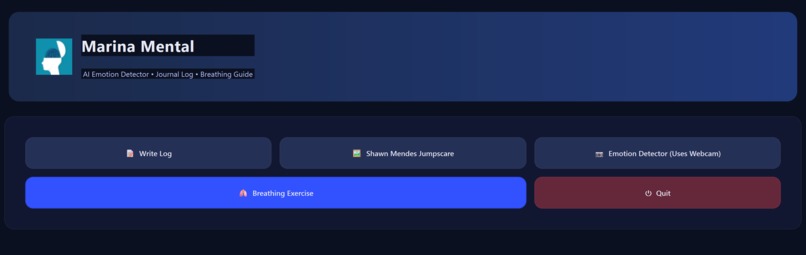
Main Menu
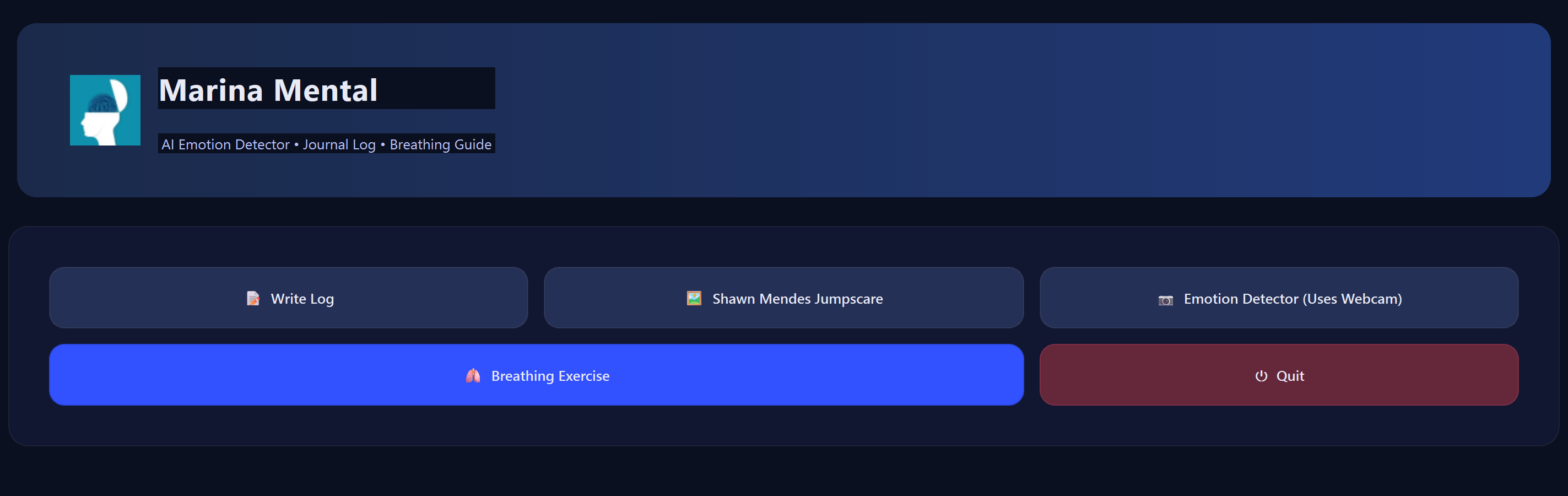
Inspiration
We knew that coming into this project we wanted to do something that could contribute towards improving mental health. Team members suggested several ideas that involved computer vision, AI, and something related to a positive affirmation chatbot. We took aspects from each of these topics and merged them together to create Marina Mental.
What it does
The product utilizes AI to detect the user’s dominant emotion. Once it has detected the dominant emotion, it returns an affirmation from the list of available affirmations. There are different affirmations for each emotion, which are happiness, anger, sadness, disgust, neutral, and surprise. It features a logging system that stores information about the user’s emotions as well as a handful of breathing exercises to reduce stress. The user has the option to check on their progress to see how far they have come. It gives the extra support the user may need for introspection and healing.
How we built it
We used OpenCV which is a python computer vision library to help with detecting human facial expressions. It started first with detecting a face on a still image, we then worked our way up to a version that can track a human face in realtime. We used pyside6 to develop a simple GUI for the user to navigate. It also allowed us to create simple animations for our breathing exercises. We created separate files logEmotion.py and visualize_emotions.py to work together and save the user’s data in JSON format to be easily readable for future chart making.
Challenges we ran into
At first when we started this project, we were deciding what kind of application this would be. Firstly, we decided to create a mobile app. However, when we researched implementing real time emotion detection on the phone, it would take a lot more time since we would need to create our model from scratch and train it using Convolutional Neural Networks, which would take up most of our time and would not come out as well in less than 24 hours. As a result, we decided on creating a desktop application that had frameworks to make the process a lot easier. A challenge we ran into was using AI to detect the emotions correctly. At times it would not pick up on the emotion being expressed by the user. Another challenge that we ran into was getting the window to fit inside the frame since it would pop up and not load into the frame.
Accomplishments that we're proud of
An accomplishment that we’re proud of is getting AI to first analyze human facial expressions, then return the appropriate affirmation to the user after it has detected their emotion. We’re also proud of our system to correctly log the user’s data after each session. Our adaptability has also shown its benefits due to the constant course correction needed for this project.
What we learned
The algorithms behind human face detection are quite more difficult than we had initially thought, which made us appreciate the field a lot more. We learned new ways to analyze datasets, develop user interfaces, and potentially store large amounts of user data. If we were to redo the project with our current knowledge and with more time, we’d know exactly where to make improvements.
What's next for Marina Mental
This experience has been a great help to each member of this team. It has proven to us that we are capable of engaging with complex and completely new topics that had previously seemed impossible. We plan to take that ambition with us as we continue to hone our skills.

Log in or sign up for Devpost to join the conversation.