Inspiration
I have worked in the automotive industry for more than 15 years, and one operational problem has remained surprisingly persistent: service appointment scheduling.
The challenge is even greater in outbound operations, where employees must contact customers, understand their vehicle needs, present preventive-maintenance offers, negotiate, check availability, and confirm an appointment. These positions often face high turnover, and finding qualified professionals with the right combination of technical knowledge, empathy, communication skills, and sales ability is difficult.
This situation has become more serious as Brazil faces an increasing shortage of qualified labor. Dealerships and service centers need to grow their customer relationships, but their teams are already overloaded with repetitive calls, follow-ups, confirmations, and rescheduling.
IASS FleetOps was inspired by a simple question:
What if one intelligent voice operation could support an entire service center—speaking naturally, adapting to each customer, protecting the schedule, and knowing when a human must take over?
What it does
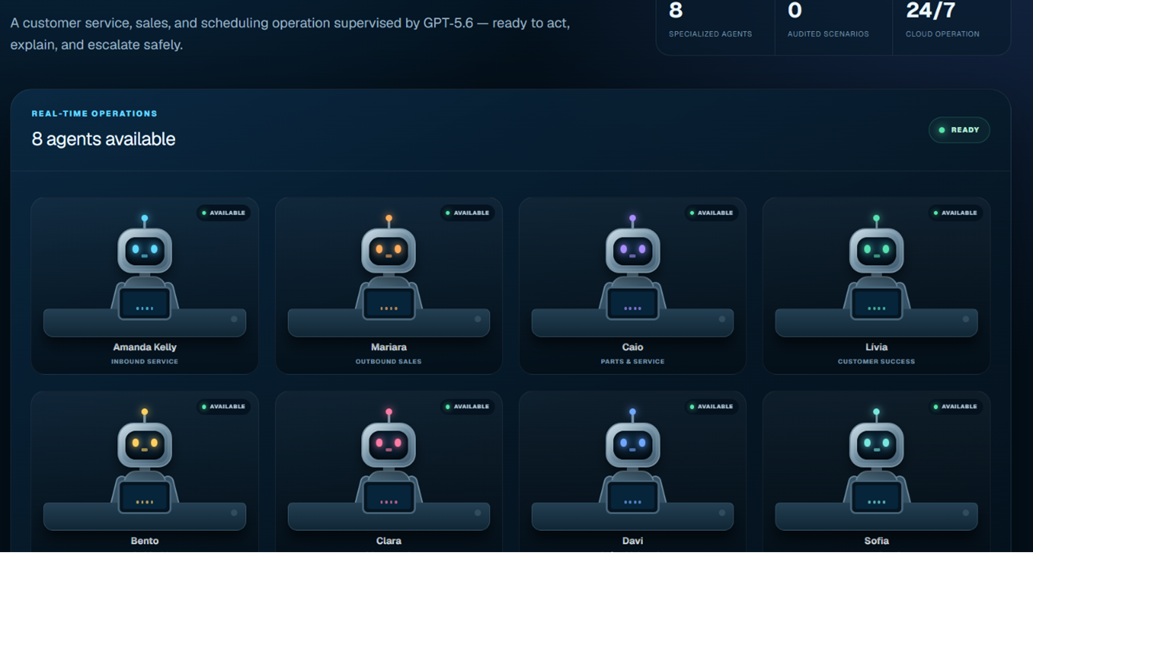
IASS FleetOps is a bilingual, AI-powered voice operations center for fleet service, customer care, sales, scheduling, and safety escalation.
The platform has specialized agents for different responsibilities. Inbound agents assist customers who contact the service center, while outbound agents proactively call customers with relevant preventive-maintenance campaigns.
The agents can:
- conduct natural inbound and outbound conversations;
- adapt their tone to the customer’s mood and urgency;
- explain maintenance campaigns without overwhelming the customer with technical details;
- collect customer, vehicle, and service information;
- check calendar availability before confirming an appointment;
- prevent double bookings and suggest alternative time slots;
- prepare appointment confirmations and WhatsApp follow-ups;
- detect safety-critical situations, such as a possible brake failure;
- stop the commercial conversation and escalate the case to a human specialist.
A GPT-5.6 Supervisor analyzes the conversation and operational context. It produces a structured decision containing intent, emotion, priority, risk, required human handoff, scheduling validation, recommended next action, customer follow-up, and a concise manager summary.
The goal is not to eliminate people. It is to let a small, qualified human team supervise a much larger operation while AI handles repetitive work consistently and remains available whenever customers need assistance.
How I built it
The project started as a local Portuguese-language prototype for a live automotive presentation. It connected voice agents with n8n workflows, Google Calendar, WhatsApp, and optional Twilio telephony.
During OpenAI Build Week, I worked with Codex to transform that prototype into a standalone, cloud-hosted product experience.
The new version includes:
- a neutral and original product identity: IASS FleetOps;
- a fully hosted English judge experience;
- separate English versions of the voice agents, without changing the validated Portuguese agents;
- browser-based voice demonstrations that do not require a real telephone call;
- synthetic customer scenarios for safe and repeatable judging;
- a GPT-5.6 operational-supervision layer using the OpenAI Responses API;
- strict structured outputs for explainable operational decisions;
- automated tests for emergency escalation, scheduling conflicts, branding, and secret protection;
- a cloud deployment that does not depend on my computer or a local server.
The architecture combines OpenAI GPT-5.6, Codex, ElevenLabs voice agents, n8n workflows, Google Calendar, WhatsApp integrations, and optional Twilio telephony.
Challenges
The greatest challenge was not simply making an AI agent speak. It was making the complete experience reliable enough to represent a real business operation.
Natural conversations require appropriate timing, emotional adaptation, interruption handling, and low latency. An outbound agent must wait for the customer to answer before beginning its introduction. It must not interrupt, transfer a call without authorization, or sound like it is reading internal instructions.
Scheduling introduced another critical challenge. An agent that speaks naturally but confirms an occupied time slot creates a serious operational problem. We added deterministic scheduling guardrails so availability must be checked before confirmation, and unavailable times produce alternative options.
Safety was equally important. If a customer reports a dangerous condition, such as a truck without functioning brakes, the system must immediately stop the sales or scheduling flow, provide safe-stop guidance, and escalate the case to a human.
The final challenge was converting a successful local demonstration into something judges could run independently. Codex helped rebuild the application for cloud deployment, isolate secrets, create the English experience, implement regression tests, and document the entire project.
What I learned
I learned that a production-ready voice agent is much more than speech recognition and text-to-speech. The real value comes from combining conversation with operational context, business rules, workflow tools, and human escalation.
I also learned that the best architecture separates responsibilities:
- voice agents manage the live conversation;
- deterministic rules protect safety and scheduling;
- GPT-5.6 interprets the complete situation and recommends the next action;
- humans remain responsible for critical or exceptional decisions.
Codex dramatically accelerated the transition from an idea and working prototype into a tested, documented, and hosted product. It allowed me to collaborate on product strategy, architecture, code, testing, voice-agent configuration, deployment, and presentation without losing sight of the real automotive-industry problem.
What’s next
The next step is to transform IASS FleetOps into a complete multi-dealership platform with its own CRM, campaign management, customer history, operational dashboards, quality monitoring, analytics, and human-agent workspace.
Future versions will support multiple dealerships, specialized campaigns, service reminders, lead prioritization, manager approvals, and measurable business outcomes such as appointments generated, conversion rate, customer satisfaction, recovered revenue, and cost per successful interaction.
My long-term vision is to give every dealership access to an intelligent, scalable operation that combines the consistency of automation with the empathy and judgment expected from an excellent human team.
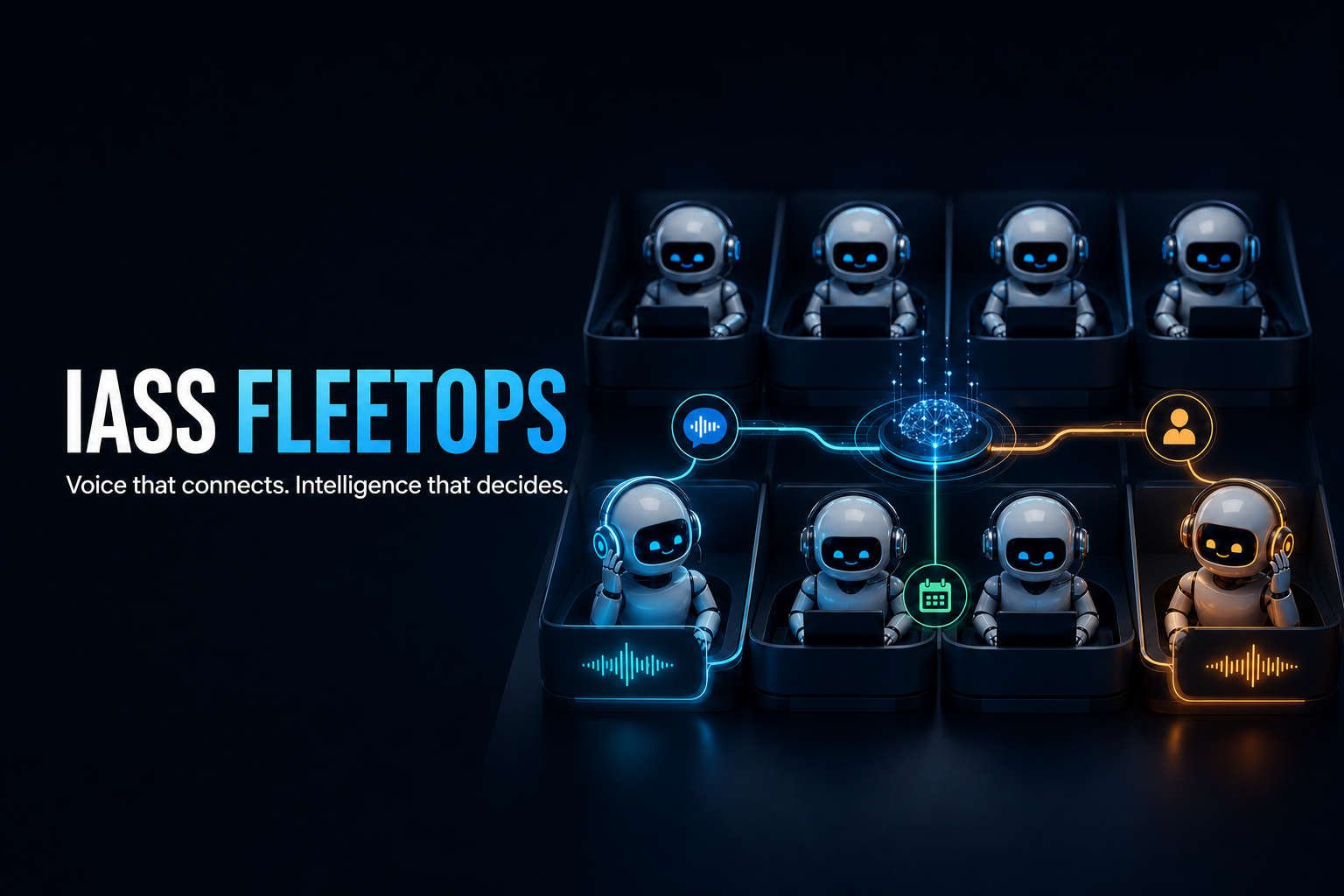
IASS FleetOps: Voice that connects. Intelligence that decides.
Built With
- agents
- ai
- api
- automation
- calendar
- cloudflare
- codex
- elevenlabs
- gpt-5.6
- n8n
- next.js
- openai
- react
- speech-to-speech
- twilio
- typescript
- voice
- workflow

Log in or sign up for Devpost to join the conversation.