-
-
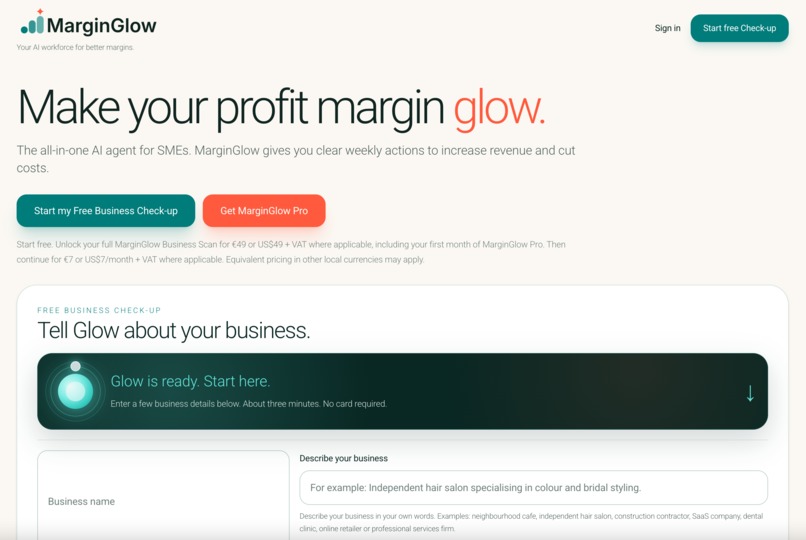
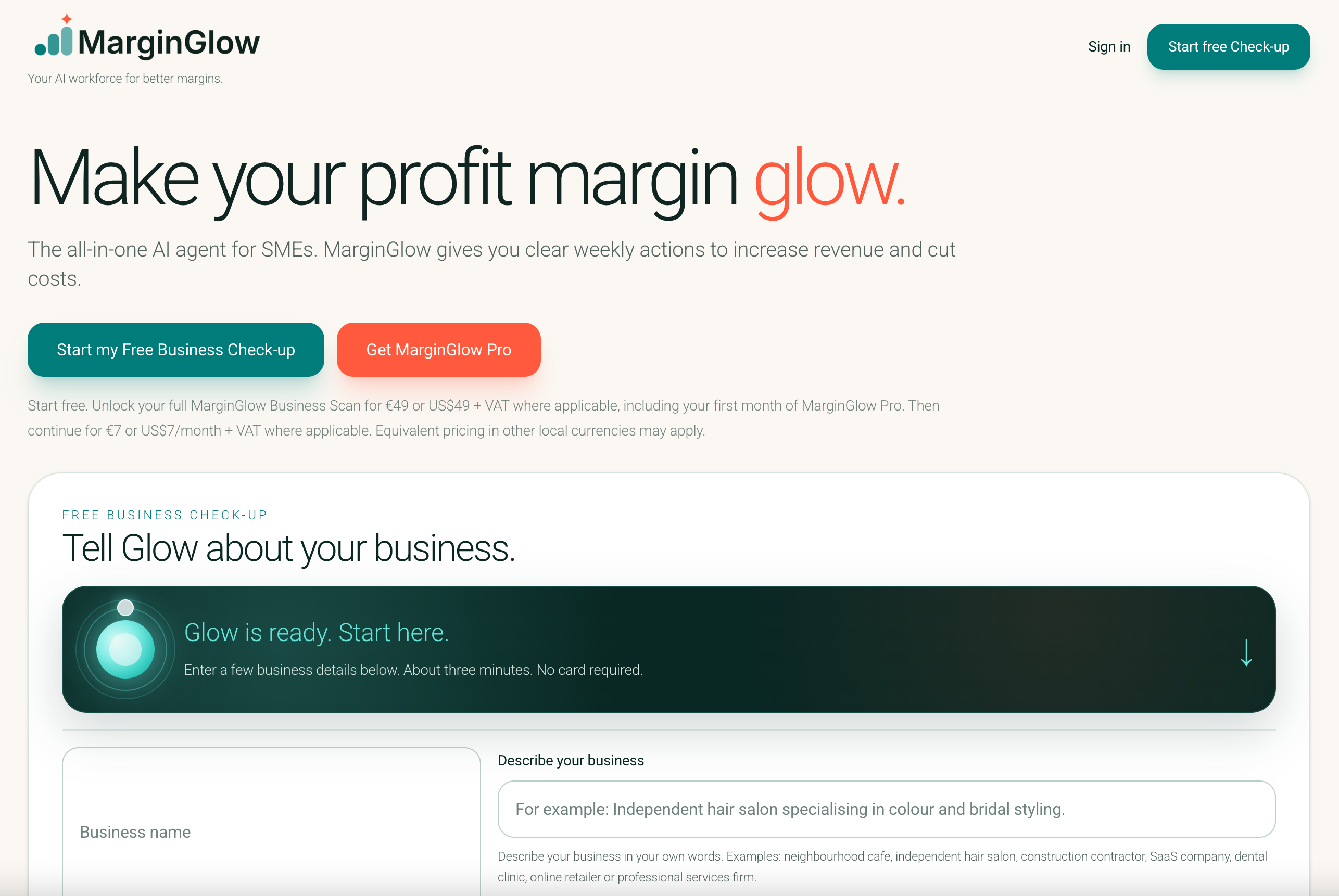
Welcome to powerful AI for small business.
-

MarginGlow AI is designed to help every small business, everywhere.
-
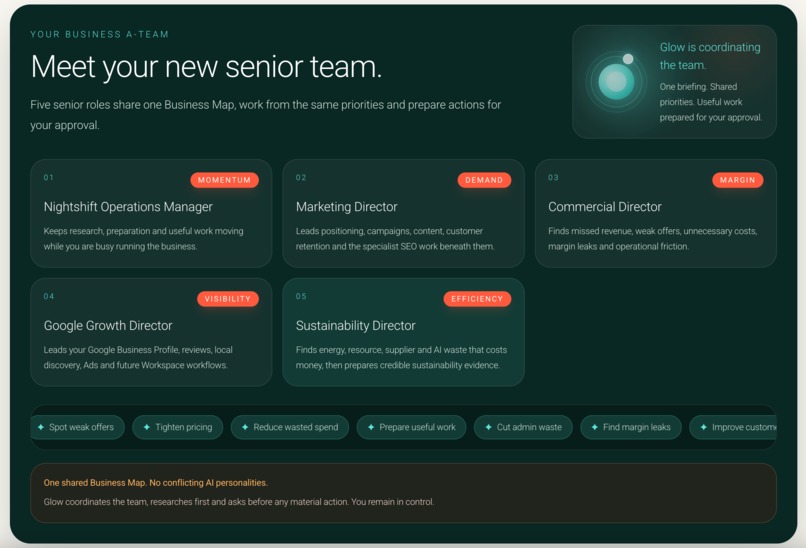
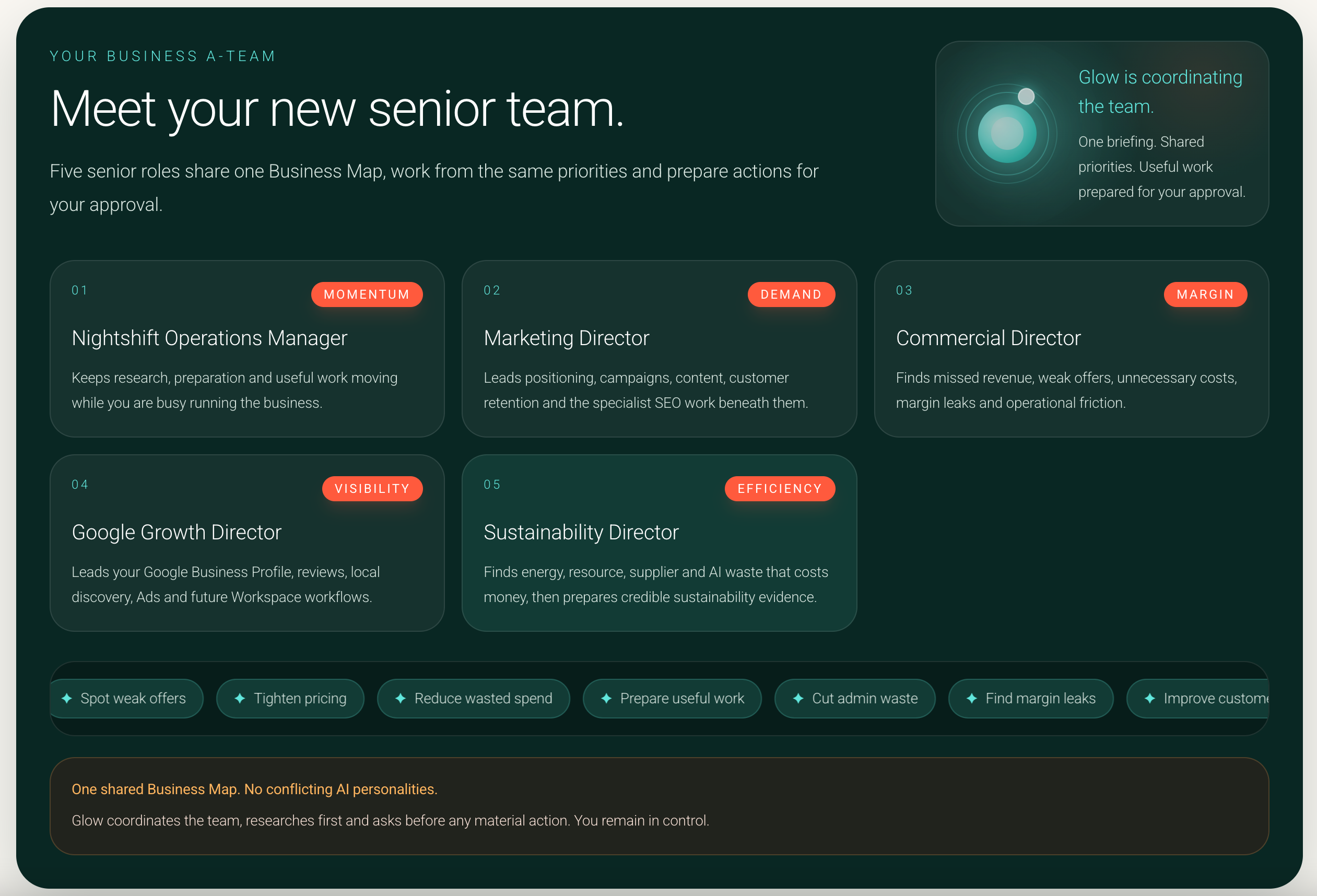
Add your C-suite in minutes.

Inspiration
Small-business owners know their businesses could do more. They see opportunities in marketing, growth, digitalisation and operations, but rarely have the time, expertise or people to act on them. Many have great products and loyal customers, but no specialist team to analyse the business, improve its visibility or plan what comes next.
The problem is not ambition. It is capacity.
Throughout our careers, we saw that gap repeatedly. Sophisticated business support was largely reserved for companies able to afford consultants, agencies and departments of specialists. MarginGlow is built on a simple idea: a five-person business deserves access to the same quality of expertise.
The European Union has approximately 34 million SMEs, representing 99.8% of enterprises and employing around 105.6 million people. The United States has 36.2 million small businesses, representing 99.9% of US businesses.
That is not a niche. That is almost everyone.
What it does
MarginGlow is a Google-first AI growth team for small businesses. It researches a business, builds a persistent understanding of how it operates, identifies opportunities and turns those opportunities into practical work.
A visitor begins with the Free Glow Check-up. Gemini analyses the information provided and researches the business’s public digital presence. It identifies strengths, gaps and opportunities without requiring the owner to complete a lengthy questionnaire.
When the visitor creates an account, those results become part of a persistent Glow Business Map and Business Memory. The owner can confirm, correct and expand what Glow discovered, including services, location, contact details, goals and preferences.
Paying customers can run a deeper Pro Scan. Gemini uses the saved business context to diagnose the business, prioritise opportunities and recommend actions based on likely value. This produces advice grounded in the individual business rather than a generic chatbot response.
Through Ask Glow, an owner can give the system a real business instruction. Glow researches the task, makes analytical decisions, prepares an output and stores the work as an agent run. The owner can review, revise, approve or reject the result.
AI provides speed, research, analysis and execution. The human retains judgement, accountability and final authority.
How we built it
MarginGlow runs on Google Cloud Run. Gemini provides business research and structured analysis, Firebase Authentication manages identity, and Cloud Firestore stores Business Memory, product activity and agent work. Stripe manages customer payments and paid entitlements.
Several AI systems operate behind the customer product. The Help Agent answers product questions using approved support knowledge. The QA Agent checks release readiness and product behaviour. Support Intelligence analyses anonymised feedback patterns so recurring customer difficulties can become product improvements.
First-party event tracking records anonymous and signed-in product interactions. Our private internal dashboard displays the customer funnel, production activity and agent execution history.
We also used AI to build and operate MarginGlow itself. Gary Byrnes, MarginGlow’s founder and a non-developer, translated customer needs and product decisions into production software through conversational AI-assisted development. AI helped inspect the application, write controlled code changes, diagnose failures, run builds and prepare deployments.
Felix Roick led operational review, tested the product from a customer perspective and examined production evidence to identify gaps.
The humans decided what problem to solve, spoke with customers, set pricing, defined acceptable risk and approved production changes. AI dramatically expanded what our small team could design, build, test and operate during the competition.
Challenges we ran into
Our greatest product challenge was turning powerful general-purpose AI into something a business owner could trust. Useful advice requires persistent context, while consequential work requires human control. We addressed this through Business Memory, structured outputs, agent execution records and explicit approval states.
A second challenge was measuring activity from visitors who completed a Free Glow Check-up without creating an account. We introduced first-party anonymous session tracking while keeping authenticated identities securely separated. Earlier activity recovered from Cloud Run logs is presented as aggregate evidence rather than being misrepresented as individual users.
We also had to improve a live product without breaking authentication, payments or stored customer work. We used small reversible changes, automatic backups and full production builds before deployment.
Accomplishments that we're proud of
MarginGlow launched publicly on 3 August 2026. It has real users, a paying customer, live Stripe revenue and feedback from businesses using the product.
Our evidence includes Cloud Run activity, first-party product events, account progression, agent execution records, customer information and payment records. The internal dashboard distinguishes customer accounts, anonymous activity, judges, internal users and historical aggregate evidence.
Customer feedback has already changed the product. When a paying customer found that important information such as her phone number could not be corrected in the Business Profile, we expanded the editable profile and improved the dashboard experience. Human experience identified the problem; AI helped us analyse, implement and verify the response.
We are also proud that a non-developer founder was able to build and operate a real AI business on Google Cloud using AI as both a product capability and a working partner.
What we learned
We learned that AI becomes substantially more valuable when it remembers the business, explains its reasoning through structured work and respects clear human approval boundaries.
We also learned that owners do not want more software administration. They want useful work completed. MarginGlow therefore focuses on outcomes rather than presenting another collection of charts and tools.
Most importantly, direct customer observation is irreplaceable. AI accelerates the response, but humans reveal which problems genuinely matter.
What's next for MarginGlow AI
Our XPRIZE category is Small Business Services. MarginGlow can help a retailer strengthen its online presence, a restaurant fill more tables, a tradesperson identify where money is being lost, or a family business plan beyond the next urgent problem.
Our next steps include deeper connections with Google Business Profile, Google Ads and Google Workspace, alongside more capable but carefully governed Glow Agents.
MarginGlow is designed to augment people, not remove them. By helping owners attract customers, protect margins and act on opportunities, it can support existing employment and enable growing businesses to create new roles. Our first customer is a local salon whose growth supports jobs in its community.
At scale, MarginGlow can also create opportunities for customer-success specialists, local implementation partners and professional advisers who help businesses execute more ambitious plans.
The owner brings ambition, judgement and final authority. Glow brings continuous research, analysis and execution. Together, they give every small business a better chance to compete, grow and create jobs sustainably.


Log in or sign up for Devpost to join the conversation.