
Inspiration
Ask an AI to design something physical, like a bracket, a drone or a circuit board, and you get an answer that sounds right. The numbers are confident, but nobody checked the physics. An engineer can't build from that, and a wrong answer in hardware costs real money or breaks in the field.
We wanted an AI you could trust with hardware: one that designs the thing and proves it works, the way an engineer would. It should show its work, test against the conditions the thing will actually face, and only call a design ready when every number has been checked.
What it does
You describe anything in one sentence, or send a photo or a 3D file. Margin:
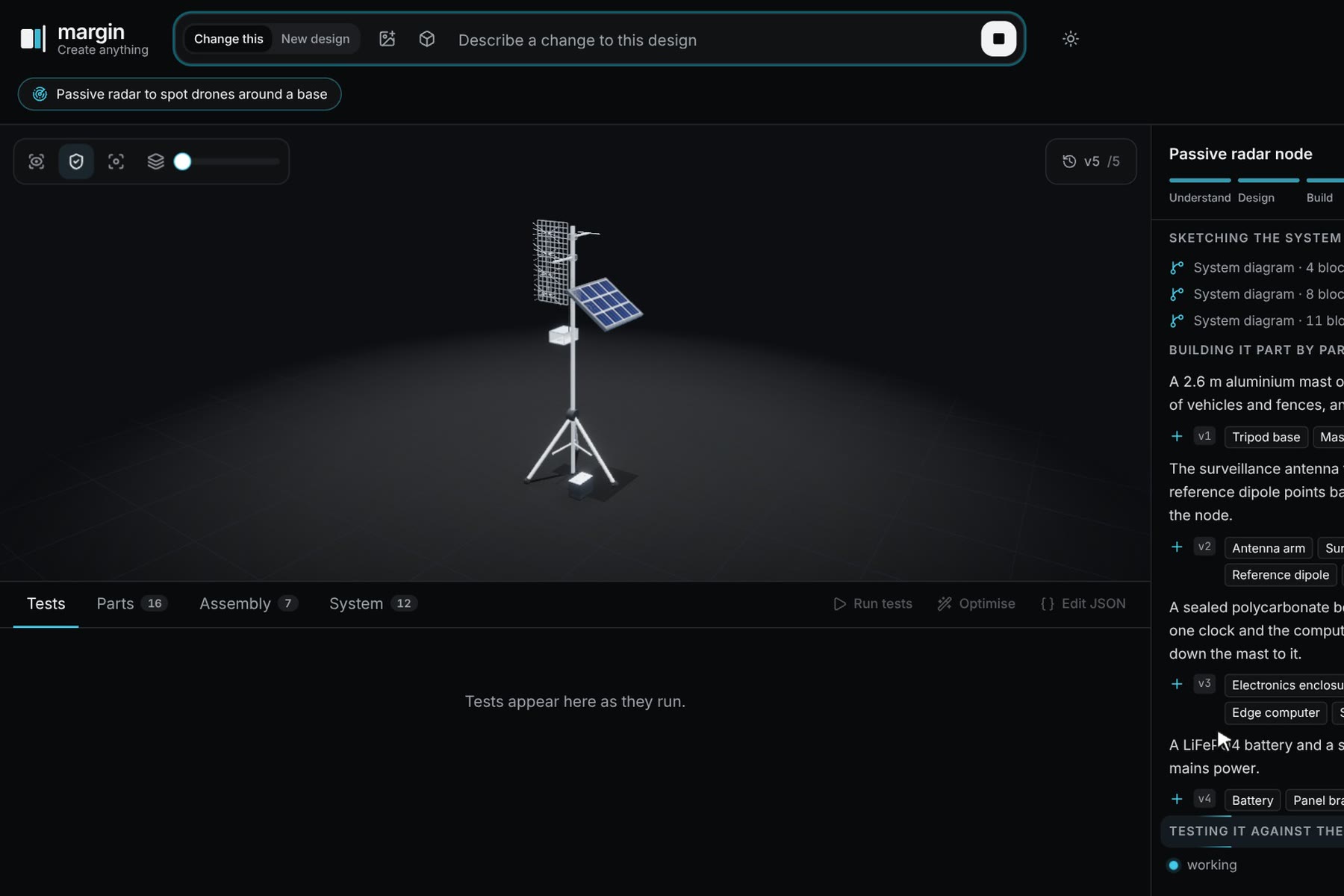
- Designs it. It writes the brief, sketches the system, and builds the design part by part in 3D, with real materials and dimensions.
- Tests it against the real world. It runs storms, heat, drops, loads, vibration, current, airflow, battery endurance and radio coverage. Each test is a physics simulation that checks its own work.
- Fixes it. When a test fails for a design reason, Claude changes the design. When it fails on size, an optimiser tries changes and keeps only the ones the simulations prove.
- Reports a margin of safety for every result, with the exact command that reproduces it.
$$ \text{Margin of safety} = \frac{\text{allowable}}{\text{actual}} - 1 $$
$+0.25$ means 25% to spare, and anything below $0$ fails. A design is ready to build only when every test passes on verified simulations.
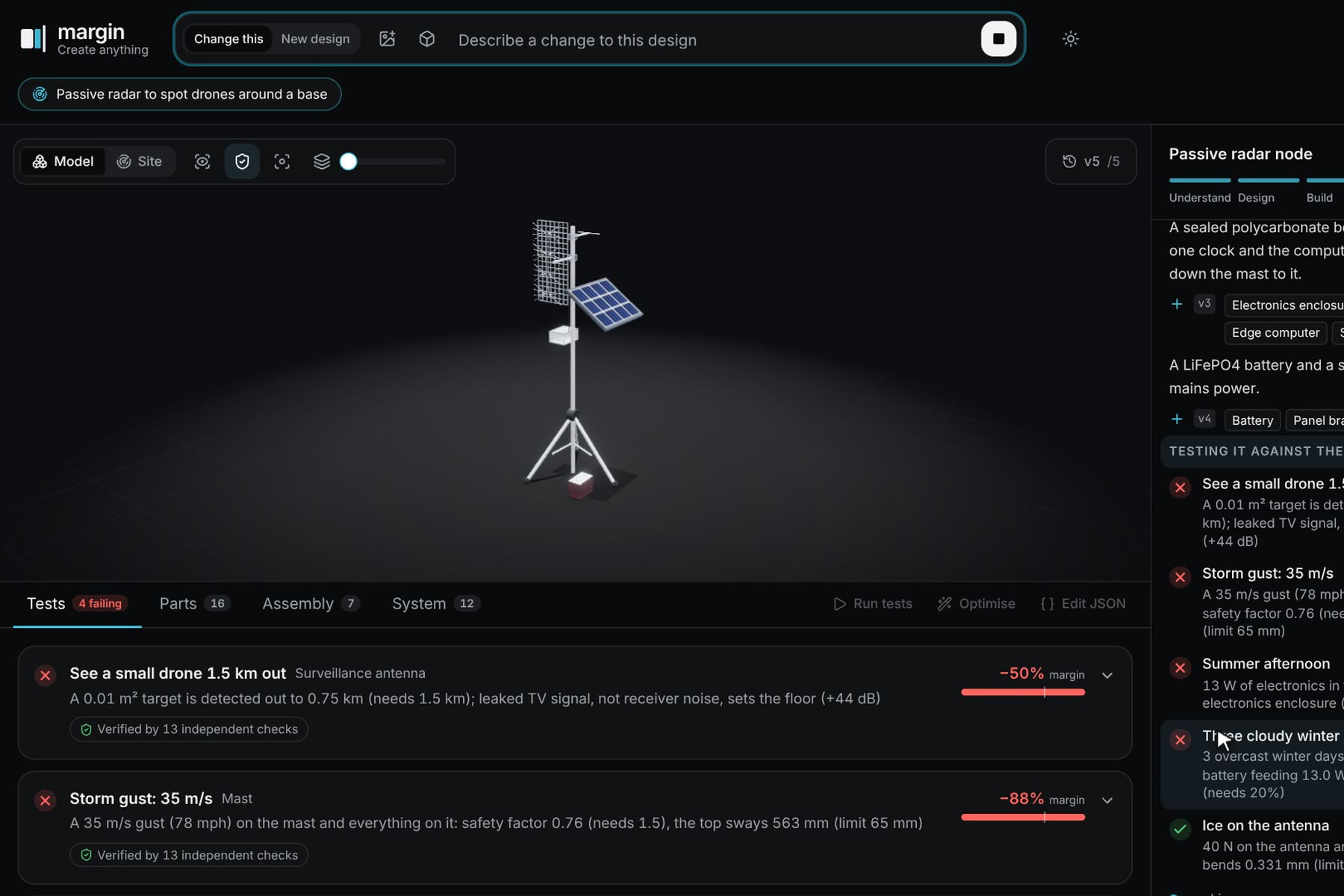
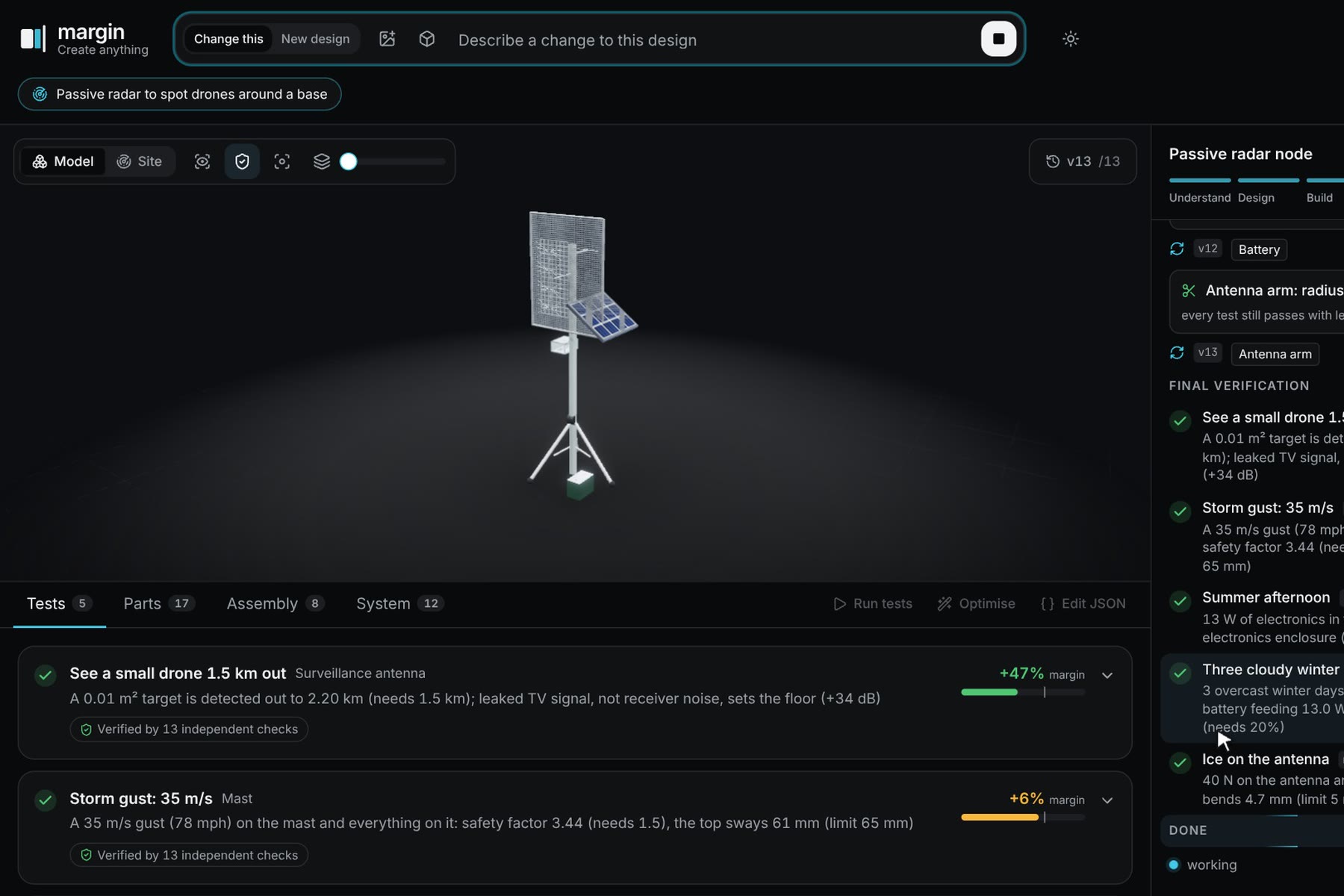
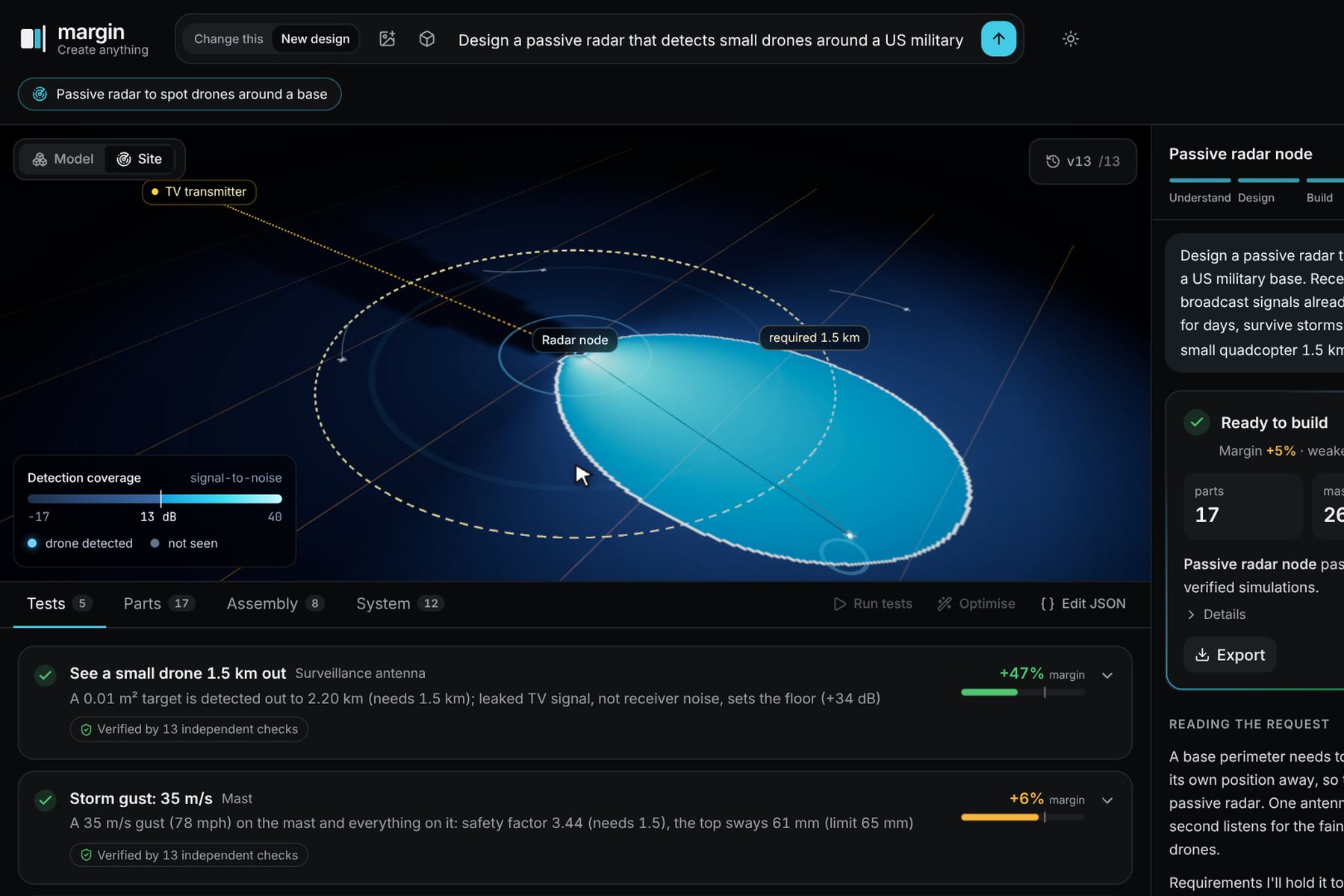
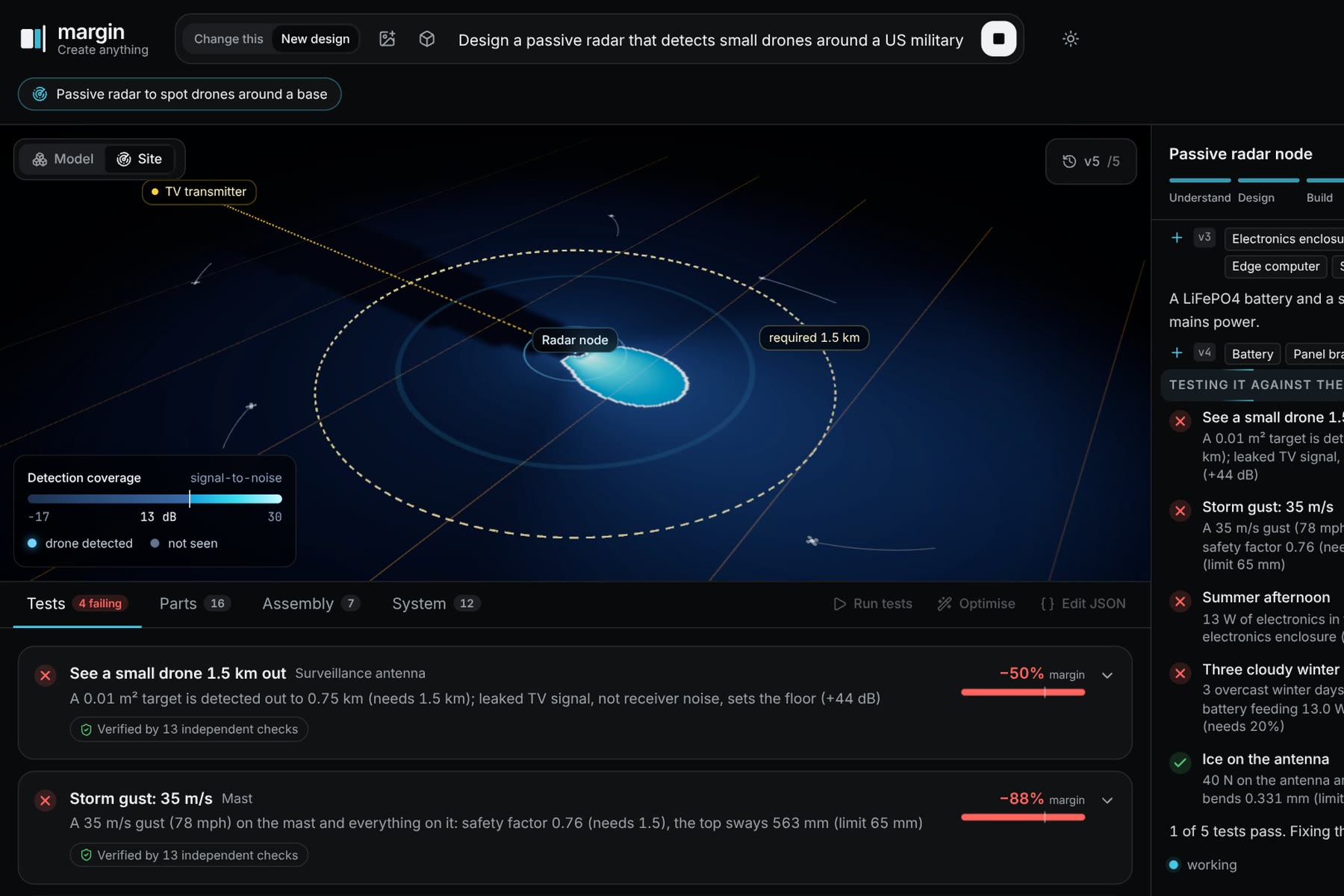
Example. "Design a passive radar that spots small drones around a base: receive-only, off-grid, survives storms and summer heat, sees a small quadcopter 1.5 km out."
- First design: 1 of 5 tests pass. Detection reaches only 0.75 km. The simulation shows that the TV signal leaking into the back of the antenna sets the noise floor, so a bigger antenna would not help.
- The fix: a wire-mesh screen. Range jumps to 2.2 km.
- The optimiser: it paints the enclosure white, sizes the battery for three cloudy days and stiffens the mast for a 35 m/s gust. All 5 tests then pass.
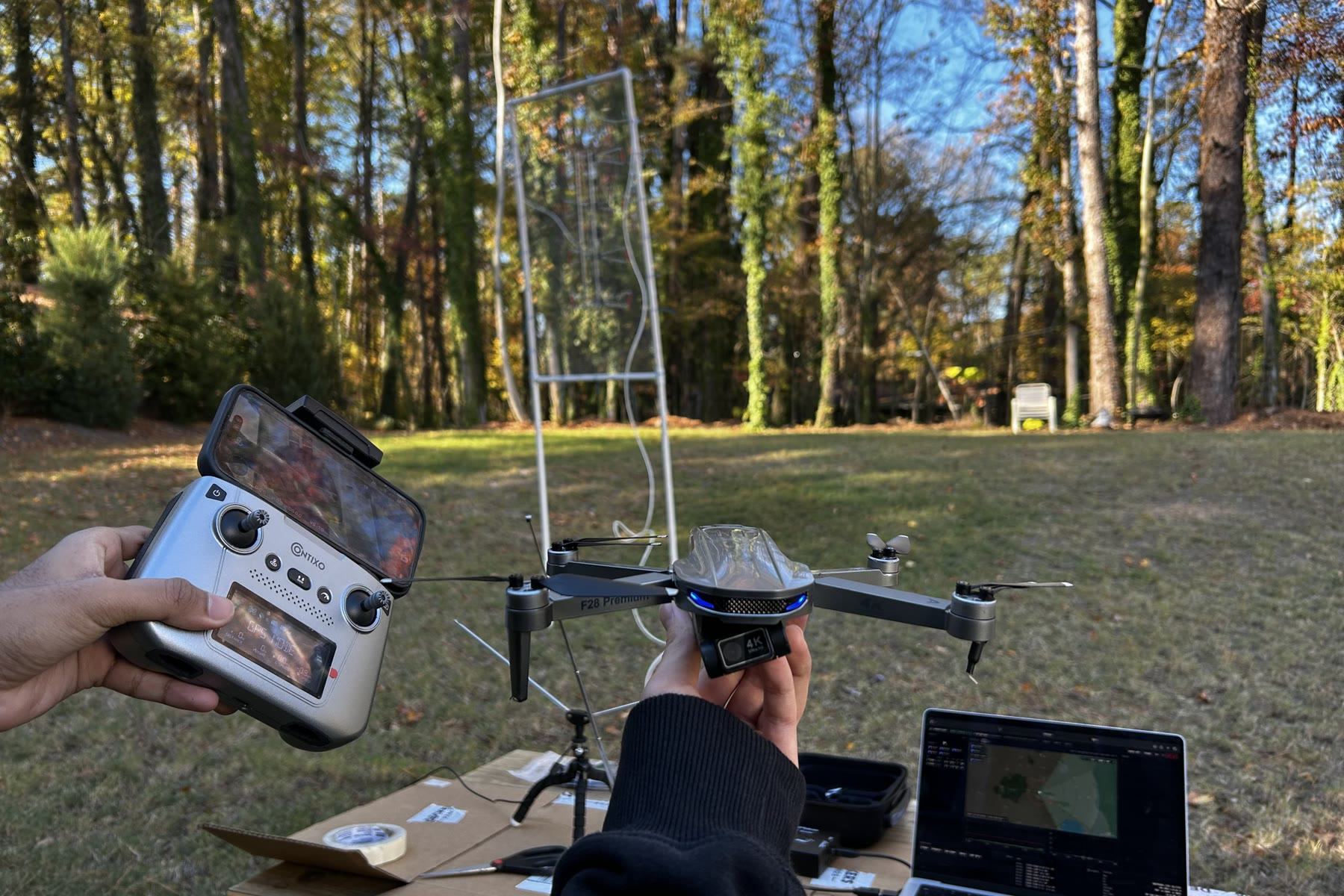
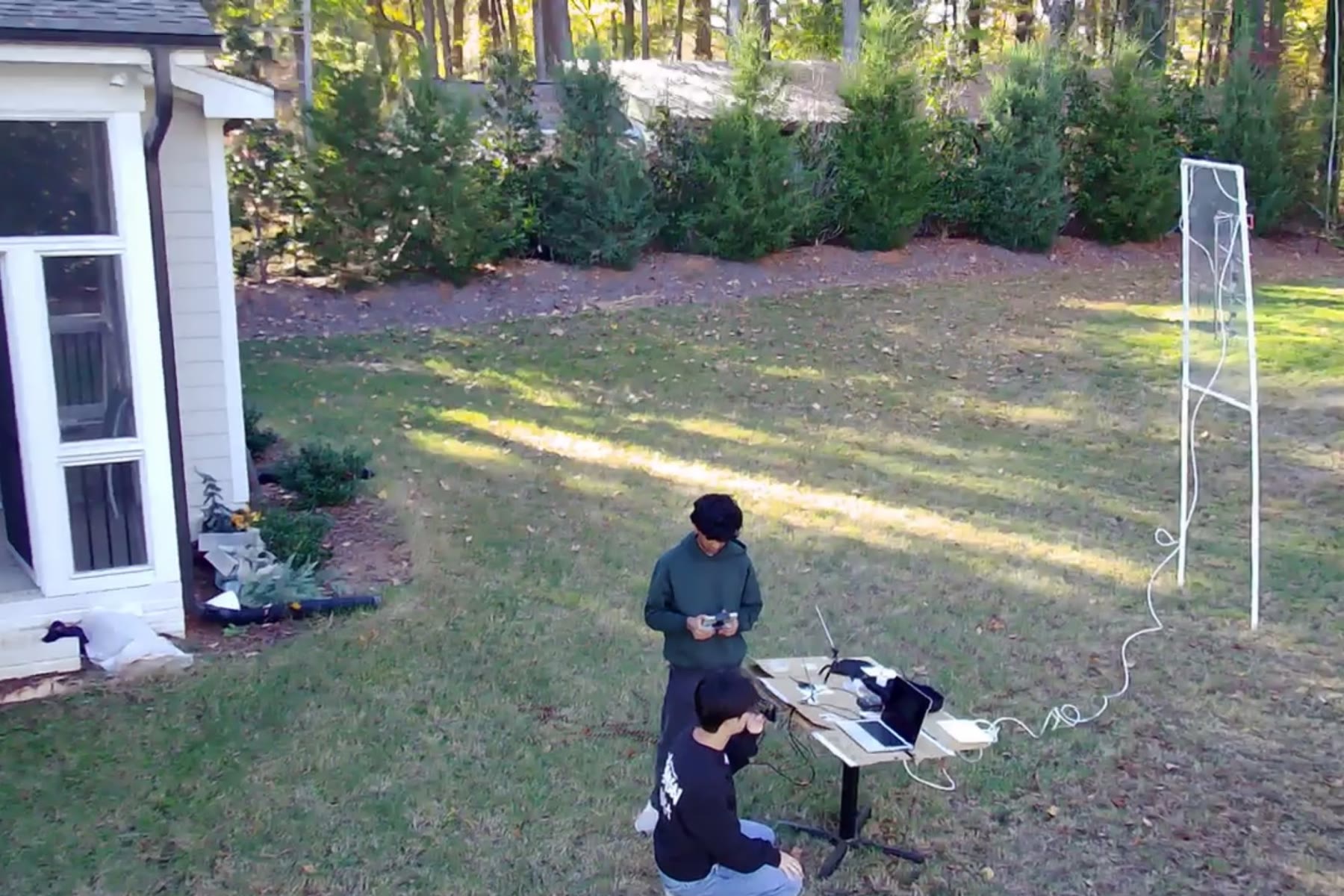
- The field test: we built the screen frame from Margin's design and tested it outdoors with a drone.
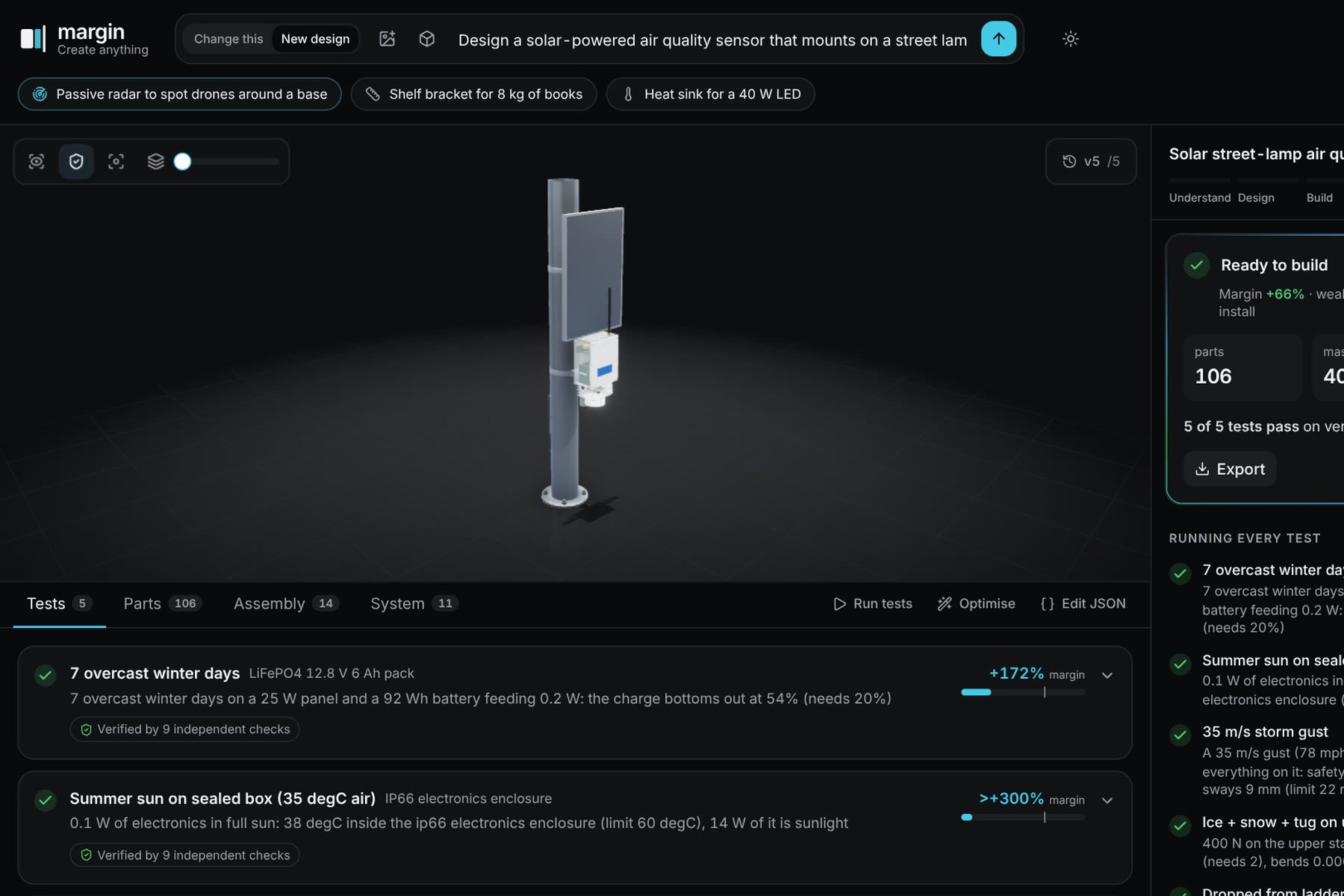
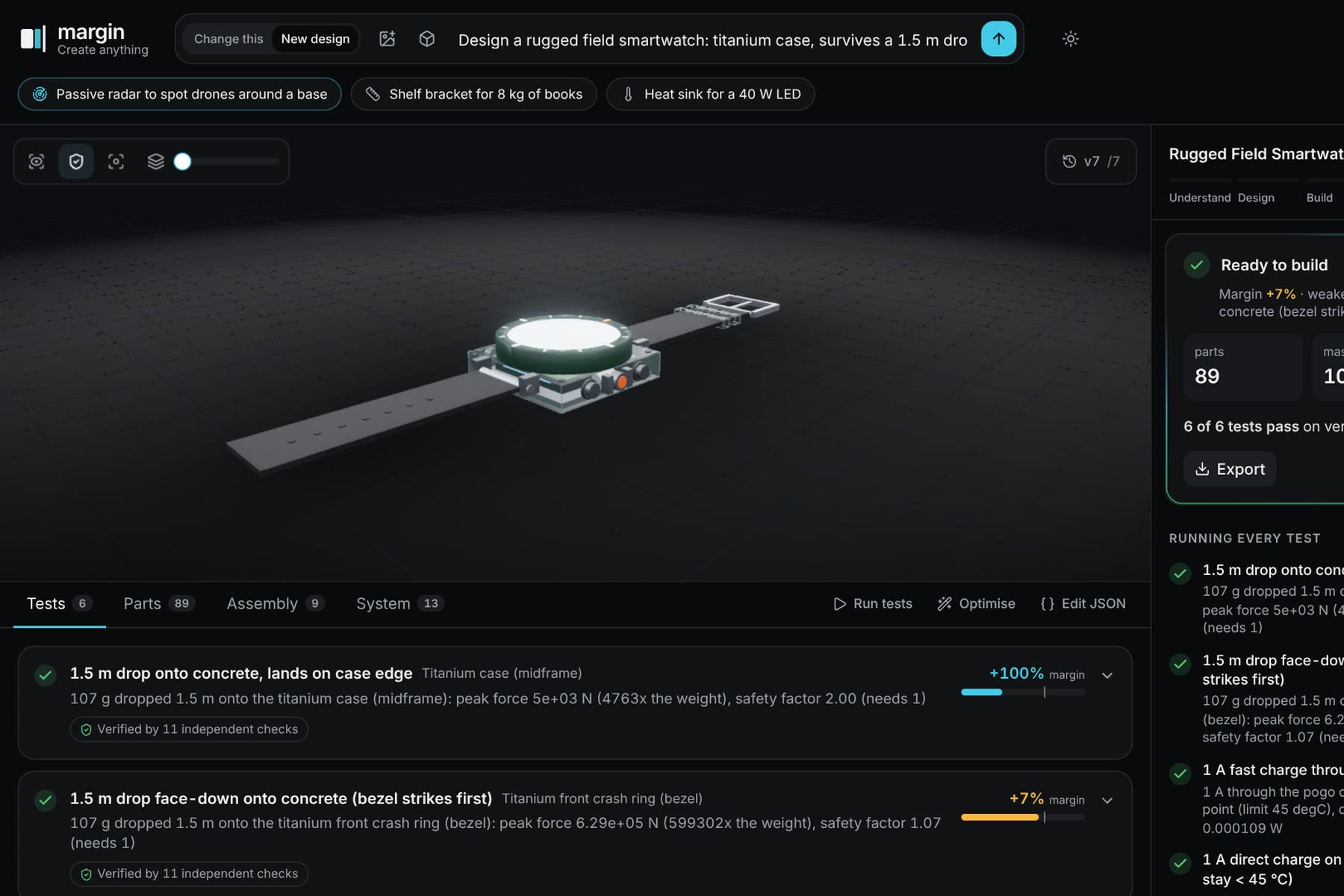
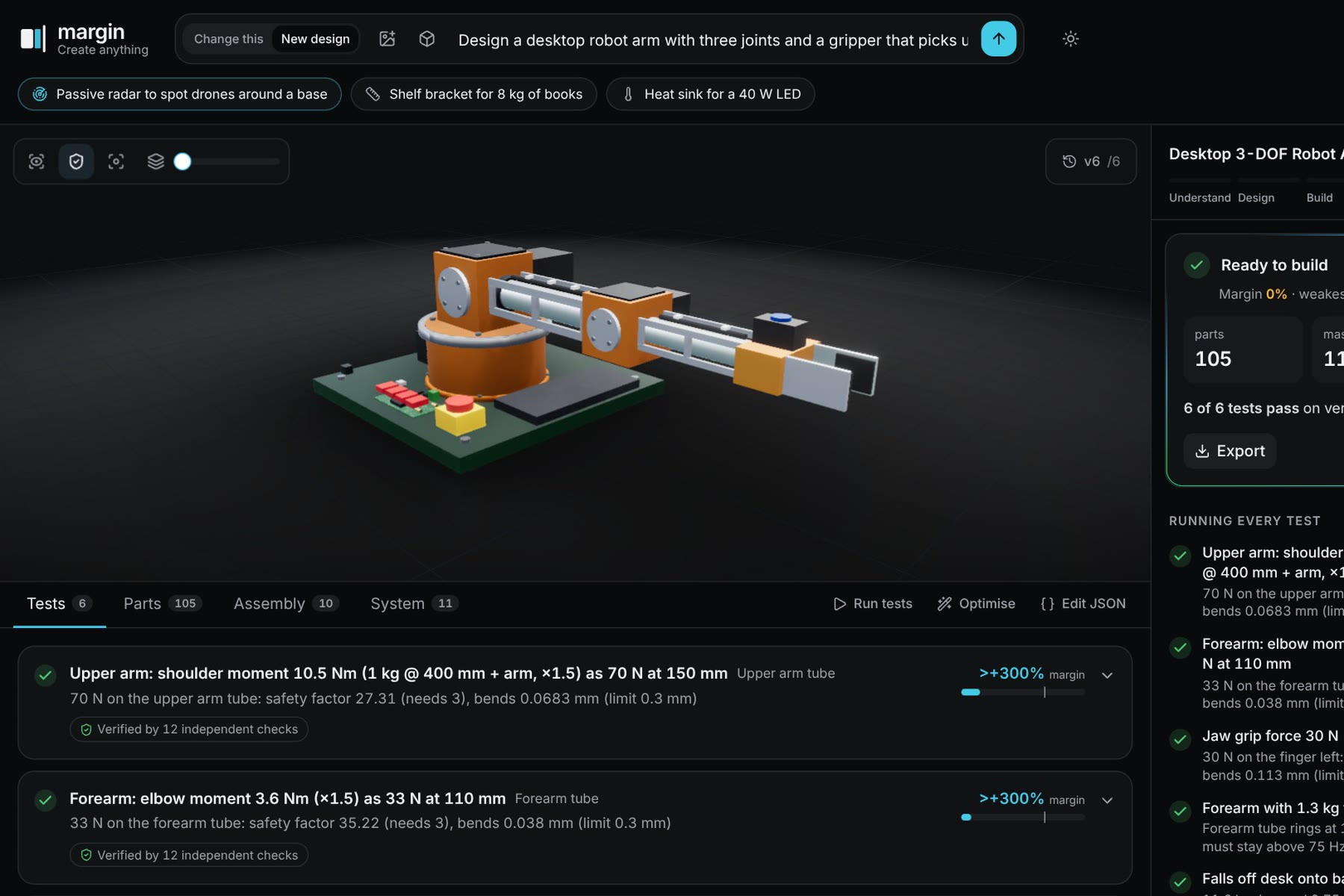
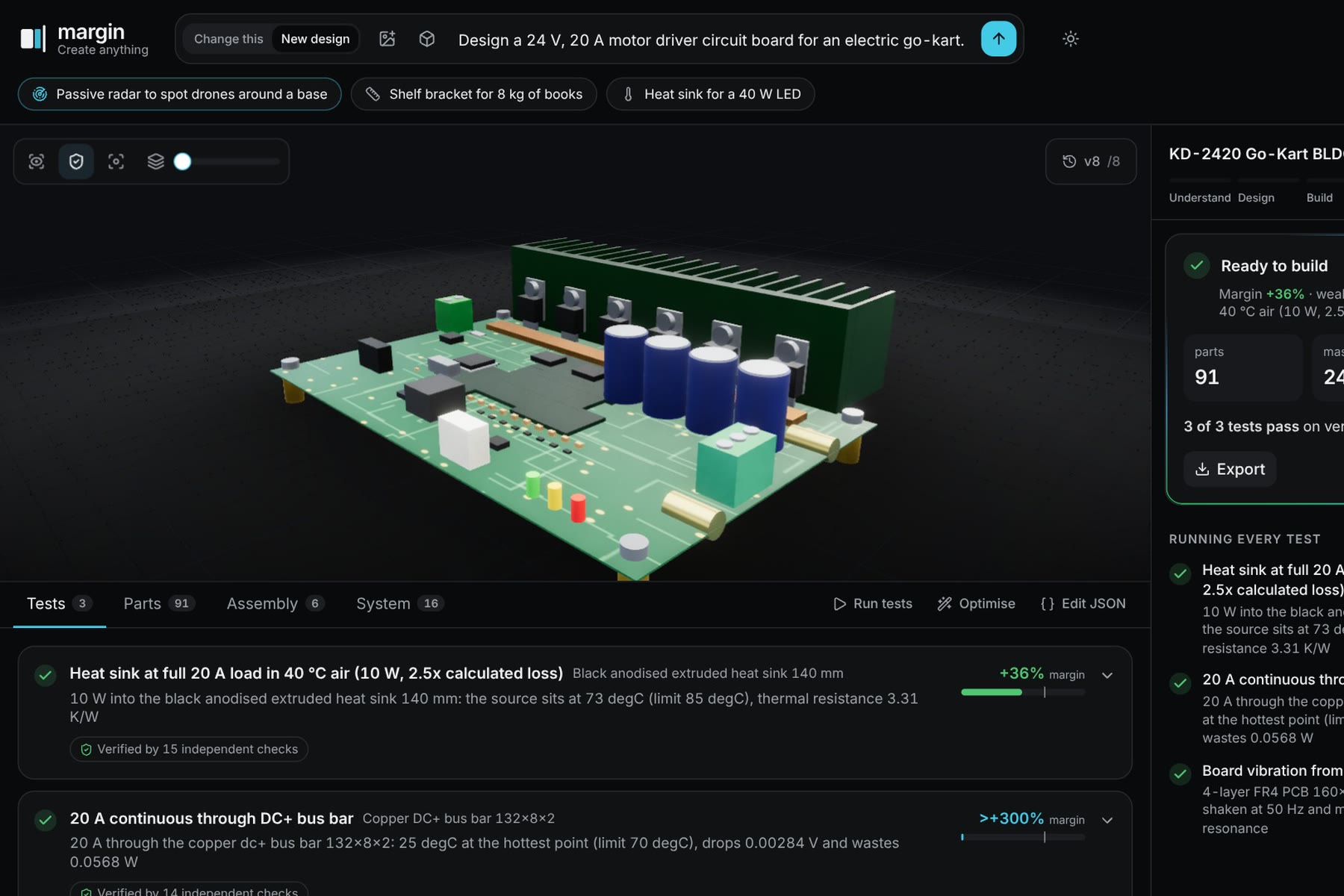
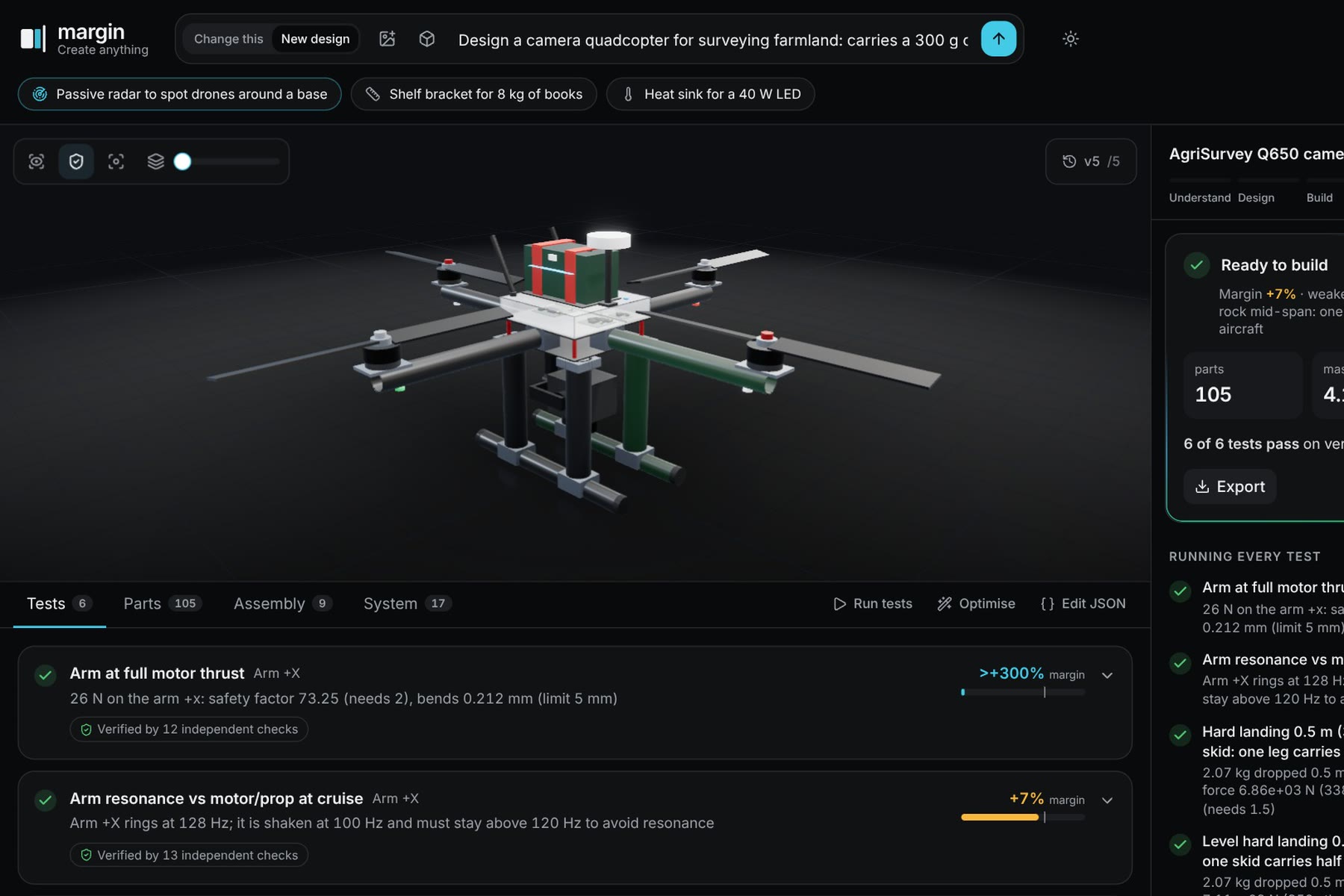
Margin then designed a survey drone, a robot arm, a rugged smartwatch, a go-kart motor driver board and a solar air-quality sensor live. Each has 89 to 106 parts and passes every one of its tests.
How we built it
- A self-checking physics engine (Python, NumPy, SciPy), written from scratch. It has 32 simulations covering finite volume, finite elements, Navier–Stokes, FDTD electromagnetics, thermal networks, bistatic radar and battery energy balance. Every run must pass a verification protocol:
- units and dimensional analysis;
- known exact or benchmark solutions;
- residuals, conservation and stability limits;
- a three-grid convergence study with Richardson extrapolation.
$$ p = \frac{\ln\left(|f_2 - f_1| / |f_3 - f_2|\right)}{\ln 2}, \qquad f_\text{exact} \approx f_3 + \frac{f_3 - f_2}{2^{p} - 1} $$
- Real-world tests (12 types) that turn a design into simulation inputs and pass limits. The radar test uses the public bistatic radar equation, with the leaked direct signal added to the noise:
$$ \text{SNR} = \frac{P_t\, G_t\, G_r\, \lambda^2\, \sigma\, T_i}{(4\pi)^3\, R_t^2\, R_r^2\, L\, \left(k T_0 F + N_\text{leak}\right)} $$
- The designer agent is Claude Opus 5.5 with tool use: set the diagram, build and update the design, run tests, optimise. Claude never does the physics. It decides what to build and which tests matter, reads the results, and fixes failures for a reason it states.
- An optimiser moves tunable dimensions both ways. It enforces containment, so electronics stay inside their box, and trims material only while every test keeps at least +5% margin.
- A live interface (React, TypeScript, three.js with React Three Fiber, Tailwind, shadcn/ui, React Flow). It streams every step: reasoning, the system diagram drawing itself, parts appearing in 3D, tests resolving, a radar coverage map with drones, and the optimiser's before-and-after.
- The demo video was cut in Remotion from frame-exact captures of the real app, recorded on a virtual clock with Playwright.
Challenges we ran into
- Trust. It's easy to make a simulation produce a number, and hard to know the number is right. We built the verification protocol first and made every result carry its own checks. Untrusted numbers never count as a pass.
- The optimiser cheated. Early on it "passed" the heat test by shrinking the enclosure until the electronics were outside it. We added containment rules, plus a minimum margin so it can't trim a part right to the edge.
- Giving the AI a reason, not just a number. The radar failure wasn't fixable by sizing. Claude had to read why the noise floor was high (leakage, not receiver noise) and change the geometry.
- Large designs got cut off. A 100-part design plus Claude's reasoning ran past the reply limit, and the run quietly ended as if it had finished. We switched to streaming with a larger limit, and made the app say clearly when a reply is cut off.
- Recording the 3D app. Software rendering ran at about 1 frame per second. We replaced the page's clock so time only advances when a frame is captured, which gives smooth 30 fps footage on any machine.
Accomplishments that we're proud of
- Every number Margin shows is verified, reproducible and stated as a margin of safety.
- The radar went from 0.75 km to 2.2 km for a physical reason the simulation exposed, and we built it and took it outside.
- Five very different objects, each designed from one sentence, in detail, passing every test.
- 259 automated tests, and a free offline mode that runs every simulation live without an API key.
What we learned
- An AI agent is most useful for hardware when it is paired with tools that can say no. The checks made Claude's designs better, not slower.
- A margin of safety reads clearly for engineers and non-engineers alike.
- The hardest bugs were honesty bugs: places where the system claimed more than it had shown.
What's next
- Import real CAD (STEP) and export manufacturing-ready drawings and BOMs.
- More physics: fatigue, fluid–structure interaction, full 3D FEM.
- Calibrate the tests against measured hardware, starting with our field node.
- Team review and versioned design history for real projects.
