Inspiration
In today's fast-paced world, anxiety and overthinking are rampant. People often react to life's challenges emotionally rather than rationally. Traditional mental health chatbots offer sympathy ("I'm sorry you feel that way"), but they often fail to solve the root problem: Logical Fallacies.
We were inspired by Marcus Aurelius and the philosophy of Stoicism, specifically the concept of the "Dichotomy of Control." We wanted to build an AI that doesn't just comfort you but actively helps you "debug" your thoughts, separating objective facts from subjective fears.
What it does
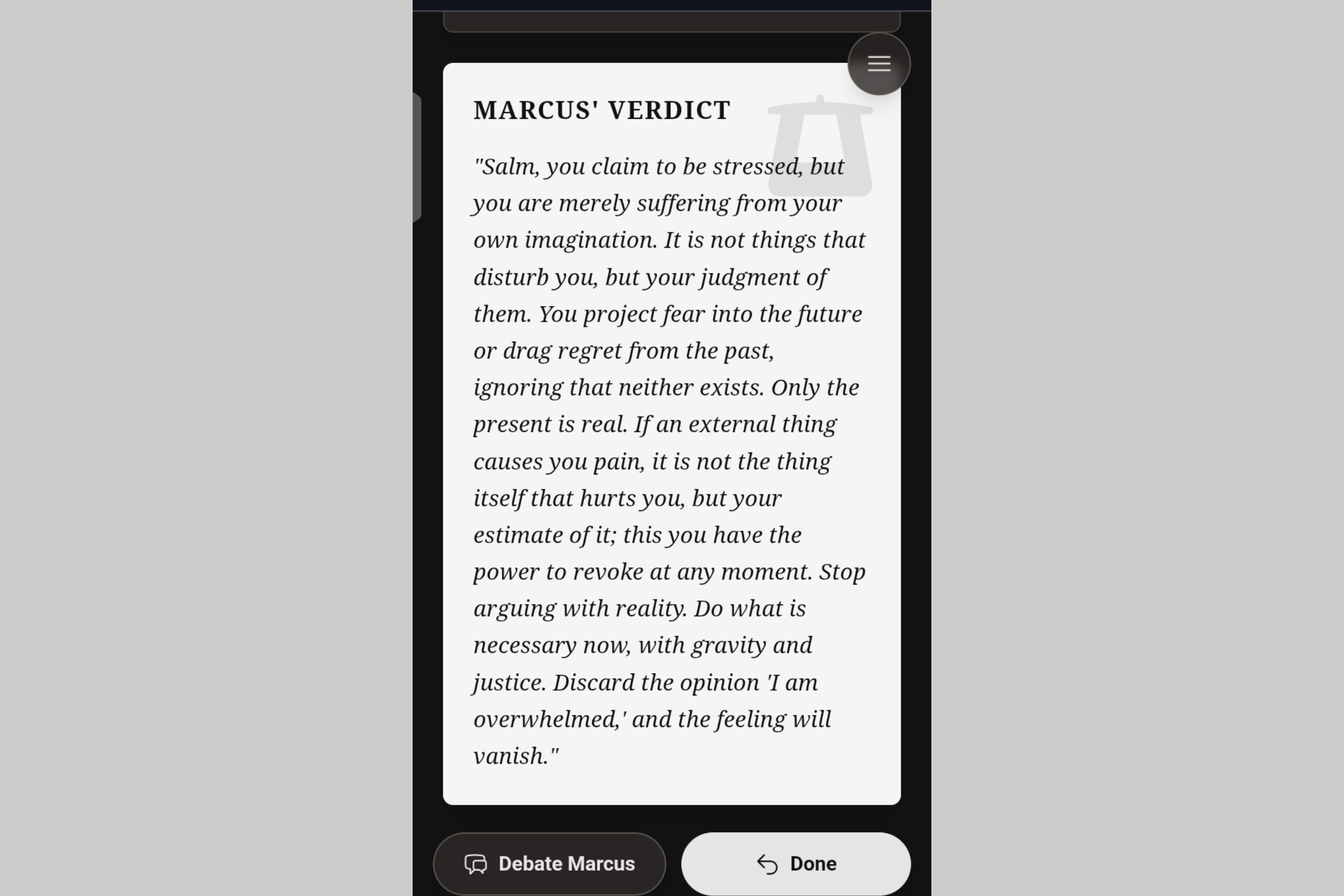
Marcus.AI is not a therapist; it is a Logic Coach. It uses the reasoning capabilities of Gemini 3 models to analyze user inputs (text or images) and provides a Stoic breakdown:
- The Filter: Instantly separates "Facts" (what actually happened) from "Opinions" (your emotional reaction).
- Dichotomy of Control: Identifies what is within the user's control and what is not.
- Visual Perspective (Multimodal): Users can upload photos of stressful situations (e.g., a messy room, a pile of bills), and Marcus.AI reframes the visual context from a neutral, objective standpoint.
- Actionable Advice: Provides one immediate, logical step to take.
How we built it
The application was built using a modern frontend stack to ensure a smooth user experience:
- Frontend: We used React with TypeScript for type safety and robust component structure.
- Architecture: The project follows a clean architecture with clear separation of concerns:
services/geminiService.ts: Handles the direct API calls to Google's generative AI.components/: Modular UI components likeDashboard,AnalysisResult, andOnboarding.constants.ts: Stores the "Brain" of the AI (System Instructions).
- AI Integration: We utilized Google AI Studio to fine-tune the system prompts, ensuring the model adopts a "Stoic persona"—cold, rational, yet helpful—preventing it from breaking character into a standard helpful assistant.
Challenges we ran into
- Prompt Engineering: The biggest challenge was balancing the AI's tone. If it was too cold, it sounded rude. If it was too nice, it lost its Stoic essence. We had to iterate on the System Instructions multiple times to get the perfect "tough love" logic.
- Structured Output: Parsing the Gemini API response to fit our UI cards (Fact vs. Opinion) required careful handling of the raw text response.
Accomplishments that we're proud of
- Successfully implementing a multimodal feature where the AI can "reason" about an image philosophically, not just describe it.
- Creating a functional application with a clean UI that effectively helps users calm down through logic, not just placebo words.
What's next for Marcus.AI
- Adding voice interaction for real-time logical debating.
- Implementing a "Daily Stoic Journal" that tracks user's logical progress over time.
- releasing the app on mobile platforms.
Built With
- gemini-api
- google-ai-studio
- react
- typescript

