Inspiration
- We wanted to create a multisensory experience, focusing on audio and haptics as game mechanics.
- Inspired by the creatures from, It Follows, Alien Isolation and PT, these enemies have rules that the player will need to learn to survive. Sometimes these rules are very obscure or surprising (e.g., they might have microphone access to listen to the player), which adds to the terror.
While some MR Horror Games exist, most are zombie wave shooters or primarily focused around jump scares, not exploring the psychology ambiguity we were interested in.
What it does
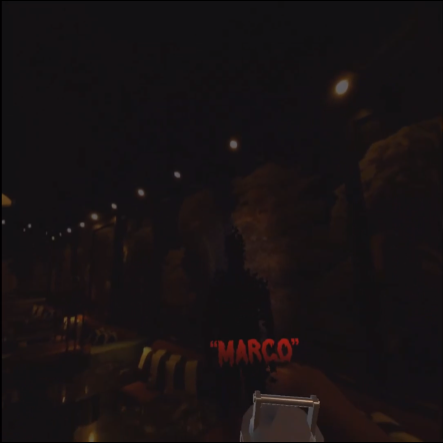
Marco Poltergeist modernizes the children’s game Marco Polo into a “Vulnerable Horror” experience that forces players to depend on other senses than just sight
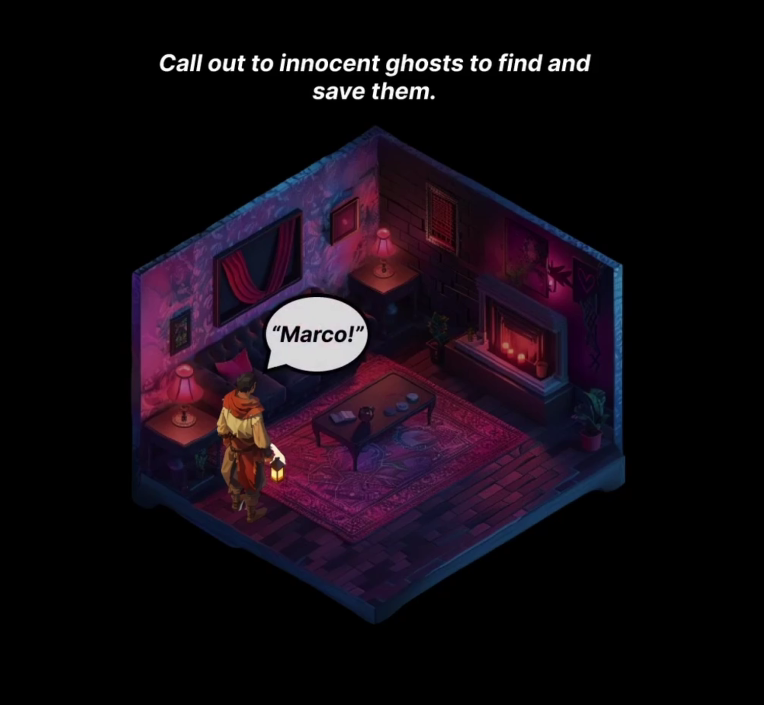
In the role of a fictionalized version of historical figure Marco Polo, players uses a call-and-response gameplay mechanic. Players call out “Marco” to the lost spirits who need help transcending to the next plane of existence. Players must listen to spatialized audio responses of “Polo” to find their location, and then touch the ghost with the palm of their hand (via hand tracking).
Over time, more malicious, deadly spirits hear the calls of Marco, and begin to stalk them.
The player also has access to a lantern, using an oculus controller. This can be used to temporarily light the area or stun and see invisible enemies.
How we built it
To achieve our multisensory goals, Marco Poltergeist utilizes a multimodal control scheme that would be impossible on devices other than the Oculus Quest 3.
Throughout the game, players will use their voice, their hands and one Oculus Quest controller to play the.
Using Meta Voice SDK, the player will call-and-respond with the ghosts they’re trying so save, to get hints on where to go next. Less friendly ghosts will stalk you based on the sounds you
Unlike most Voice experiences, players do not need to push a button to trigger voice detection, making the implementation feel more seamless and natural.
We use Meta’s Audio SDK to spatialize every interaction in the game.
We darken the players play-space, giving enough sight to comfortably and safely move around their nearby playspace, allowing players to illuminate further with their lantern.
By using scene model, we take advantage of real tactile feedback, by having the player touch their surrounding, linking the real world and the digital world
Challenges we ran into
Inability to do live keyword detection via Voice SDK
Difficulty testing scene in a large open room. MRUK helped a lot with the prefab rooms
Keeping up with versioning of API and samples
Accomplishments that we're proud of
Being able to alter passthrough to create a tense ambience
Being able to query utilize scene date wit MRUK
Implementing extensive audio feedback
What we learned
Scene API for mixed reality and how to procedurally design for unknown sized spaces
Designing haptics in a realtime graph view with haptics studio and haptic SDK
What's next for Marco Poltergeist
- Playtesting
- Do players want a clear game loop or something more similar to PT, with a more complex, less-transparent user journey?
- Co-located, local multiplayer, using shared Spatial Anchors
- More ghosts, with improved AI
- Goal is to make a game like PT or Alien Isolation where part of the terror is not knowing
- Items
- Salt Circle
- Barriers
- Hand-tracking only version, anticipating the future of newer headsets without controllers
- Accessibility modes
- Turn off jump scares
- Adjust room lighting
- Portal-Based, online Multiplayer
- Improved art and audio


Log in or sign up for Devpost to join the conversation.