
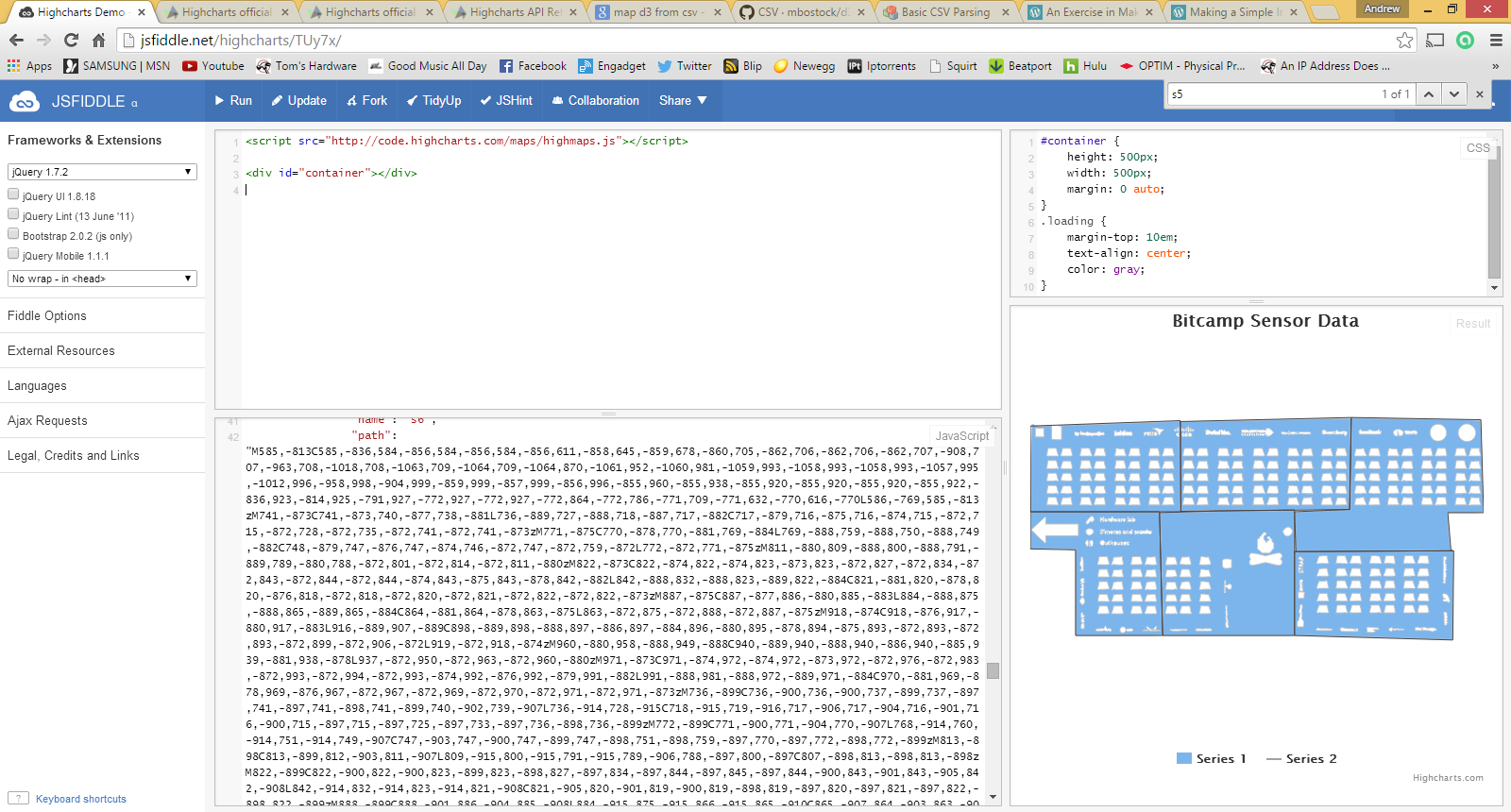
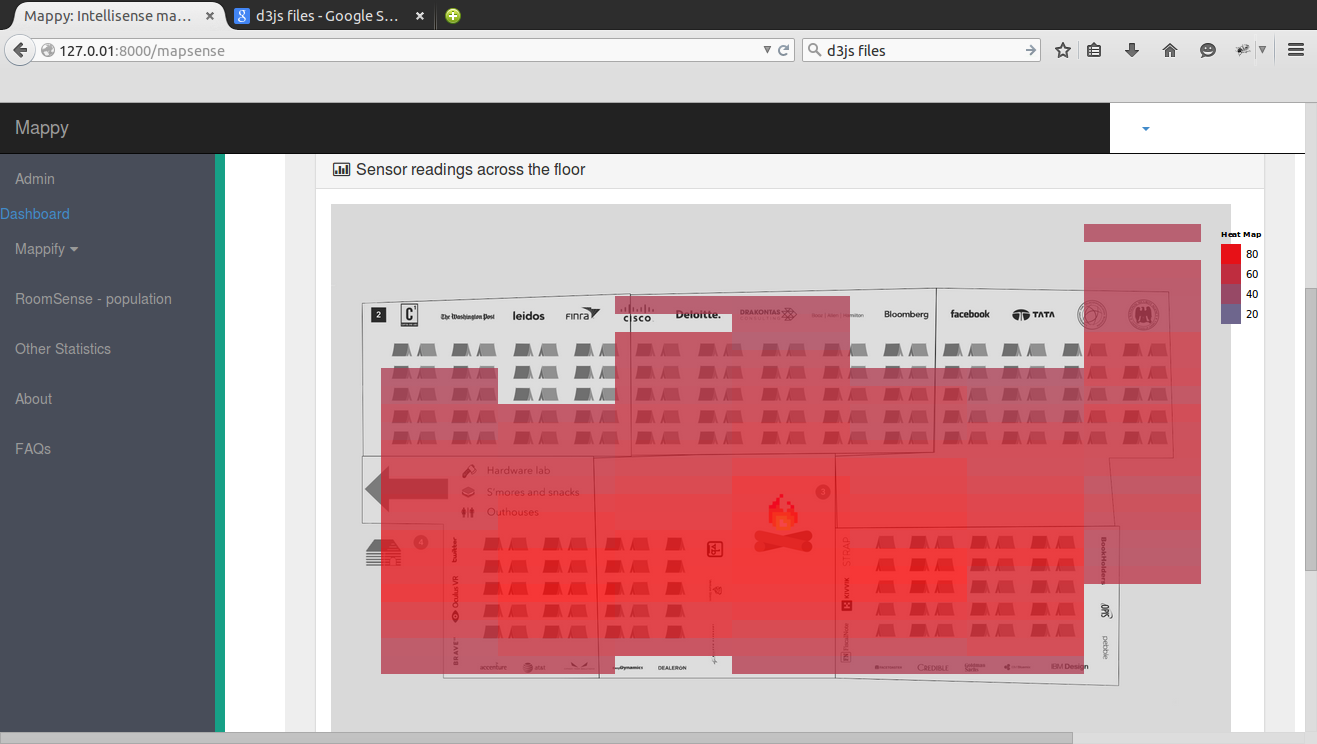
Mappy makes use of the various information posted by six sensors provided by the NSA's LTS lab and aims to bring data to life through stunning visualizations. Additionally, Mappy's RoomSense technology feeds all of this information into an algorithm to accurately estimate the number of people present in Cole Field House throughout the duration of Bitcamp and cMe makes use of the WiFi signals throughout the venue to track your exact position. From there, Mappy can deliver tailored sensor data to your device.
Every thirty seconds the sensors, placed around Cole Field House, post information about temperature, humidity, motion, light, and noise. Mappy then makes use of this information using a combination of Python and D3 scripts. The Python scripts are responsible for making JSON requests and appending new sensor entries into a CSV file which is monitored by the D3 script. D3, a powerful Javascript library for data visualization, takes these CSV entries and updates the interactive visualization of Cole Field House as needed. The end result is what you see on your screen.
The raw data is also used in the RoomSense algorithm to estimate the number of people in Cole Field House. Advanced machine learning algorithms make sense of all the data and bases the estimate mainly on the sound, temperature, humidity, infrared, and motion readings.
Although D3 is amazingly powerful, it has a steep learning curve and proved to be a challenge for the Mappy team. Perfecting the indoor triangulation and occupancy estimation algorithm was also difficult to accomplish under the time constraints. There were also some issues getting Django and Azure to cooperate with each other, but after speaking with various people it was confirmed that these problems were being caused by Azure and we were left with limited options. The ideas behind RoomSense and cMe were also too complicated to accurately implement during such a short time period.
The Mappy team learned a lot about data processing and visualization throughout Bitcamp. Additionally, we learned a great deal about the potential there is for developing a viable way to track indoor position by using existing WiFi signals. We also learned a great deal about human tracking and how much potential this application has. There are many ways to identify a person and using sound, temperature, motion, infrared, and other data can all be used to uniquely identify a person. We obviously didn't have enough time or technology to accurately identify individuals, but future iterations of Mappy could include this feature. Our submission is by no means meant to be a complete product. It serves as a great starting point for an ambitious idea that will certainly reappear in the future.

Log in or sign up for Devpost to join the conversation.