-
-
MapLoud Logo
-

MapLoud Icon
-
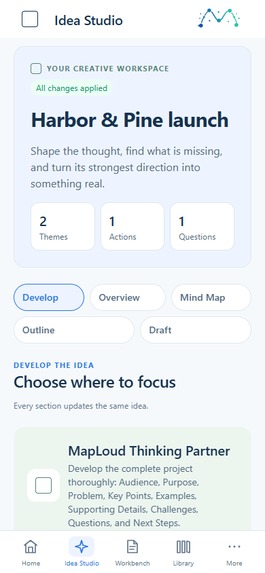
Maploud App Idea Studio
-
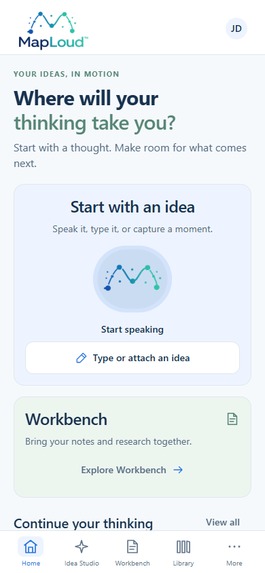
MapLoud App Homescreen
-
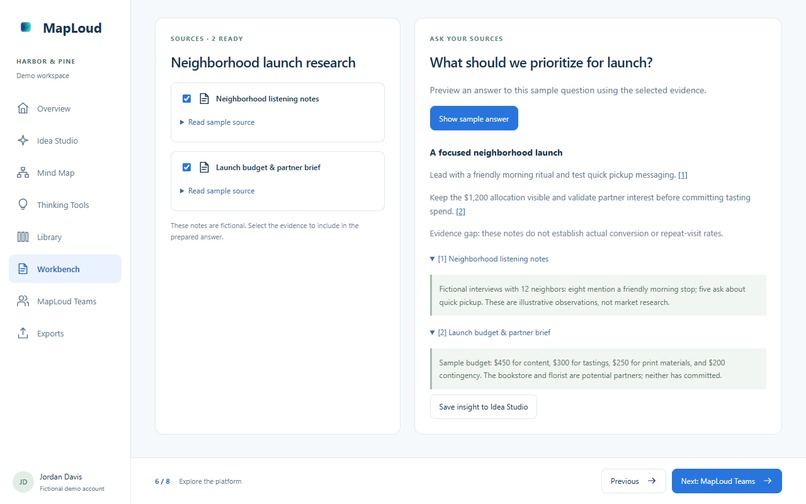
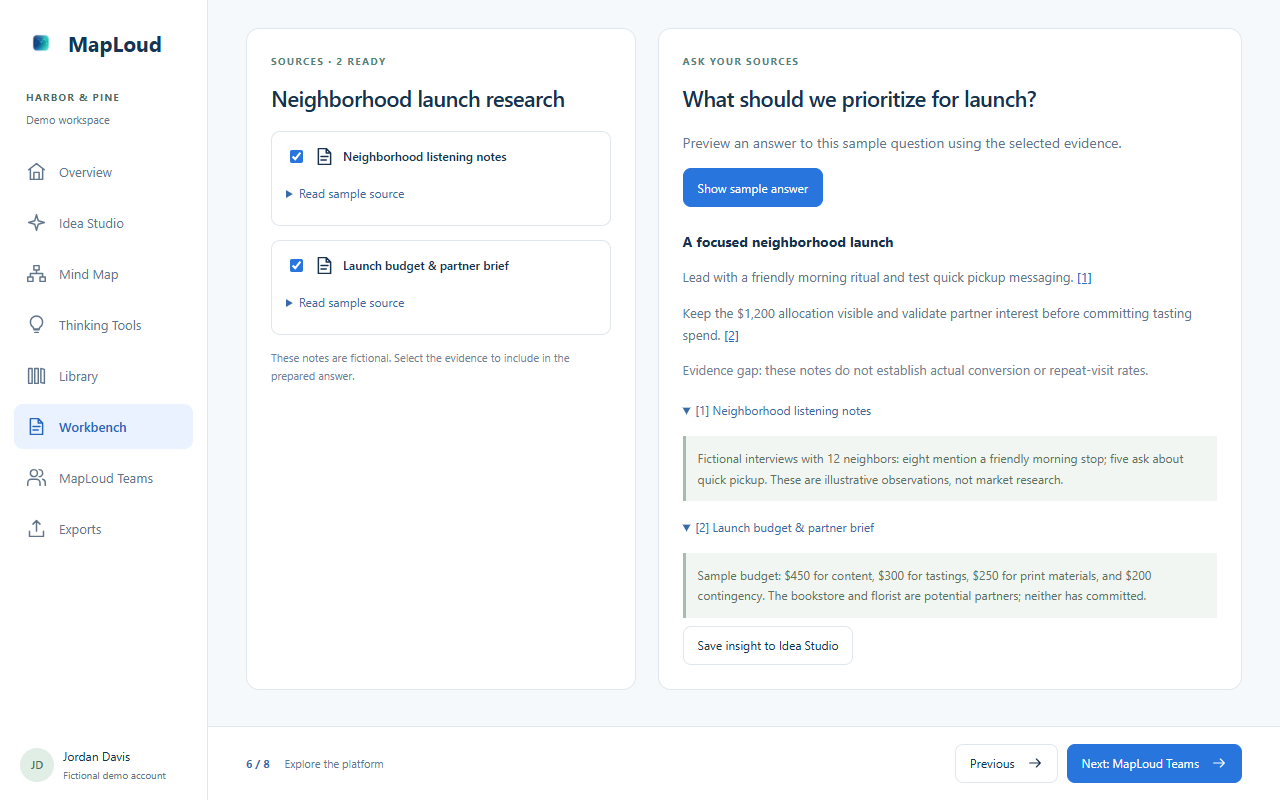
Maploud Workbench
-
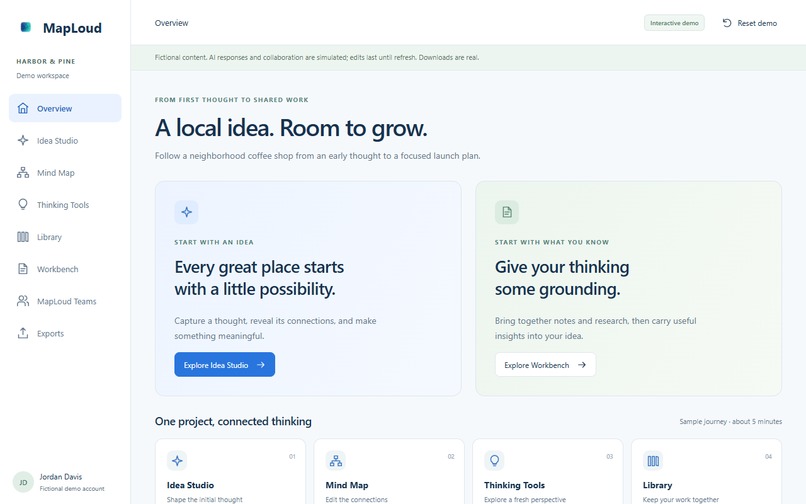
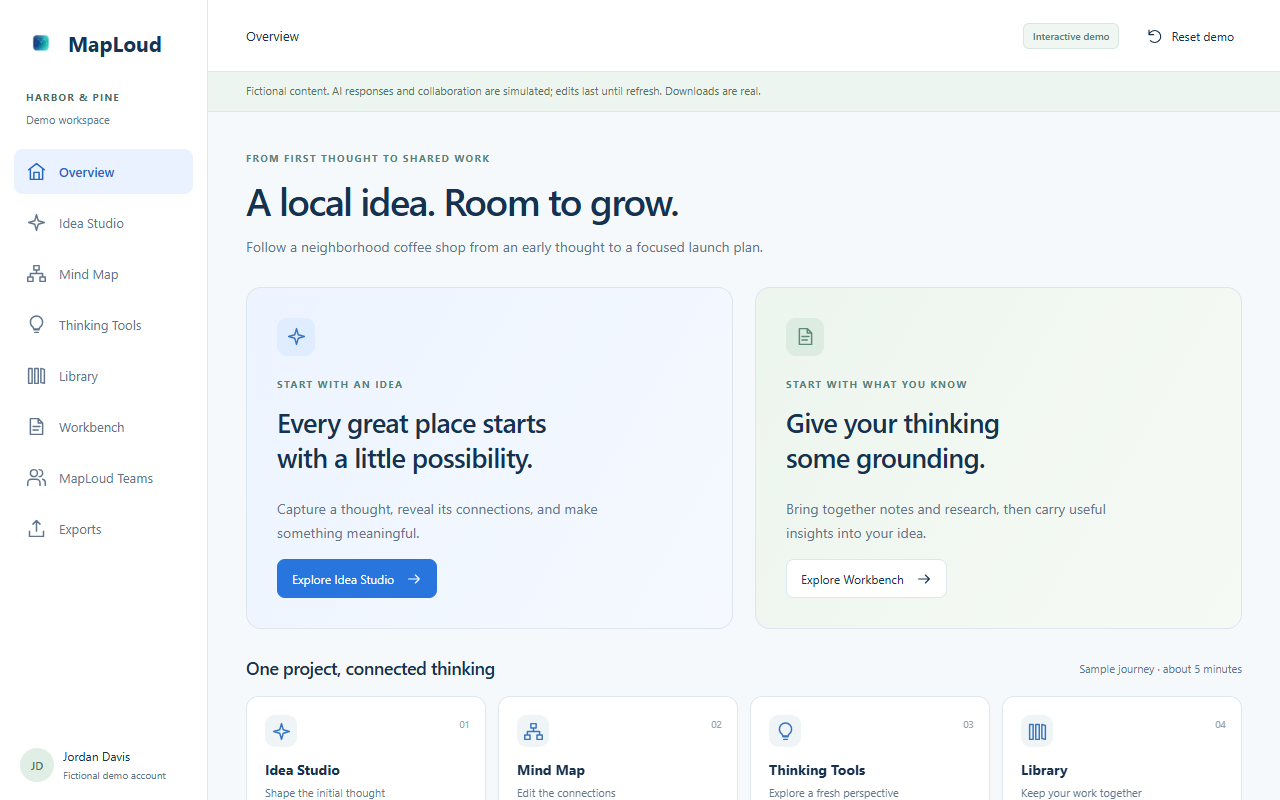
Maploud Web Homescreen

Inspiration
MapLoud started with a simple frustration: I had no shortage of ideas, but turning those ideas into something structured and useful was much harder.
Most tools seemed to solve only one part of the problem. Notes captured thoughts. Mind maps visualized them. AI chat could help explore them. Documents held the finished work. Research lived somewhere else. Every time I moved between those tools, I lost some of the context that made the original thought valuable.
I originally set out to build a better way to mind map my thinking.
It became something much bigger.
MapLoud is now an AI-powered thinking platform designed to help people move from an unfinished thought or a collection of information to structured, actionable work, without losing the context along the way.
What MapLoud does
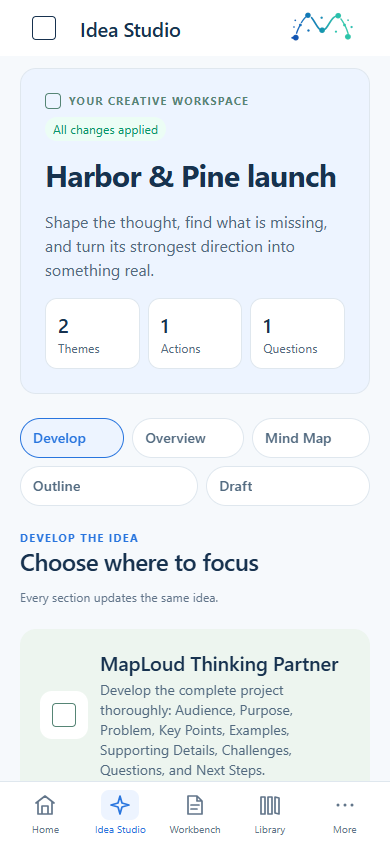
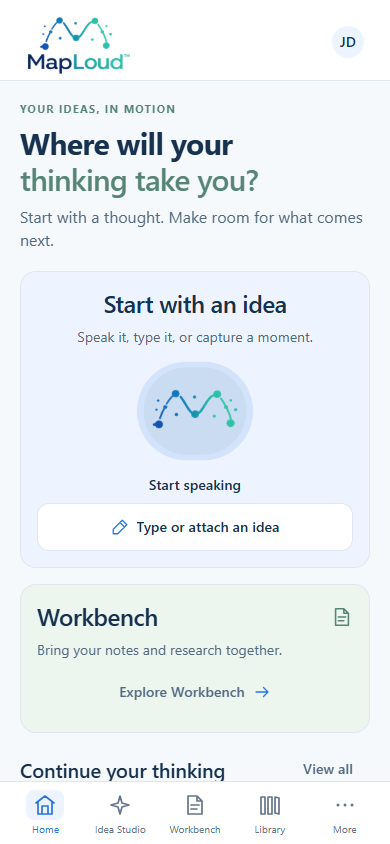
A user can start with a thought through text or voice and develop it inside Idea Studio. MapLoud helps organize that thinking into a dynamic Mind Map, where ideas can continue to evolve instead of becoming a static diagram.
From there, users can apply structured Thinking Tools such as SWOT Analysis, 5 Whys, First Principles, Customer Persona, Pros & Cons, and Roadmap. These aren't isolated AI chats. They work from the context already developed within the project.
That continuity is fundamental to MapLoud.
Instead of repeatedly explaining the same project to AI, the user's work grows with them.
MapLoud also includes Workbench, where users can bring in PDFs, Word documents, notes, photos, screenshots, and other source material. They can ask questions across those sources, examine supporting references, develop findings into new work, and move those insights into Idea Studio.
With MapLoud Teams, that same workflow becomes collaborative. Teams can bring research and ideas together, work from shared information, develop projects, and preserve the context behind the work instead of scattering it across documents, chats, and tools.
The result is one connected workflow:
Capture → Understand → Visualize → Develop → Create → Collaborate
How I built it
I'm a Sr. Project Manager by profession, not a traditional software engineer.
I approached building MapLoud the same way I've approached complex projects throughout my career: break the problem down, understand the dependencies, test what works, learn quickly, and keep iterating.
Building MapLoud also meant stepping far outside my existing skill set. I had to learn how to code, understand how different parts of an application work together, troubleshoot errors, work with APIs and databases, and become comfortable making technical decisions I had never been responsible for before.
AI-assisted development helped accelerate that learning process. Rather than replacing the need to understand what I was building, it became a tool that helped me learn, experiment, debug, and turn the product I had in my head into a real application.
MapLoud's stack includes technologies and services such as RevenueCat, Supabase, Railway, Resend, and Vercel, alongside AI capabilities that power the contextual thinking experience.
RevenueCat handles subscription infrastructure for the product, allowing me to spend more of my limited development time improving the actual user experience rather than building billing infrastructure from scratch.
MapLoud launched publicly on August 10, 2026, on iOS and the web.
But launch wasn't the finish line.
Since then, I've continued learning, coding, building, testing, and refining the product based on what I learned from putting it into people's hands. What began primarily around idea development and visual thinking expanded into Workbench for source-grounded work and MapLoud Teams for collaborative thinking.
One of the things I'm proudest of isn't simply that I launched an app. It's that I learned the technical skills necessary to take an idea I couldn't build when I started and turn it into a product I can continue developing today.
Challenges
One of the hardest technical and product challenges has been context.
AI can generate an answer very quickly. The harder problem is helping AI understand where a person already is in their thinking and allowing new insights to become part of that evolving context.
I didn't want MapLoud to become another interface where every AI interaction effectively starts over.
That meant thinking carefully about how projects, mind maps, source material, AI-generated insights, and structured thinking frameworks relate to one another.
Another challenge has been building while wearing nearly every founder hat.
I have been managing product decisions, development, testing, infrastructure, positioning, customer discovery, and launch while continuing to work a full-time job.
That constraint has forced me to prioritize relentlessly. Every feature has to answer a question:
Does this help someone move their thinking forward?
If it doesn't, it doesn't belong in MapLoud.
What I learned
The biggest thing I've learned is that the problem isn't simply capturing information.
People already have plenty of places to put things.
The harder problem is turning everything they've accumulated, thoughts, research, documents, questions, conversations, and partial ideas, into understanding and then into action.
I've also learned that AI is most useful to me when it is thinking with us, not thinking for us.
That principle has shaped MapLoud.
The goal isn't to press a button and have AI replace the user's thinking. The goal is to give people an environment where AI can help them examine, connect, challenge, organize, and develop their own thinking.
And building MapLoud has changed my own understanding of what the product can become.
I started by trying to build a mind-mapping application.
I'm now building an operating system for thinking.
What's next
The next phase is about proving where MapLoud creates the most value.
I'm expanding MapLoud Teams with small businesses and knowledge-work teams that deal with scattered research, documents, ideas, and decisions every day.
I'm also continuing to improve contextual continuity across Idea Studio, Mind Map, Thinking Tools, and Workbench so that the platform becomes more useful as a person's or team's thinking develops.
MapLoud is still early, and I'm still learning, building, and improving it every day.
But the idea behind it is simple: AI shouldn't think for you. It should think with you.
That's what I'm building MapLoud to do.
Built With
- ai
- ios
- railway
- resend
- revenuecat
- supabase
- vercel


Log in or sign up for Devpost to join the conversation.