-
-
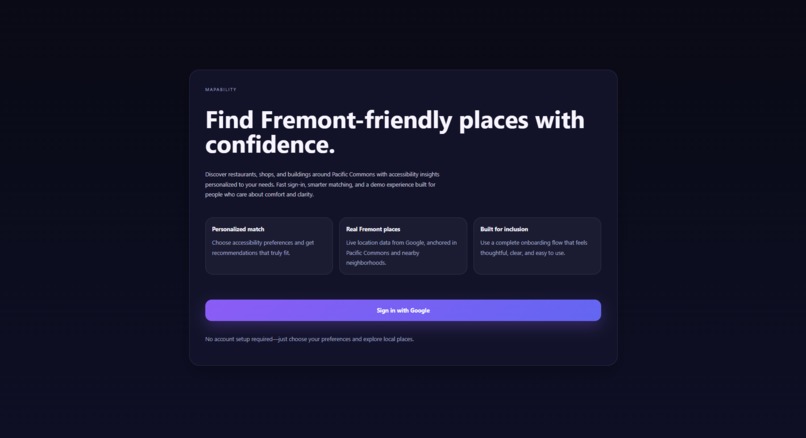
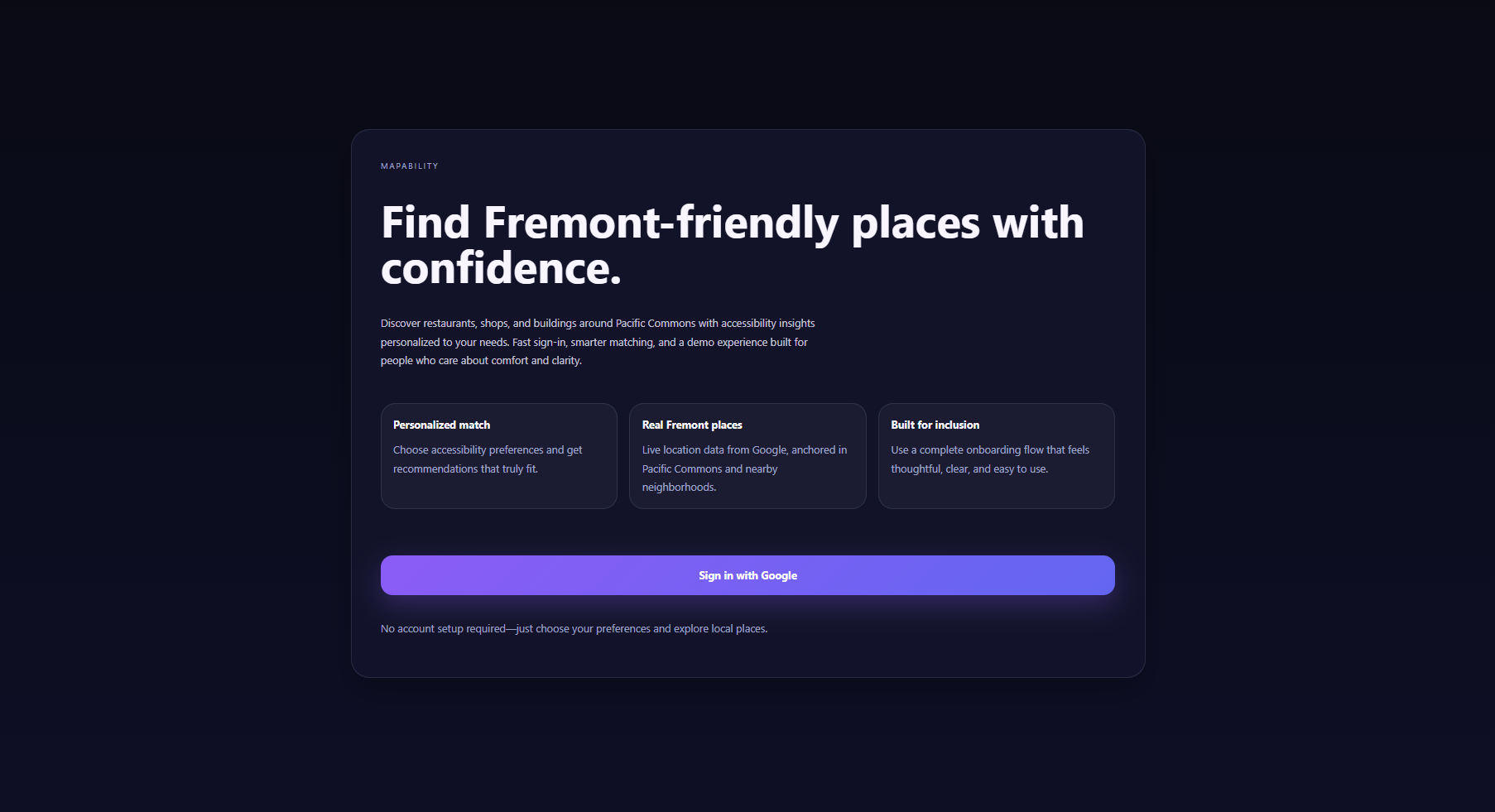
Loading Page
-
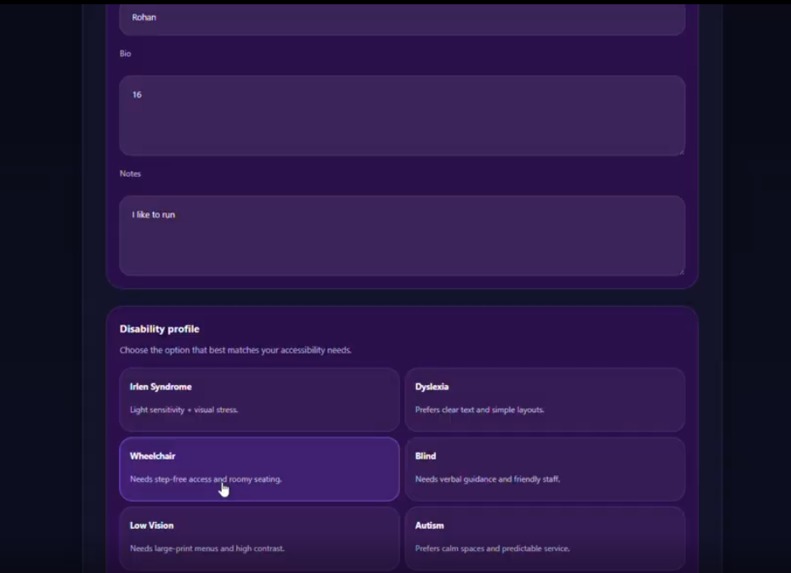
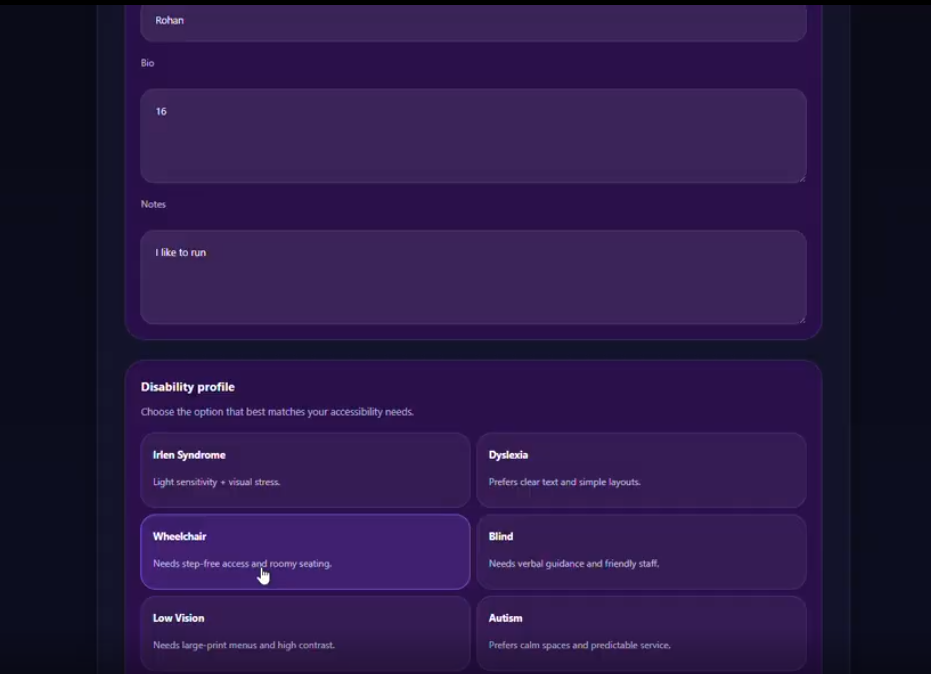
Customizable Profile with some of the programmed disabilities
-
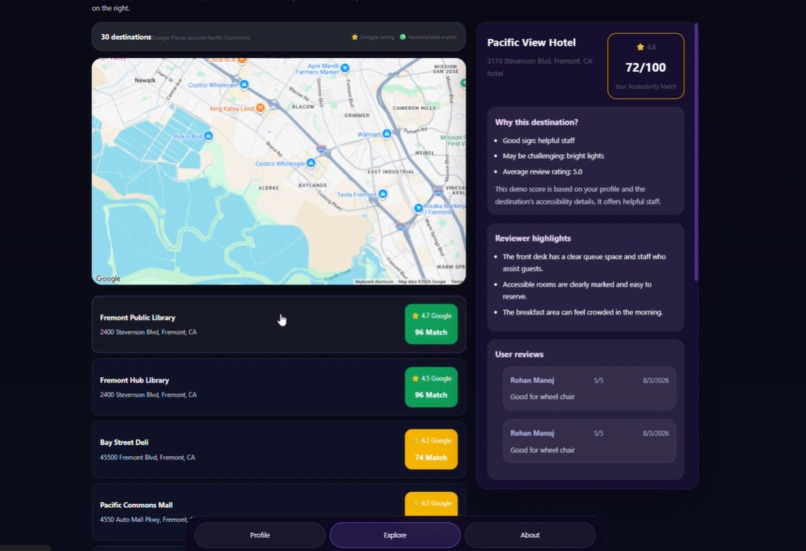
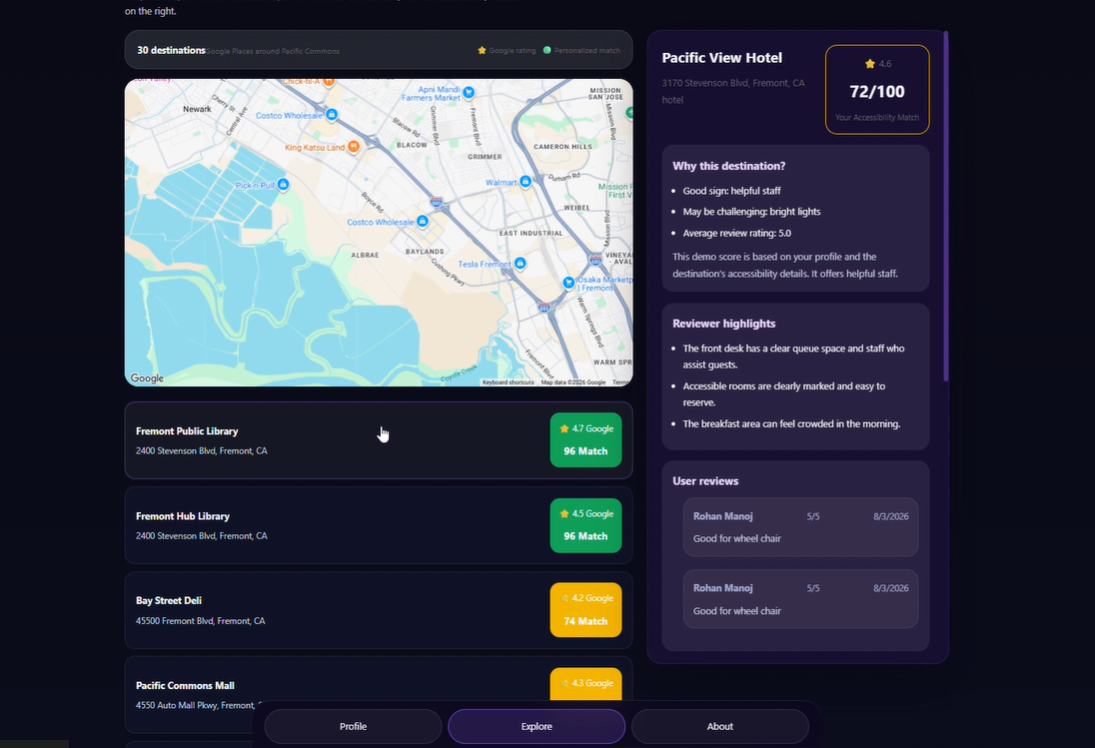
Accessibility Map + Review System
-
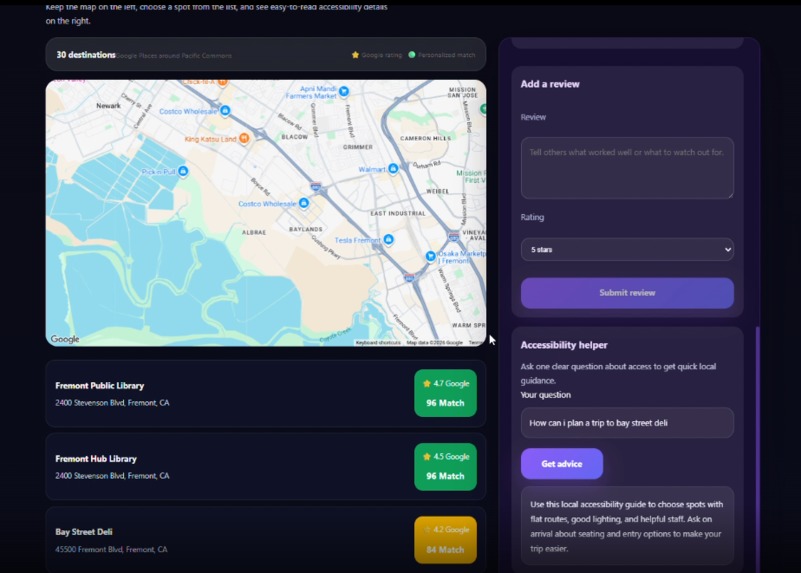
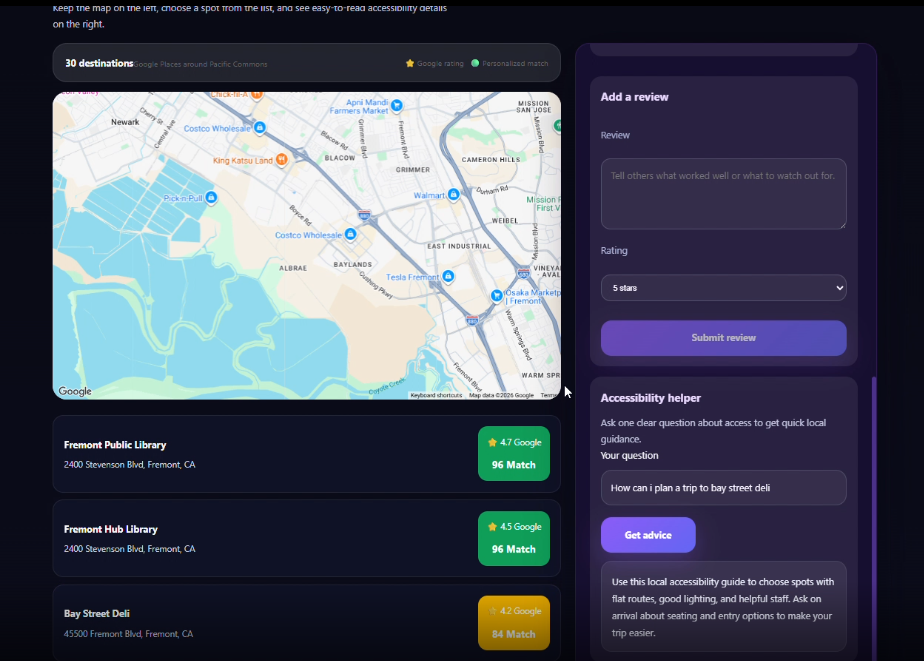
Accessibility Map + AI Overview system
Inspiration
Millions of people use Google Maps to navigate their way through the world, but this accessibility information remains frustratingly vague. Even when a restaurant has a beautiful 4.8 star rating, it might not be 100% accessible to those with low vision, Irlen Syndrome, autism, deafness, and many other additional needs. We want to build a platform that allows people to find what is personal to them, not just a one-size-fits-all accessibility check list. We want to be able to change the world by letting people go out and experience a better world.
Our mission is to build something that allows the user to make a better choice before stepping out the door by utilizing AI, community information, and an individual accessibility profile.
It's not about asking the question "is this restaurant accessible?," but rather asking "is this restaurant accessible for me?"
What it does
Mapability is an AI powered accessibility companion which provides a personal accessibility overlay on top of your favorite maps.
A user can set up an accessibility profile based on common disabilities and accessibility needs such as blindness, low vision, wheel chair accessibility, dyslexia, Irlen Syndrome, autism, hearing issues, and many other custom accessibility needs. Mapability then goes through each restaurant and provides a compatibility score for each user based on their accessibility profile
With Mapability users can see:
Accessibility score based on individual needs
AI powered commentary about what makes a place good/bad for each individual need
Accessibility reviews instead of regular restaurant reviews
Google reviews and ratings along side accessibility information so that users can chose between a place with a 5/5 star restaurant rating with poor accessibility versus a 4/5 star restaurant with great accessibility
Mapability does not attempt to compete against existing mapping services, but rather enhance them by providing a personal accessibility overlay on top of your existing location services. This provides the user with confidence that the place they want to visit is going to be a good fit for them individually.
How we built it
When building this service we worked with modern technologies for a full stack web application.
The front end was built with React which allowed for an interactive accessibility map. With this interactive map users are able to see which restaurants are nearby and what accessibility information is available for them. Google Maps provides the map visuals and functionality to ensure a familiar experience when browsing restaurants and other businesses.
Firebase was used for back end services and data storage. We were able to store information about user accessibility profiles and restaurant accessibility information using Firebase.
To provide even more value for the user we utilized large language models to generate personalized accessibility summaries based on the users selected accessibility profile.
Instead of simple raw accessibility facts we are able to provide a personal summary of how the environment may effect a user with specific accessibility needs.
This creates a truly personal accessibility layer on top of the existing Google Maps location information and business data. All of this was done without over complicating the overall UI/UX for the end user.
Additional features we would have liked to implement are mentioned in the following section.
Challenges we ran into
One challenge we had was turning highly individual accessibility needs and thoughts into something that could be used for general accessibility recommendations.
People with different accessibility needs often have very different requirements for what makes a good restaurant
One thing we struggled with was ensuring we provide enough information while keeping the information easily accessible and understandable.
Another major challenge was working with the short time frame of the hackathon.
Due to this short time frame we had to limit the number of major features we could include.
One of our biggest challenges was working with such a short time frame and having to make the hard decisions on what to cut from the original feature set.
Lastly, another challenge we faced was integrating all of the various technologies into a smooth usable application. There is a lot to consider when working with Google Maps, Firebase, and AI accessibility information.
This challenge really revolved around the prompt engineering with the AI to ensure that we got accurate results that made sense to the individual user.
Accomplishments we're proud of
We are extremely proud of the accomplishment of building something that not only goes above and beyond the "generic accessibility checklist," but rather something that truly provides personal recommendations based on the users accessibility needs. Some of our favorite parts of this project include:
Accessibility profile system
Interactive map
Utilizing AI to provide accessible summaries for each restaurant based on individual needs
Making something that truly serves a purpose in the real world
Creating a fully working MVP within a short time frame of a hackathon
Most importantly we are proud of being able to show that accessibility can be enhanced and made to be much more personal with the use of AI.
What we learned
We learned a lot from the overall process of making this application. One thing we are especially proud of is the knowledge and experience we have gained from working with mapping services, back end systems, and AI to create such a useful application. One of the most important lessons we learned is the depth of accessibility and how working with various accessibility conditions often requires more personal care. From a technical stand point we learned a lot about how to make accessible applications, prompt engineering for AI, and front end development. The most important lesson we learned was learning to iterate quickly under time constraints.
What's next for Mapability
While our MVP was a complete success, we see a lot of potential and room for growth for Mapability in the future. One thing we would like to do in the future is expand the overall scope of the location based accessibility platform. While it makes sense to start small with restaurants it would be great to also include stores, parks, entertainment venues, hotels, and more
We plan on building a community around this product where users can submit their own accessibility reviews as well as photos for computer vision analysis for automatic accessibility features.
We also plan on creating a much more robust AI system which will allow for even more in depth reviews for each individual accessibility need.
Another thing we want to do is develop a mobile version of this application which users can utilize when being out and about.
We ultimately want the accessibility information to be a similar experience to normal maps, but much more personal for each individual user.
Built With
- firebase
- github
- google-maps
- openai
- react
- tailwind


Log in or sign up for Devpost to join the conversation.