Inspiration
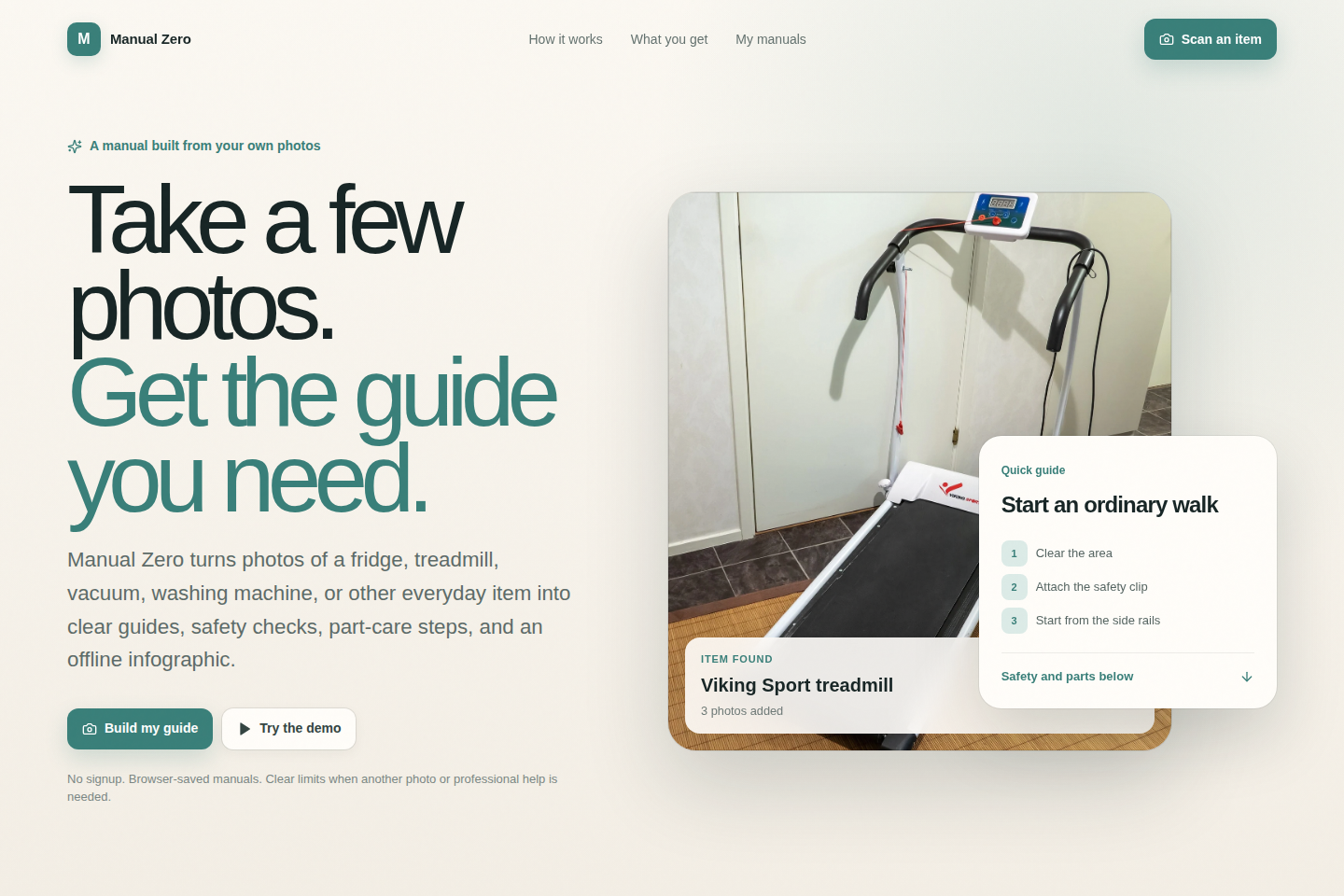
Product manuals go missing when people need them most. A label may be hard to read, controls may be unfamiliar, and a repair question can quickly turn into unsafe guesswork. We wanted the item itself and a few useful photos to become the starting point for a clear manual.
What it does
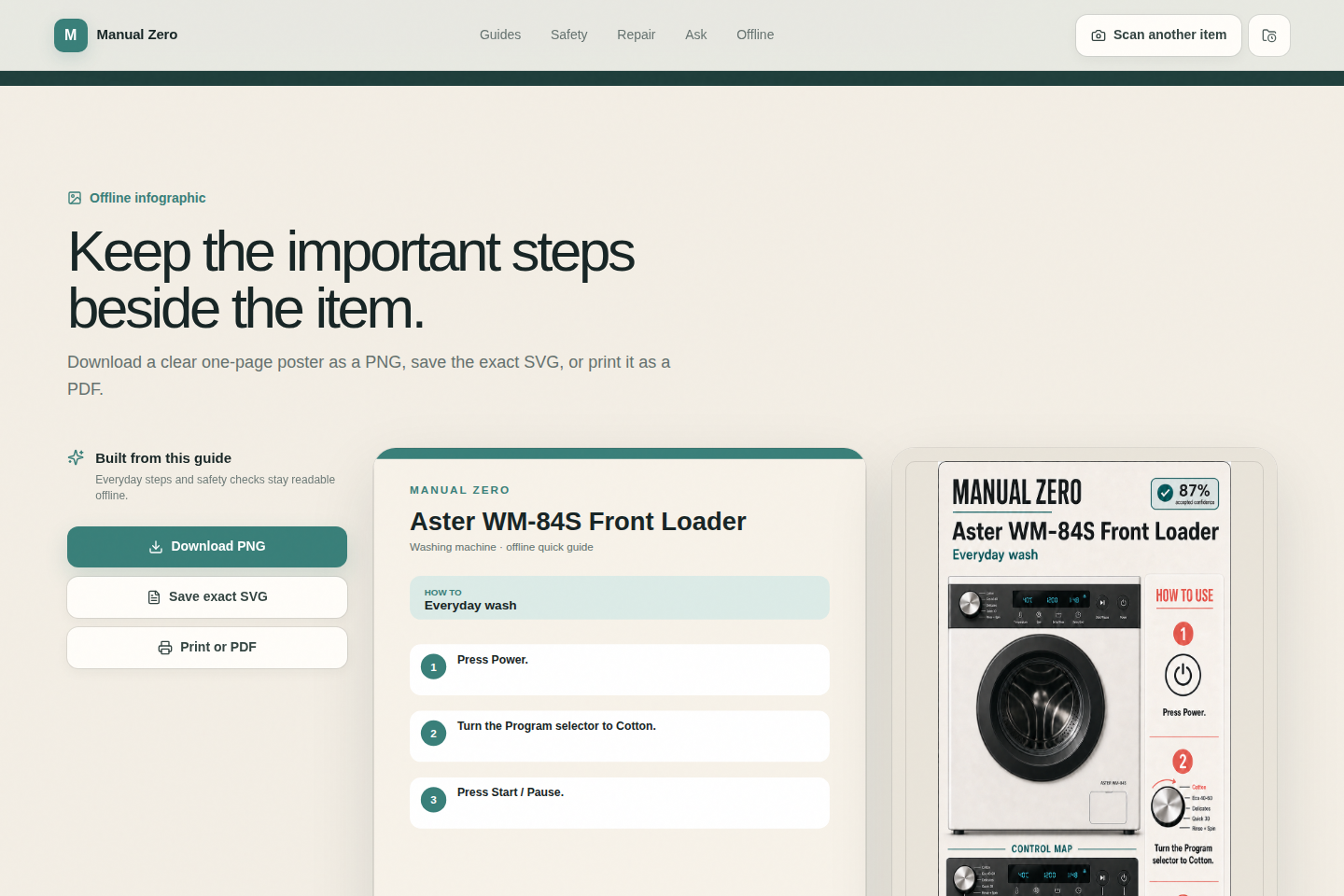
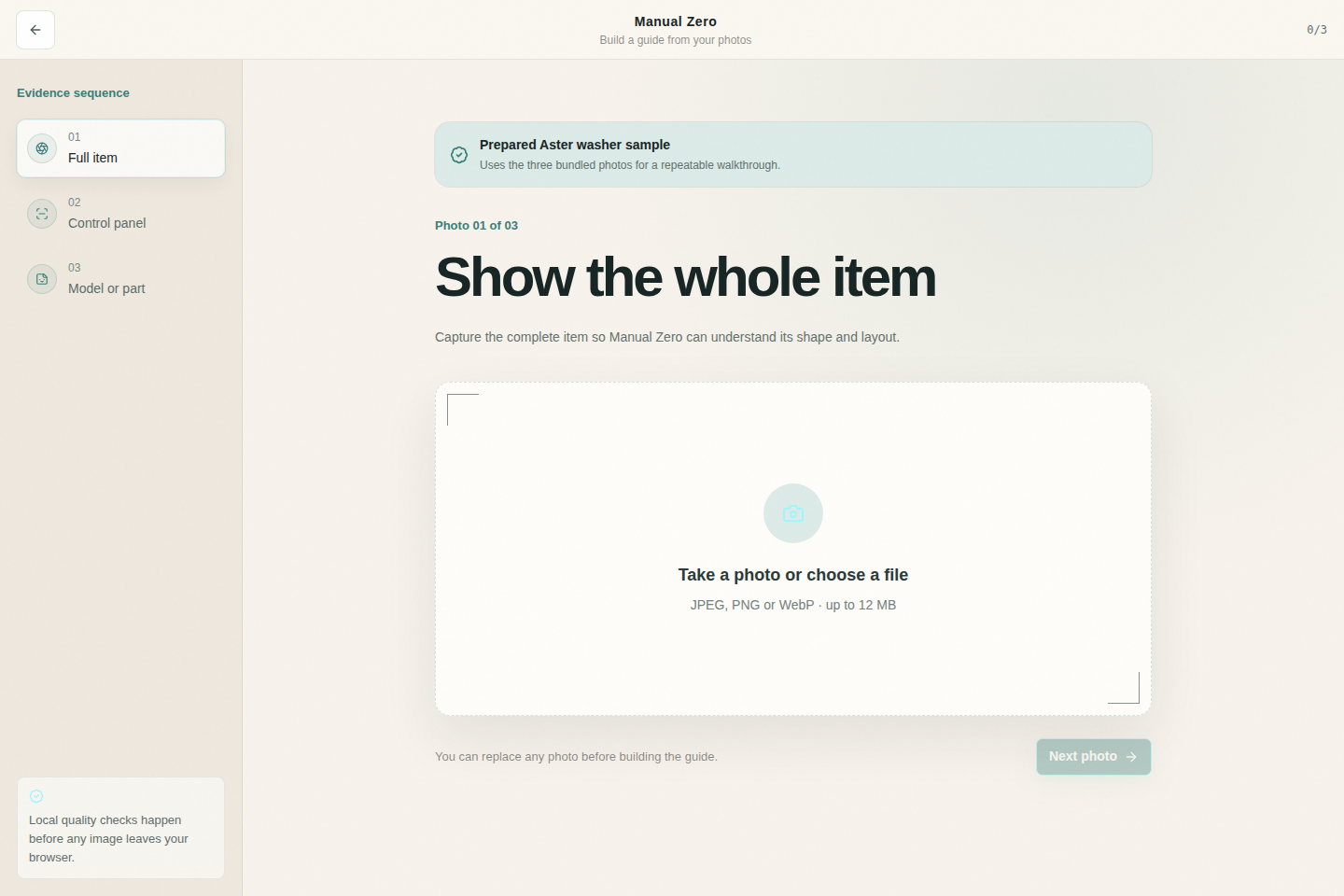
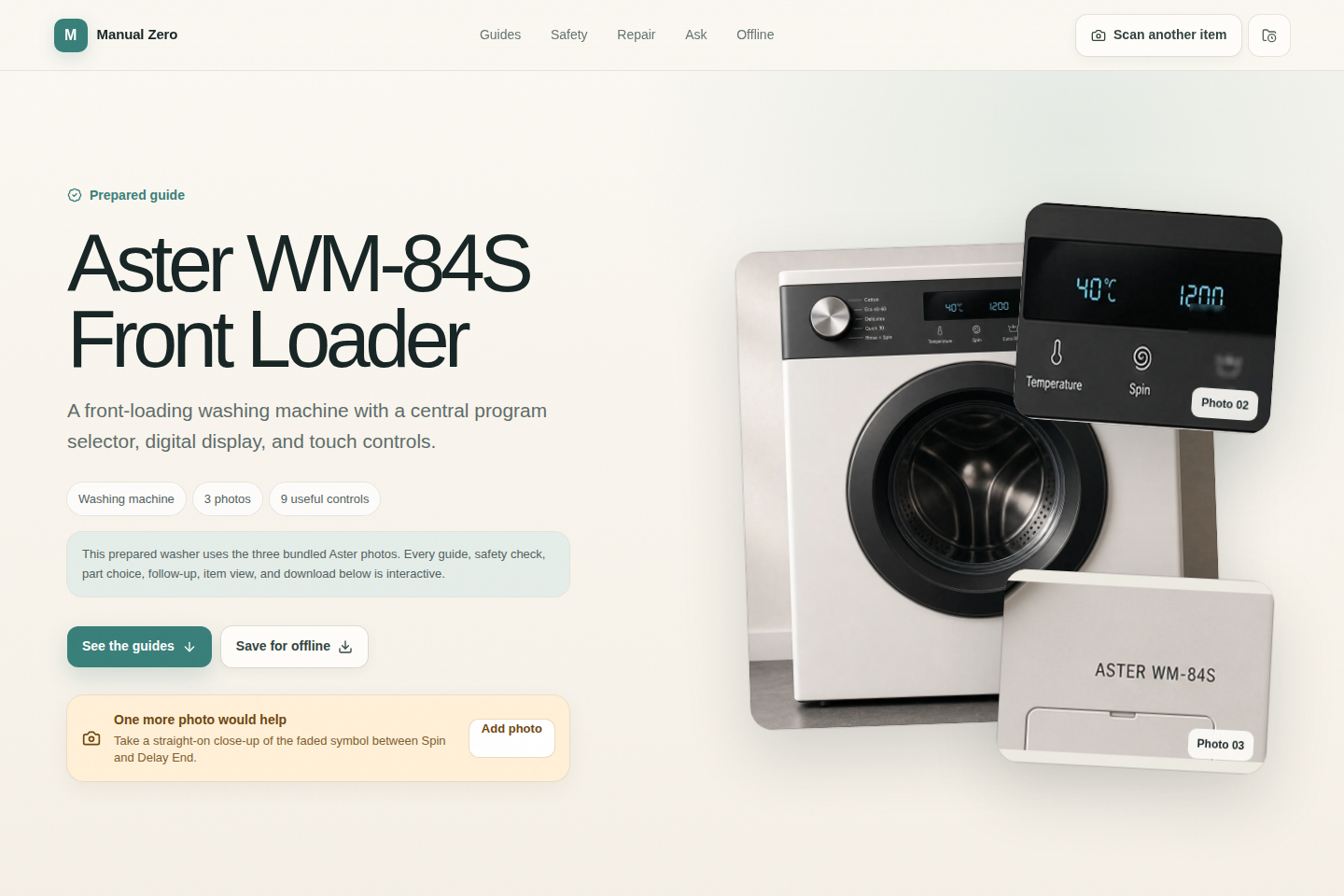
Manual Zero turns photos of a household item into a focused guide. The capture flow asks for the full item, its controls, and its model or part label. From there, the user can:
- Choose everyday guides for the identified item.
- Review safety steps before taking action.
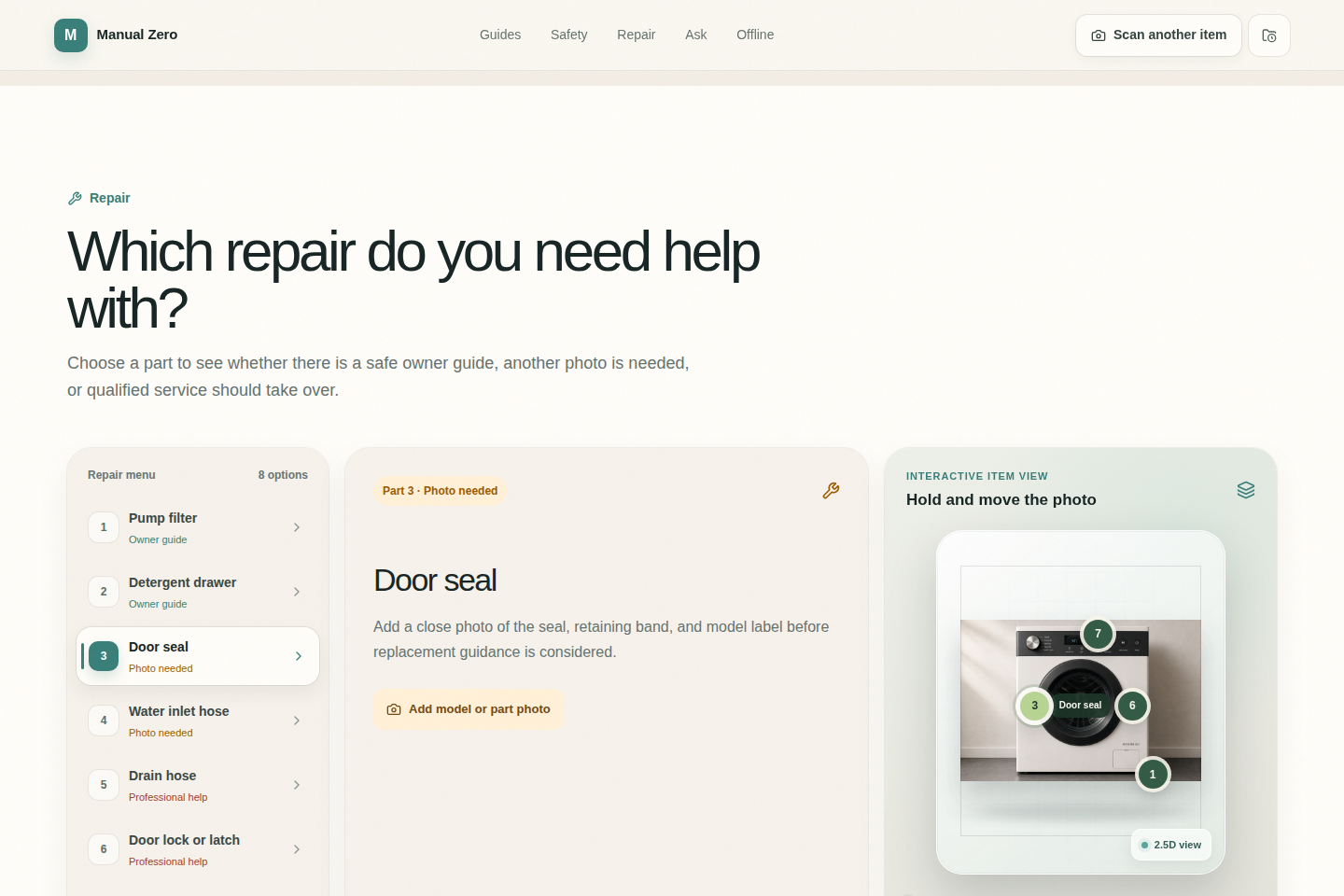
- Open a repair menu and locate parts on a numbered movable item view.
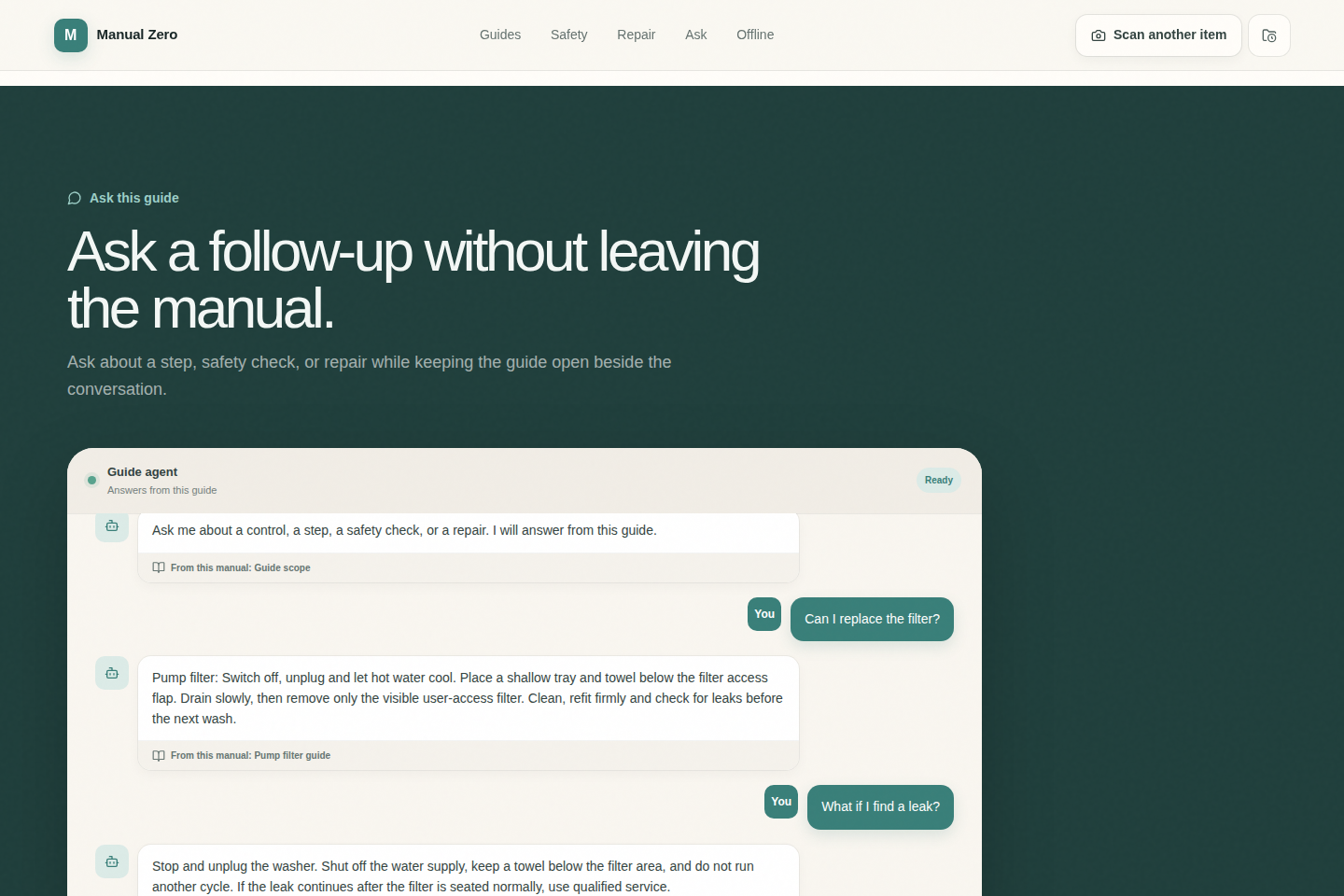
- Ask follow-up questions that stay grounded in the current manual.
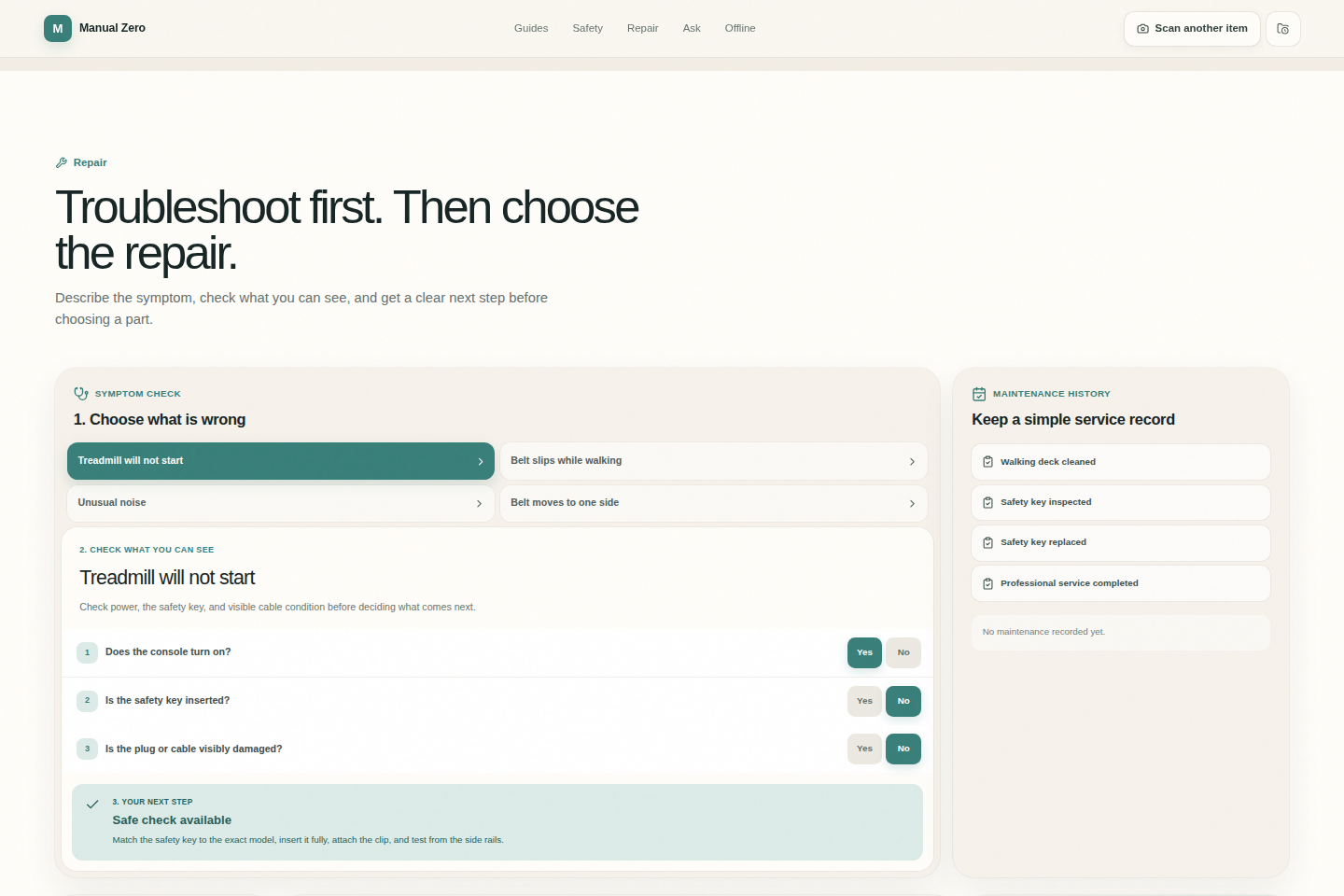
- Use item-specific tools, such as treadmill symptom checks and replacement search links.
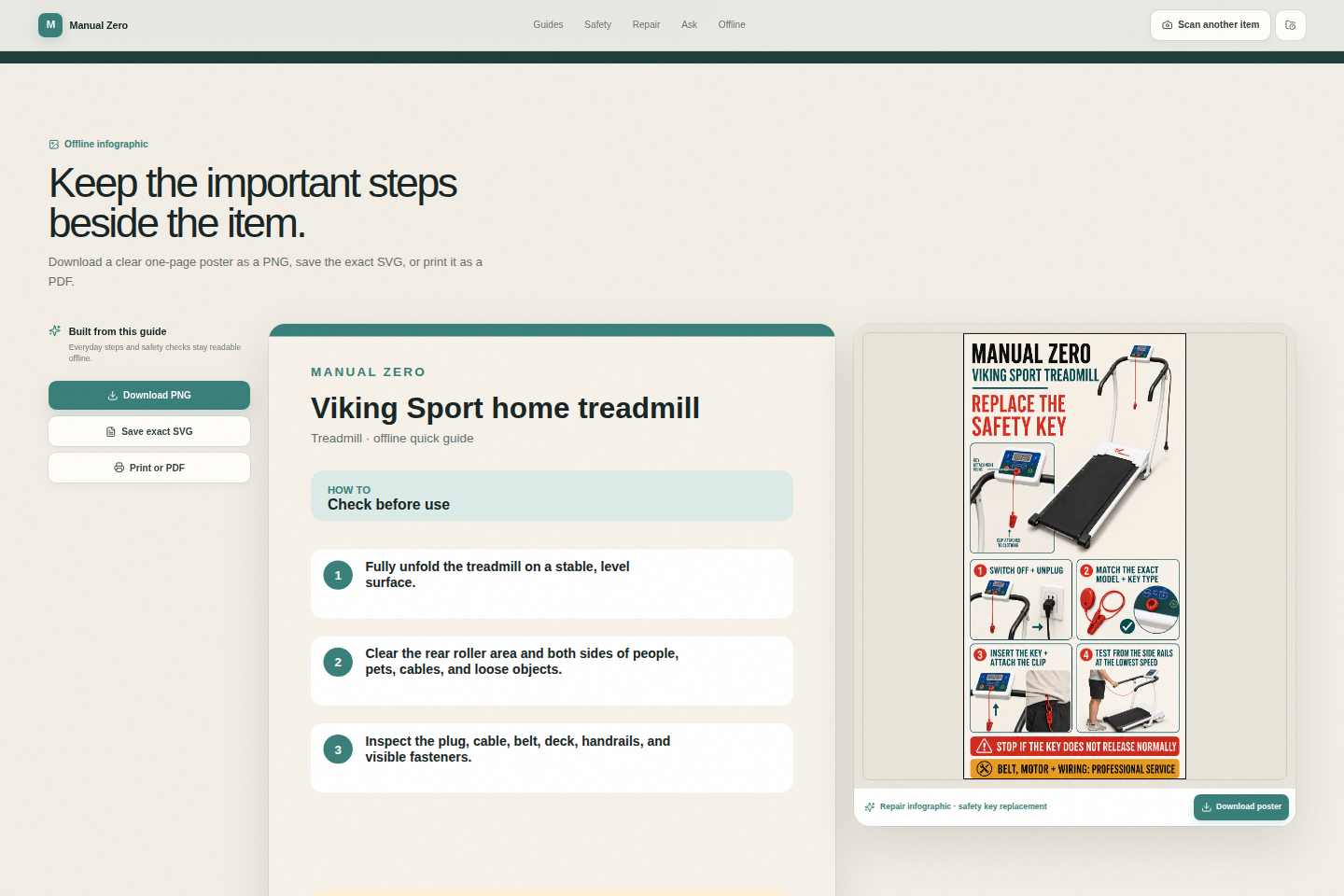
- Save a one-page manual for offline use.
- View polished, reviewed infographic examples generated with GPT Image.
A prepared public demo makes the complete experience easy to judge without credentials. A separate private route lets judges unlock live GPT-5.6 analysis and test their own photos.
How we built it
The app uses Next.js, React, and TypeScript. Uploaded images are normalized with Sharp, stripped of unnecessary metadata, and sent only through server routes. GPT-5.6 performs multimodal analysis and returns structured data that is validated with Zod before it reaches the interface.
The guide is stored as a structured manual instead of loose model prose. That structure powers guide steps, safety boundaries, repair choices, grounded follow-up help, the movable 2.5D item view, revision history, and offline export.
Live projects use private Vercel Blob storage. A browser IndexedDB vault provides a second local copy and portable .manualzero files. Supabase is not required.
The final product film was built with Remotion and uses recordings of the deployed app. The repository also includes Playwright browser coverage, Vitest tests, deterministic judge fixtures, and licensed or original demo assets.
How Codex and GPT-5.6 were used
Codex helped turn the initial idea into a complete product. It shaped the guided capture flow, implemented the app, refined the user experience, set safety boundaries, wrote tests, diagnosed deployment issues, and produced the final demo workflow. We used it as an engineering and design collaborator while keeping the core product decisions human-led.
GPT-5.6 powers the live multimodal path. It reconciles evidence across the full-item, control, and label photos. It then produces a schema-valid guide plan that the app can inspect, render, and constrain. Separate structured calls support evidence reconciliation and safe workflow planning.
Challenges we faced
The hardest part was making the result useful without pretending that an inferred guide is manufacturer documentation. We had to show uncertainty, block risky actions, preserve user corrections, and keep follow-up answers within the accepted evidence.
Deployment raised another challenge. Consecutive uploads and analysis requests can run on different serverless instances. We solved that without Supabase by adding private Vercel Blob persistence, while keeping a local in-memory adapter for development and an IndexedDB vault for offline recovery.
The demo also needed to prove more than one happy path in under three minutes. We combined a washing-machine walkthrough with a treadmill example, gave each device distinct features, and kept the captions short enough to follow.
What we learned
Multimodal output becomes much more trustworthy when it is treated as structured evidence instead of a single answer. A strong capture flow matters as much as the model call.
We also learned that offline artifacts are not an extra feature here. They are part of the main value because repair and maintenance often happen away from a screen or stable connection.
What we are proud of
Manual Zero feels like a focused product instead of a model wrapper. It has a clear public demo, a secured live judge path, two different item experiences, grounded follow-up help, accessible offline output, and explicit safety limits.
What is next
Next, we would add verified manufacturer sources, broader item-specific diagnostics, optional runtime infographic generation for every accepted manual, and user-controlled cross-device sync.
Built With
- codex
- framer
- gpt-5.6
- next.js
- openai-api
- react
- remotion
- three.js
- typescript
- vercel

Log in or sign up for Devpost to join the conversation.