Inspiration
Geothermal energy has enormous potential to power a cleaner future, but understanding what happens during drilling operations remains a complex, data-intensive process. Critical information is buried in lengthy Daily Drilling Reports, spreadsheets, equipment logs, and operational observations. Engineers often spend hours manually reconstructing timelines, investigating incidents, calculating downtime, and comparing operations before they can make informed decisions.
We asked ourselves: What if drilling engineers could spend less time documenting what happened and more time understanding why it happened?
That question inspired Mantle (BoreSight), an AI-powered geothermal drilling intelligence platform designed to transform raw operational data into actionable, explainable insights.
Inspired by the Steel & Steam theme, we see the drilling infrastructure as the steel and the continuous flow of operational information as the steam that powers intelligent decisions. Our vision is to build a system that doesn't merely process reports, but progressively understands the operations behind them.
What it does
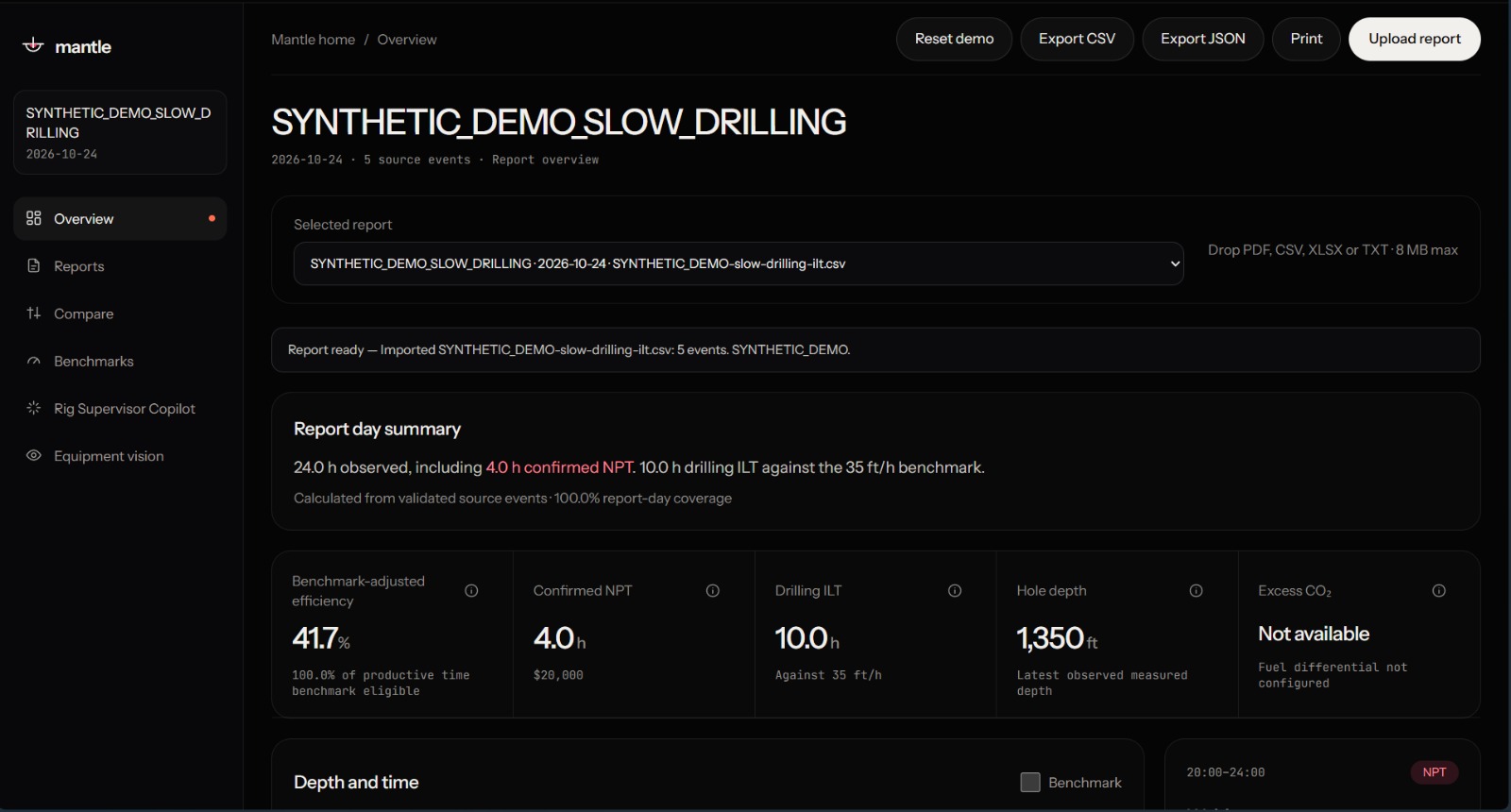
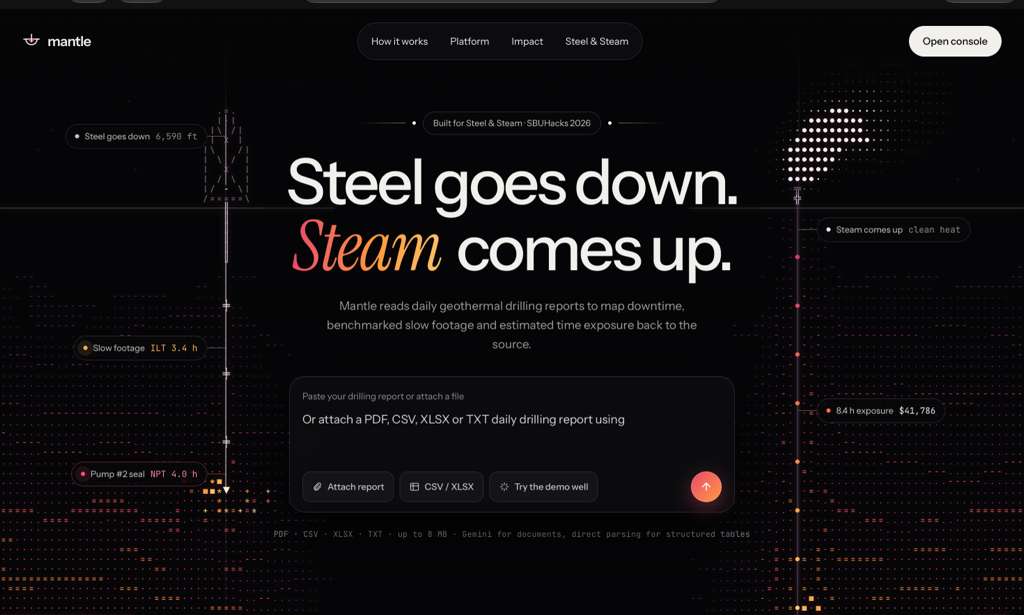
Mantle transforms geothermal drilling reports into an interactive operational intelligence workspace, combining AI-powered document understanding, deterministic analytics, data visualization, and conversational investigation.
- Intelligent document processing
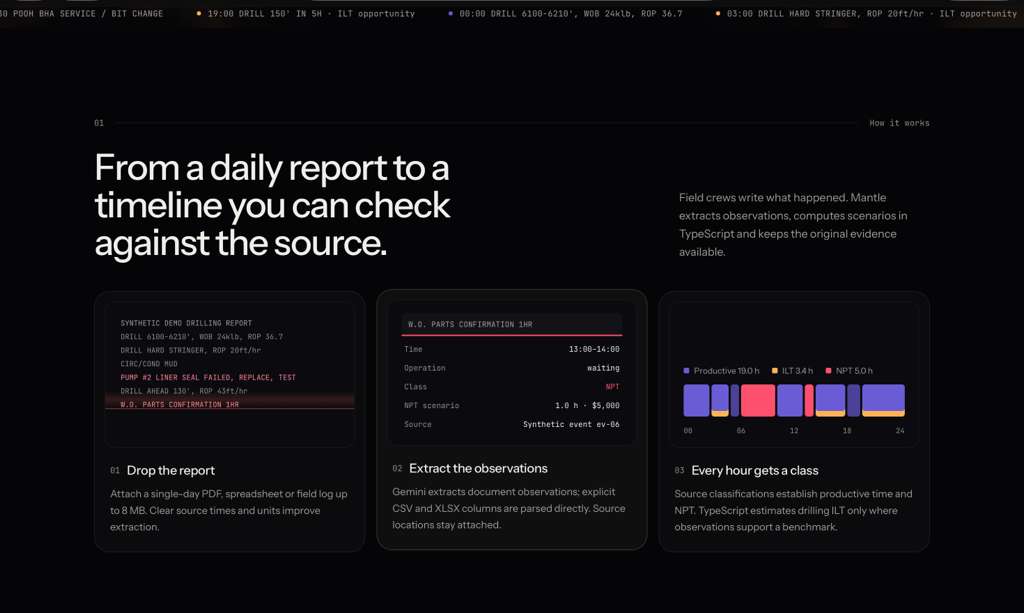
Engineers can upload Daily Drilling Reports in PDF, CSV, XLSX, and TXT formats. Using Google Gemini, Mantle interprets technical drilling terminology and extracts structured operational information, including activities, timestamps, drilling depths, equipment incidents, and supporting source evidence.
Suitable structured spreadsheets can also be parsed deterministically. Extracted data passes through validation and timeline checks to identify invalid durations, overlapping activities, missing information, and conflicting values instead of silently accepting questionable results.
- Interactive drilling analytics
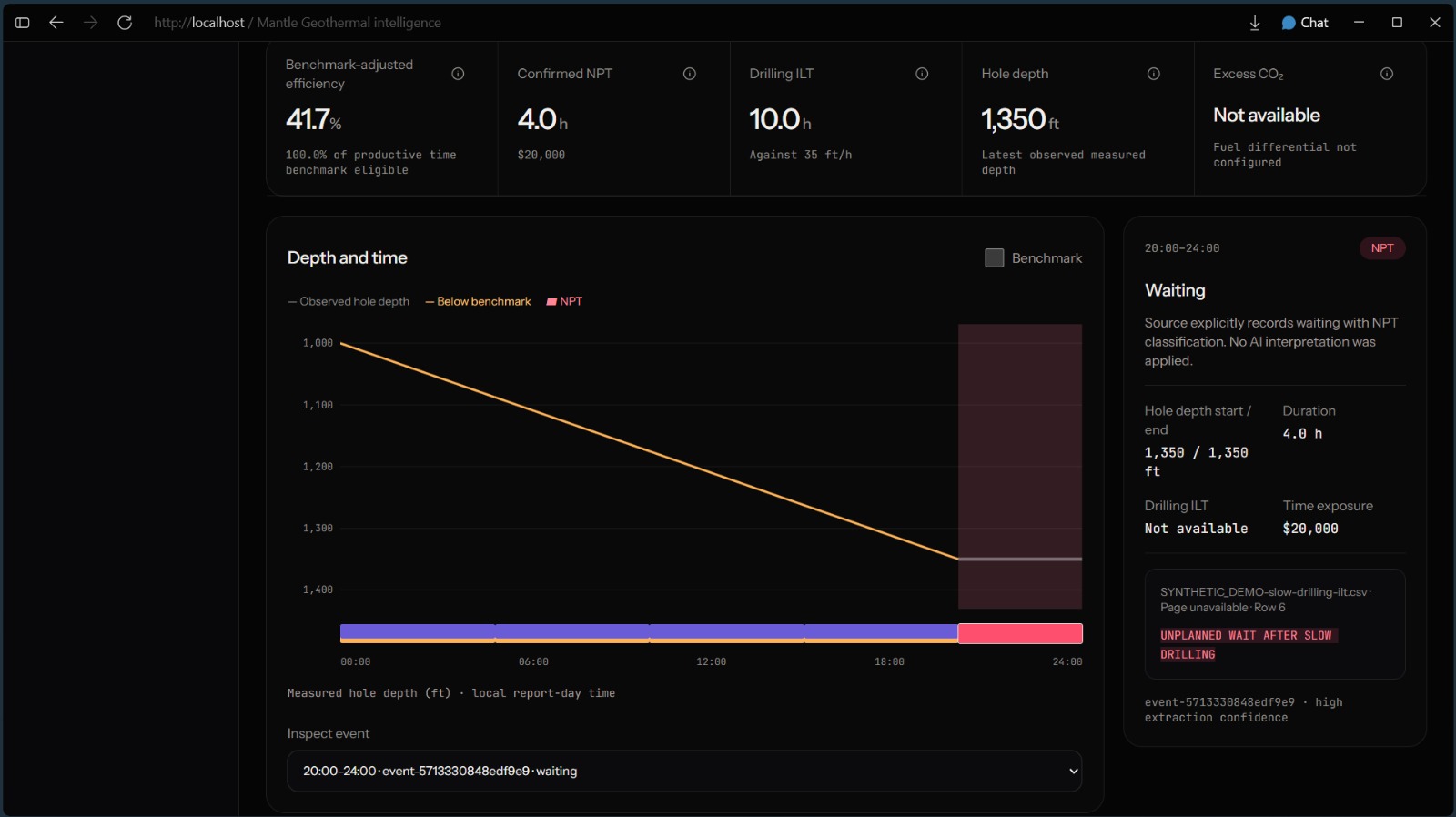
Mantle transforms validated operational events into a chronological, 24-hour report timeline, giving engineers a clearer picture of drilling activities and operational performance.
Key capabilities include:
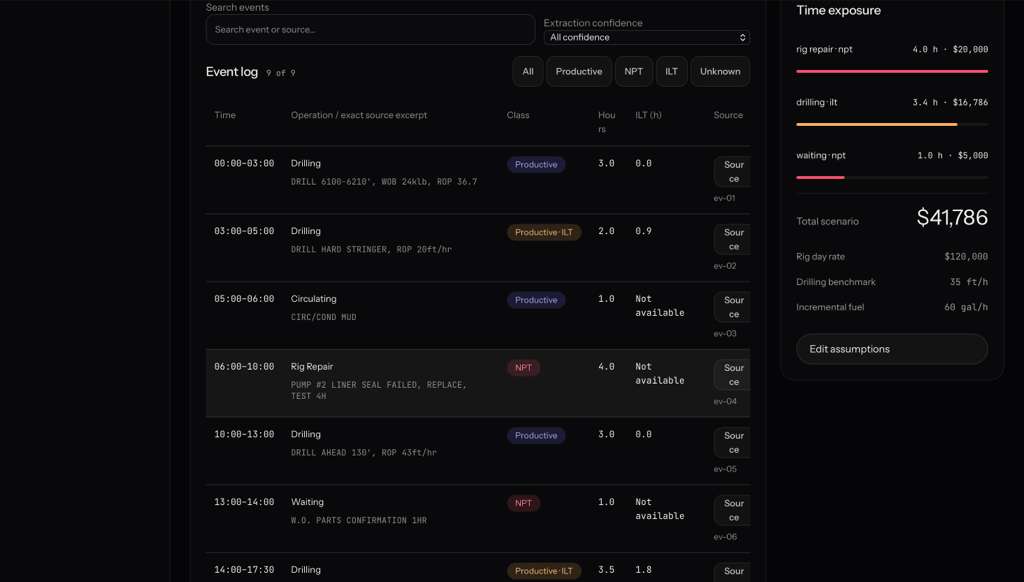
Interactive activity timelines and searchable operational event tables.
Depth-versus-time charts and activity visualizations.
Non-Productive Time (NPT) analysis based on recorded event classifications.
Invisible Lost Time (ILT) estimates based on eligible productive drilling intervals and configurable benchmarks.
Report coverage analysis, missing-time indicators, and data-quality warnings.
Report comparisons and editable cost scenarios.
Source evidence linked to PDF pages, spreadsheet rows or sheets, and text excerpts when available.
Exportable analysis and print-friendly reports.
Cost and efficiency scenarios remain transparent estimates based on explicit assumptions, not guaranteed savings or verified financial losses.
- Rig Supervisor Copilot
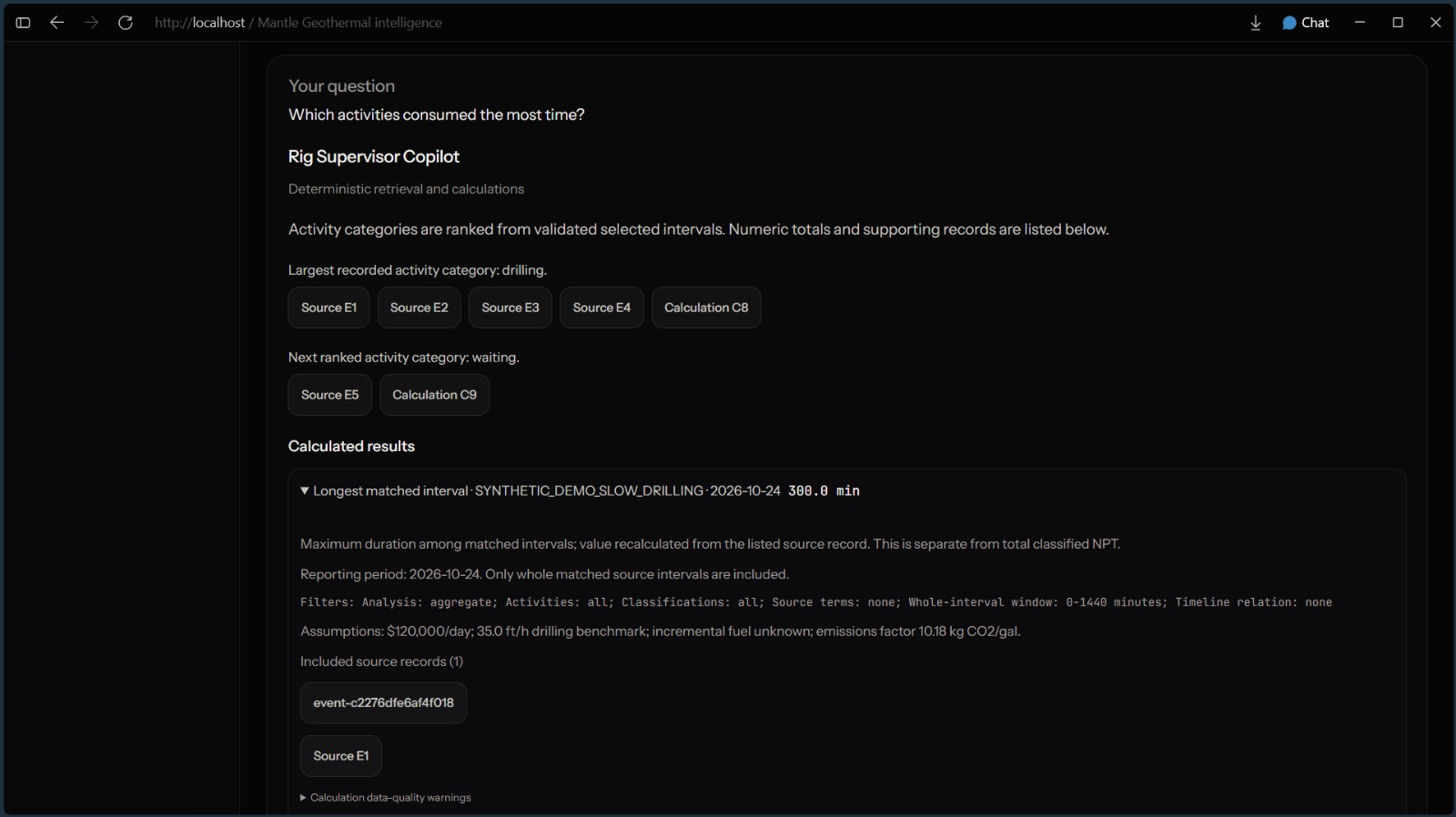
Our biggest step toward making drilling intelligence accessible is Rig Supervisor Copilot, a conversational AI assistant integrated directly into Mantle.
Instead of navigating multiple reports and charts manually, engineers can ask questions in natural language:
"Which activities contributed the most recorded NPT?"
"What happened before and after the stuck-pipe incident?"
"Compare operational bottlenecks across these reports."
"What did the crew report about the equipment failure?"
"Which findings require further investigation?"
Powered by Google Gemini and a hybrid Retrieval-Augmented Generation (RAG) architecture, the Copilot retrieves relevant validated operational events and supporting passages from original reports. It combines computed metrics with source-grounded explanations to help engineers investigate incidents and understand operational patterns.
- Evidence-backed intelligence
Mantle is designed to make findings traceable rather than simply convincing. Engineers can inspect source evidence, review calculation assumptions, and distinguish documented facts from reported explanations, inferred patterns, and unresolved questions.
When the available reports do not establish an incident's cause, the system should communicate that limitation instead of inventing an explanation. The Copilot supports human investigation; it does not autonomously control drilling equipment or replace engineering judgment.
How we built it
We built Mantle as a full-stack web application with a modular architecture separating document ingestion, AI interpretation, data validation, deterministic analytics, evidence retrieval, and visualization.
Technology stack
Next.js 15.5 and Node.js: Web application, server-side processing, API routes, and AI integration.
React 19: Interactive dashboard, report explorer, and conversational Copilot.
TypeScript: Application logic, operational data contracts, retrieval orchestration, and deterministic analytics.
Tailwind CSS 3.4: Responsive styling and a distinctive industrial interface.
Google Gemini API (@google/genai): Technical document interpretation, structured event extraction, question understanding, and conversational answer synthesis.
Hybrid RAG: Structured event retrieval combined with keyword/full-text retrieval of relevant report passages.
Zod: Schema validation for extracted records, request parameters, and structured responses.
ExcelJS: Spreadsheet workbook processing.
pdf-lib: PDF processing and report-page selection workflows.
Recharts: Interactive drilling charts and data visualizations.
Vitest: Automated unit and integration testing.
ESLint and TypeScript checks: Static analysis and code-quality verification.
Our architecture: From raw reports to intelligence
Upload → Extract → Validate → Analyze → Retrieve → Explain → Verify
Ingestion: Accept supported PDF, CSV, XLSX, and TXT inputs, with configured file-size and page limits.
AI interpretation: Use Gemini to understand unstructured reports and convert technical descriptions into structured operational records.
Validation: Apply Zod schemas, timeline constraints, and data-quality checks to identify malformed or conflicting events.
Deterministic analytics: Calculate durations, recorded NPT, eligible ILT estimates, and configurable cost scenarios using TypeScript functions.
Hybrid retrieval: Retrieve relevant normalized events and original report passages based on the engineer's question and selected reports.
Conversational synthesis: Use Gemini to explain the retrieved evidence and computed findings in natural language.
Verification: Present supporting evidence and calculation details so engineers can inspect the results.
Why hybrid RAG?
A drilling engineer asking "How many hours were lost to pump repairs?" needs a reliable calculation. Asking "What did the crew report about the pump failure?" requires the original narrative. Asking both questions together requires both types of evidence.
Our hybrid RAG design addresses these different needs. Structured queries and deterministic functions handle numerical analysis, while document retrieval supplies the relevant operational context. Gemini synthesizes the results rather than serving as the authoritative calculator.
We designed the initial retrieval architecture to reuse existing validated events and report evidence without requiring a separate vector database for the first version.
Engineering for trust
We also incorporated safeguards around validation, source provenance, missing data, report scope, and server-side API credentials. Model outputs must pass validation, uploaded report content is treated as untrusted data, and numerical findings remain grounded in the deterministic analytics engine.
The current application is a local-first MVP. Production authentication, durable shared storage, and multi-user authorization remain future development goals.
Challenges we ran into
- Turning inconsistent documents into reliable timelines
Drilling reports contain specialized terminology, irregular tables, narrative remarks, timestamps, and measurements. Extracting information that merely looks correct is not enough; the events must form a coherent timeline. We addressed this challenge through structured schemas, validation rules, source references, and explicit handling of missing or conflicting information.
- Preventing AI-generated numerical errors
Language models can produce convincing explanations while making arithmetic mistakes. We separated AI interpretation from deterministic numerical computation, allowing TypeScript functions to calculate operational durations and metrics reproducibly.
- Connecting calculations to real-world context
A downtime figure alone does not explain an incident. Engineers also need the original operational remarks and surrounding events. Our hybrid RAG architecture combines structured event retrieval with relevant report passages to connect quantitative findings with documented context.
- Handling uncertainty responsibly
Missing timestamps, incomplete timelines, and conflicting report totals can undermine operational analysis. Instead of silently inventing values or reconciling discrepancies without evidence, Mantle is designed to surface these limitations for human review.
- Integrating everything into one usable workflow
Document processing, analytics, visualizations, scenario modeling, source inspection, and conversational investigation needed to work together. We focused on making these capabilities part of one coherent product rather than building disconnected AI demonstrations.
Accomplishments that we're proud of
Built an end-to-end operational intelligence platform that transforms supported drilling reports into structured events, timelines, analytics, and evidence-backed investigations.
Integrated Google Gemini into a specialized industrial workflow for technical document interpretation and conversational analysis.
Implemented hybrid RAG to connect validated operational records with relevant passages from original reports.
Separated AI from authoritative numerical calculations, using deterministic TypeScript analytics for durations, NPT, eligible ILT estimates, and cost scenarios.
Made traceability central to the experience through source references, validation checks, coverage warnings, and visible assumptions.
Created a conversational interface for operational investigation, allowing engineers to ask questions rather than manually navigate every report.
Designed a foundation for continuous drilling intelligence, with an architecture that can evolve beyond manually uploaded reports.
What makes us most proud is the philosophy behind Mantle: an AI system should not only tell engineers what it thinks happened; it should help them investigate the evidence, understand the calculations, and recognize what remains unknown.
What we learned
Building Mantle taught us that applying AI to a specialized engineering domain requires more than connecting an application to a language model.
The quality of extracted data, validation rules, retrieval strategy, deterministic calculations, and evidence presentation all influence whether the result is useful. We learned to assign language models the tasks they are suited for—interpreting irregular documents and explaining context—while relying on explicit algorithms for reproducible numerical results.
We also gained experience integrating LLM APIs into a full-stack application, designing structured data pipelines, building retrieval-augmented generation workflows, validating model outputs, visualizing operational data, and creating an interface for complex technical investigations.
Most importantly, we learned that trustworthy industrial AI must make its conclusions inspectable. A confident answer is not enough; engineers need to understand where it came from and whether the available evidence actually supports it.
What's next for Mantle
Our ultimate vision is to evolve Mantle from a report-analysis platform into a continuously observing, AI-powered drilling intelligence system that can understand operational activities without depending on manually prepared reports.
Today, Mantle analyzes information provided through drilling reports. In the future, we want to reduce that manual dependency by developing an intelligent system that observes drilling operations, builds structured operational records automatically, and feeds those records into the same analytics and Copilot experience.
- From manual reports to continuous observation
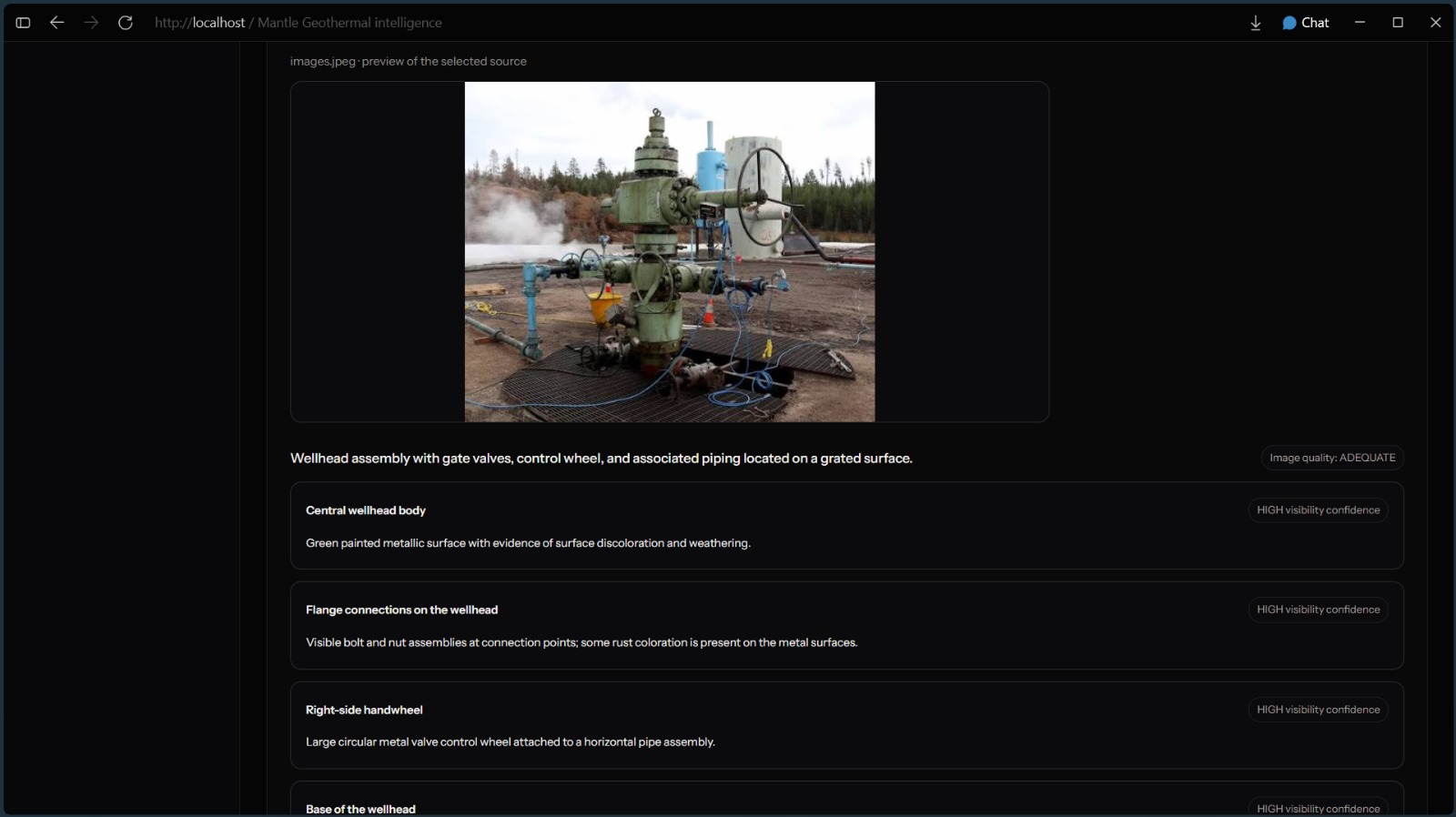
We envision integrating computer vision using OpenCV, camera feeds, equipment observations, available sensor streams, and other operational data sources to identify and track activities across a drilling site.
Instead of waiting for an engineer to prepare a report, the system could progressively learn to identify operational states, record event timestamps, track observable equipment behavior, detect potential anomalies, and assemble a continuously updated activity timeline.
Measurements such as drilling depth, equipment pressure, or temperature would need to come from suitable instrumentation or verified data sources whenever they cannot be reliably inferred from video.
- A domain-specialized drilling AI model
We want to develop or adapt a domain-specialized language model with deeper knowledge of geothermal drilling processes, machinery, technical terminology, equipment behavior, and operational relationships.
Rather than training a large language model entirely from scratch as our first step, we could adapt an existing model using curated domain-specific data, supported by a structured operational knowledge base and verified technical documentation.
Combined with computer vision and other operational data, this specialized AI could help interpret observed activities, correlate events, and explain potential incidents in the context of drilling operations.
- The same analytics, powered by automatically collected data
The foundation we have already built remains central to this vision.
Automatically observed activities would pass through the same validation and structured-event pipeline. Mantle's deterministic TypeScript engine would continue calculating NPT, eligible ILT estimates, operational durations, and configurable cost scenarios. The dashboard would continue visualizing performance, and the Copilot would retain its ability to answer questions, compare operations, investigate incidents, and provide evidence-backed explanations.
The difference is that the data pipeline would progressively move from manually uploaded reports to continuously collected and validated operational information.
- Toward proactive operational intelligence
With reliable continuous data, Mantle could eventually support near-real-time anomaly detection, trend monitoring, timely alerts, automated shift summaries, and earlier identification of unusual operational patterns.
Engineers could ask questions such as:
"What changed during the last shift, which events contributed to increased downtime, and what evidence supports that conclusion?"
Mantle could retrieve recorded events, inspect relevant observations, calculate associated durations, and assemble a traceable explanation—without requiring someone to manually compile every detail first.
This remains a long-term vision requiring reliable data collection, domain-specific evaluation, sensor integration, temporal event correlation, and rigorous human verification. Automated observations would need confidence checks, and safety-critical decisions would remain under qualified human oversight.
Our goal is to move Mantle from an AI that understands drilling reports to an AI system that continuously builds an evidence-backed understanding of drilling operations themselves. We want to make industrial intelligence more accessible, reduce repetitive reporting work, and help engineers spend more time investigating problems and making informed decisions.
Built With
- ai
- css
- data-analytics
- data-visulization
- engineering-analytics
- eslint
- exceljs
- gen-ai
- geothermal-energy
- git
- github
- google-gemini-api
- html
- javascript
- lucid-react
- natural-language-processing
- next.js
- node.js
- predictive-analytics
- react
- recharts
- tailwind-css
- typescript
- vitest
- zod

Log in or sign up for Devpost to join the conversation.