-
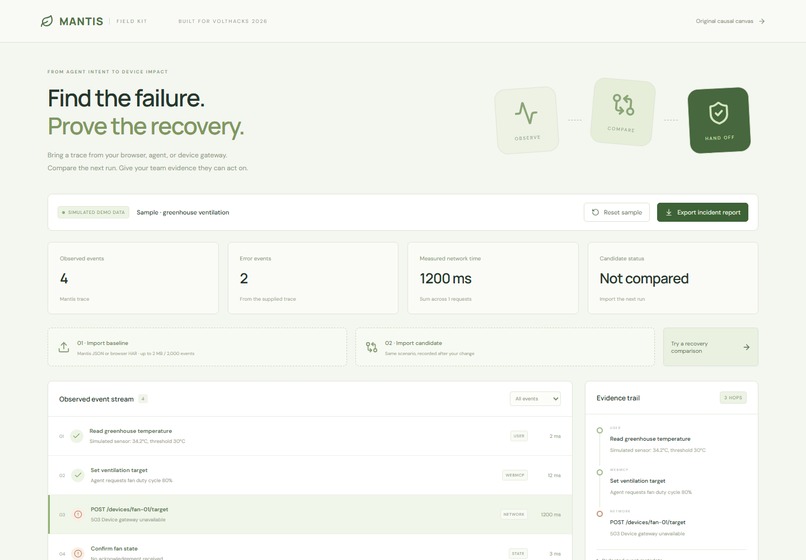
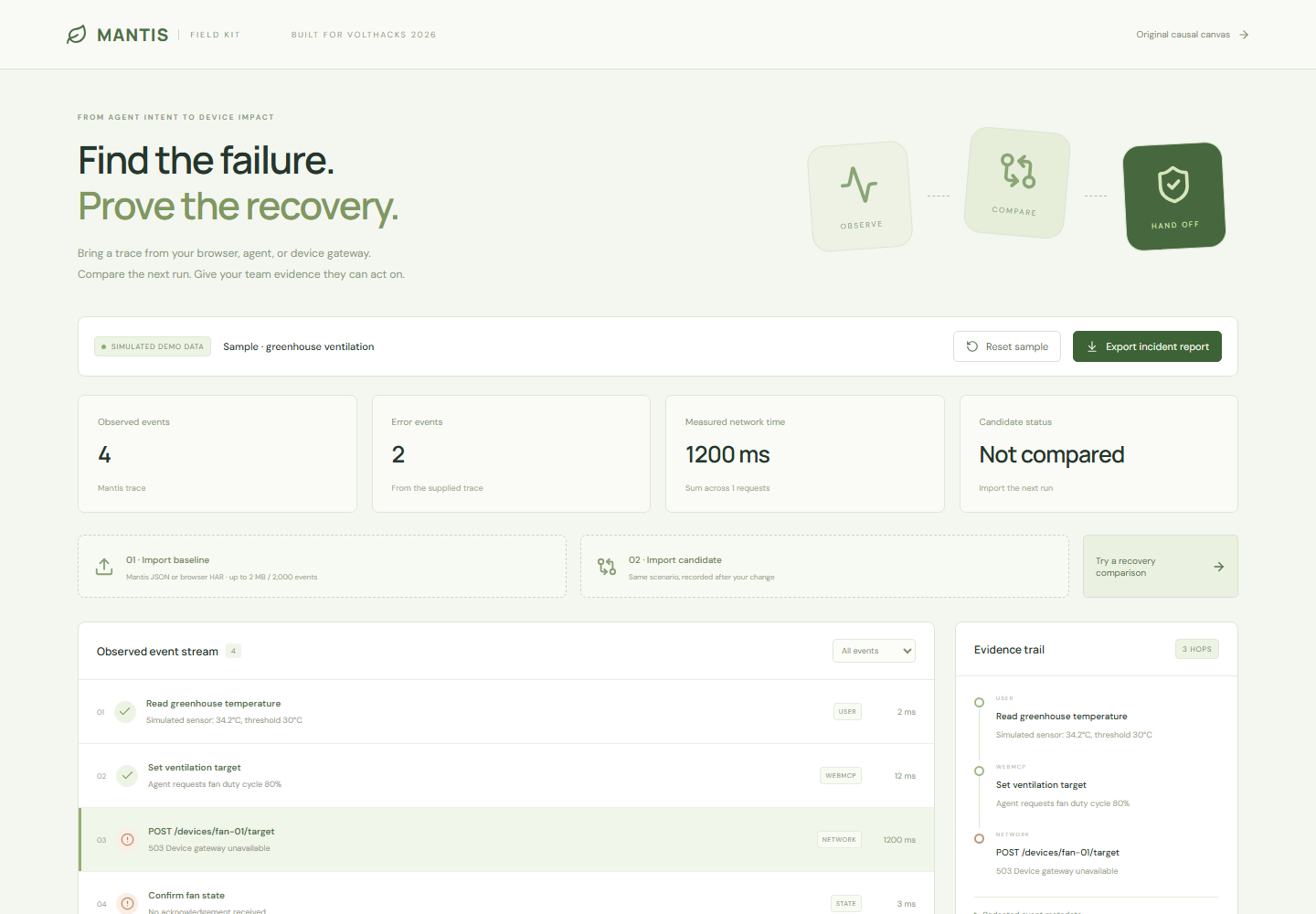
Incident workbench with a clearly labeled simulated greenhouse gateway trace.
-
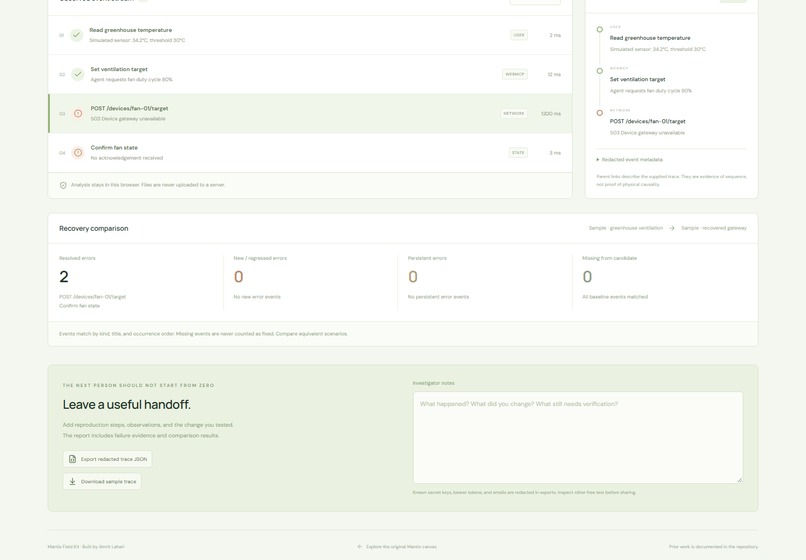
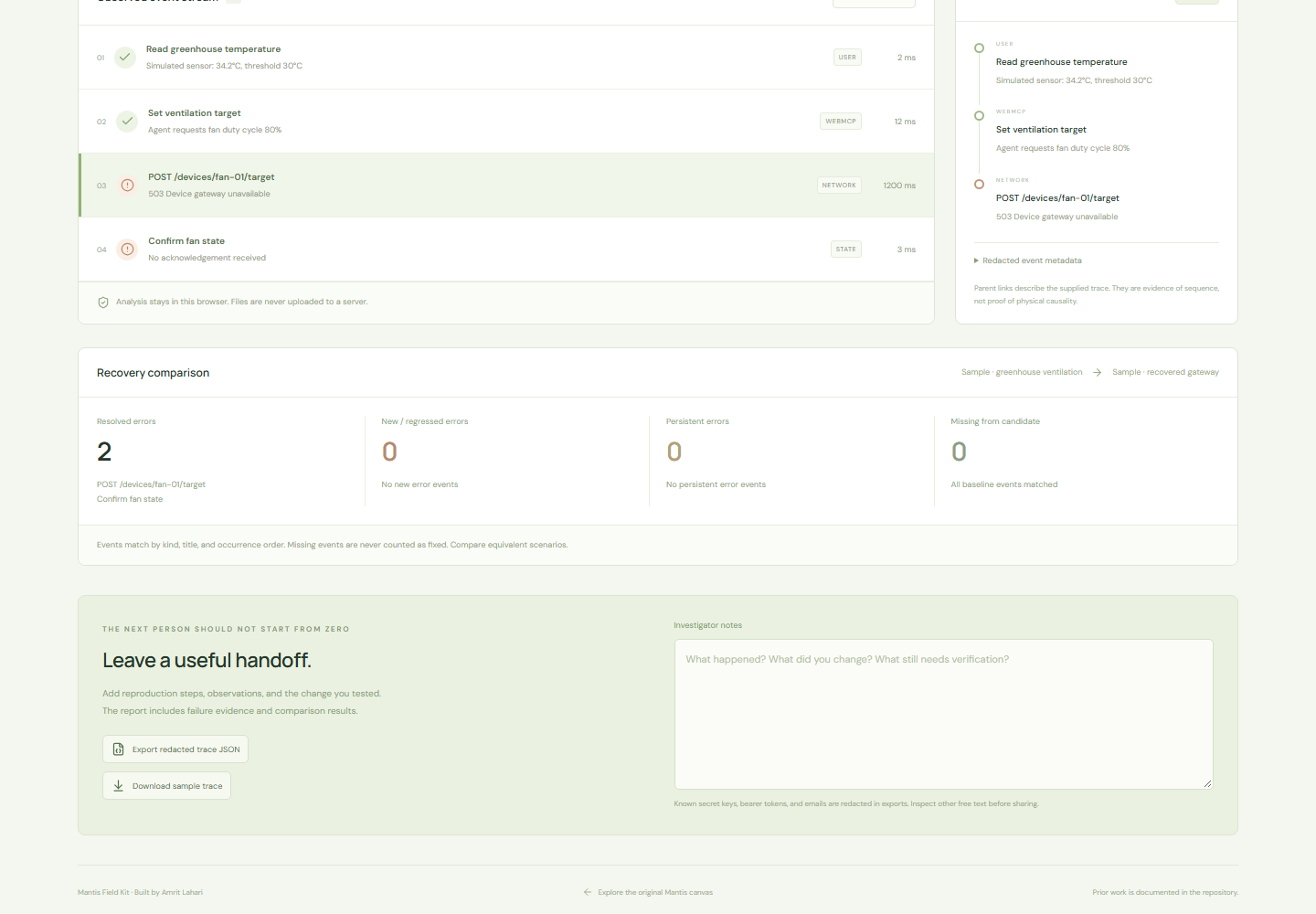
Baseline and recovery comparison: resolved, regressed, persistent, and missing events stay distinct.
-
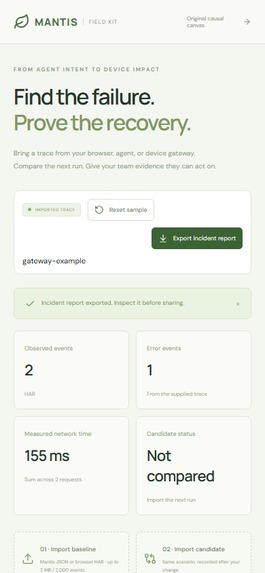
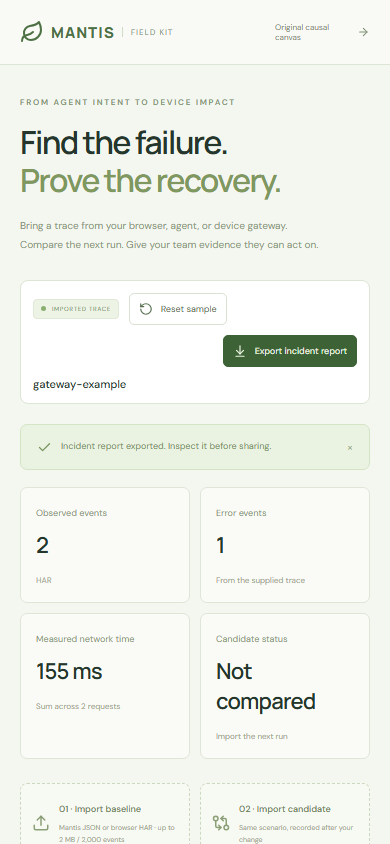
Responsive incident evidence view on a mobile viewport.
-
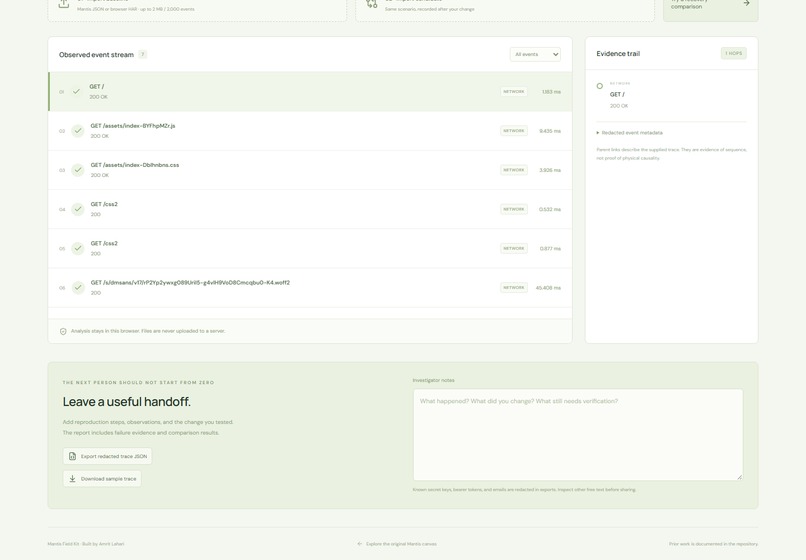
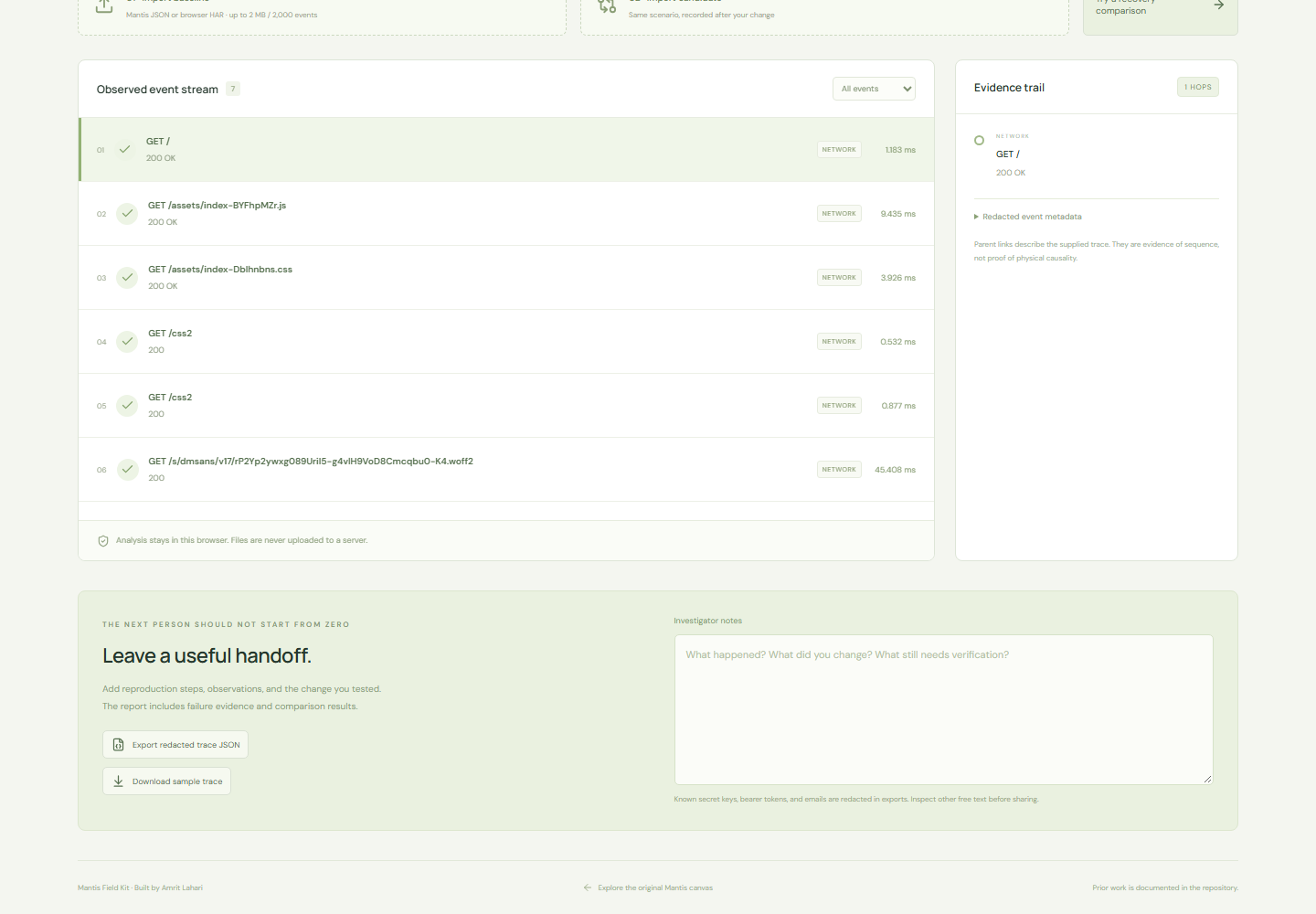
A real browser HAR import with filtered network evidence and local analysis.
Live application · Watch/download the narrated demo · Source repository
Inspiration
Agent-driven automation often fails between boundaries: an agent issues a command, a device gateway rejects it, and a downstream state never arrives. Builders need a way to inspect that chain and show whether the next run actually improved.
What it does
Mantis Field Kit is a browser-based incident workbench for agent and device-gateway workflows. Import a Mantis-format JSON trace or a browser HAR file, inspect recorded failures and parent links, compare a baseline with a candidate run, and export a redacted incident handoff.
The comparison distinguishes resolved errors, new or regressed errors, persistent errors, and missing events. A missing event is never counted as a successful fix. Repeated requests are matched by kind, title, and occurrence order.
The included greenhouse ventilation scenario is explicitly simulated. It demonstrates a temperature observation, an agent ventilation command, a failing gateway request, and a recovery run. We do not claim a physical hardware deployment.
How we built it
React and TypeScript provide the interface and deterministic analysis engine; Vite builds the static application. Browser File APIs read local JSON/HAR files without uploading them. The parser validates event identities, parent references, causal cycles, size limits, and timing formats.
HAR imports exclude headers, cookies, query strings, and request/response payload bodies. Trace imports and report notes redact known secret keys, bearer tokens, and email patterns. Redaction is heuristic: users should inspect exports before sharing.
What is new for VoltHacks
This is an adaptation of my existing Mantis project, not a claim that the original project was created from scratch during this event. The original causal-canvas interface and twelve WebMCP tools remain accessible through “Original causal canvas.”
New work completed on September 11, 2026 includes the Field Kit interface; real JSON/HAR imports; validation and redaction; baseline-versus-candidate analysis; recorded-parent evidence trails; Markdown and JSON handoff exports; a simulated device-gateway scenario; responsive layouts; and tests for these workflows. The source repository preserves original history and records these additions as separate commits. The baseline is documented in .autohack/PROVENANCE.md.
Challenges we ran into
The hardest issue was avoiding misleading recovery claims. Different runs can contain different events, so missing events are shown separately from resolved errors. Another challenge was preserving useful incident evidence without importing every sensitive field from a HAR file.
Accomplishments and validation
The workbench handles real uploaded files as well as labeled samples. Automated checks cover malformed input, duplicate IDs, missing parents, causal cycles, redaction, HAR filtering, repeated-request comparisons, report downloads, and mobile layout. The original Mantis canvas and WebMCP interactions are covered by the retained regression suite. Exact commands and results are documented in the repository.
What we learned
An incident handoff is useful when it separates observed evidence from interpretation. Parent links do not prove physical causality, total network durations are not wall-clock time, and a passing candidate trace does not validate a production system.
What's next
Planned work includes adapters for additional device telemetry formats, stronger scenario alignment, and explicit links from imported events into the original causal canvas. These are future plans, not shipped features.
Built With
- har
- playwright
- react
- typescript
- vite
- webmcp

Log in or sign up for Devpost to join the conversation.