-
-
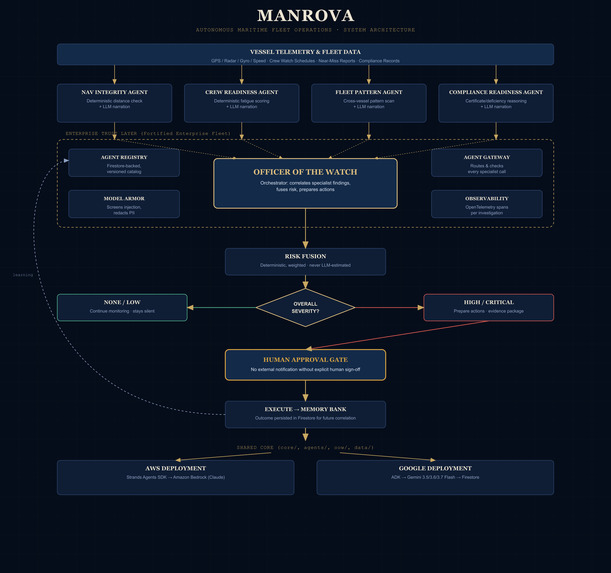
Architectural drawing
-
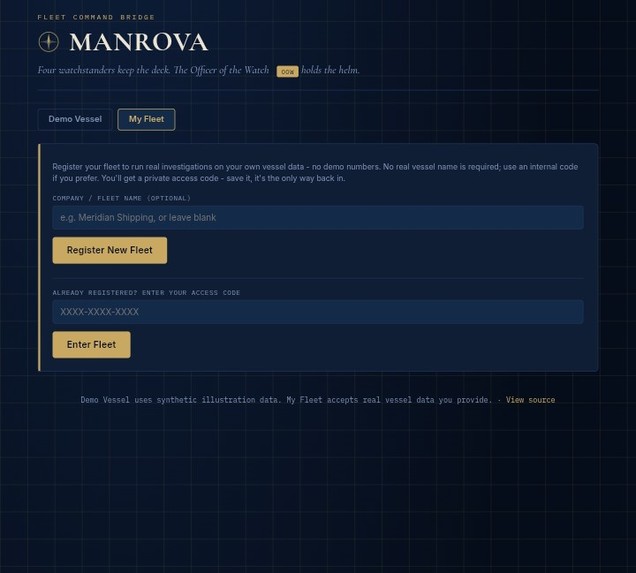
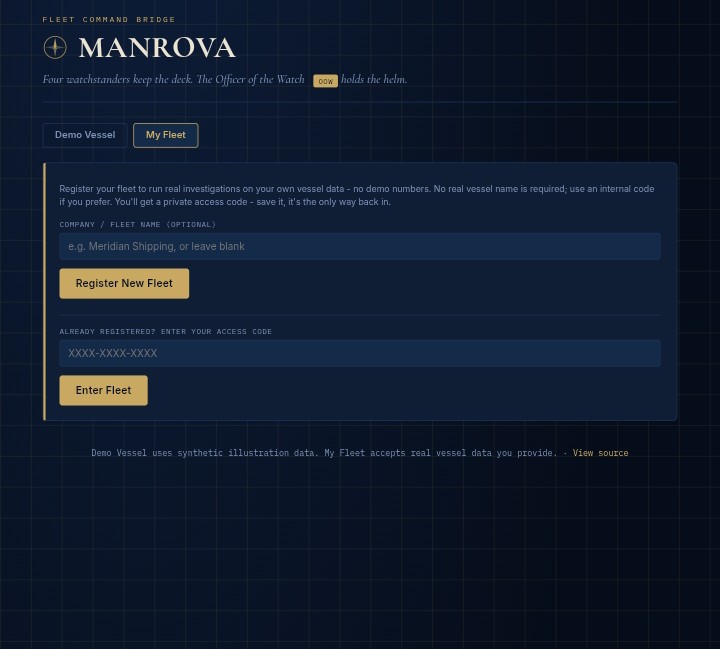
Manrova Landing page
Inspiration
A vessel can generate a huge amount of operational information: navigation data, crew conditions, near-miss reports, compliance records and incident signals.
The problem is not simply collecting this information. The difficult part is connecting the signals quickly enough to understand what is happening, determine what matters, and get the right information to the right person.
That is where Manrova started.
We wanted to explore what happens when AI agents are given specific responsibilities and allowed to work together as an operational team rather than building another chatbot that waits for someone to ask it a question.
The idea became simple:
Let the agents watch. Let them investigate. Let them coordinate. Let humans make the critical decisions.
What Manrova Does
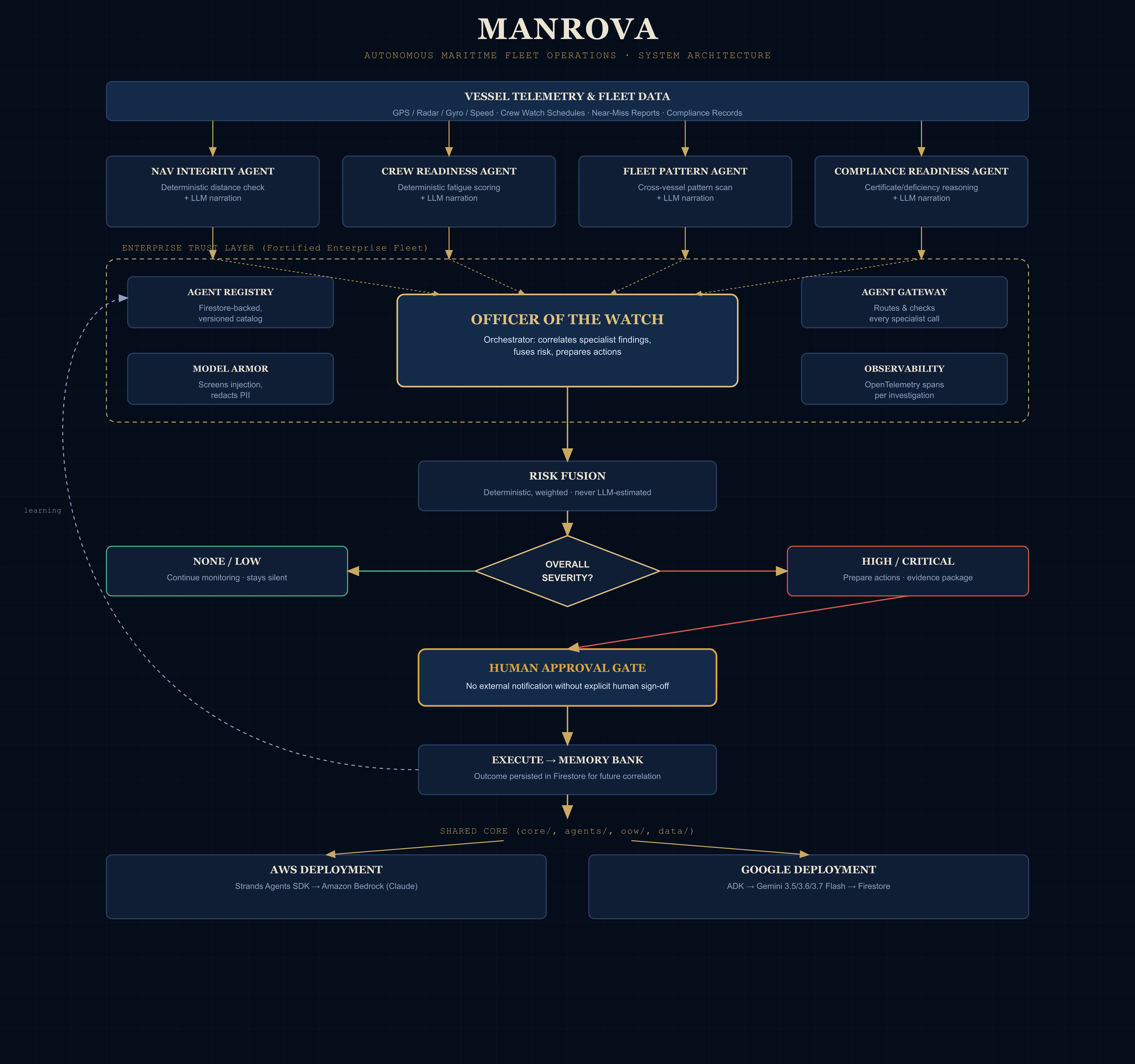
Manrova is an agentic maritime operations system built around an Officer of the Watch orchestrator and four specialist agents.
Navigation Integrity Agent
Monitors navigation signals such as GPS, radar-derived position, gyro heading and speed to identify potential navigation anomalies.
When the signals disagree beyond an expected threshold, the event can be escalated for further investigation.
Crew Readiness Agent
Looks at crew rest and duty patterns to identify conditions that may increase operational risk.
Crew information can also become important context when another incident is already developing.
Fleet Pattern Agent
Looks across near-miss and incident information to identify recurring patterns.
A problem reported on one vessel may become much more important when similar events start appearing elsewhere in the fleet.
Compliance Readiness Agent
Tracks vessel compliance information and provides relevant context when an incident requires coordination with parties such as the Master, DPA or class society.
The Officer of the Watch
The four agents do not operate as isolated tools.
Their findings flow into the Officer of the Watch, which acts as Manrova's coordination layer.
The OOW determines which specialist information is relevant, gathers the available evidence and coordinates the next stage of the incident.
The system then passes the structured findings through deterministic risk logic to establish the overall severity.
For lower-risk situations, Manrova can continue monitoring.
For higher-risk situations, it prepares the relevant response and brings the human decision-maker into the loop.
The system assists the watch. It does not replace the watch.
Why This Is Agentic
The important part of Manrova is not simply that it uses AI.
It is the way the agents divide responsibility and work together.
A navigation anomaly can trigger the orchestrator.
The orchestrator can then pull crew, fleet-pattern and compliance context.
The combined evidence can change how the incident should be understood.
This creates a workflow where agents are not just answering questions. They are monitoring, reasoning, coordinating, escalating and maintaining operational context.
How We Built It
Manrova was designed around a shared core containing the agent, orchestration, data and operational logic.
The architecture separates deterministic safety logic from the agentic layer.
Critical calculations such as navigation deviation, weighted risk scoring and incident state transitions remain deterministic. Agents work with the resulting structured information to interpret evidence, coordinate specialist findings and prepare actions.
The project also supports provider-specific implementations, including an AWS path using Strands Agents SDK and Amazon Bedrock, alongside the project's Google implementation.
The Enterprise Trust Layer
For the Fortified Enterprise Fleet track, Manrova implements each of the required components directly, not just conceptually.
Every agent, the four specialists and the Officer of the Watch, is published to a live Agent Registry in Firestore, versioned and scoped to the permissions it actually needs. Every specialist call is routed through an Agent Gateway that checks those permissions before allowing it through. Untrusted free text, such as a near-miss report, passes through a Model Armor-style guardrail that screens for prompt injection and redacts PII before it ever reaches a model. Every investigation is wrapped in Agent Observability trace spans, so the full reasoning chain is auditable. Completed investigations persist in a Firestore-backed Memory Bank, so a vessel's history survives across sessions instead of resetting with every request. And each agent runs under its own Agent Identity, a dedicated IAM service account with least-privilege access, rather than one shared credential for the whole system.

Building With Real Vessel Data
We wanted the project to feel closer to an actual maritime operations environment rather than a collection of artificial demo screens.
For testing, Manrova can accept vessel information including:
- GPS latitude and longitude
- Radar latitude and longitude
- Gyro heading
- Speed
- Crew rest hours
- Continuous duty hours
This makes it possible to introduce realistic sensor disagreement and observe how the Navigation Integrity workflow responds.
For the demonstration, public vessel information was used as the basis for a test scenario, while simulated sensor and crew inputs were clearly treated as test data.
What We Learned
One of the biggest lessons was that building an agentic system is not about giving an LLM more responsibility.
It is about giving each agent a clear responsibility, defining what information it can trust, deciding when it should involve another agent, and knowing when control must return to a human.
We also learned that deterministic logic and agentic reasoning work better together than either one trying to do everything.
The deterministic layer provides boundaries.
The agents provide interpretation and coordination.
The human provides final authority when the situation requires it.
Challenges
The biggest challenge was designing a system that felt autonomous without making unsafe assumptions.
A maritime system cannot simply let an AI model make unrestricted decisions because a situation may involve navigation, safety, crew welfare and regulatory consequences at the same time.
That led us to design Manrova around a human-in-the-loop approach.
Another challenge was turning multiple specialist capabilities into one coherent product instead of four unrelated agents.
The Officer of the Watch became the answer: one command layer connecting the specialist agents into a single operational workflow.
The Goal
Manrova is an experiment in what agentic AI could look like when it is placed in an operational environment.
Instead of asking:
"What can an AI assistant tell a vessel operator?"
we asked:
"What could a team of agents continuously do for a vessel operator?"
Manrova is our answer.
Watch continuously. Correlate evidence. Escalate only when necessary. Keep the human at the helm.
Built With
- adk
- agents
- ai
- amazon
- amazon-web-services
- bedrock
- cloud
- firestore
- gemini
- multi-agent
- next.js
- python
- react
- sdk
- strands
- technology
- typescript
- vercel

Log in or sign up for Devpost to join the conversation.