-
-
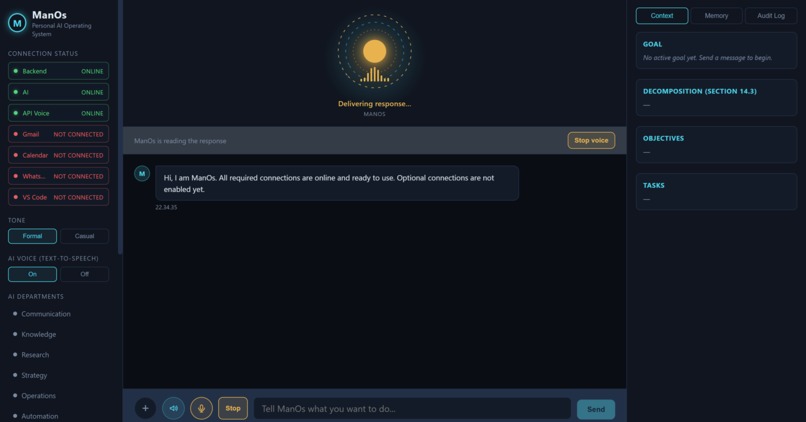
Manos Ui
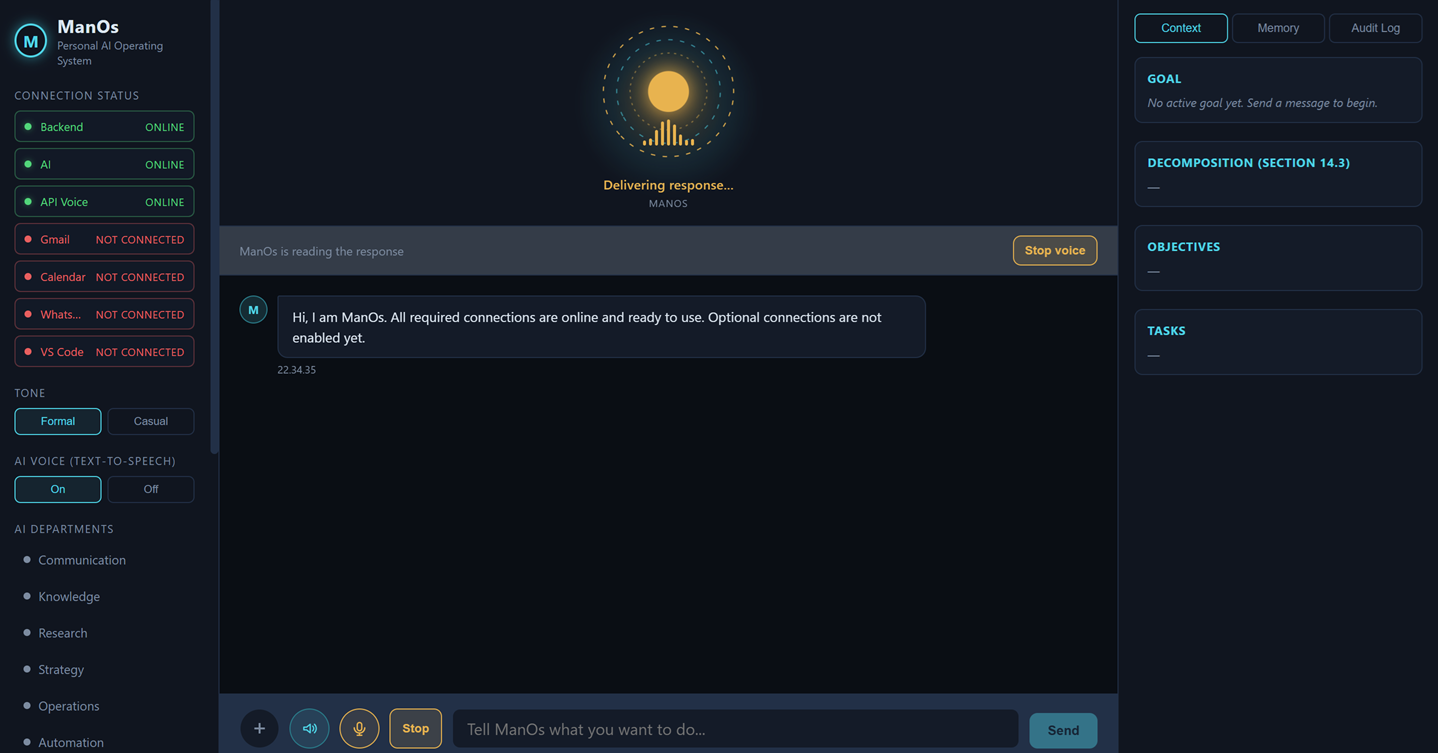
Manos – Your AI Chief of Staff
Inspiration
Large Language Models are excellent at answering questions, but answering is only a small part of real work.
Professionals spend most of their day switching between emails, calendars, documents, messaging apps, browsers, and development tools. Even with AI, users still have to manually connect these steps together.
We wanted to build something different.
Instead of creating another chatbot, we built an AI Chief of Staff—a voice-first agent that understands goals, plans multi-step workflows, asks for approval before sensitive actions, and executes real work across multiple tools.
Our vision is simple:
Talk naturally. Let AI handle the execution.
What it does
Manos transforms natural conversations into completed tasks.
Users simply describe what they want, and Manos:
- Understands the user's intent
- Breaks complex goals into executable subtasks
- Determines which tools are required
- Generates an execution plan
- Requests approval before external actions
- Executes the workflow
- Maintains conversation context throughout the process
Examples include:
- Managing emails
- Creating presentations
- Organizing files
- Generating documents
- Executing coding tasks
- Planning multi-step projects
- Orchestrating multiple AI tools from a single conversation
Rather than responding with text alone, Manos focuses on completing objectives.
How we built it
Manos is built around GPT-5.6 and Codex as its reasoning and execution engine.
The architecture consists of several coordinated components:
- Voice Input Layer
- Intent Understanding
- Planning Engine
- Task Decomposition
- Secure Approval Workflow
- Tool Router
- Memory Layer
- Execution Engine
GPT-5.6 provides high-level reasoning, planning, and decision making, while Codex powers software engineering tasks such as code generation, debugging, and implementation.
The backend coordinates multiple tools and services to complete real-world workflows while maintaining user control through approval checkpoints.
Challenges we ran into
Building an AI agent proved very different from building a chatbot.
Some of the biggest challenges included:
- Determining when the assistant should execute versus ask for clarification.
- Preventing accidental execution of sensitive actions.
- Designing reliable multi-step task planning.
- Coordinating reasoning across different tools.
- Creating a natural voice-first experience instead of a traditional chat interface.
Balancing autonomy with safety became one of the most important design decisions throughout the project.
Accomplishments that we're proud of
We're especially proud that Manos goes beyond question answering.
Instead, it acts as an AI coworker capable of understanding objectives and driving them toward completion.
Key achievements include:
- Voice-first interaction
- Multi-step autonomous planning
- Secure approval-based execution
- Real-world tool orchestration
- Modular agent architecture
- GPT-5.6 reasoning combined with Codex execution
We believe this creates a significantly more practical AI experience for everyday professional work.
What we learned
This project reinforced an important lesson:
Large language models alone are not enough to build capable AI agents.
Reliable agents require:
- Planning
- Memory
- Tool orchestration
- Safety mechanisms
- Human approval
- Continuous execution
Building these surrounding systems is just as important as choosing the right model.
What's next for Manos
This prototype is only the beginning.
Our roadmap includes:
- Mobile-first experience
- Continuous background execution
- Enterprise integrations
- Calendar and productivity automation
- Multi-agent collaboration
- Long-term memory
- Personal knowledge graph
- Enterprise deployment
- Team collaboration features
Our long-term vision is to make Manos an AI Chief of Staff that professionals can trust to transform conversations into completed work.
Built With
- agents
- ai
- api
- codex
- docker
- engineering
- fastapi
- github
- gpt-5.6
- llm
- node.js
- oauth
- openai
- postgresql
- prompt
- python
- rag
- react
- rest
- speech-to-text
- sqlite
- text-to-speech
- typescript
- voice
- websocket

Log in or sign up for Devpost to join the conversation.