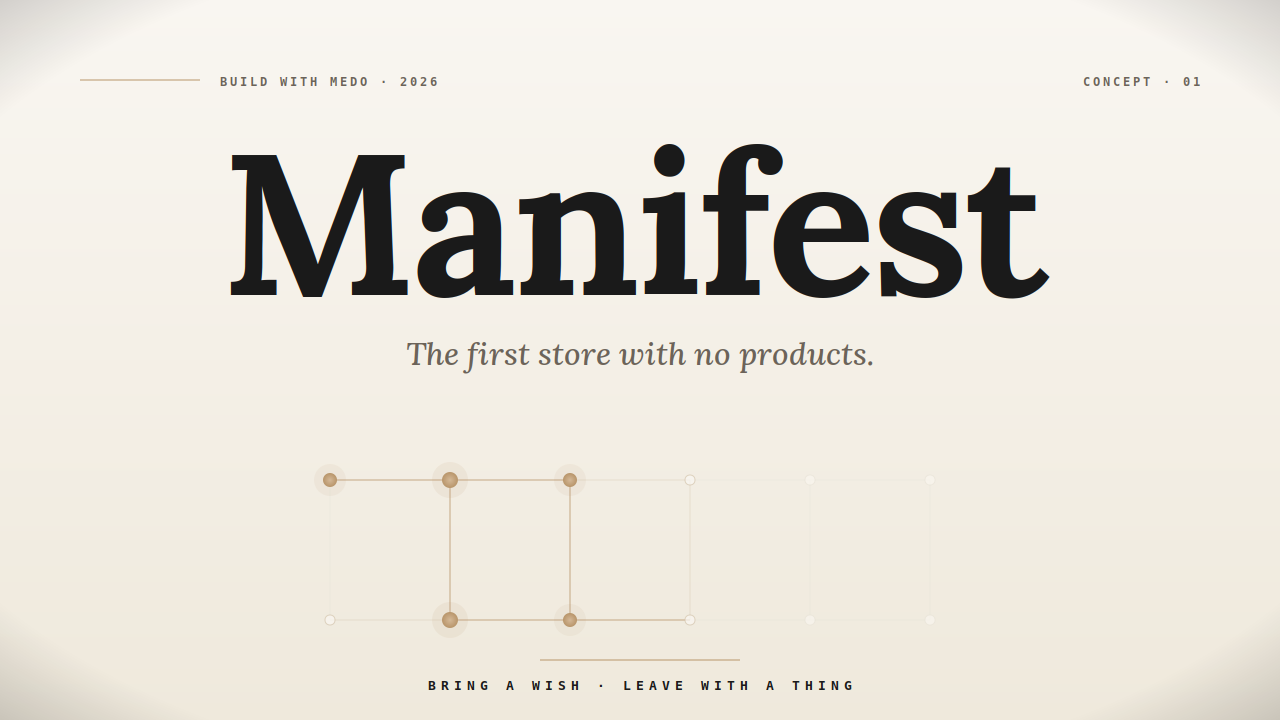
Every product on Earth was once a wish.
MANIFEST connects the wires.
The lie we all agreed to
For two thousand years, commerce worked exactly one way: sellers show you what they have, and you choose from their shelf. Browse. Search. Filter. Compare. The internet didn't change this — it just made the shelf infinite. Every e-commerce platform on Earth — Shopify, Amazon, Etsy, Faire — is the same metaphor, scaled up.
We've never tried the opposite.
What if a store had no catalog at all? What if you didn't browse products — you described what you actually wanted, and the right thing was commissioned for you, in real time, by a real human, on the other side of the world?
That's MANIFEST.
What it does
MANIFEST is a wish-based commerce platform. There are no products on the homepage. No categories. No search bar. There is one empty page and one word: Wish.
You speak a context. A person. A feeling. A problem.
"A gift for my sister who just moved into her first apartment after a breakup. She loves ceramics and hates anything too colorful."
"My grandfather is turning ninety. He doesn't want anything. I want to give him something he doesn't know he wants."
"A jacket like the one my dad wore in 1986 but waterproof."
The moment you submit, twelve AI agents ignite — visible on screen as a soft constellation of light. They decompose your wish into its emotional core. They scout makers across the world. They reject the obvious answers. They negotiate price and timeline. They commission three custom objects, on the spot, from real artisans whose craft, taste, and capacity fit your wish.
Within sixty seconds, three made-for-you proposals materialize:
- A hand-bound leather journal from a bookbinder in Bologna
- A stoneware vessel from a ceramicist in Lisbon
- A brass cuff with the date stamped in morse code from a metalsmith in Oregon
Each has a real price, a real timeline, a real maker. You choose one. You commission it.
Then the maker writes back — in voice, by name — and the wait begins.
Inspiration
The idea started with a single observation: every gift I've ever loved giving was something I imagined first, then searched for. The search never quite found it. I'd settle. Compromise. Buy something close enough.
Online commerce treats every customer as a generalized demand for a generalized supply. But human want isn't generalized. It's hyper-specific, emotionally loaded, often unspoken. The thing you actually want is rarely already made — and there's no infrastructure to ask for it to be made.
We realized AI agents could finally be that infrastructure. Not as a shopping assistant. Not as a search engine. As a translation layer between intent and craft.
MANIFEST is what happens when you put the wish in front of the catalog, and the catalog vanishes.
How we built it
MANIFEST is a full-stack agentic application built on top of MeDo as the multi-agent orchestration backbone, with Supabase for data, auth, edge functions, and storage, and Gemini 2.5 Flash as the LLM brain across all reasoning agents.
The agent pipeline is the heart of the product. When a wish arrives, the system fires five distinct AI agent roles in sequence, each with its own system prompt, temperature, and output schema:
- Brief Decomposer — reads the raw wish and extracts hidden structure: emotional core, recipient, occasion, craft hints, tone register, surprise directives. Returns strict JSON.
- Maker Scout — queries our maker network with the decomposed brief, scoring candidates by craft, style, and capacity.
- Aesthetic Judge — receives five candidates and picks three, rejecting the obvious answers in favor of ones that subvert expectation in the right way.
- Materializer (called 3×) — commissions one custom object per chosen maker. Returns product name, image prompt, materials, rationale, price, lead time.
- Maker Message Generator — after order, writes a personal note from the artisan and converts it to voice via TTS, in the maker's regional accent.
In parallel, twelve agent traces stream into the UI to visualize the orchestration as a living constellation: Brief Decomposer, Cultural Context, Maker Scout, Materials, Aesthetic Judge, Price Negotiator, Timeline, Backup Options, Cross-Vendor Bidding, Memory Weaver, Personalization, Quality Auditor.
Product images are generated on demand through Gemini's image-generation endpoint. Orders run through Stripe (test mode). Maker voice messages are synthesized through Gemini TTS and persisted to Supabase storage.
The frontend is React + TypeScript + Tailwind, designed around an "empty room maximalism" aesthetic: cream backgrounds, humanist serif typography, a single gold accent color, generous negative space, no spinners, no progress bars — the agent constellation is the loading state.
Challenges we ran into
The silent JSON-parsing bug. The earliest version of the agent pipeline had a regex that quietly broke whenever an LLM returned a JSON array (the Aesthetic Judge's expected format). It would catch the parse failure, fall back to a non-AI ranking, and produce generic results — without leaving any trace. We rebuilt the JSON extractor with a bracket-depth walker, added Gemini's structured-output JSON mode, lowered temperatures on parsing-critical agents from 0.7 to 0.3–0.4, and added explicit fallback-logging to the trace table so every silent failure became visible.
Calibrating taste. Early Materializer outputs were technically correct but emotionally generic — "Custom Ceramic Vase by Kenji Mori." The whole product depends on the proposals feeling surprising and specific. We tightened the Materializer system prompt to demand evocative product names (5–8 words, no generic placeholders) and grounded rationales (must reference a specific detail from the original wish). The shift was dramatic. "Custom Ceramic Vase" became "The Quiet Vessel for a New Beginning."
Designing the constellation. A loading state can't look like a loading state. We iterated through five visual versions — radial cluster, spiral, force-directed graph — before landing on a 2×6 grid that reads as deliberate and typeset rather than chaotic. Active nodes pulse with a soft gold glow; inactive nodes sit at 0.5 opacity. The eye is drawn to the sequence of fired agents, not to all twelve at once.
Making the maker feel real. The hardest emotional moment in the whole product is the post-order maker message. If it feels AI-generated, the magic collapses. We tuned the Maker Message Generator to write in the artisan's first-person voice, reference one specific detail from the wish, state the lead time honestly, and avoid the words "honored," "privileged," "journey," and exclamation marks. The result reads like a real working craftsperson sent a real email.
Accomplishments we're proud of
- A category redefinition, not a feature. MANIFEST is not "AI on top of commerce." It's a new metaphor — post-catalog commerce — built end-to-end in one sprint.
- Twelve concurrent AI agent roles orchestrated through MeDo, with proper JSON schemas, temperature tuning, fallback-logging, and complete observability.
- Real two-sided architecture. The maker network, the agent-mediated commissioning, Stripe checkout, and the maker voice message are all wired into a coherent end-to-end flow.
- A cinematic, identifiable visual signature. The empty-room aesthetic and the living constellation are unlike anything else in the e-commerce category.
- Genuine emotional impact in the demo. The post-order maker message — the moment Andrea writes back about your grandfather — has made testers pause for a beat. That pause is the thing we built the entire product to create.
What we learned
Aesthetic is architecture. Half the project's distinctiveness comes from refusing to look like a SaaS dashboard. Banning the word "search," forbidding spinners, picking the serif before picking the framework — these weren't decorative choices, they were structural ones.
Silent fallbacks are the most expensive bug. Catching errors and degrading gracefully feels responsible, but if the user can't tell the agent failed, the whole product silently rots. Every fallback in MANIFEST now logs to the trace table — failure made visible is failure that can be fixed.
Specificity is the moat in agentic UX. Generic LLM output is what 90% of agentic apps will look like. The Materializer + Aesthetic Judge prompts spend more tokens on what to refuse than on what to produce. That's where the taste lives.
Slow commerce is a feature. Six-week lead times sound like a liability. In MANIFEST they're a romance — the anticipation, the maker's progress photos, the actual arrival. We stopped fighting the wait and started staging it.
What's next for MANIFEST
- Onboard the first 50 makers to the real network — bookbinders, ceramicists, metalsmiths, woodworkers, embroiderers — across six regions.
- Open the maker side — a lightweight PWA where artisans receive briefs, set autonomy rules for their agent, accept or reject bids in their own voice.
- Memory layer. Wishes accumulate. Two years from now, MANIFEST should know what you've given, who you give to, what worked, what didn't — and use it to make the next wish more precise.
- Verticals. Parallel Us for couples planning wedding gifts. Parallel Them for memorial commissions of those we've lost. Parallel Career for corporate gifting that doesn't feel corporate.
- The end state. A Stripe-scale infrastructure layer for agent-mediated bespoke commerce — every commissioned object on the internet, mediated by intelligence, fulfilled by hands.
Every product on Earth was once a wish.
We just built the wires.
Built With
- agentic-commerce
- deno
- gemini
- gemini-2.5-flash
- google-ai
- image-generation
- llm
- medo
- medodev
- multi-agent-ai
- postgresql
- react
- shadcn-ui
- stripe
- supabase
- supabase-edge-functions
- tailwindcss
- text-to-speech
- typescript
- vite

Log in or sign up for Devpost to join the conversation.