Inspiration
Malaysia has a rich mix of languages and slang, but non-locals or even Malaysians sometimes struggle to understand colloquial Manglish. The project aims to bridge that gap, making informal Malaysian English understandable across languages and contexts.
What it does
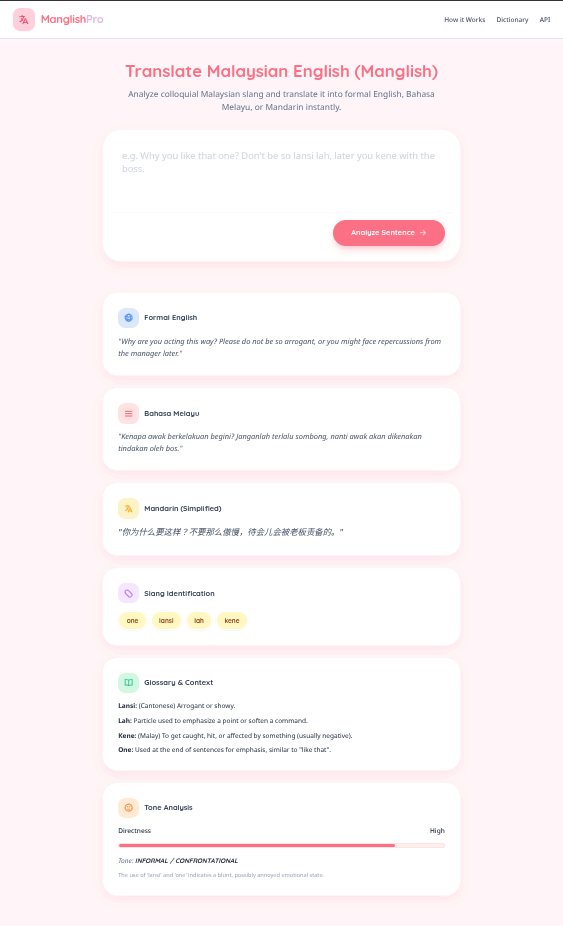
Manglish Pro translates colloquial Malaysian English (Manglish) into formal English, Bahasa Melayu, or Mandarin. It also identifies slang words, explains their meanings, and analyzes the tone of the sentence. Users can input any sentence, and the platform returns a full contextual translation and insights.
How we built it
- Frontend: HTML, Tailwind CSS, and JavaScript for a clean, interactive interface.
- Backend: Python with FastAPI serving API endpoints.
- AI Integration: Google Gemini AI API for translation, slang identification, and tone analysis.
- Data Storage: JSON files for slang glossary and context information.
- Hosting / Deployment: Render / Railway / Vercel for easy cloud deployment.
- Version Control: Git & GitHub with SSH access for secure collaboration.
Challenges we ran into
- Understanding Manglish’s mixed grammar and slang nuances.
- Integrating AI API responses dynamically into a web interface.
- Handling multiple translations and tone detection without overloading the backend.
Accomplishments that we're proud of
- Fully functional, user-friendly web platform that handles real-time translations.
- Slang glossary and tone analysis features that provide cultural context, not just literal translation.
- Maintaining the original UI design while integrating dynamic AI responses.
What we learned
- Handling multilingual NLP with slang and informal phrasing is complex but feasible with AI APIs.
- FastAPI and Uvicorn provide a lightweight, fast backend for web projects.
- Clean, modern UI with Tailwind improves usability and makes AI outputs readable.
What's next for Manglish Translator
- Add user accounts to save translation history.
- Expand slang glossary dynamically from user input.
- Deploy a mobile-friendly version for on-the-go translations.
- Implement offline caching for common phrases to reduce API calls.

Log in or sign up for Devpost to join the conversation.