-
-
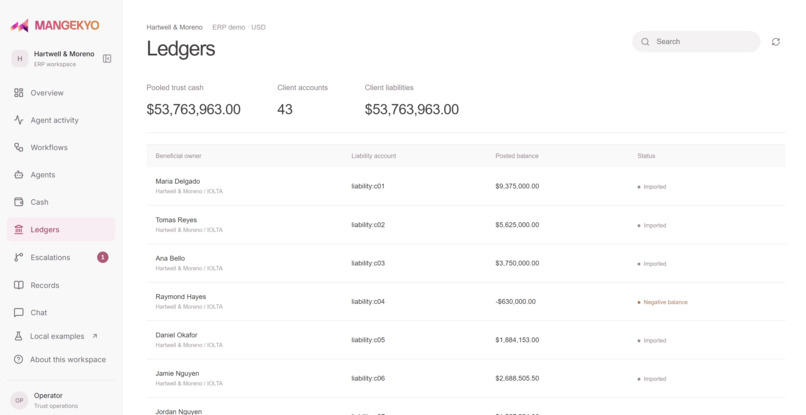
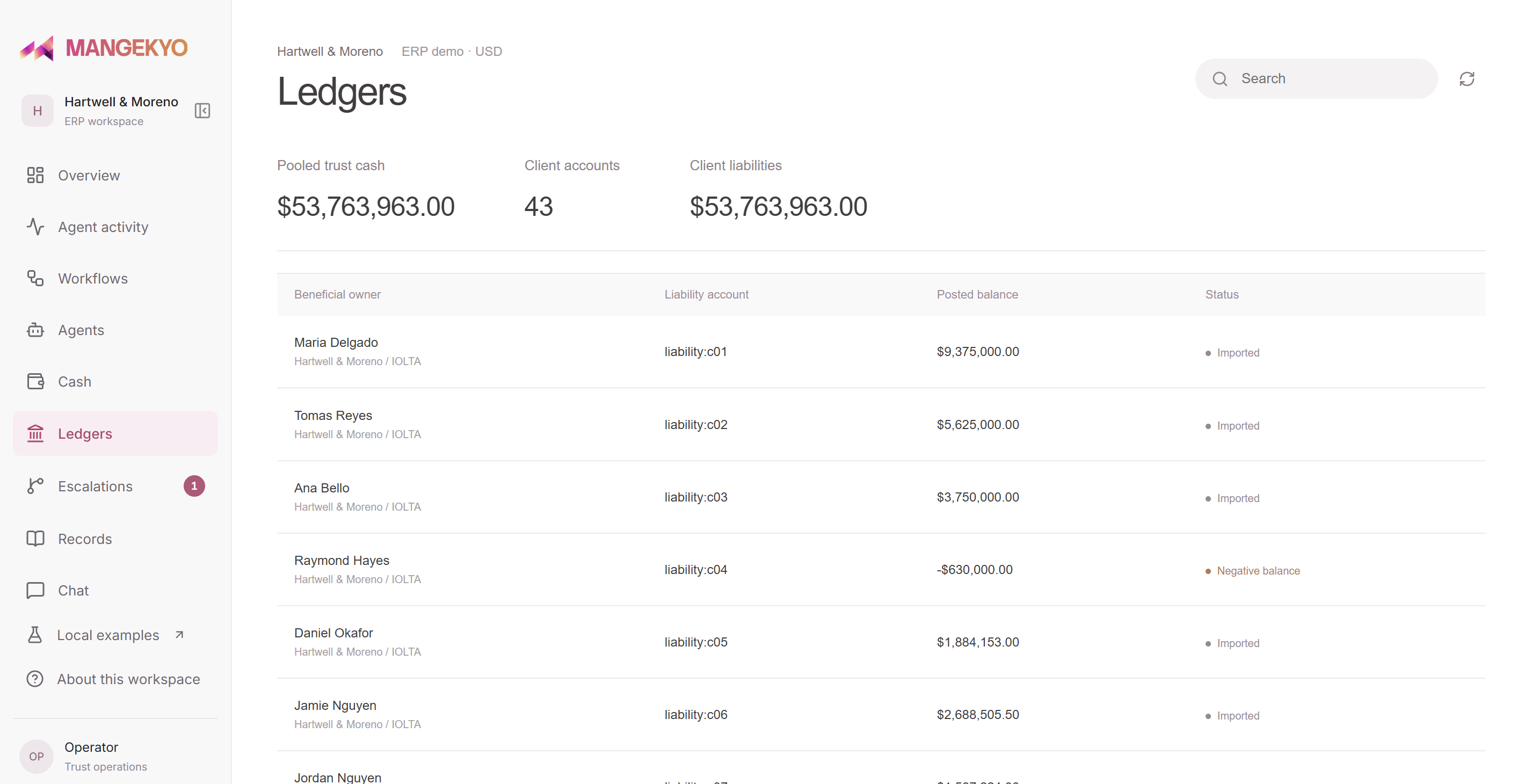
Ledgers
-
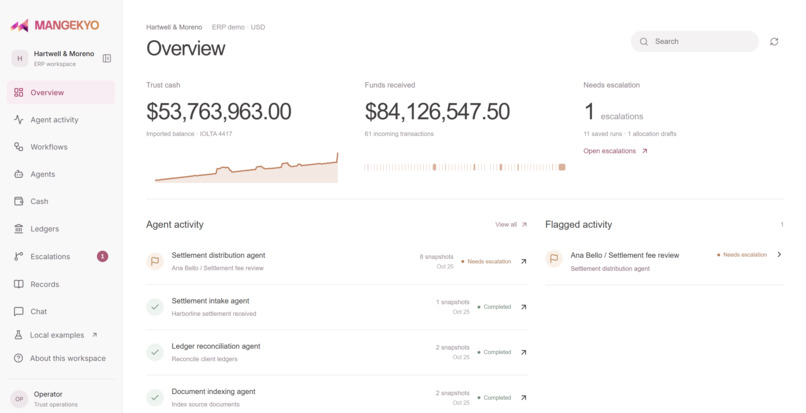
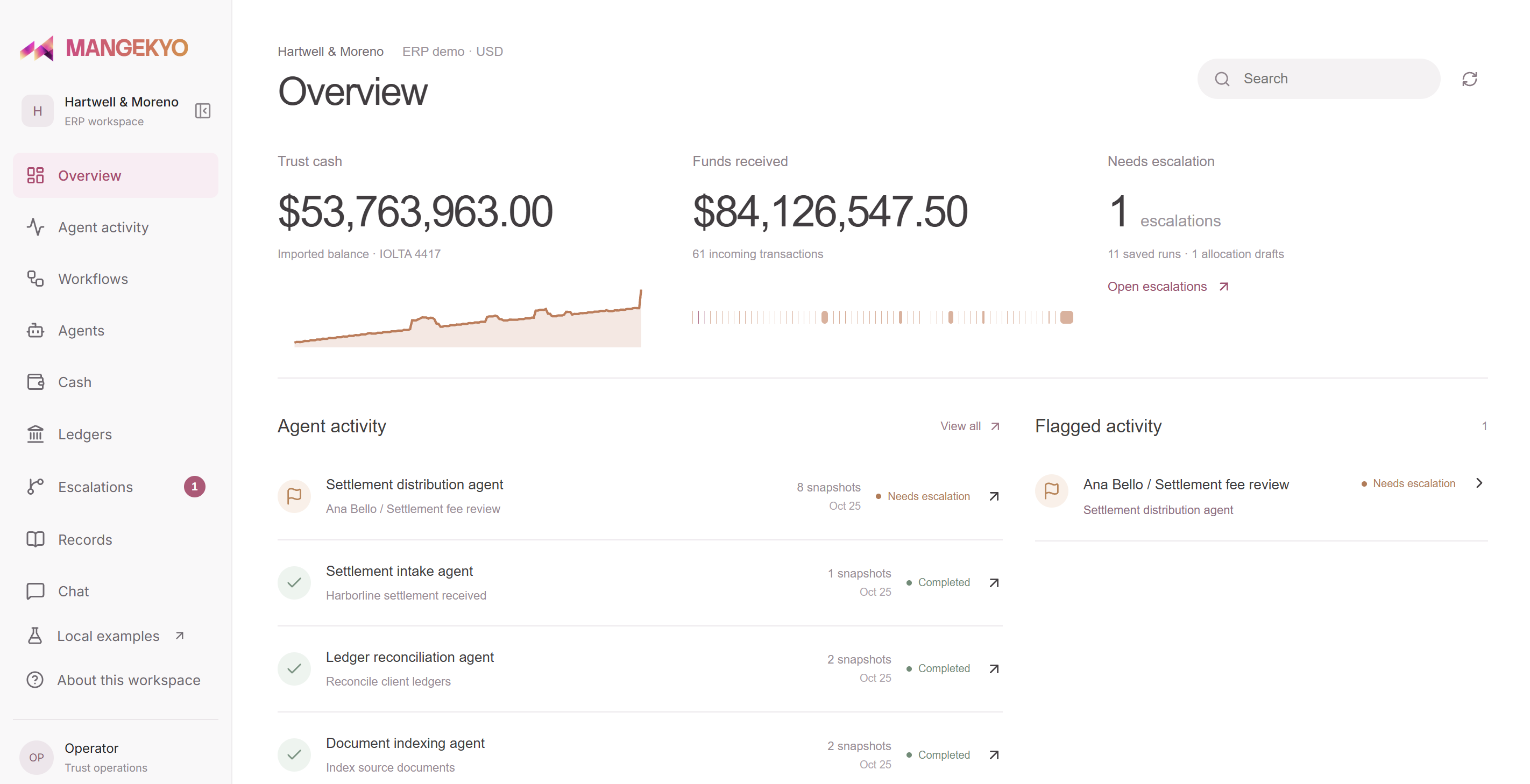
Overview/Agent Activity
-
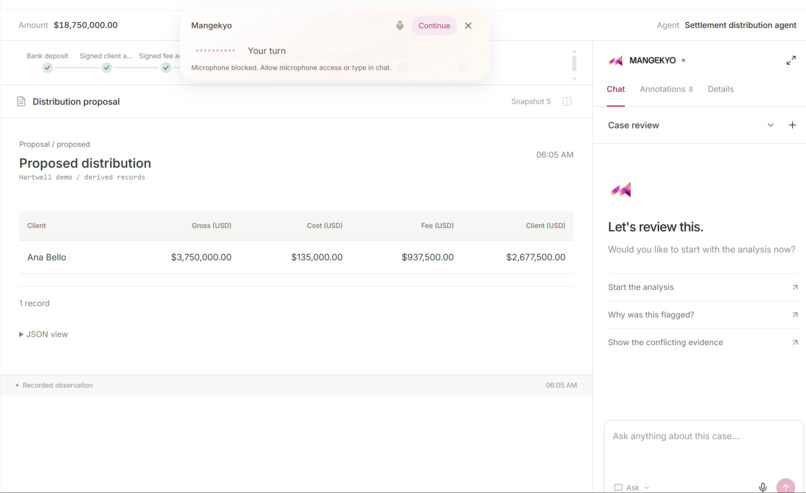
Database Read - Escalation
-
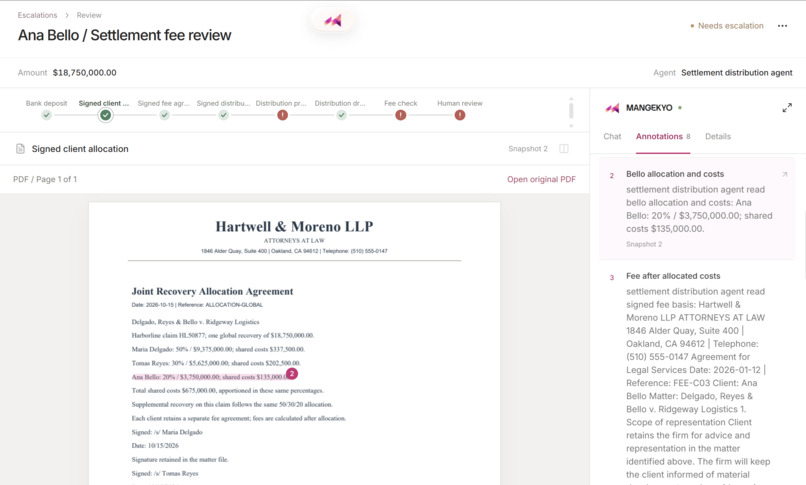
Document Snapshot - Escalation
-

Snapshot Graph
-
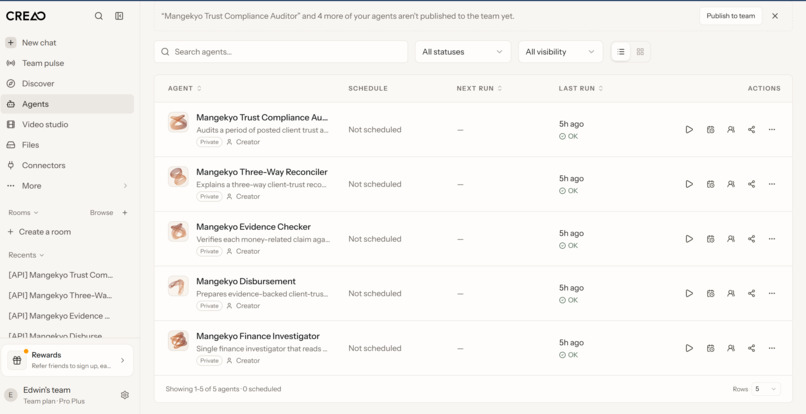
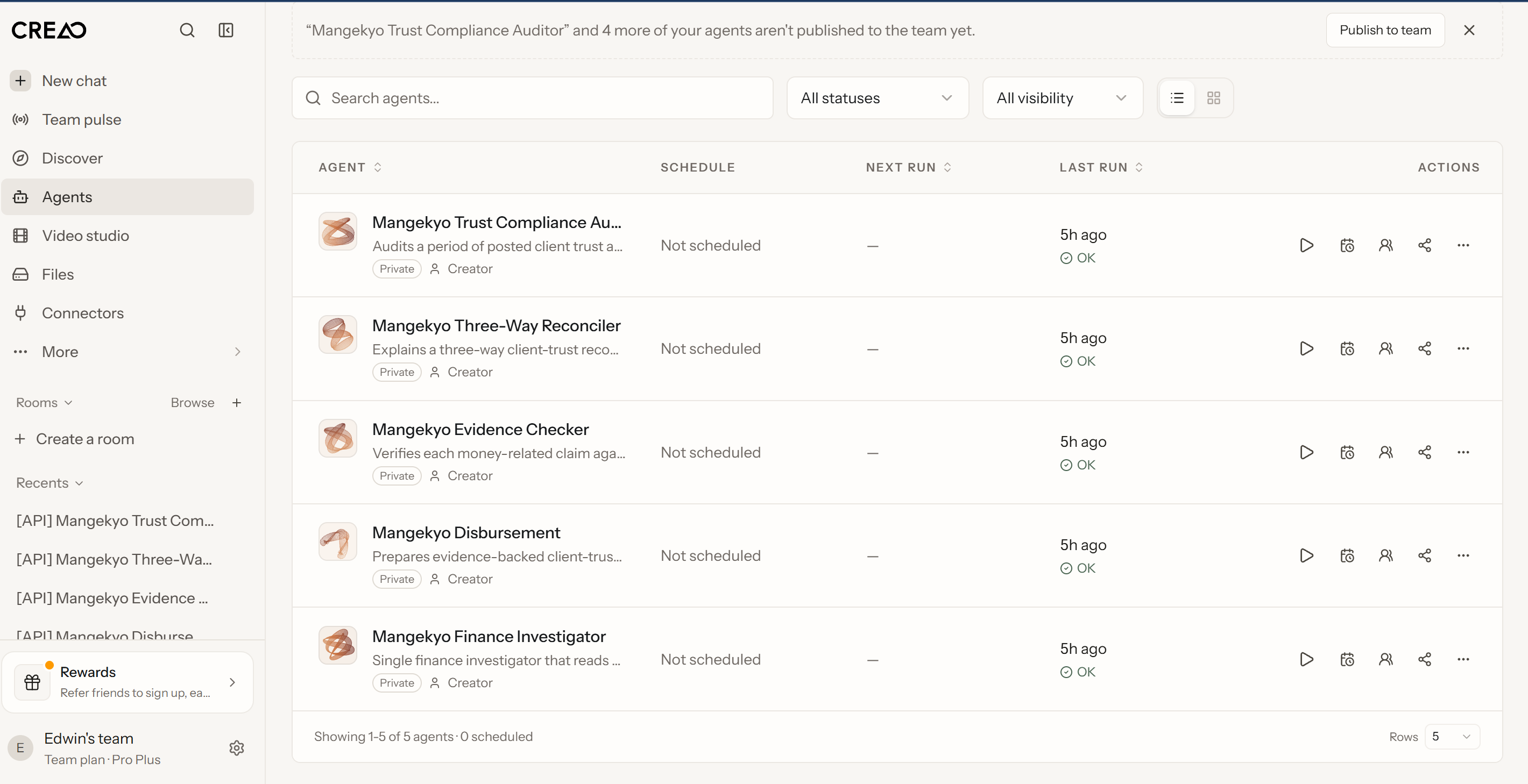
Creao agents

Inspiration
In 2024, Synapse Financial Technologies collapsed, leaving consumers unable to access their money and exposing an estimated $60–90 million shortfall. The crisis revealed a fundamental problem: knowing how much money is in an account doesn't necessarily mean knowing who owns it.
For businesses managing client funds, such as law firms and custodial platforms, even small accounting errors can have serious consequences. As autonomous AI agents take on these financial operations, auditability becomes far more crucial. How can we trust their decisions if we can't see what they actually read, interpreted, or changed?
That's why we built Mangekyo, a platform with a visual auditing agent that introduces Git-like version control for agent context. By capturing agent observations and decisions as snapshots, Mangekyo lets humans trace errors to specific checkpoints, inspect the underlying evidence, and steer agents onto corrected execution branches without losing the original history.
Validated corrections can also be saved as agent memory, helping improve future runs.
P.S. Mangekyo is named after Naruto's Mangekyō Sharingan. Just as the eye grants extraordinary visual abilities, our agent gives humans eyes into autonomous AI workflows.
What it does
Mangekyo is an autonomous trust-account management platform combining specialized financial agents with an independent visual auditing agent.
Businesses connect their existing ERP systems, allowing Mangekyo to ingest financial records, client agreements, invoices, and supporting documents. Our multi-agent orchestration system automatically generates and assigns tasks for:
- Document processing: Extracting and interpreting financial records.
- Fund ownership verification: Ensuring client funds are correctly allocated.
- Three-way reconciliation: Matching bank balances, accounting records, and individual client balances.
- Independent verification: Cross-checking financial proposals across specialized agents.
- Compliance and corrections: Detecting discrepancies, enforcing financial controls, and preparing corrections.
These tasks run autonomously, reducing manual bookkeeping, repetitive checks, and operational overhead for trust finance teams.
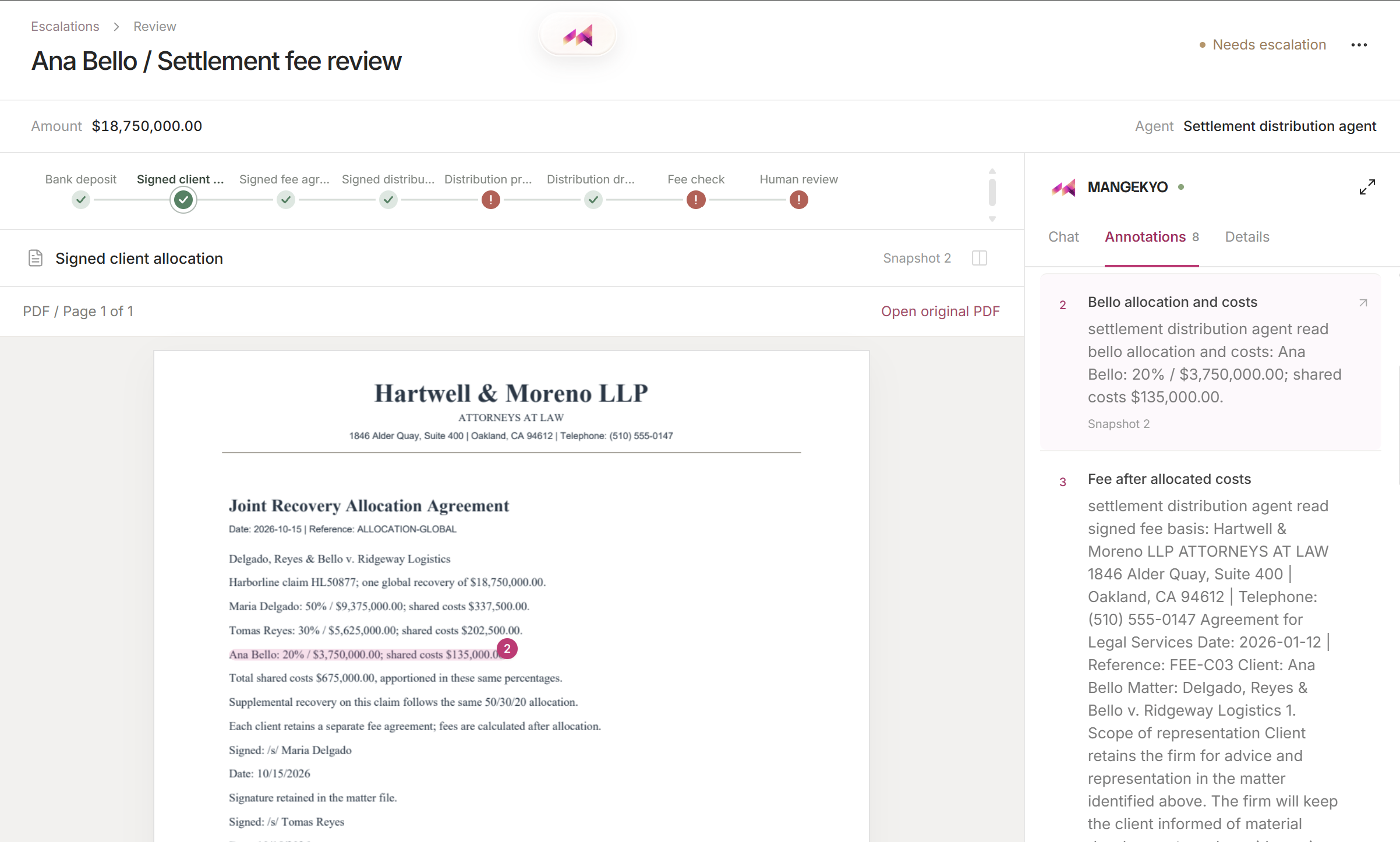
Simultaneously, the Mangekyo agent independently monitors tasked agents, capturing screenshots, PDF parsing, and database reads and writes in a Git-like visual execution history.
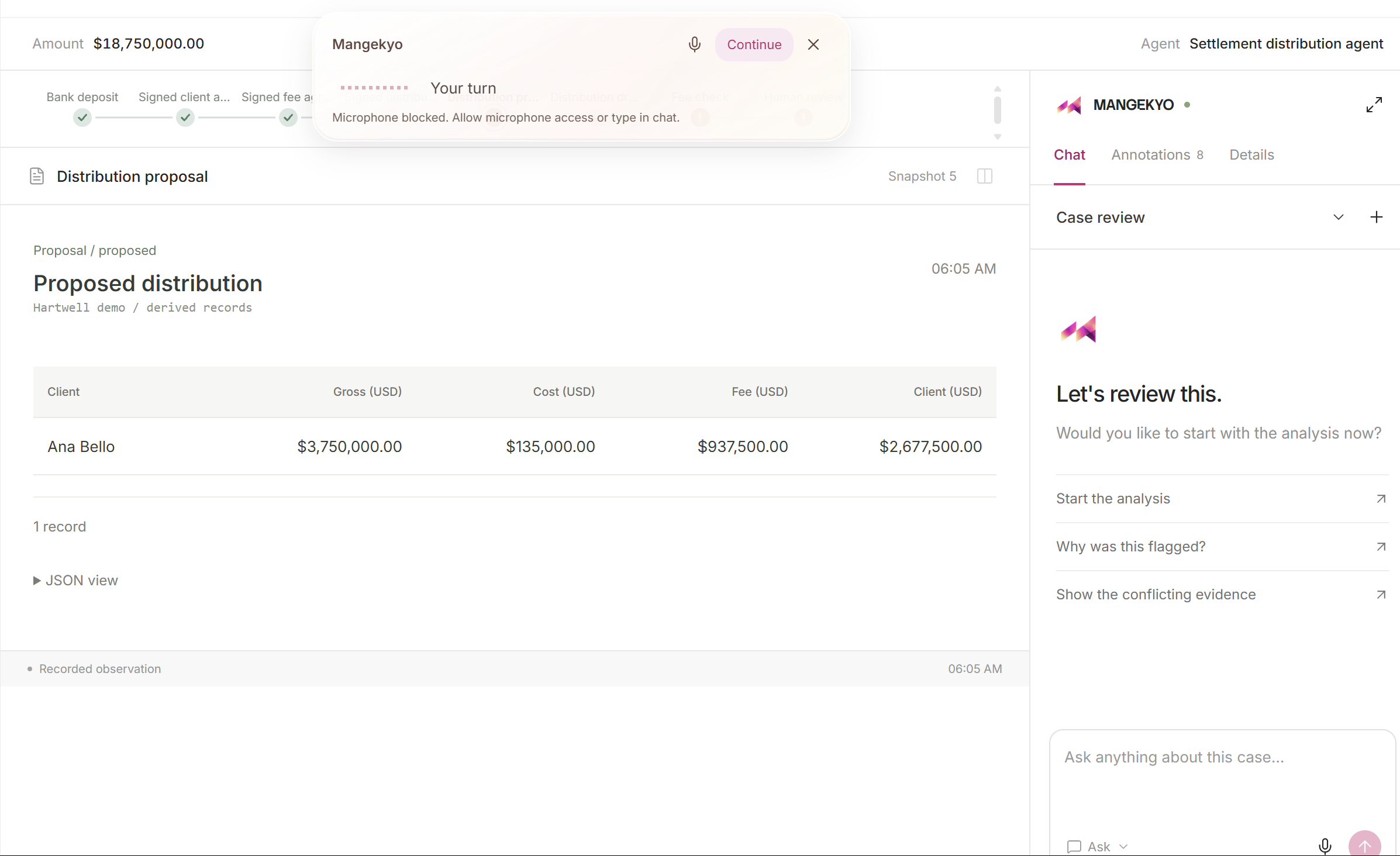
When conflicting evidence triggers an escalation, humans can trace the agent's workflow through annotated snapshots, inspect the exact source of disagreement, and investigate through voice or chat.
Reviewers can then steer the tasked agent from a specific snapshot, creating a corrected execution branch while preserving the original history.
Each validated correction can become targeted fine-tuning data and versioned agent memory, enabling continuous improvement from real execution failures.
How we built it
Mangekyo consists of two connected systems: an autonomous finance system that manages trust-account operations and an independent visual auditing agent that monitors execution, detects discrepancies, and enables human intervention.
Autonomous Finance System
We designed a multi-agent architecture that distributes financial responsibilities across specialized agents:
- Agent orchestration: We used CREAO to build and coordinate specialized agents for autonomous financial workflows.
- Specialized agents: We used a variety of models (Gemini, Claude, and ChatGPT) to handle document intake, ownership matching, independent verification, reconciliation, and compliance.
- Financial controls: We validate agent proposals against financial records, permissions, and deterministic accounting rules using the Mangekyo agent and human-in-the-loop review for flagged misalignment events.
- ERP integration: We connect client companies to our platform through ERP integrations that link financial records, client agreements, ledgers, and supporting documents to agent workflows.
- Application and backend: We built Mangekyo with Next.js, React, TypeScript, and Tailwind CSS, using Convex for real-time synchronization, task management, and persistent financial records.
- Testing: We synthesized an ERP sandbox that performs actual local document and database reads, captures screenshots, and saves financial drafts.
Mangekyo Visual Auditing Agent
We built a separate auditing system that captures and traces what tasked agents observe and do.
- Visual capture: We used Playwright and Chromium to record browser interactions, screenshots, document parsing, and execution events.
- Git-like agent context: We organize observations into versioned snapshots and a navigable execution graph.
- Interactive auditing UI: Built with React Flow, allowing reviewers to inspect screenshots and annotated evidence.
- Conversational investigation: We used Claude for chat and Fish Audio to generate text-to-speech that human reviewers can interact with during the auditing process.
- Agent improvement: Convex was used to store validated corrections as versioned memory and fine-tuning data for future runs of the same agent.
Challenges
Multi-agent system: Coordinating specialized financial agents with independent responsibilities, shared data, and consistent task execution.
Making it feel real: Building a realistic ERP sandbox that supports actual document reads, database interactions, and financial workflows.
Designing for nontechnical reviewers: Accountants shouldn't need to understand agent frameworks or read technical logs. We prioritized visual evidence, clear annotations, and conversational investigation.
Balancing autonomy and human precision: Determining when agents can complete work independently and when conflicting evidence requires human intervention.
Correcting agents without compromising financial controls: Agent workflows can be rerun, but completed financial transactions cannot simply be undone. Our steering system preserves original execution history while enforcing financial authorization boundaries.
Accomplishments
Creating a visual experience that truly connects: Built an intuitive, evidence-first auditing interface that makes autonomous agent execution easier to understand. This became our key demo moment.
Git-like agent memory: Developed an interactive snapshot graph that preserves execution history and supports corrected branches.
Human-in-the-loop steering: Enabled reviewers to investigate escalations, provide corrective instructions, and rerun affected tasks without losing the original history.
Conversational investigation: Integrated chat, text-to-speech, and evidence-linked annotations to help reviewers understand errors without reading technical logs.
Synthetic ERP demonstration: Built an end-to-end local workflow that identifies a $33,750 trust-account discrepancy, escalates it, and produces a corrected financial draft with an audit trail.
Agent self-improvement: Developed versioned memory workflows that turn validated corrections into reusable context and potential fine-tuning data for future agent runs.
Lessons we learned
Balanced accounts don't guarantee correct payments: Three-way reconciliation alone cannot verify every contractual entitlement. Our Hartwell scenario showed how an incorrect fee calculation could misallocate $33,750 despite established settlement ownership.
Independent verification is essential: Agents should not approve their own financial proposals. Separating decision-making, independent checking, and deterministic financial controls helps prevent unsupported actions.
Visual evidence beats raw logs: Highlighting the exact document fields behind a decision makes errors easier for human reviewers to understand and investigate.
Corrections should preserve history: Steering an agent should create a traceable new execution branch, not erase the original mistake or its supporting evidence.
Self-improvement requires validation: Human corrections can become valuable agent memory and targeted fine-tuning data, but lessons must be verified, scoped, and approved before reuse.
What's next
Our next goal is to complete the integration between the autonomous finance core and Mangekyo's visual auditing agent.
We plan to expand the system with:
- Additional ERP integrations
- Broader autonomous trust-account workflows
- Live monitoring across multiple specialized agents
- More advanced cross-document auditing
- Persistent, approved agent memory
- Stronger compliance and authorization controls
We are also developing Mangekyo TrustBench, a benchmark suite for evaluating autonomous financial agents on reconciliation accuracy, ownership verification, compliance, discrepancy detection, and recovery from errors.
We want to measure not only whether agents complete financial tasks, but whether they perform those tasks correctly, safely, and with sufficient evidence for human oversight.
Our long-term goal is to make Mangekyo's visual auditing infrastructure reusable across other high-stakes autonomous systems.
Autonomy should not mean losing visibility or control.
Built With
- chromium
- claude-api
- convex
- creao
- fish-audio
- next.js
- node.js
- playwright
- python
- radix-ui
- react
- sqlite
- typescript
- vitest


Log in or sign up for Devpost to join the conversation.