Inspiration
I’m a long-time fan of manga and anime. Recently, like many developers, I’ve been using AI coding tools such as Kiro or Cursor to speed up my workflow. While working with these tools, I suddenly wondered: What if creators had something like Cursor or Kiro, but built specifically for manga and comic creation?
There are countless creative people with amazing ideas and compelling stories, but not everyone can draw. That limitation often prevents great stories from ever becoming full manga. So I thought: Why not let AI handle the artwork so creators can focus entirely on storytelling? That idea became MangaV0.
What it does
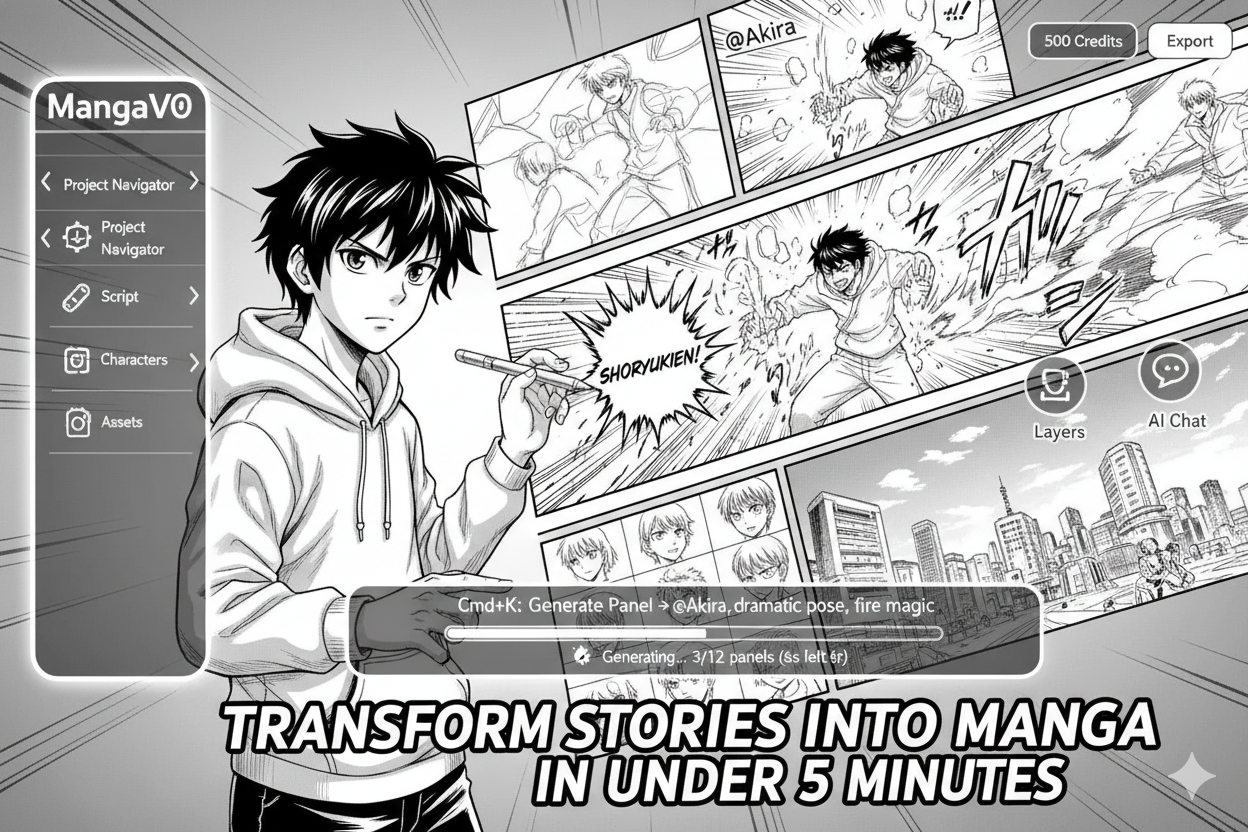
MangaV0 is an AI-powered assistant that helps creators transform their stories into manga pages. You provide the ideas, plot, and descriptions; AI handles panel composition, character visuals, and page generation. The goal is to make manga creation accessible to anyone, no drawing skills required.
How we built it
I started building MangaV0 using Kiro. Its Spec Mode was incredibly helpful at the early stage. After drafting a full requirements document, designing the system, and breaking everything into clear tasks, Kiro generated a fast, clean project setup with all the essential features ready to iterate on. From there, I implemented the manga generation pipeline, character system, image generation prompts, panel orchestration, and performance optimizations.
Challenges we ran into
- Character consistency across pages and panels To keep characters consistent, I first analyzed the story, then generated stable “anchor styles” for each main character. These anchor embeddings are referenced during panel generation, ensuring characters look the same across the entire manga.
- Slow generation due to sequential task processing Initially, all AI tasks ran sequentially, making page generation slow. I had to analyze and reorganize the task graph so unrelated tasks could run in parallel. This significantly improved performance, though there’s still room for optimization.
- High cost when testing with Google Nano Banana models Running multiple experiments quickly became expensive while tuning prompts and workflows.
- Feature completeness MangaV0 is still in early development, and many features remain to be built or refined.
Accomplishments that we're proud of
- Built a functional prototype that can generate full manga pages from story input.
- Achieved character consistency using anchor-style generation.
- Improved generation speed with parallel task processing.
- Designed a scalable pipeline that can later be extended to custom AI models and real-time collaboration.
What we learned
- Story analysis is crucial, not optional. A strong structure upfront leads to more coherent panel generation.
- Anchor-style character generation dramatically improves visual continuity.
- Task orchestration deeply impacts both performance and cost.
- AI tools like Kiro can accelerate development significantly when used well.
- Model testing and prompt tuning can be surprisingly expensive if not carefully managed.
What's next for MangaV0
- Editable manga pages - Allow users to fine-tune, redraw, or adjust AI-generated panels.
- Export & sharing - Easy export to PDF, images, or web formats for publishing or sharing.
- Prompt & task optimization - Faster generation with better quality.
- Custom AI models - Train specialized manga-focused models for style, characters, and layouts.
- Real-time collaboration - Multiple creators creating or editing manga together.
- Creator publishing hub - A platform where artists can publish their manga, let others view, comment, and like their work, or even offer premium paid content.
Built With
- fal
- nextjs
- tailwindcss
- trigger
- vercel


Log in or sign up for Devpost to join the conversation.