Inspiration
A lot of families in Andhra Pradesh go through the same thing after a hospital stay. The patient comes home with a bag of medicines and a discharge summary written entirely in English. The doctor explained everything at the hospital, but once they're home the questions start. Which tablet is for the morning? Is this one before food or after? What symptoms mean we should go back? When is the follow-up?
Usually someone in the family reads the papers and explains them. But often the person who's comfortable with English lives in another city, and the patient ends up working it out over a phone call.
That's the gap we wanted to close. Our starting point was simple: nobody should need to know English to understand their own discharge instructions.
We also didn't want to build another medical chatbot. We wanted something that takes the paperwork the patient already has and turns it into something they can actually read, without letting AI make decisions about their medicines.
What it does
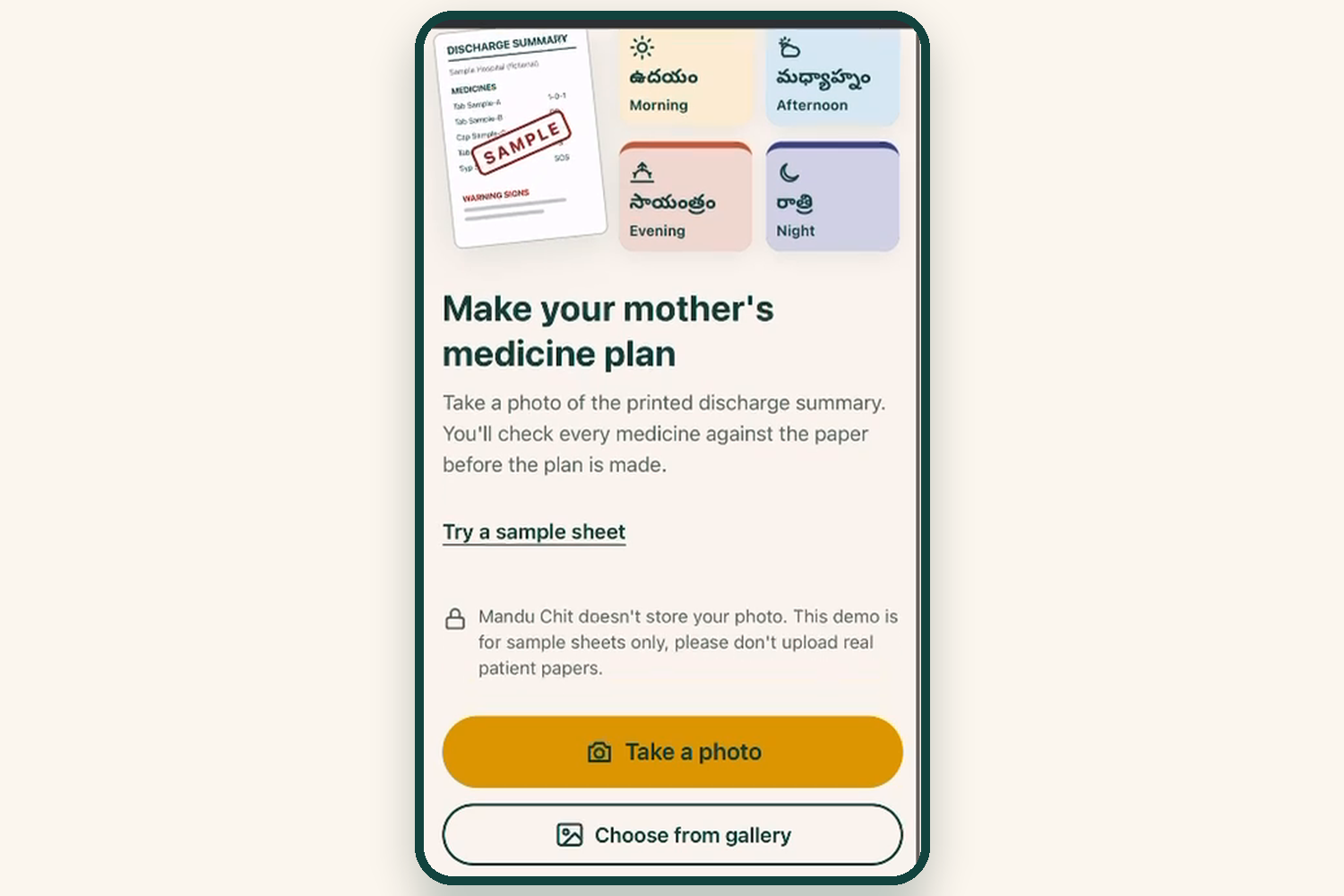
Mandu Chit turns an English discharge summary into a large-print medication and discharge plan in Telugu.
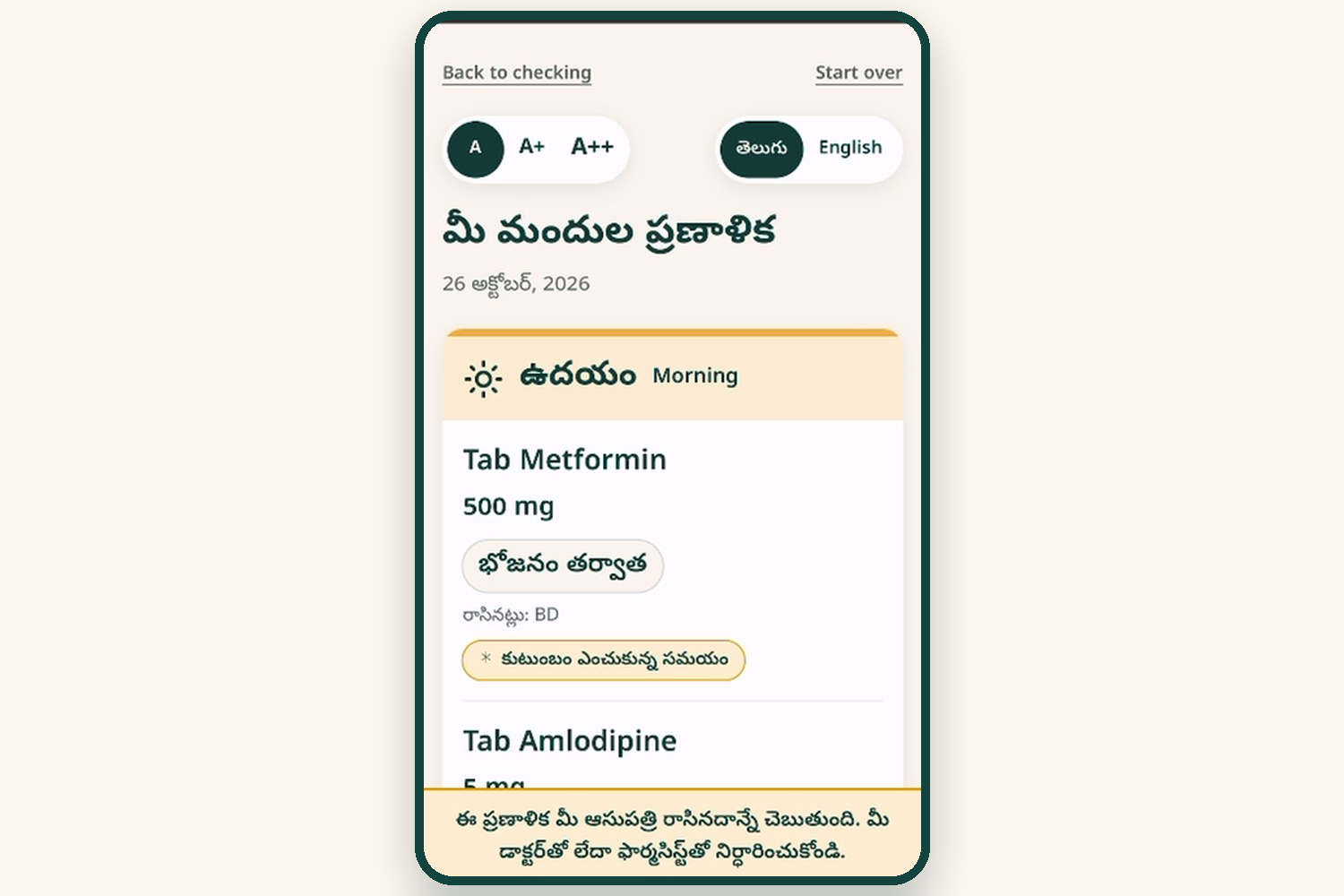
You upload or photograph the summary. The app pulls out the medicines, doses, food instructions, warning signs and follow-up details, translates them into Telugu, and lays them out on four time cards: Morning, Afternoon, Evening and Night. A medicine only goes on a time card if the document actually supports it.
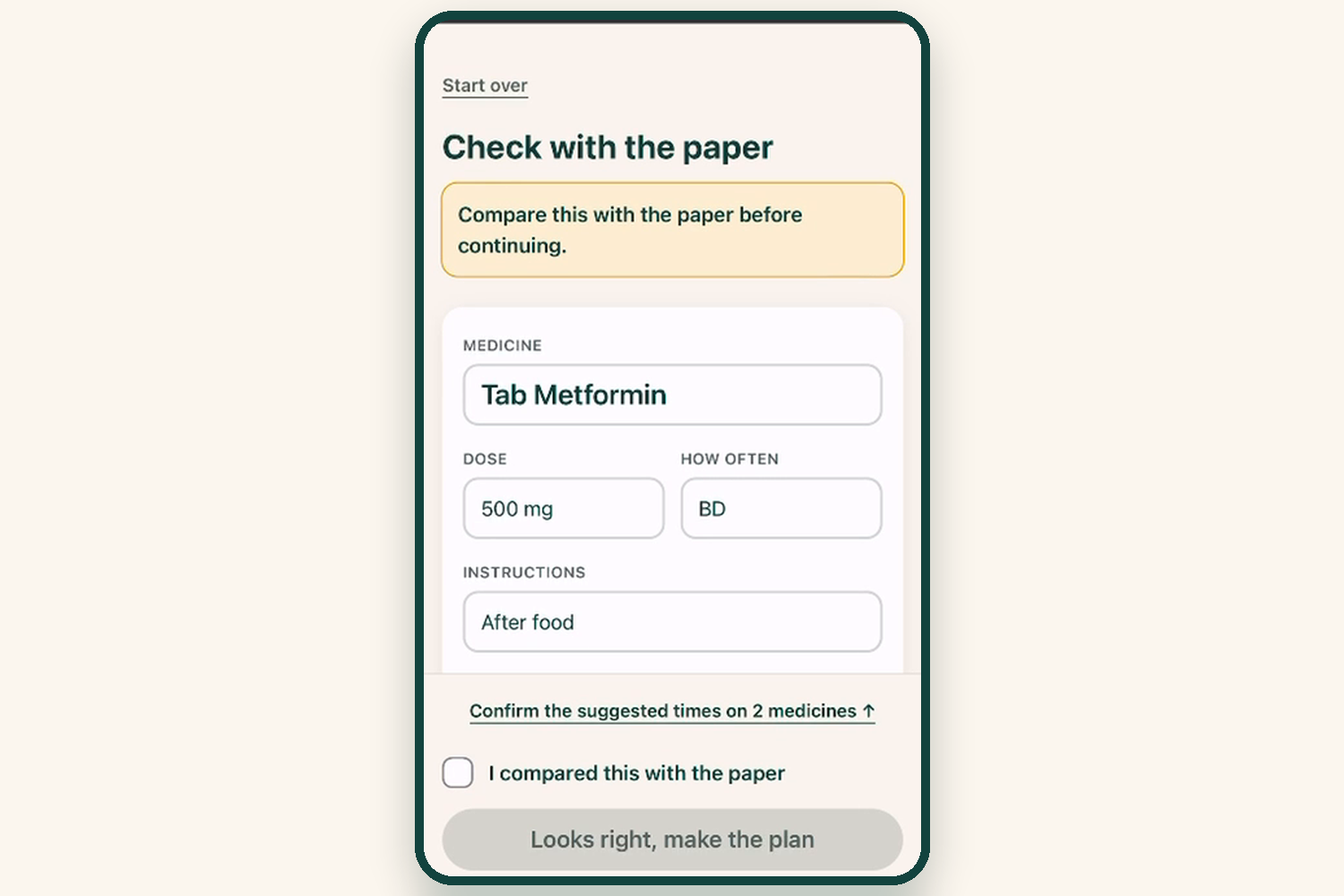
Before the plan is created, a caregiver checks each medicine against the original document and confirms it. If they correct something, the app shows the original next to the corrected version so the change is visible.
When something is missing or unclear, such as a dose with no frequency or a timing that doesn't add up, the app doesn't guess. It flags the item and tells the family to check with a doctor or pharmacist.
The final plan also includes warning signs, precautions and the follow-up date. You can switch between Telugu and English, make the text bigger, print the plan or share it on WhatsApp.
To be clear about what it isn't: Mandu Chit doesn't diagnose, change doses or recommend treatment. It only helps families understand instructions their doctor has already given.
How we built it
We spent time on planning before writing any code. We wrote down who the users are, what the app should and shouldn't do, where the safety lines are, and how each feature should behave. The scope, the PRD and the implementation specs are all in the devpost/ folder. We then built the app in stages from those documents, writing the features, validation rules and tests as we went.
Stack: Next.js, TypeScript, Tailwind CSS, Google Gemini (document reading and Telugu translation), Zod (validation), Vitest (testing) and Vercel (hosting).
The most important design decision was to keep the AI part separate from the medication scheduling. The flow works like this:
- Upload: the user photographs or uploads the discharge summary.
- Extract: Gemini reads the document and pulls out the medicines, warning signs and follow-up details.
- Validate: Zod checks the structure of the output, and a separate check rejects any translation where a number or unit has changed.
- Organize: plain TypeScript rules (no AI) place each medicine on a time card, and only when the instructions clearly support it.
- Flag: anything missing, unclear or contradictory goes into an "Ask your doctor" section.
- Confirm: the caregiver checks each row against the original document.
- Generate: the app creates the Telugu plan, ready to view, print or share.
We wrote the tests for the time-card rules before we wrote the rules themselves. The idea we kept coming back to was: AI reads and translates, regular code organizes, people verify.
We used Claude Code as a coding assistant during development. For the demo video, we used Veo for the opening scene and a synthetic voice for the narration.
Challenges we ran into
Gemini's free tier. We kept running into rate limits and "model overloaded" errors in the middle of processing a document. We added retries, a time limit and clear error messages, so users see what went wrong instead of a screen that never finishes loading.
Slow translations. Some requests took much longer than we'd like. Lowering the model's thinking level and setting a fixed time limit for processing made it much faster.
A small translation change that mattered. While we were comparing models, a lighter model translated "in 1 week" as "after 1 week." It reads almost the same, but for a follow-up appointment that difference matters. This is why we tightened our literal-translation requirements and added the checks on numbers and units. It also showed us that a translation can sound fluent and still be wrong.
Making the confirm step noticeable. The first version of "Tap to confirm" was easy to miss. Since confirmation is the main safety step, we redesigned it so it stands out.
Stale CSS. At one point our style changes weren't appearing because old build files were cached. Clearing the build cache fixed it.
Instructions that named a time but not a frequency. We found cases like "take at night" with no clear number of days or how often to take it. Instead of guessing, we changed the rules to send these to the "Ask" section, and we updated the spec to match.
Accomplishments that we're proud of
We have a working prototype that shows uncertainty instead of hiding it. You can go from uploading a discharge summary to a readable Telugu plan from start to finish, and it's live at mandu-chit.vercel.app.
Specifically, we're proud that:
- Medicine timing is decided by tested, deterministic rules, not by the model.
- Translations are rejected if a number or unit changes.
- Incomplete instructions are flagged instead of filled in.
- Caregivers check everything against the source, and every correction is visible.
- The interface is bilingual, large-print, printable and shareable on WhatsApp.
Above all, we're proud of the question we built around: how do you use AI to make medical instructions easier to understand without letting it quietly change them?
What we learned
Small wording changes around timing, dose or frequency can make a real difference in healthcare, even when the translation sounds natural.
Planning before coding helped a lot. Having the PRD and specs written down kept us focused, and when requirements changed we could see exactly what changed. Writing tests before the scheduling rules made us think about edge cases like missing frequencies much earlier than we otherwise would have.
We also learned that a safety feature only helps if people notice it. The confirm button showed us that.
And we learned that "please check with your doctor or pharmacist" is often a better answer than a confident guess.
Privacy, safety and limitations
Mandu Chit is a prototype. It isn't a clinically validated medical device and doesn't replace professional medical advice.
- The demo uses made-up discharge summaries, not real patient records.
- The app doesn't intentionally store uploaded photos, but the document content is sent to Gemini. On the free tier, Google's terms may allow that content to be used to improve their services, so please don't upload real patient records to the public demo.
- The Telugu output hasn't been formally reviewed by clinicians or independent native speakers yet.
- We haven't tested it with real patients or measured clinical effectiveness.
- Every plan needs to be checked against the original document, and anything unclear should be confirmed with a doctor or pharmacist.
What's next for Mandu Chit
Clinical and language review. Work with Telugu-speaking doctors, pharmacists and native-language reviewers to check translation accuracy, medical terms and whether patients understand the plan. Run proper usability and safety testing before any real-world use.
More languages. Hindi, Tamil, Kannada and Malayalam.
Professional sign-off. A step where a pharmacist or nurse verifies the plan before the patient receives it.
Reminders and audio. WhatsApp or SMS medicine reminders, spoken instructions for people who find reading difficult, and better handling of handwritten prescriptions.
Hospital integration. In the longer term, connecting with hospital information systems and EHRs so hospitals can produce regional language discharge instructions themselves. That would need proper interoperability work, a security review, institutional approval and involvement from healthcare staff.
Today, Mandu Chit helps a family turn an English discharge summary into a Telugu plan they can read and check. We'd like to reach the point where language isn't what stands between a patient and understanding their own care.
Built With
- google-gemini-api
- next.js
- react
- tailwind-css
- typescript
- vercel
- vitest
- zod

Log in or sign up for Devpost to join the conversation.