-
-
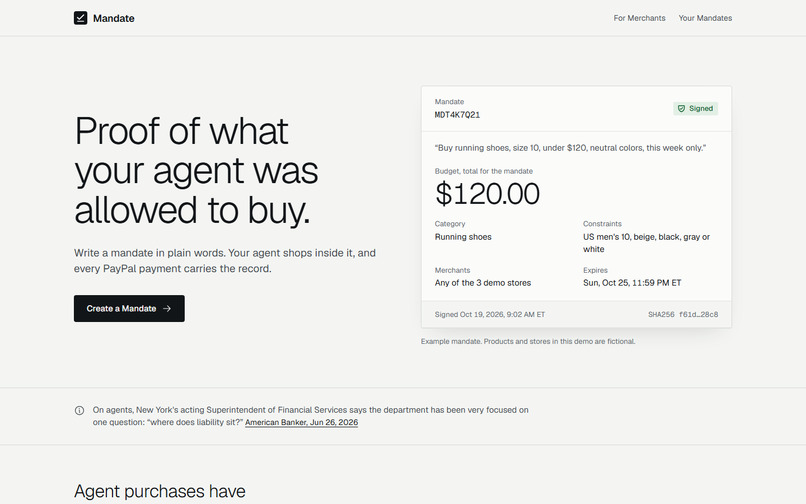
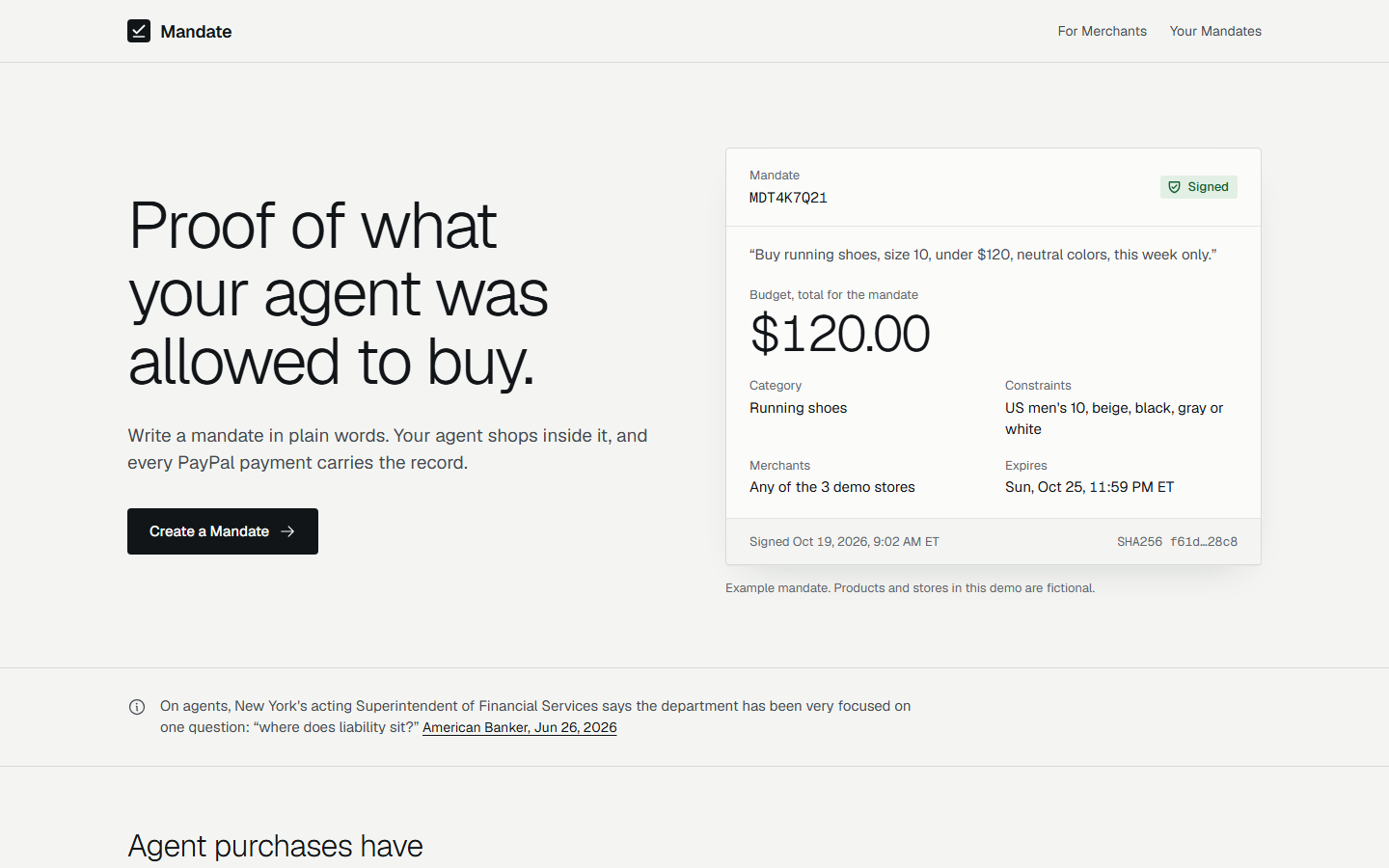
Landing: the problem with linked sources, and an example signed mandate with its real SHA256 fingerprint.
-
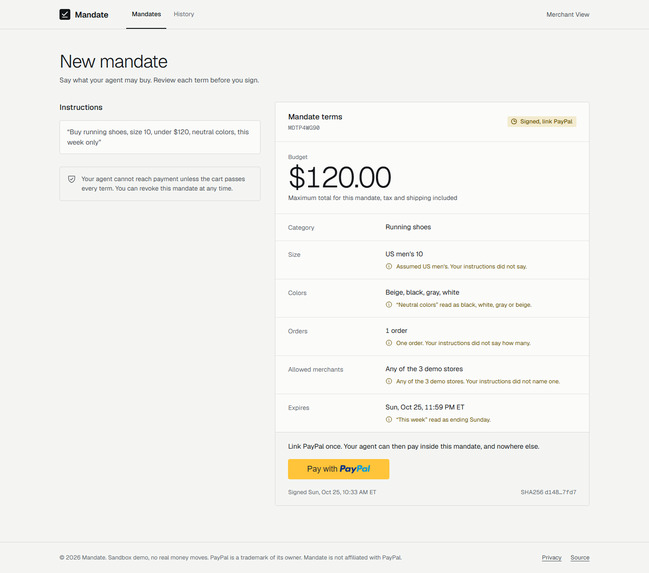
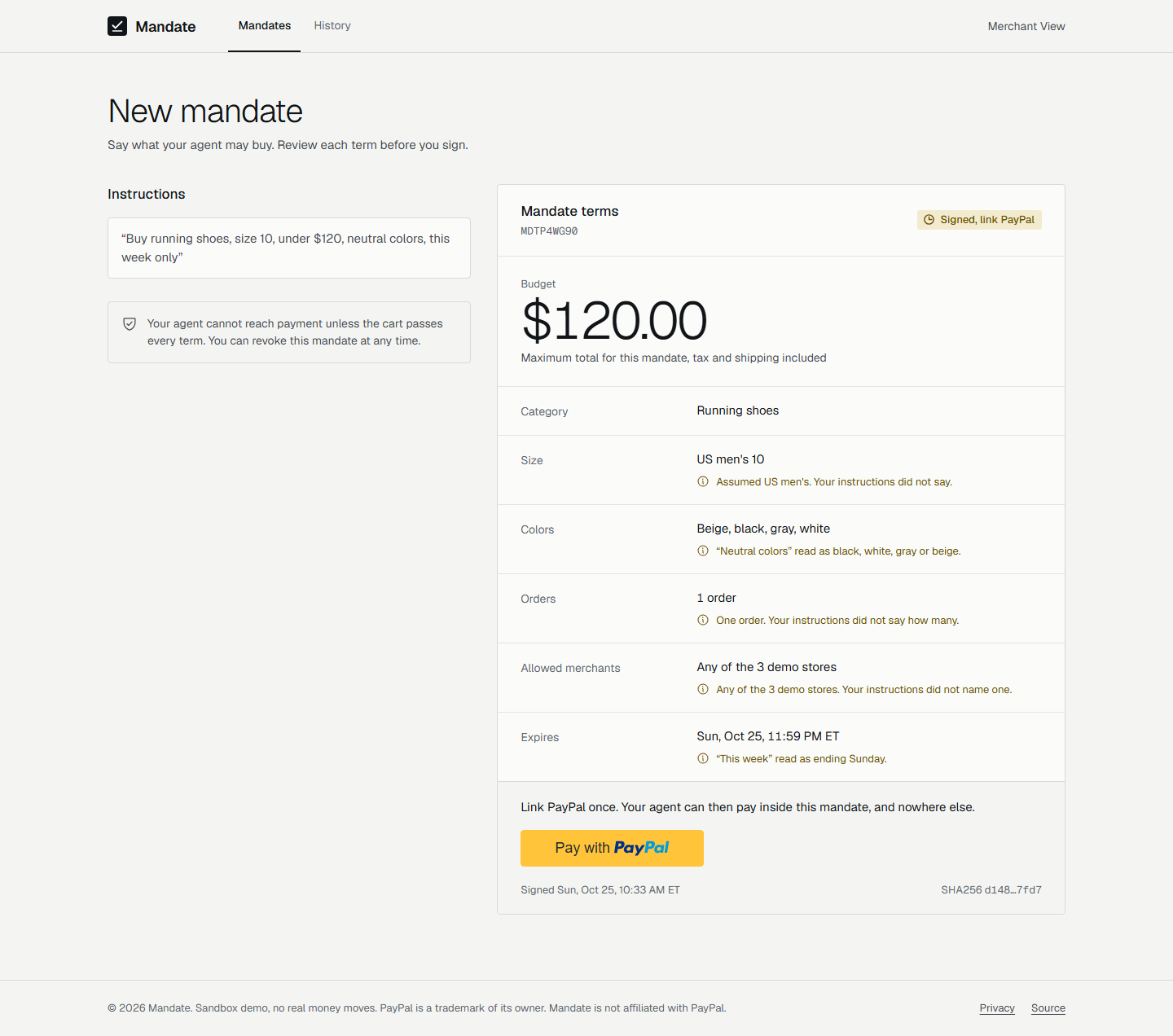
Claude turns plain words into terms with stated assumptions; signing fixes them with a fingerprint, then PayPal is linked once.
-
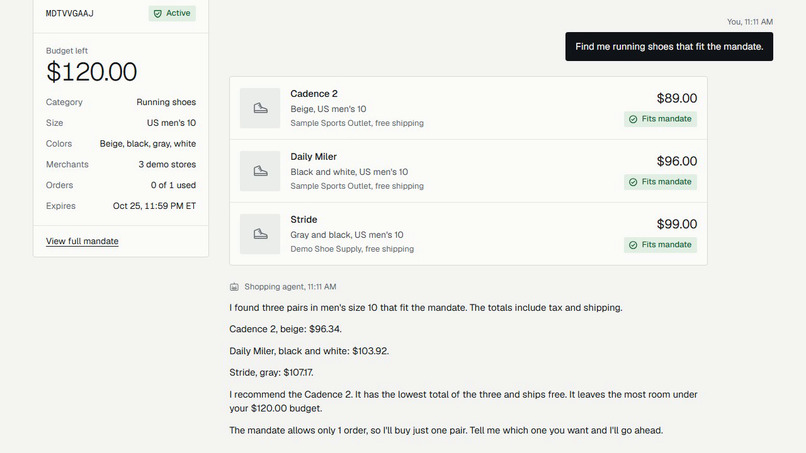
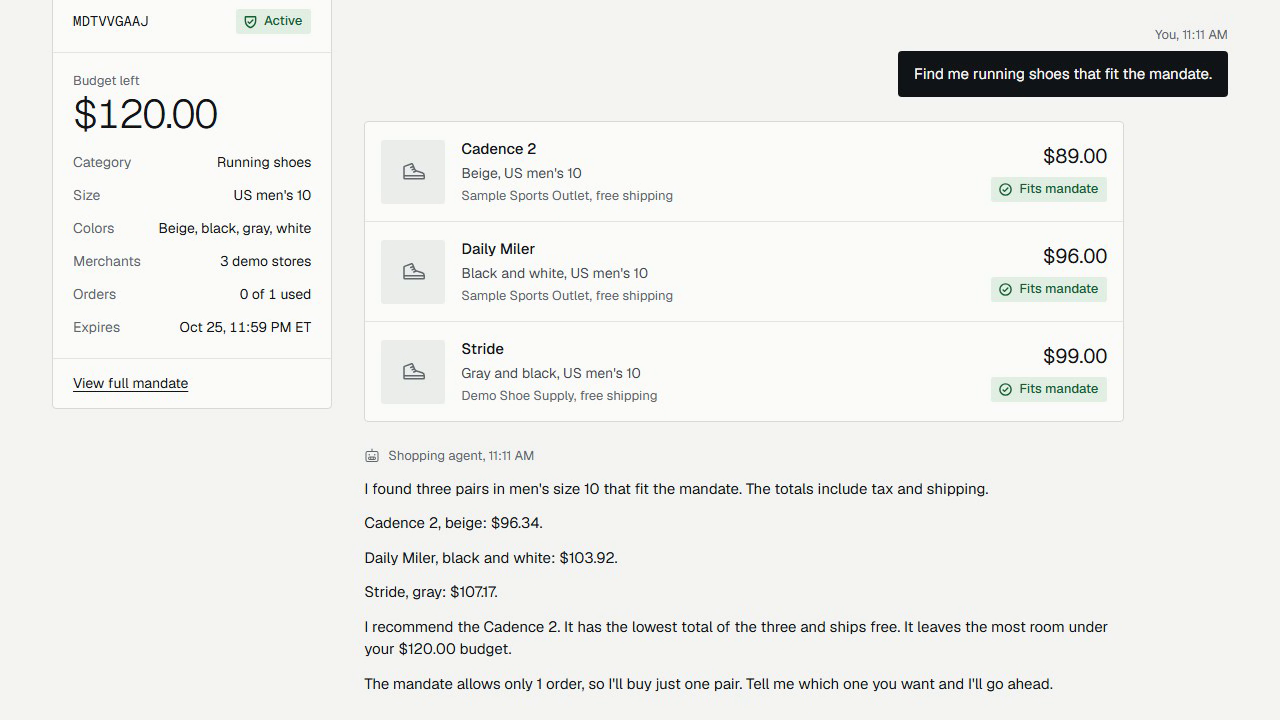
The shopping agent searches three stores and proposes what fits; fit labels come from the same deterministic check.
-
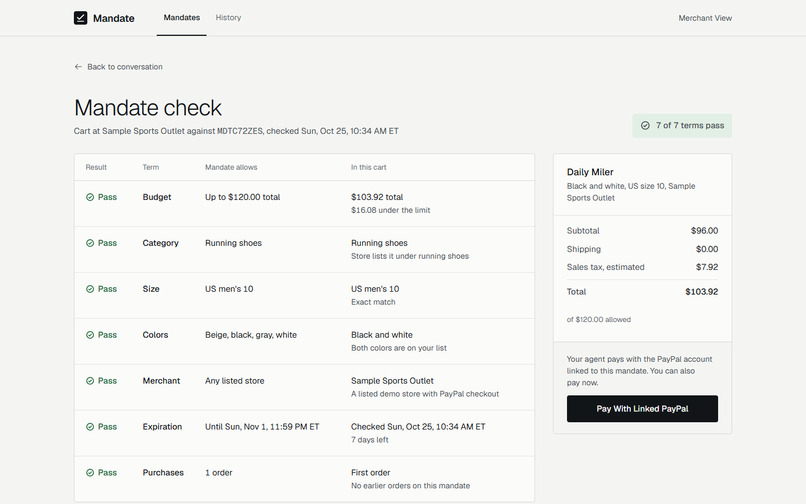
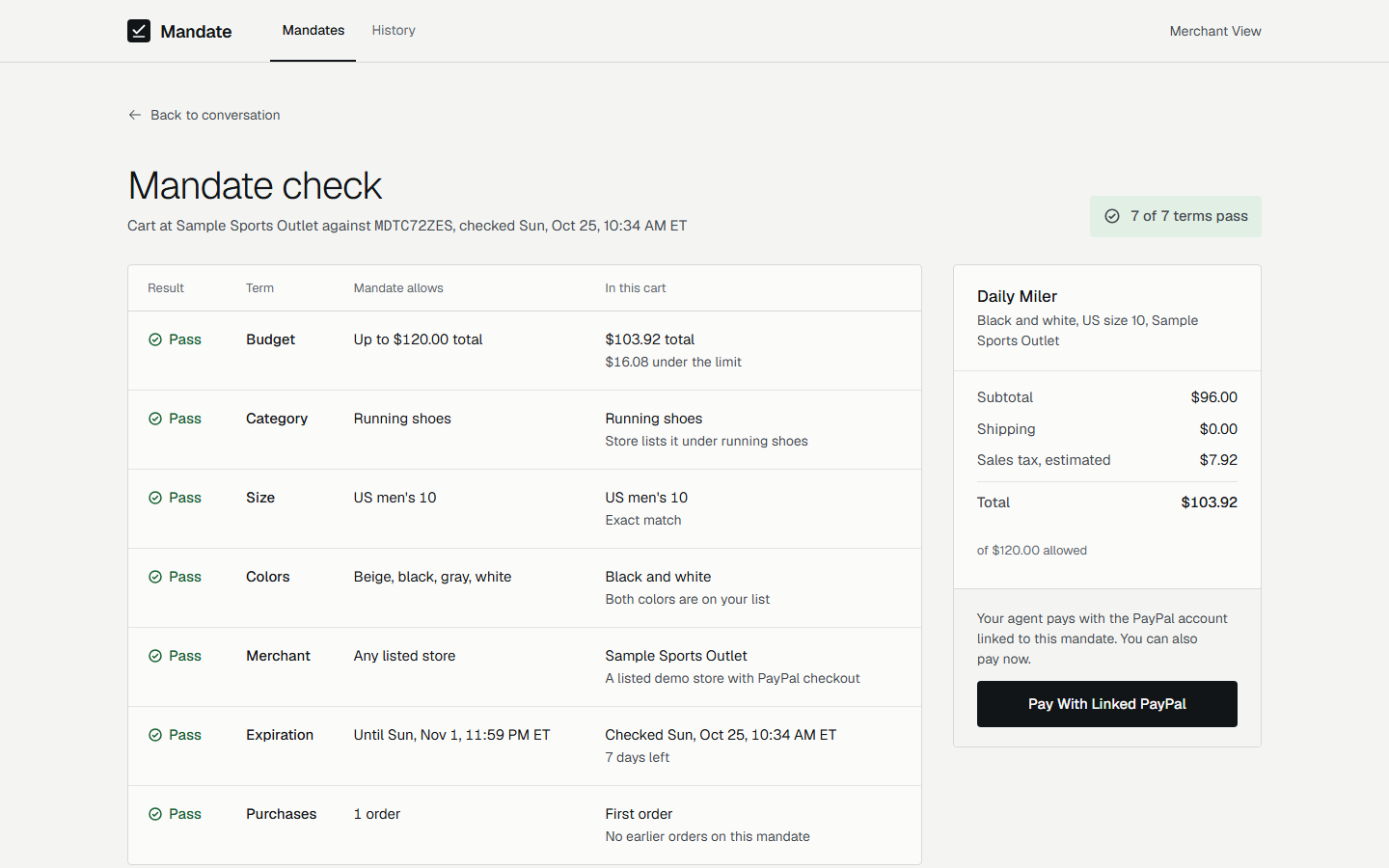
Before PayPal is called, code checks the cart against every term. 7 of 7 pass, so the agent pays with the linked PayPal.
-
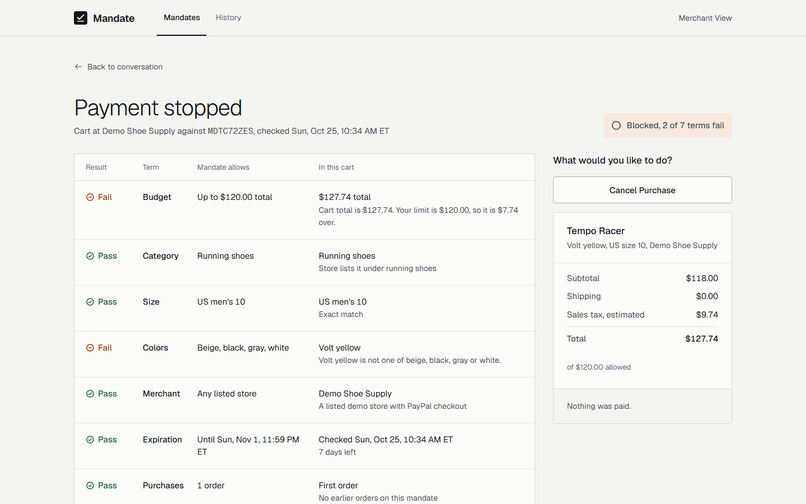
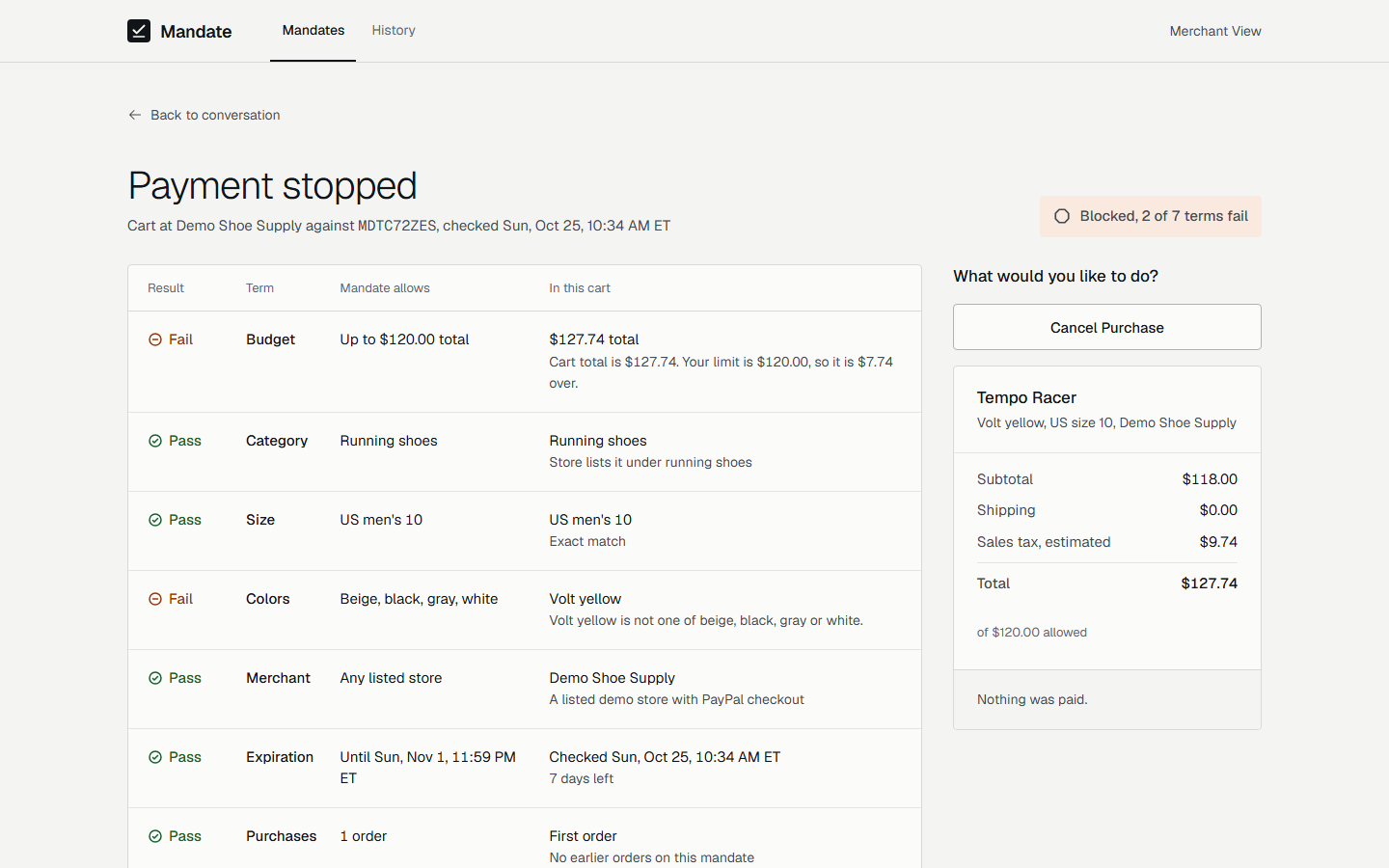
Outside the mandate nothing is paid: failed terms are explained, and only the buyer can widen it with a new signature.
-
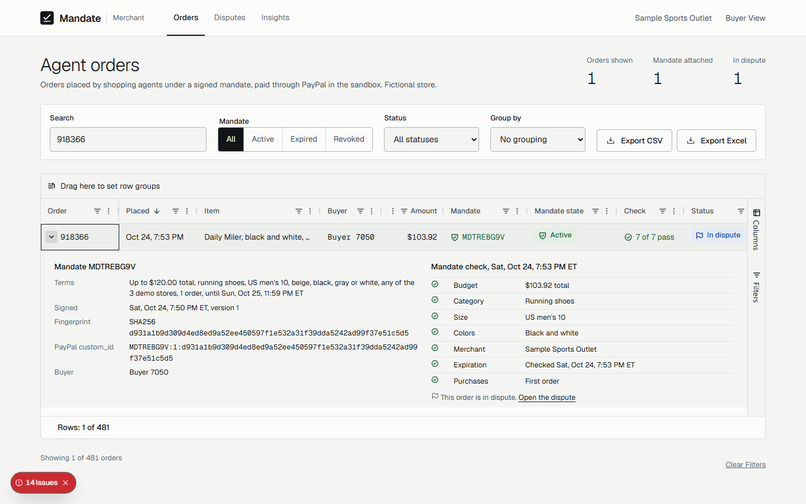
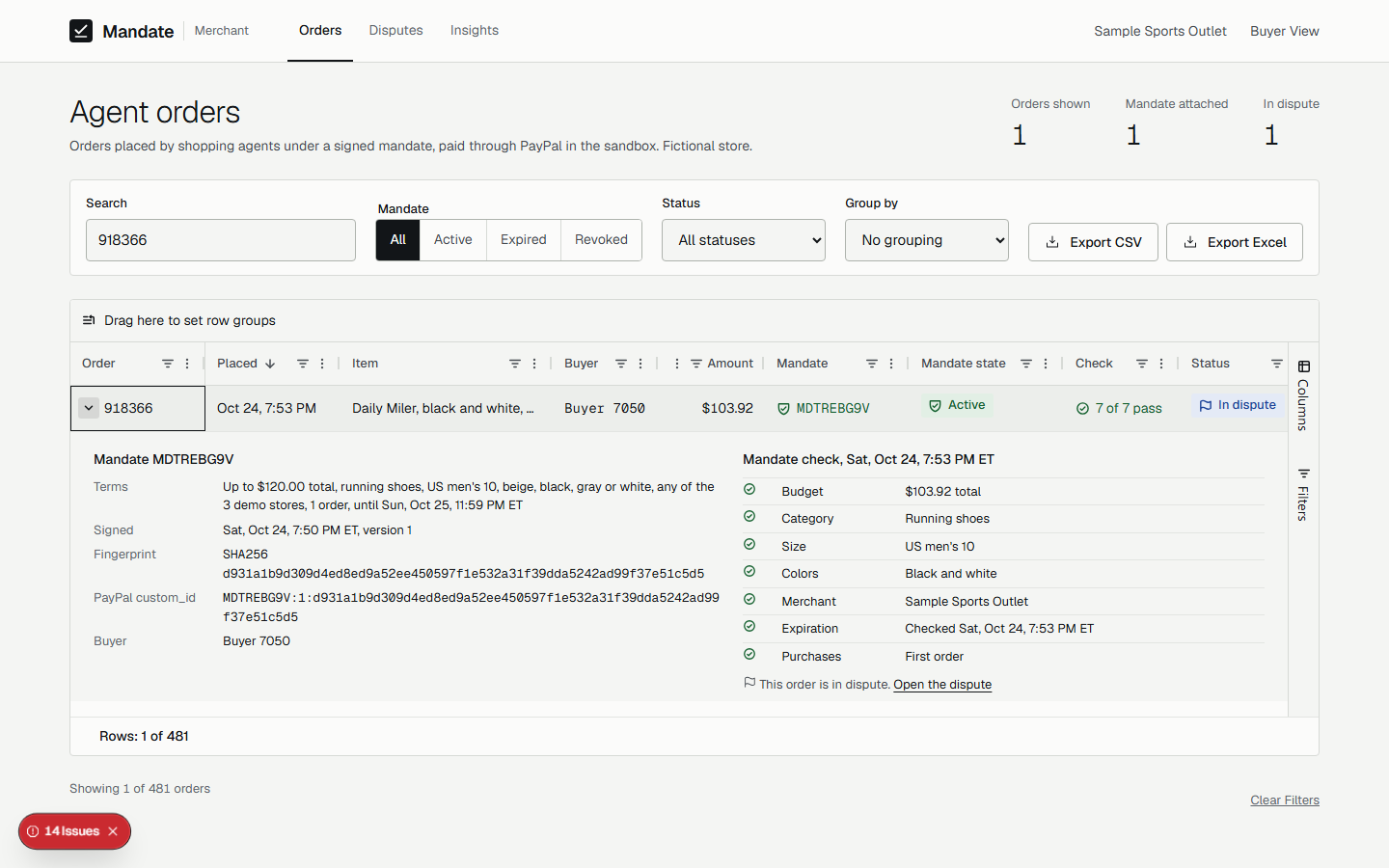
The merchant sees every agent order with its mandate fingerprint, adds tracking through the PayPal Agent Toolkit, and follows disputes.
-
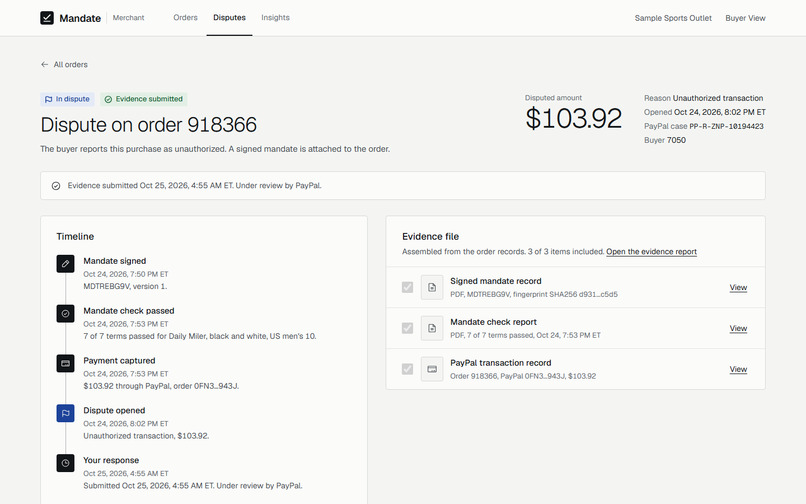
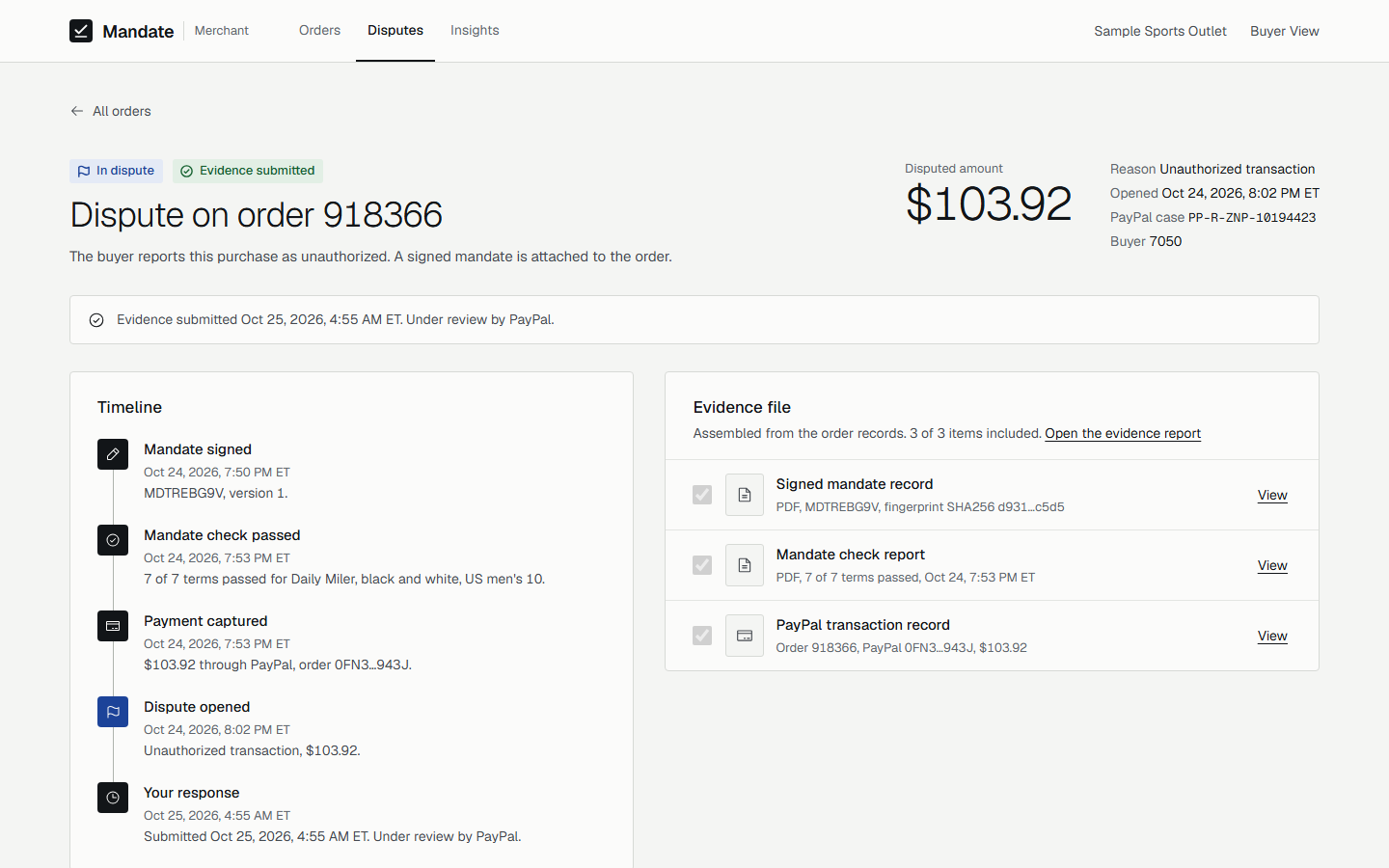
A real sandbox dispute: the evidence file is assembled from the signed mandate, the check and the payment, page by page.
-
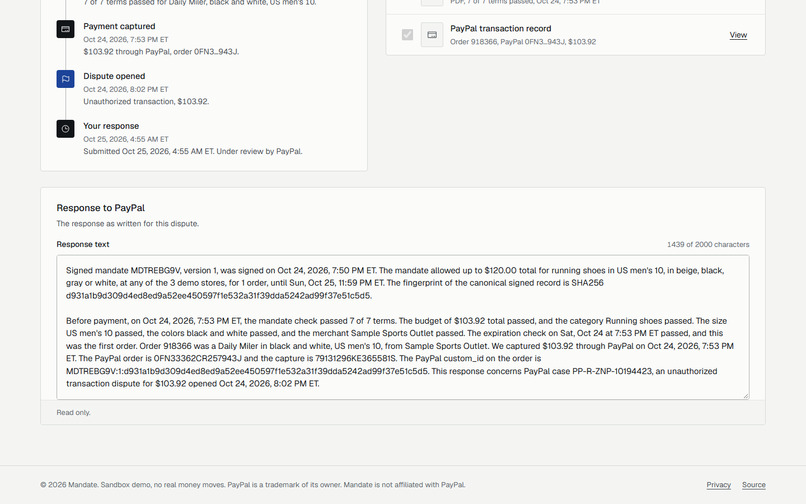
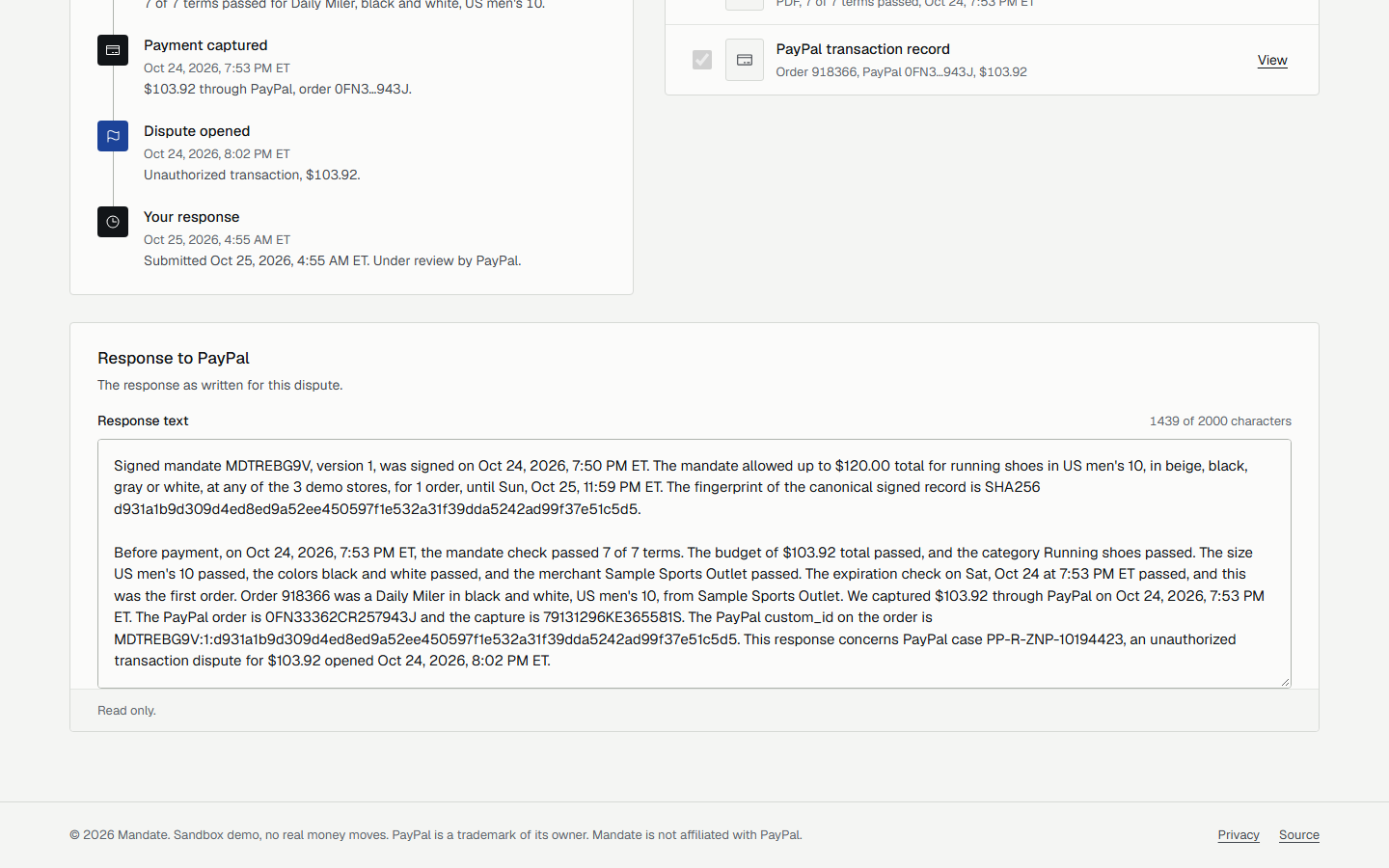
Claude drafts the response; every sentence cites the evidence it rests on, and the merchant reviews it before anything reaches PayPal.
-
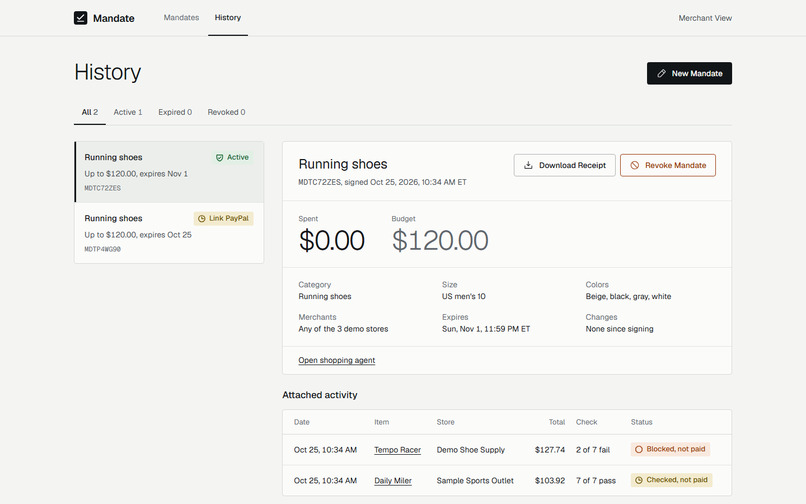
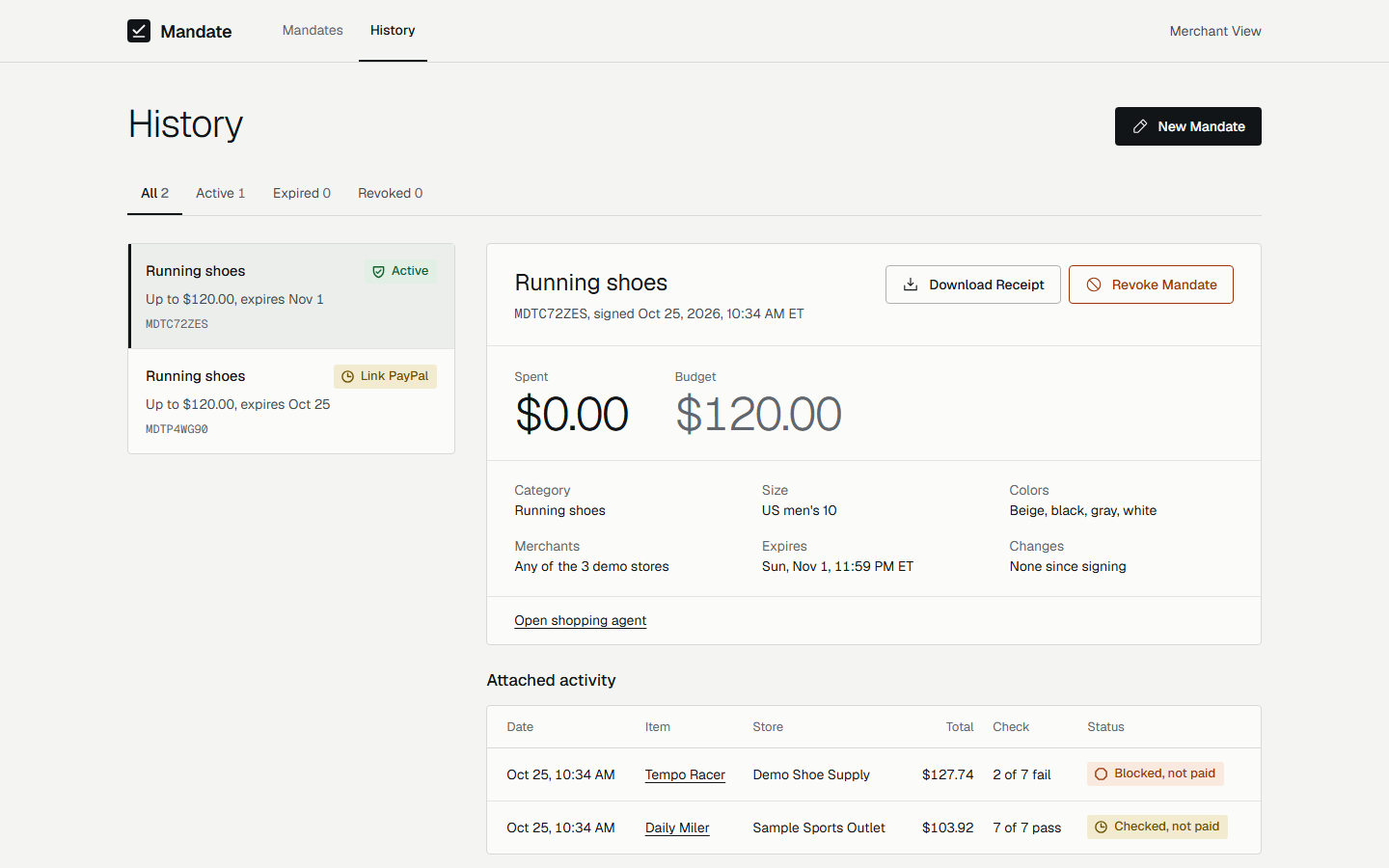
The buyer's history keeps every mandate, check and payment, and a mandate can be revoked at any time.
Inspiration
Shopping agents already pay on behalf of people, and nobody has settled who carries the cost when one of those purchases is disputed. Merchant Cost Consulting writes that there is still no concrete chargeback liability rule for agent purchases (Oct 10, 2026). Chargeflow explains that a disputed agent purchase generally follows card not present rules, so the merchant carries the loss unless it wins (Jul 7, 2026), and its evidence playbook tells merchants to keep the customer's mandate for each agent order: what was authorized, the price cap, the merchants allowed, the expiry (Jul 19, 2026). New York's financial regulator is asking the same question: "where does liability sit?" (American Banker, Jun 26, 2026).
The missing piece is a record of intent that exists before the agent pays, is enforced when it pays, and can be shown when the payment is disputed. That is Mandate.
What it does
For the buyer
- Write what the agent may buy in plain words. Claude turns it into structured terms: total budget, category, sizes and colors, allowed stores, expiry, number of orders. Edit, then sign.
- Signing fixes the terms with a SHA256 fingerprint of the canonical record and a timestamp. Link PayPal once (Vault), so the agent can pay without you present.
- The shopping agent searches three fictional stores and builds a cart. Before any PayPal call, the Mandate check compares the cart with every term, by code. A compliant cart is paid, with the mandate reference in the PayPal order's
custom_id. A cart outside the mandate is blocked, each failed term is explained, and you can widen the mandate (new version, new signature), switch to a compliant product, or cancel. - Revoke at any time; download a receipt with every signed version, check and order.
For the merchant
- An AG Grid view of agent orders with the mandate, fingerprint, check score and dispute state: search, filters, grouping, master detail, CSV and Excel export, and shipment tracking reported to PayPal through the Agent Toolkit.
- When a buyer opens a dispute, a verified PayPal webhook starts an evidence file built from stored records only, with a factual draft response. Every drafted sentence must rest on an included evidence item, and every number and identifier in it must appear in that item. The merchant includes or excludes items, edits, confirms accuracy, and only then submits to PayPal.
No sign up: each visitor gets a private demo session and can switch between buyer and merchant.
How we built it
- Next.js 16 (App Router, React 19, TypeScript strict), Postgres with Drizzle (PGlite locally), hosted on Render with Render Postgres from a Blueprint.
- Render Workflows runs the dispute evidence assembly: the verified webhook starts the
assembleEvidencetask with an idempotency key and answers PayPal at once; the task builds the evidence file and the grounded draft with retries and its own compute. On the hosted demo the file was ready 4 seconds after the event. The app keeps a safety net if a run cannot start or leaves no file. - PayPal: Orders v2 (vault charge,
payeeper store,custom_id,PayPal-Request-Id), Vault v3, JS SDK v6, Webhooks with signature verification, Customer Disputes v1 (provide-evidence), and the Agent Toolkit for read and tracking actions. - Claude (
claude-sonnet-5-5, official Anthropic SDK): structured outputs for mandate drafting and dispute drafts, the SDK tool runner for the shopping agent, and a narrow judge for free text preferences. - AG Grid Enterprise for the merchant view, themed from the design tokens.
- The consent gate: one function can make PayPal move money. It takes only ids, locks the mandate row, re reads everything, recomputes totals and the fingerprint, runs the check, pays with the check id as idempotency key, and checks again before any capture.
- Spec driven: a constitution, a spec, a plan, contracts and a task list (GitHub Spec Kit) came before the code, and tests came before each money path. A bypass suite tries to pay outside the mandate in every way we could think of.
- Design from a Claude Design canvas: one ink, no gradients, icons and labels for every state, 4px radius, Geist.
Challenges we ran into
- Letting an agent pay without letting it decide. The model proposes; it never supplies an amount, a verdict or a term to the payment path. Money moving toolkit tools are not registered at all, and a static test fails if any file outside
lib/paymentsreaches the PayPal transport. - Concurrency. Two carts can race for the last allowed order, or a revocation can race a capture. Row locks on the mandate and a re check before capture make both impossible, and tests prove it.
- A draft that cannot invent. Free text is where a dispute response could overclaim. Sentences carry the evidence keys they rest on, and the server drops any sentence whose numbers or identifiers are not in those items.
- Who owns the money owns the case. Our first REST app belonged to a different business account than the store receiving the money through
payee. Payments worked, but PayPal refused tracking on those sales, and disputes follow the same rule. We moved the app to the demo store's own account, which also meant the buyer had to save PayPal again: a saved PayPal belongs to the merchant whose app created it. - Errors that look like successes. The Agent Toolkit returns PayPal errors as normal content. Our first sandbox run read a refused tracking call as done, so we taught the wrapper to raise them; the screen now says PayPal refused it. The toolkit's server SDK also needed a dependency it only lists for development, which we supplied with a pnpm package extension.
- A real dispute is slow and stateful. The buyer had to secure the sandbox account before an "unauthorized" report went through, the case appeared about ten minutes later, and our local tunnel expired overnight with the events in flight. Updating the webhook URL and asking PayPal to resend recovered them, signature intact.
Accomplishments that we're proud of
- A payment path where "outside the mandate" is not a warning but an impossibility, with a test for each way around it.
- An amendment flow that never silently widens consent: a blocked cart can only proceed after a new, explicit signature and a new fingerprint.
- Dispute evidence that is ready within a minute of the PayPal event, built from records created at signing and payment time, not reconstructed afterwards.
- Every buyer and merchant journey tested on desktop and phone.
What we learned
- A merchant initiated charge on a saved PayPal completes in one call, to any of three stores through
payee, with the mandate reference kept on the order and the capture. The buyer approves once; the agent pays afterwards. PayPal-Request-Idmakes retries safe: a replayed order or capture returns the stored result instead of charging twice.- Ownership is the rule to design around: tracking, disputes and saved payment methods belong to the merchant that received the money or created the token.
- A dispute answered from our page reached PayPal as one seller evidence with the evidence report PDF and the response; the case moved to Under review. PayPal filed the evidence as OTHER, so the next step is to read the evidence types it requests before sending.
- Every finding is dated in
scripts/LEARNINGS.mdand summarized in the README.
What's next
- Map mandate terms to emerging agent payment standards so the same record can travel with a network token.
- Let merchants require a mandate reference before accepting agent orders.
- Dispute outcomes by mandate state, to measure whether signed intent changes results.
Built With
- ag-grid-enterprise
- anthropic-claude
- drizzle-orm
- next.js
- paypal-agent-toolkit
- paypal-disputes-api
- paypal-js-sdk-v6
- paypal-orders-v2
- paypal-vault
- paypal-webhooks
- pdf-lib
- playwright
- postgresql
- react
- render
- render-workflows
- typescript
- vitest