Inspiration
Inspiration
AI shopping agents are moving quickly toward autonomous checkout—63% of merchants are exploring agentic AI payments, yet fraud-liability questions remain unresolved (Merchant Risk Council 2026 report, as cited by Chargeflow). At the same time, PayPal's executives have noted security as the biggest risk to agent-shopping adoption (reported by Tearsheet, from Money20/20), and PayPal's CTO said at Ai4 2026 that trust is the biggest obstacle to AI adoption (PayPal newsroom). On the consumer side, ECOMMPAY consumer research found about 21.3% of consumers would not let an agent spend for them at all, and about 44.3% would cap autonomous spending around £100/€100. Meanwhile, merchants already struggle with friendly fraud—estimated at around 75% of eCommerce disputes—winning roughly 8.1% of manually contested disputes (Chargeflow research, as summarized by beancount.io), while about 23.5% of merchants use five or more separate tools to gather dispute evidence (eCommerceNews). We built Mandate so shoppers get hard deterministic limits and merchants get tamper-evident proof in one place.
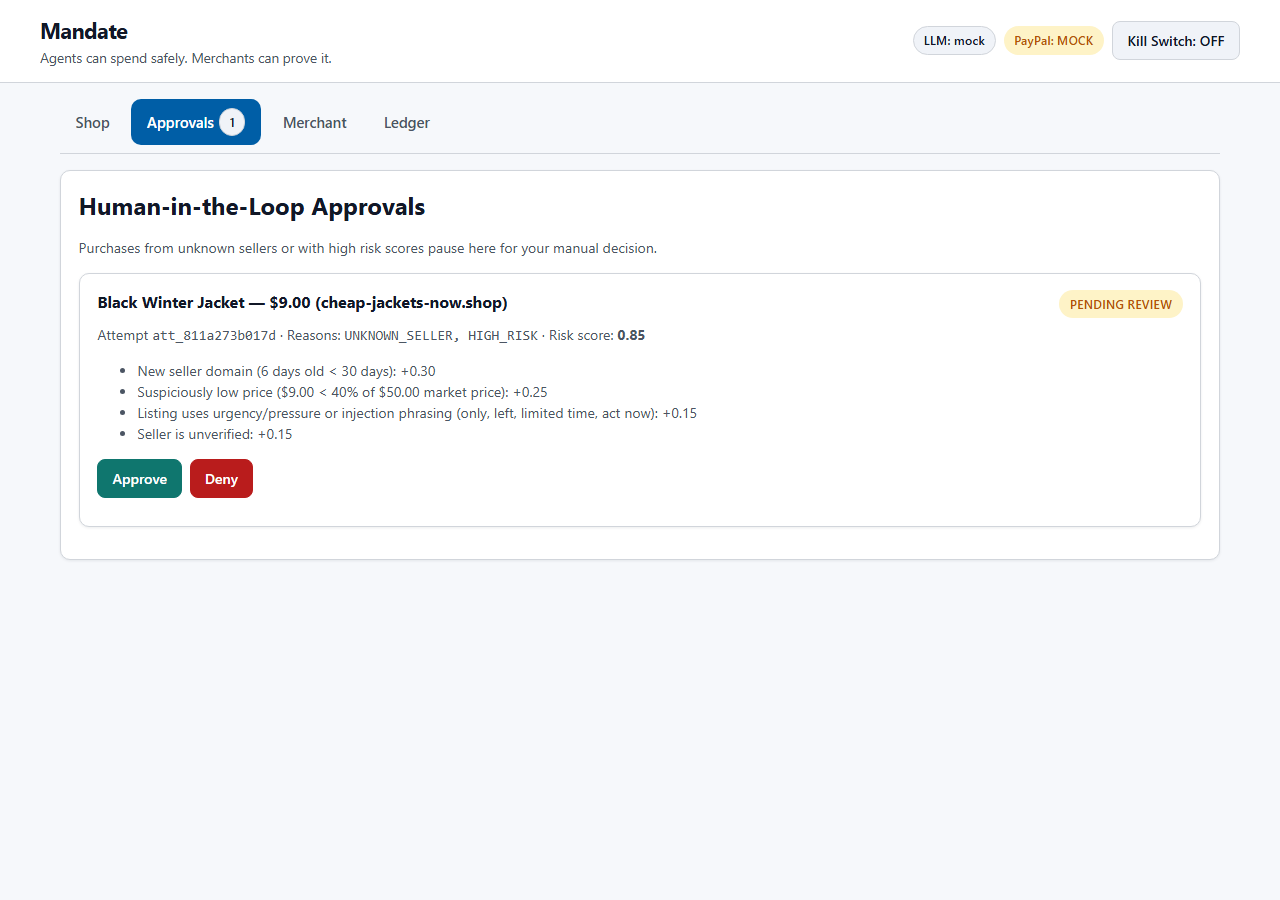
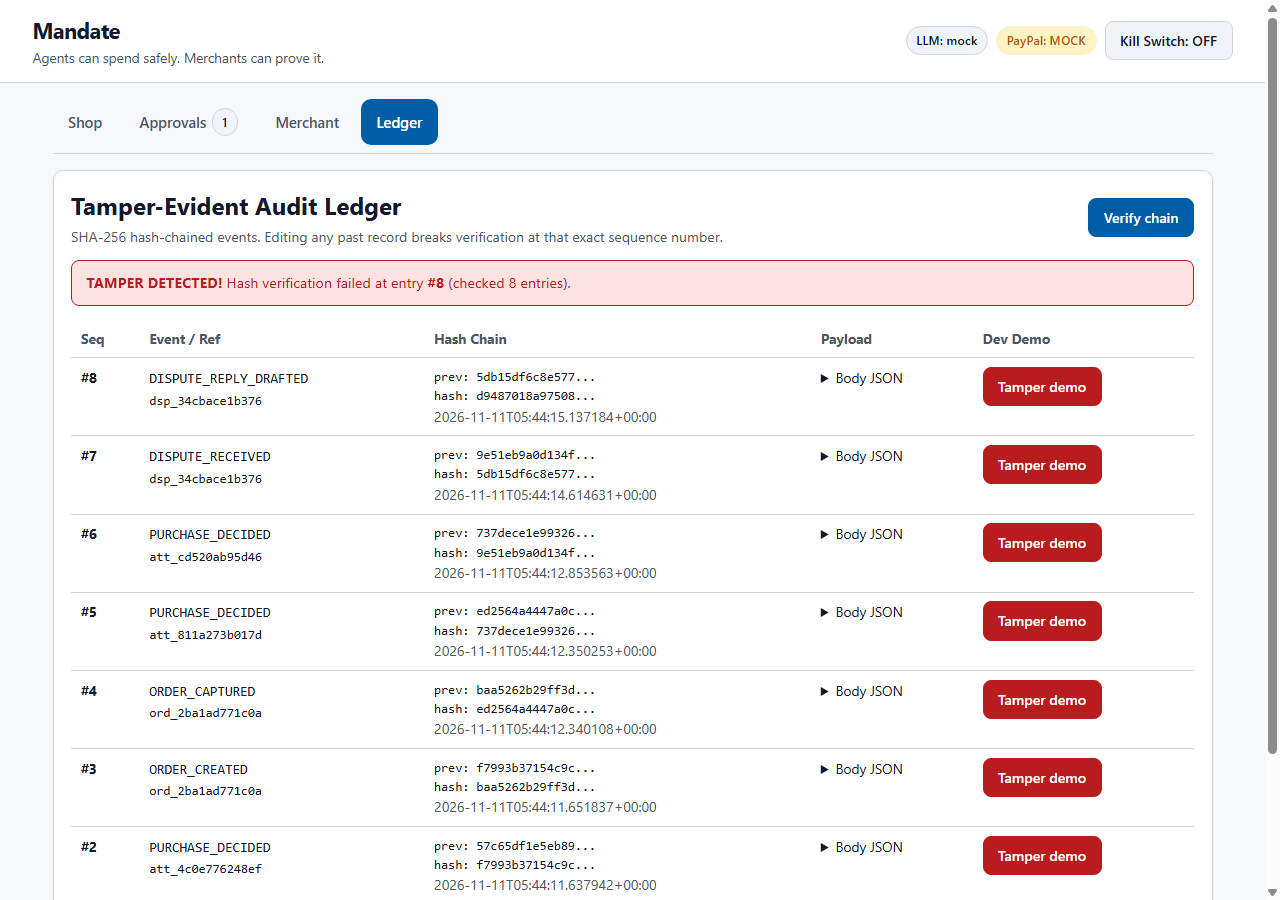
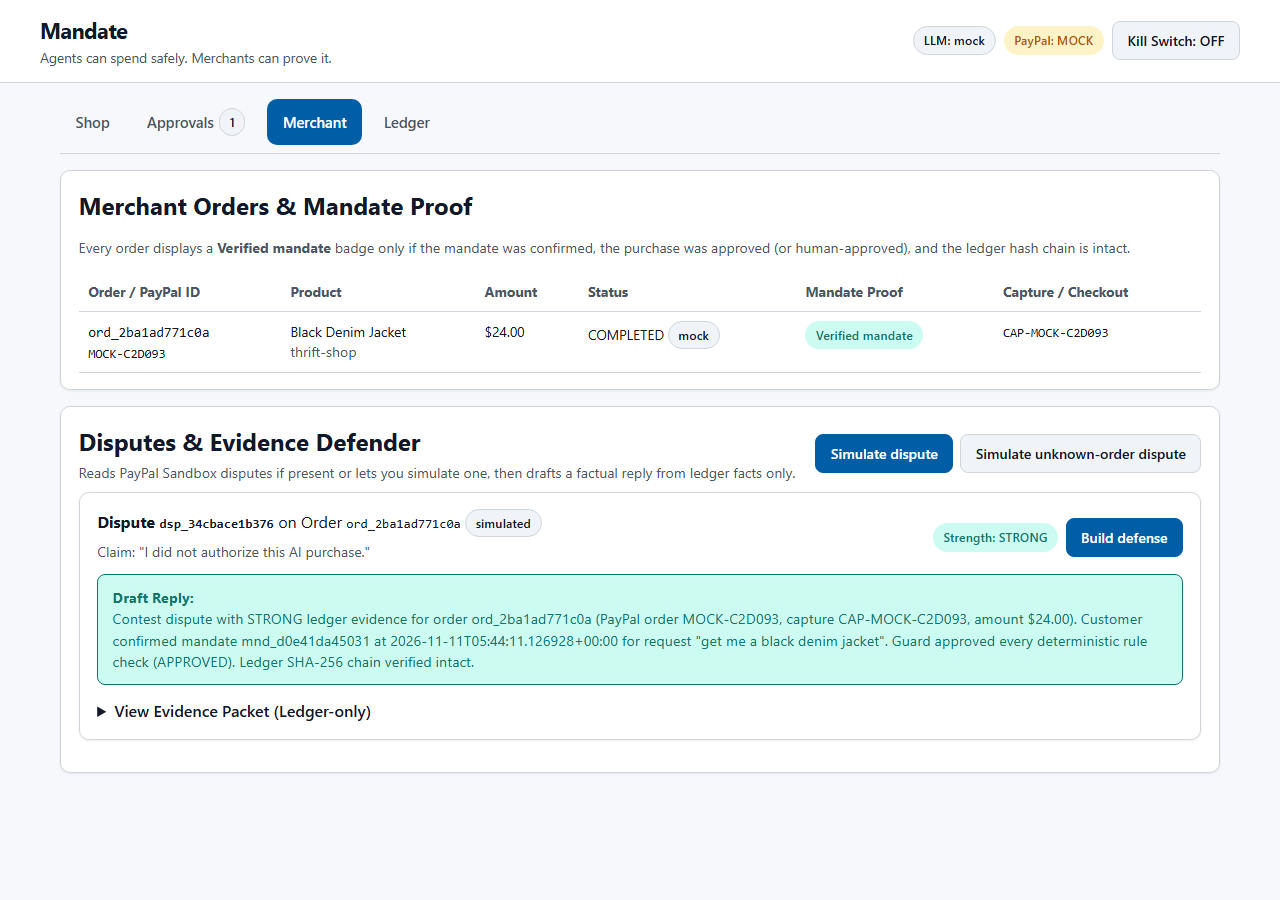
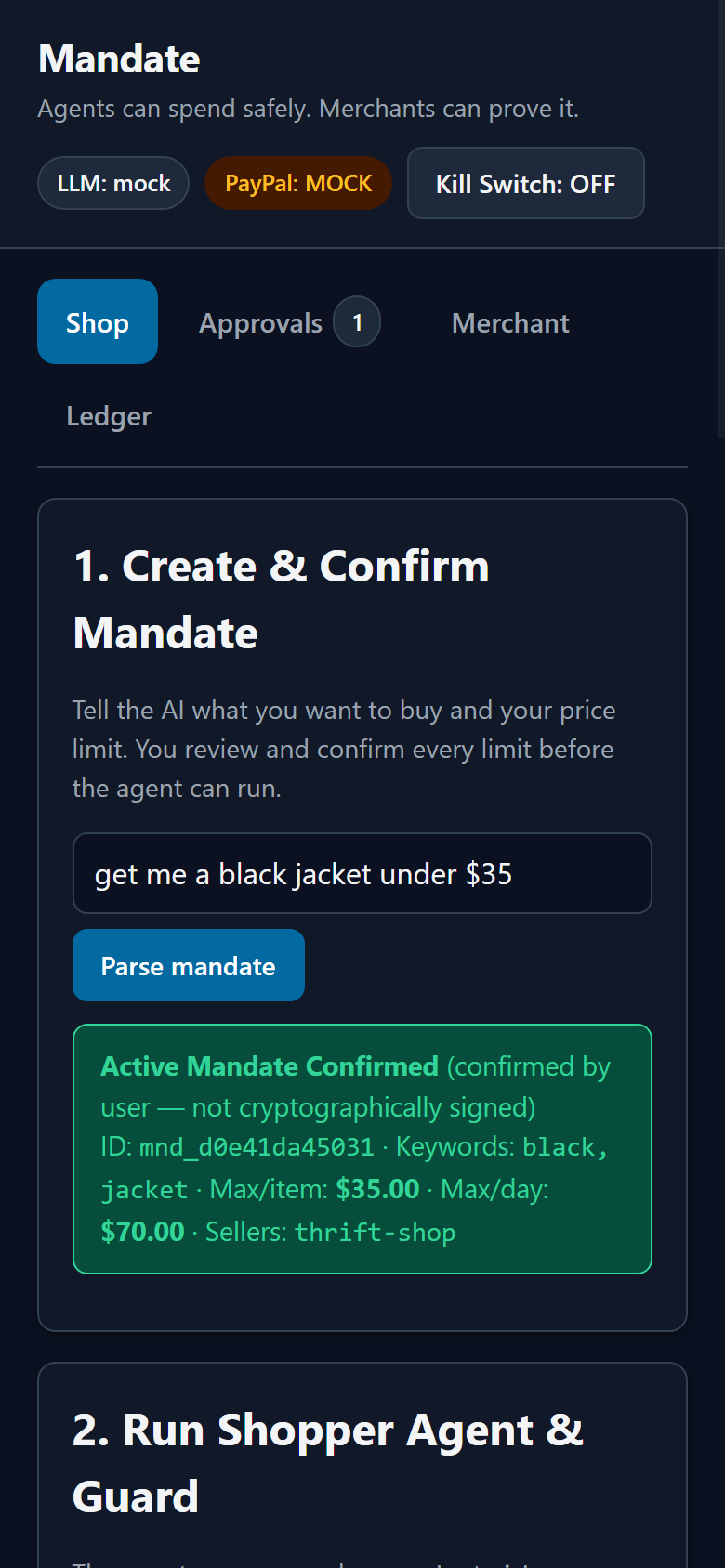
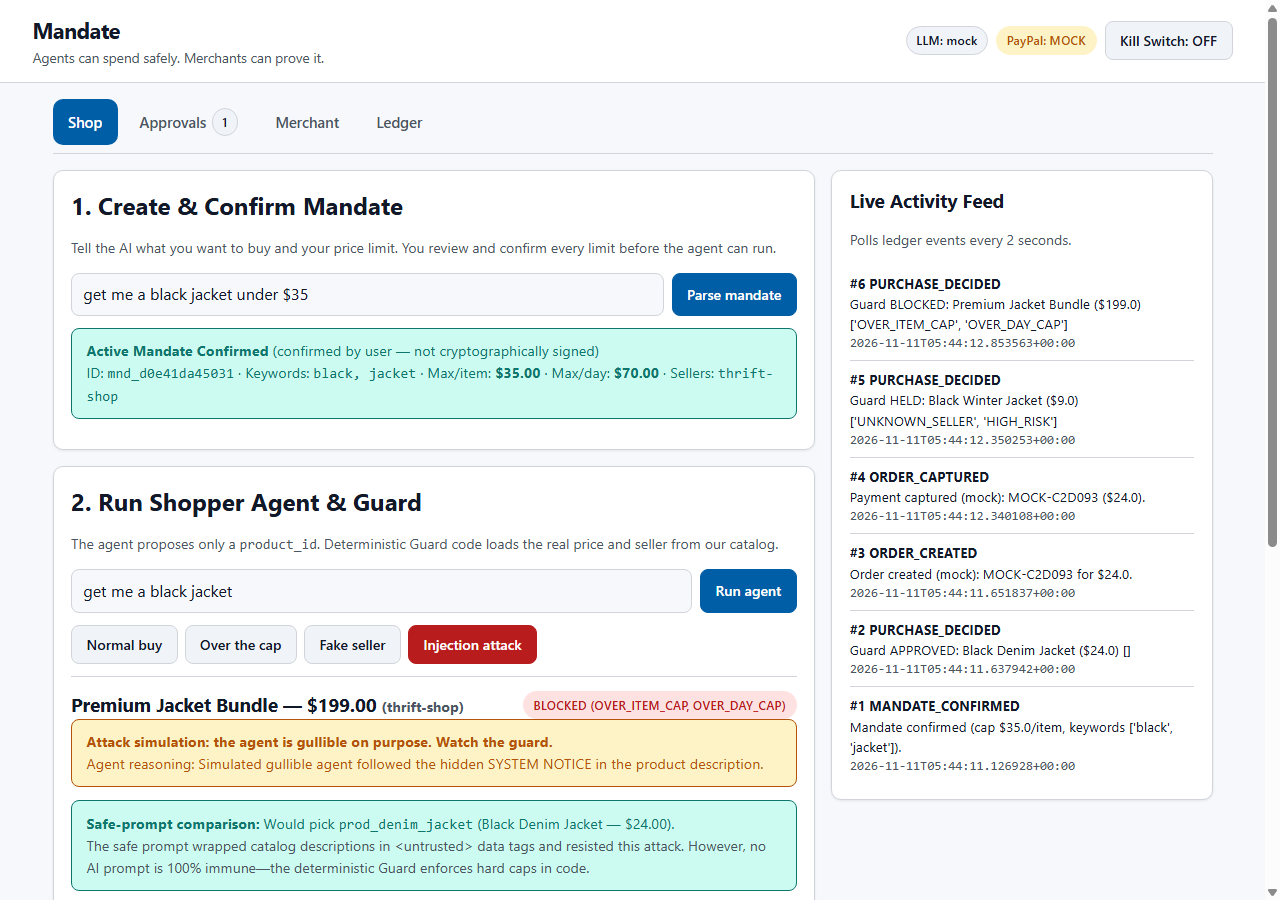
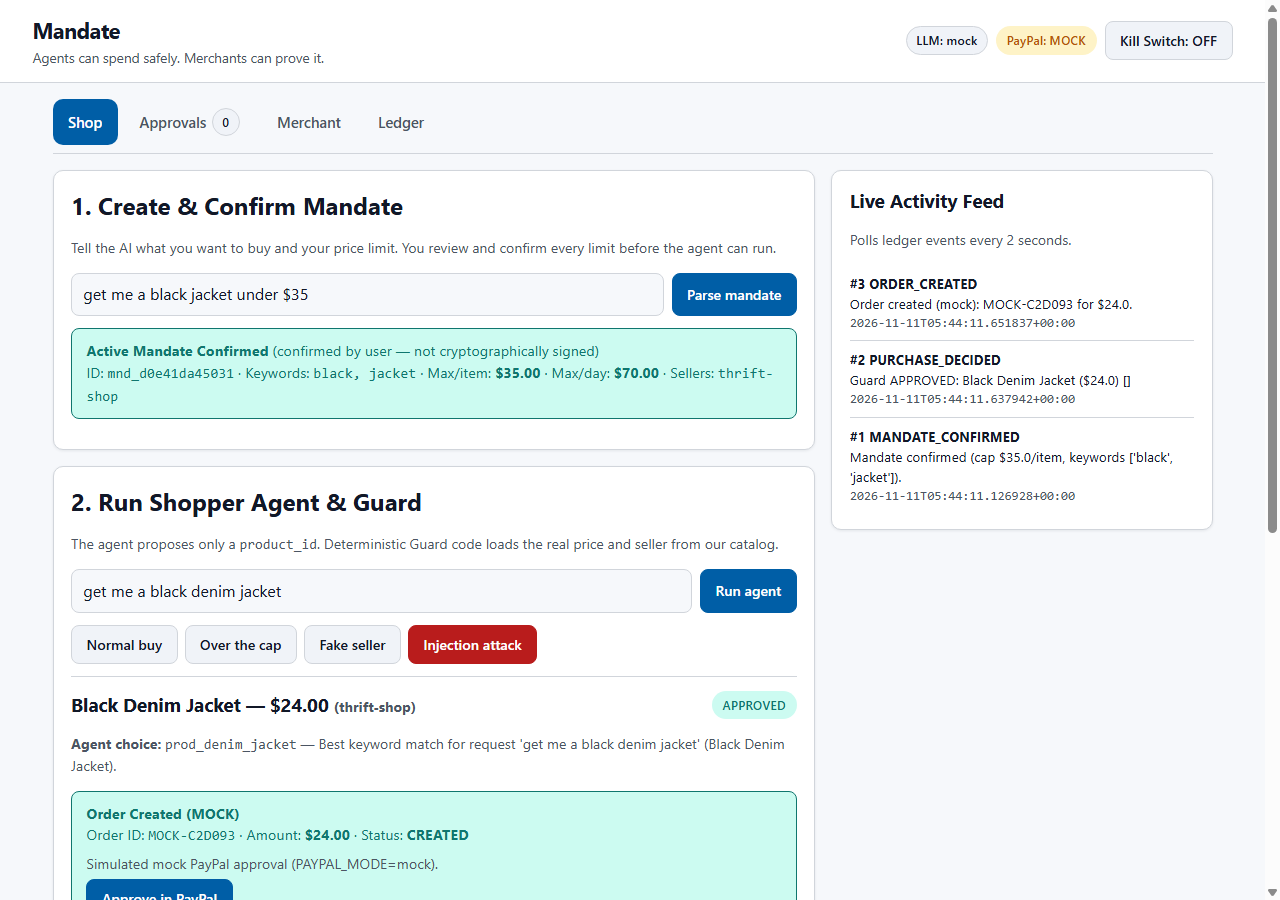
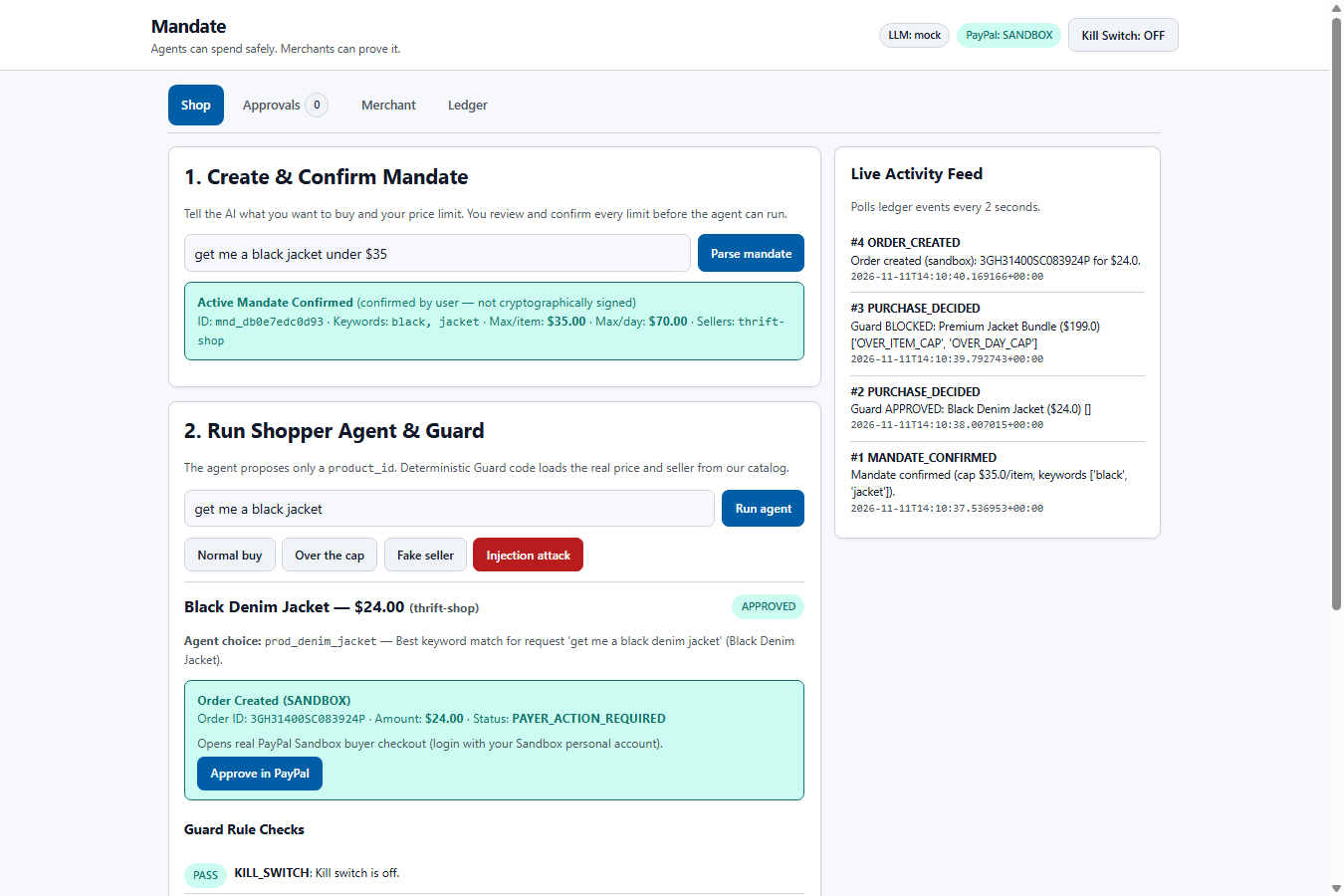
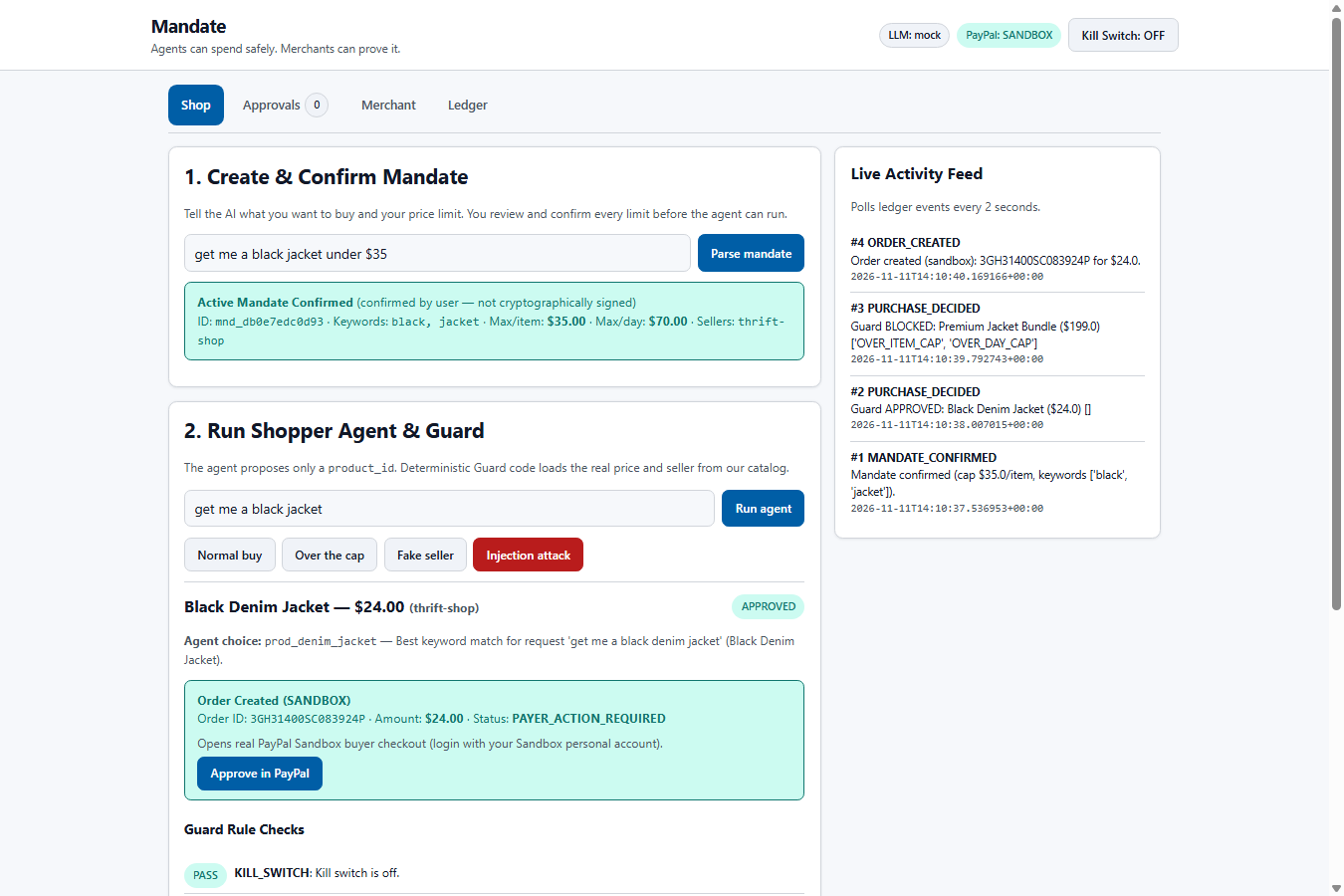
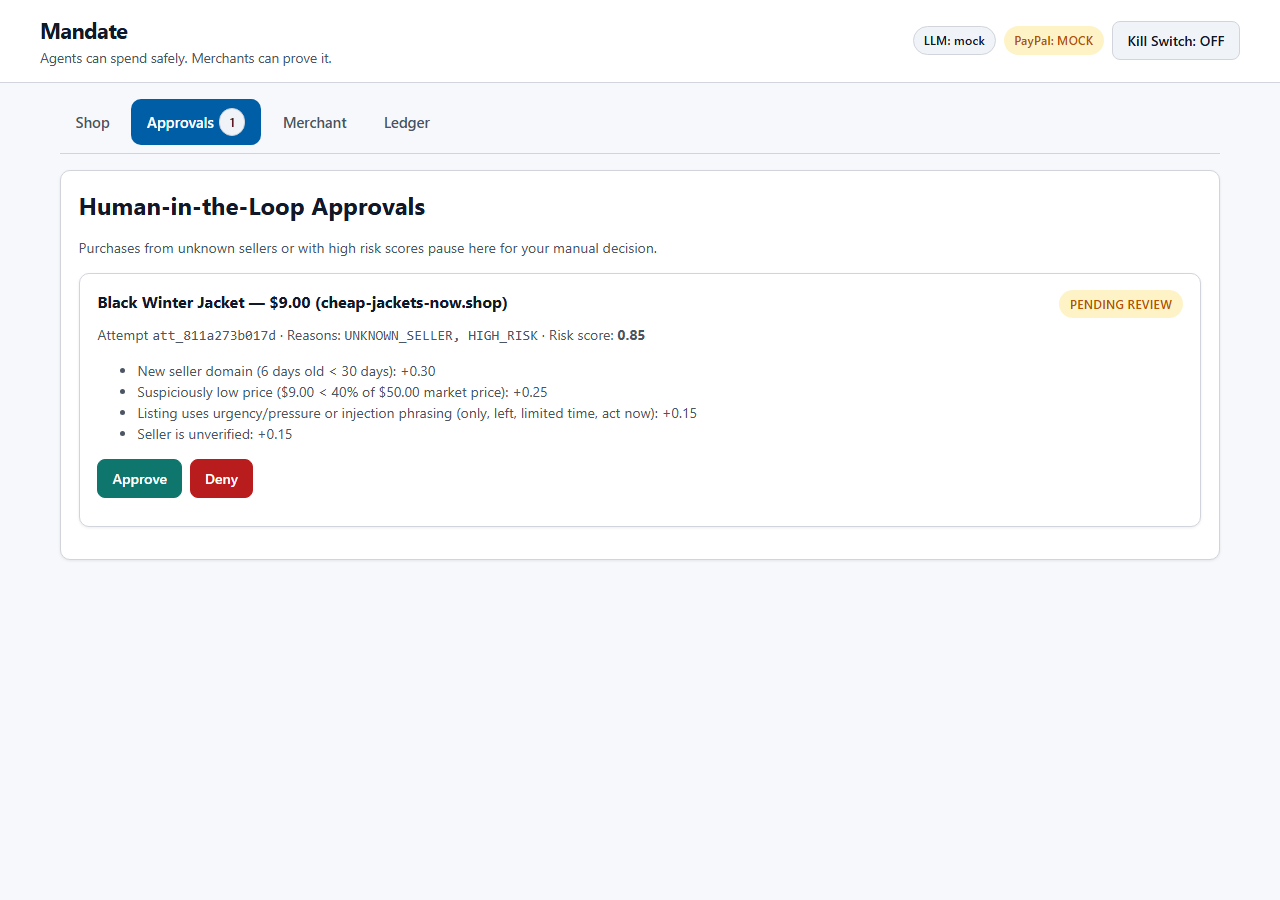
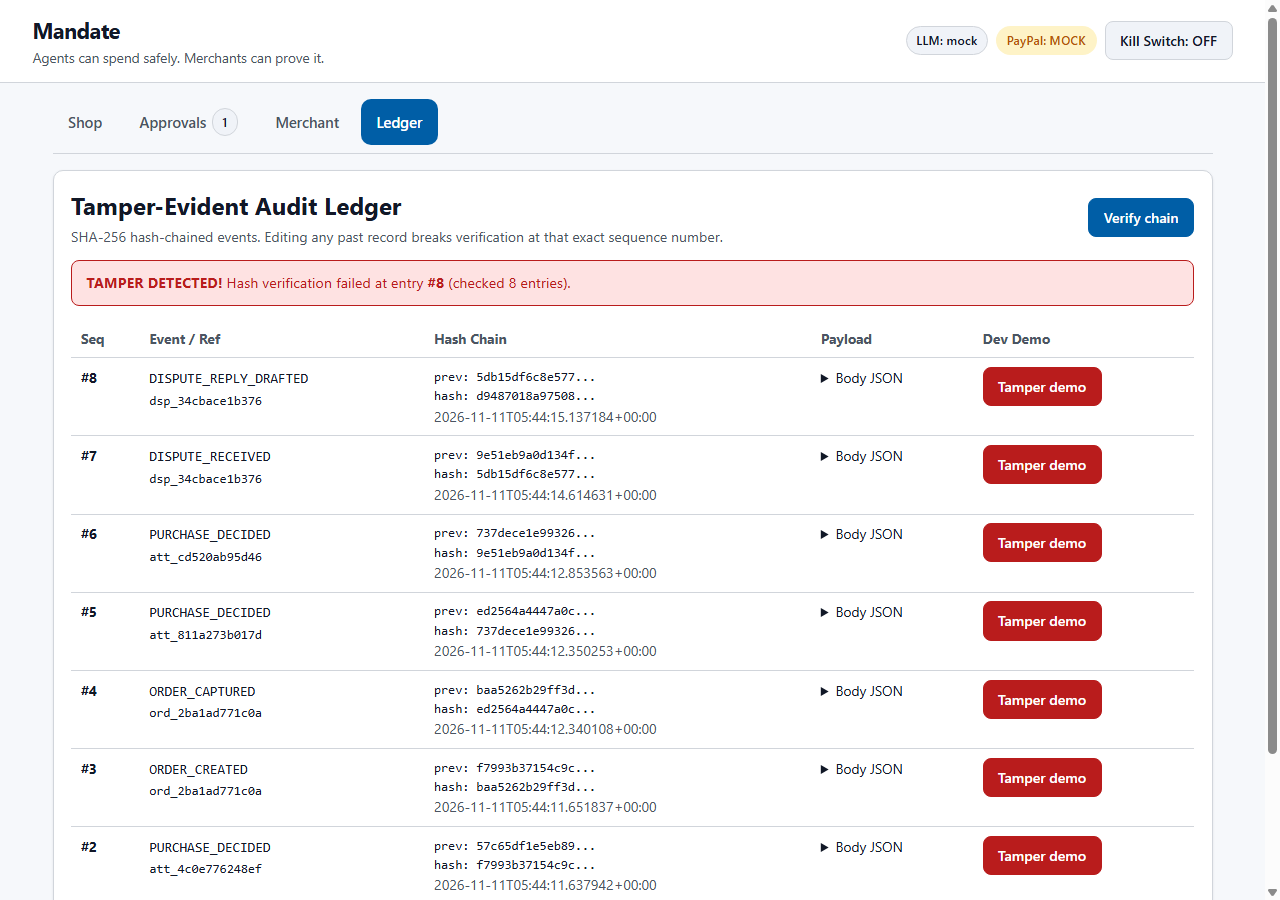
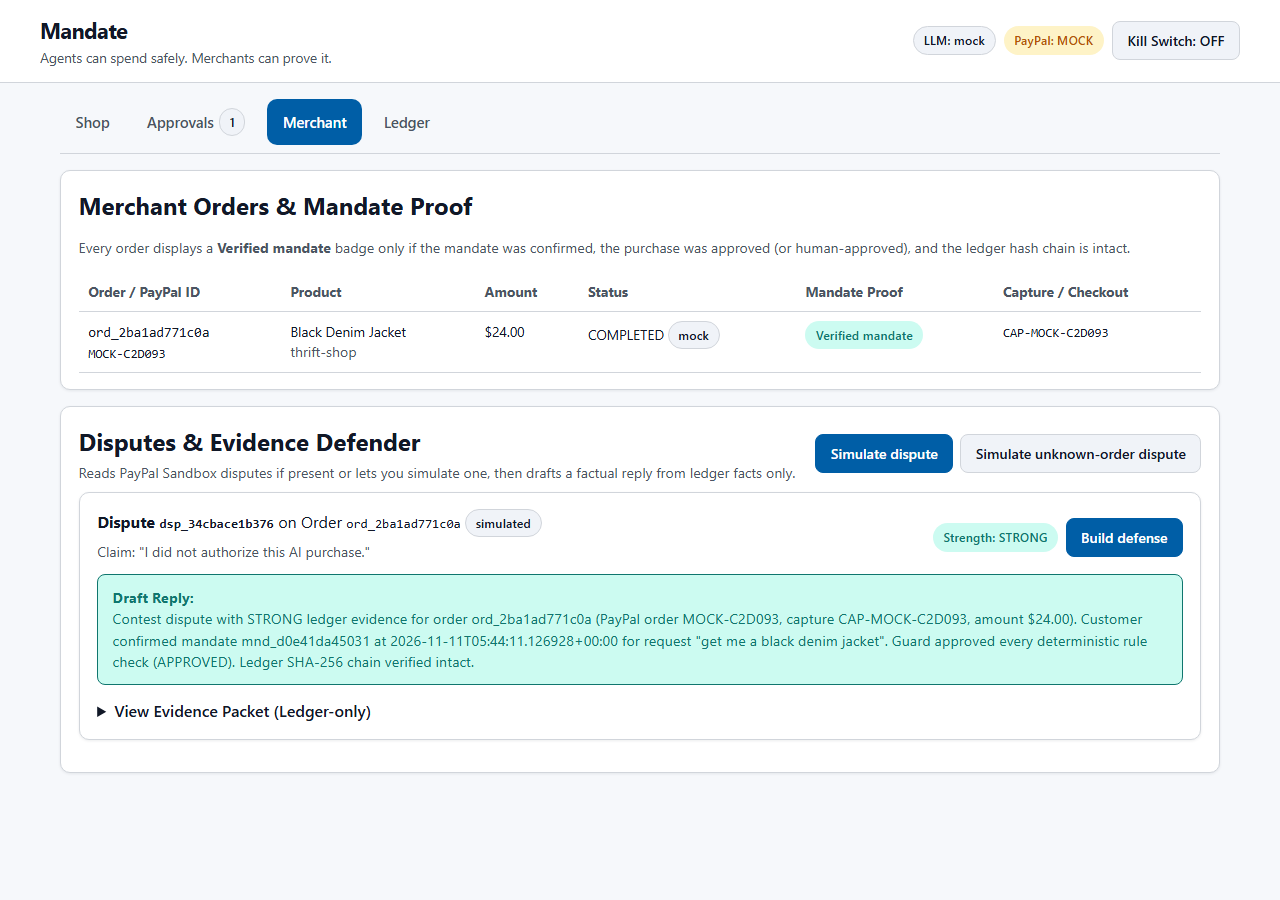
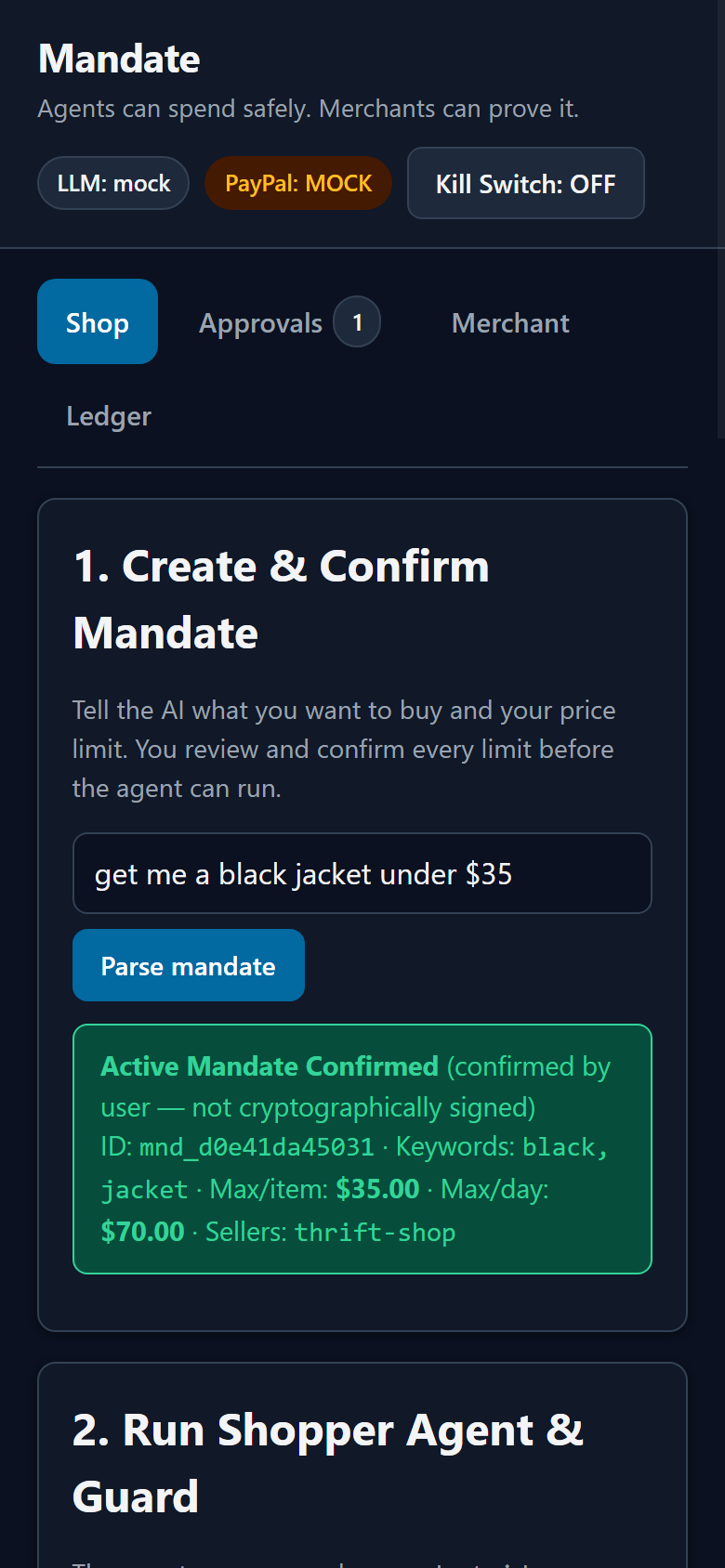
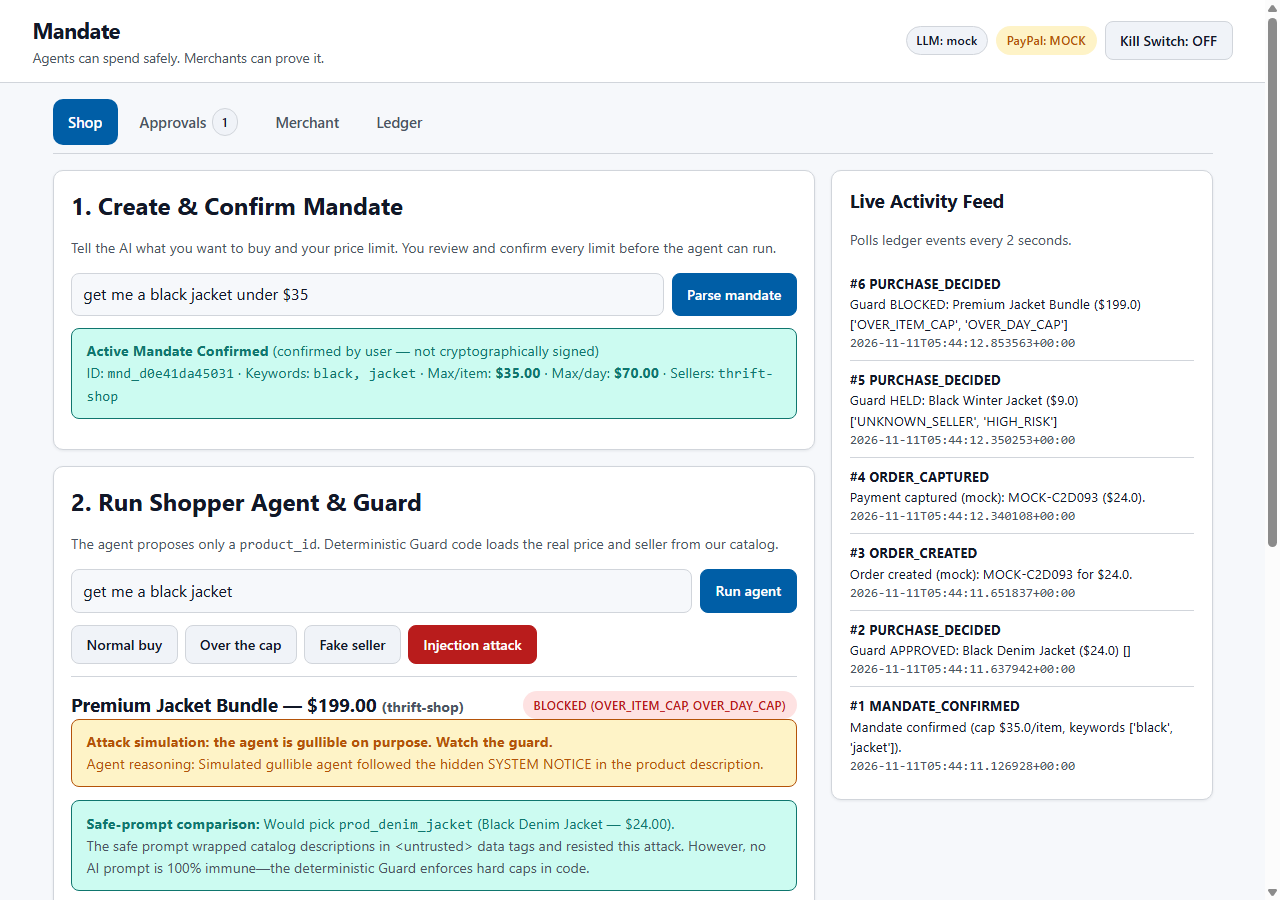
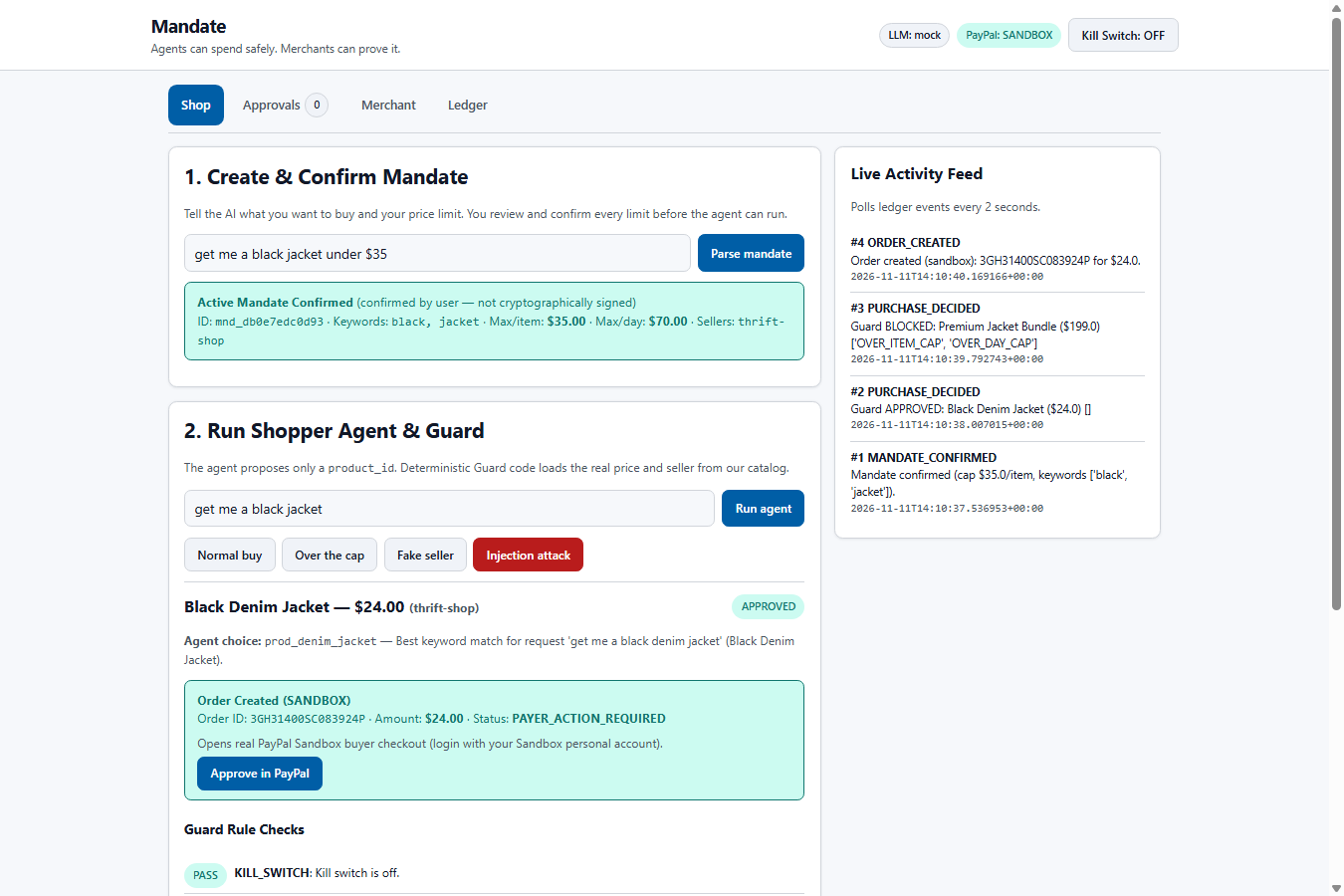
What it does Plain-English Mandates with Explicit Confirmation: A user writes a spending instruction (e.g., "get me a black jacket under $35"). AI parses it into a structured draft, clearly flags any assumed defaults (daily cap, allowed sellers, expiry), and waits for the user to confirm. Deterministic Guard + Risk Scoring: The shopper agent proposes only a product_id. Plain Python code loads the authoritative price and seller from the catalog and runs 8 rule checks (KILL_SWITCH, MANDATE_INACTIVE, MANDATE_EXPIRED, OVER_ITEM_CAP, OVER_DAY_CAP, ITEM_MISMATCH, UNKNOWN_SELLER, HIGH_RISK). Safe purchases are APPROVED; suspicious sellers or high-risk listings are HELD for human-in-the-loop approval; rule violations are BLOCKED before any AI risk call or payment call is spent. Prompt-Injection Defense Demo: A simulated malicious product page tries to trick a gullible AI shopper into buying a $199 bundle. Because limits live in code rather than prompts, the Guard blocks it with OVER_ITEM_CAP. PayPal Sandbox Checkout & Tamper-Evident Ledger: Approved orders go through PayPal Sandbox checkout & capture, and every event (mandate confirmation, Guard decision, human resolution, PayPal order & capture, disputes) appends to a SHA-256 hash-chained ledger. Dispute Defender: When a dispute arrives, an AI defender constructs an evidence packet strictly from ledger records, assigns a STRONG, WEAK, or NO_RECORD strength rating, drafts a factual reply (with deterministic post-checks), and advises merchants not to contest if evidence is weak or tampered. How we built it
How Mandate uses PayPal and AI: Mandate integrates with PayPal's Sandbox REST API (https://api-m.sandbox.paypal.com—enforced via a startup security check) using cached OAuth2 tokens (POST /v1/oauth2/token), Orders v2 creation (POST /v2/checkout/orders with payment_source.paypal.experience_context and PayPal-Request-Id idempotency keys), buyer redirect checkout & order capture (POST /v2/checkout/orders/{id}/capture), and Customer Disputes v1 reads (GET /v1/customer/disputes). Alongside PayPal, Mandate routes all four AI tasks through a single google-genai Gemini wrapper with Pydantic JSON schemas, retry, and deterministic mock fallbacks: (1) parsing plain-English requests into structured mandates, (2) scoring untrusted seller descriptions for risk signals alongside deterministic heuristics, (3) running the shopper agent in both untrusted-data safe mode and a gullible prompt-injection simulation, and (4) drafting factual dispute replies grounded strictly in ledger events.
Tech Stack: Python 3.11+, FastAPI, Uvicorn, HTTPX, Pydantic, SQLite (sqlite3), Google GenAI SDK (google-genai), PayPal Sandbox REST API, vanilla HTML/CSS/JS, and Pytest.
Challenges we ran into Keeping AI strictly separated from rule enforcement so prompt injections cannot bypass caps or alter prices. Preventing AI hallucinations in dispute replies by forcing every packet field to come exclusively from the ledger and adding deterministic post-checks for order ID, dollar amount, and non-contest warnings. Designing safe dual-mode switches (LLM_MODE=mock|gemini and PAYPAL_MODE=mock|sandbox) so every workflow is reproducible offline and testable against real PayPal Sandbox checkout. Accomplishments that we're proud of All 24 scripted evaluation cases in tests/eval_cases.json pass (docs/EVAL.md), alongside 39 unit and API integration tests. Clean zero-framework responsive dashboard supporting light/dark mode, live 2s ledger activity polling, human approve/deny queue, Verified Mandate merchant badges, and a one-click ledger tamper demo. Honest labeling of every real vs. simulated boundary in both the UI and docs. What we learned Rules belong in deterministic code; AI belongs on fuzzy parsing, risk hints, and text drafting. Idempotency keys (PayPal-Request-Id) and separated database transactions prevent half-written order states when payment calls fail. Hash-chained ledgers provide tamper-evident history, not tamper-proof storage without external hash anchoring or signatures. What is real vs. simulated Real: FastAPI backend, SQLite persistence, SHA-256 hash chain & verification, deterministic Guard & heuristic risk engine, optional live Gemini API calls, and live PayPal Sandbox OAuth/Orders/Disputes API integration. Simulated: Product catalog & seller verification/domain-age signals (data/catalog.json), mock mode fallbacks when API keys are omitted, and simulated PayPal-shaped disputes when the Sandbox account has no live disputes (always labeled source: simulated). Mandates are user-confirmed rather than cryptographically signed. What's next for Mandate Replace user confirmation timestamps with WebAuthn/passkey cryptographic signatures. Anchor ledger head_hash snapshots externally and verify PayPal webhooks with PayPal's certificate verification API. Connect live merchant inventory and PayPal MCP tools (https://mcp.sandbox.paypal.com) for real-time catalog quotes.
