-
-
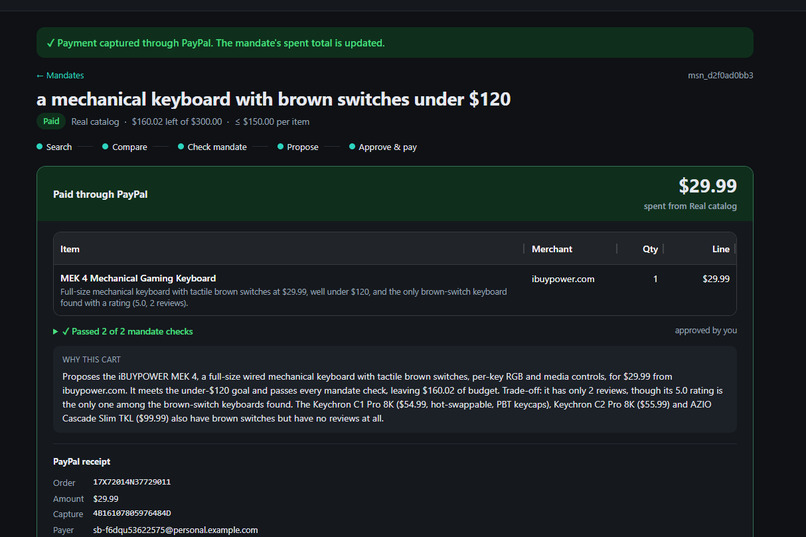
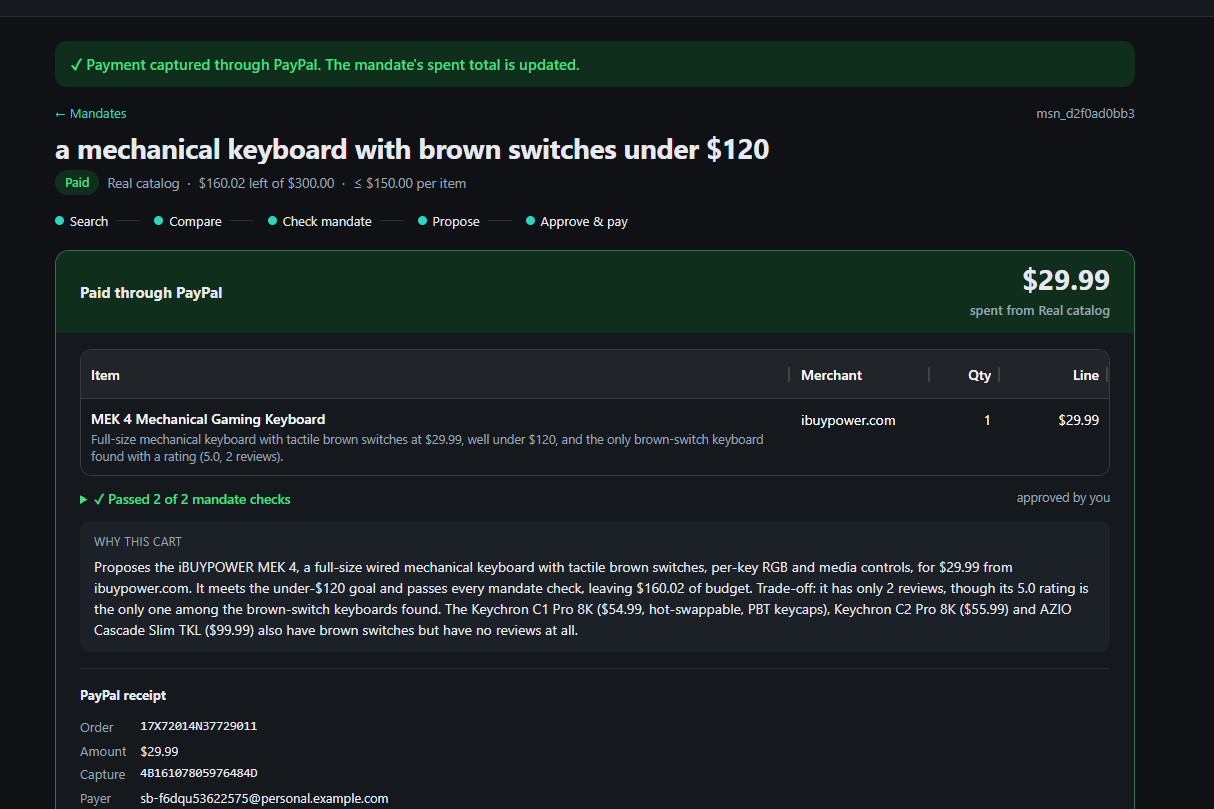
Live demo: a real PayPal sandbox order captured after a human approved the agent's cart, with order and capture IDs.
-
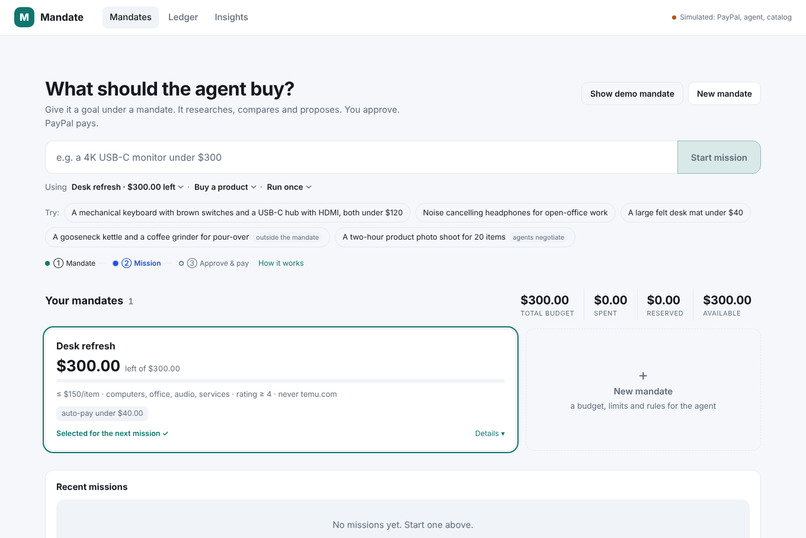
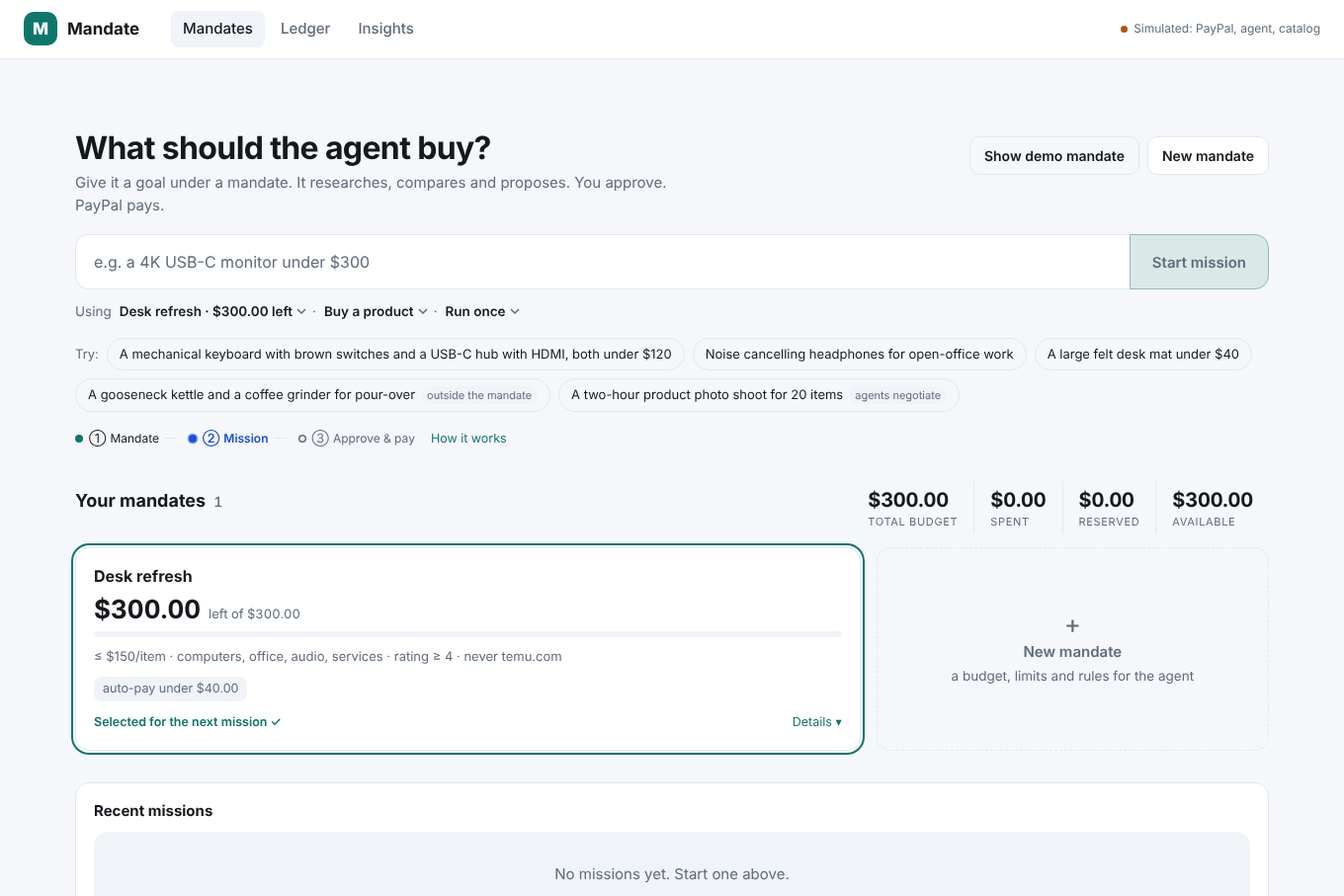
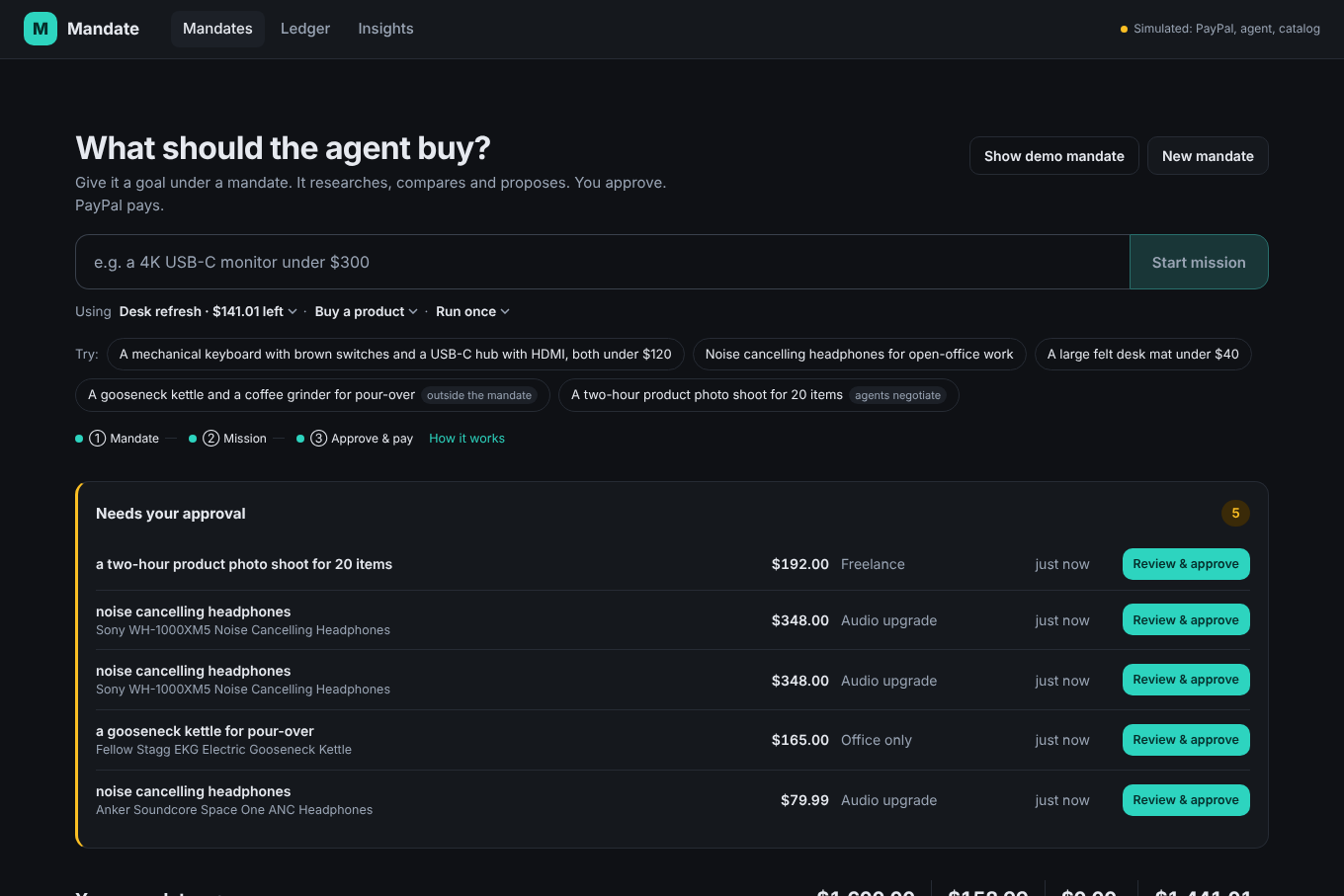
The dashboard (offline demo): give the agent a goal under a mandate and see the budget left and what needs approval.
-
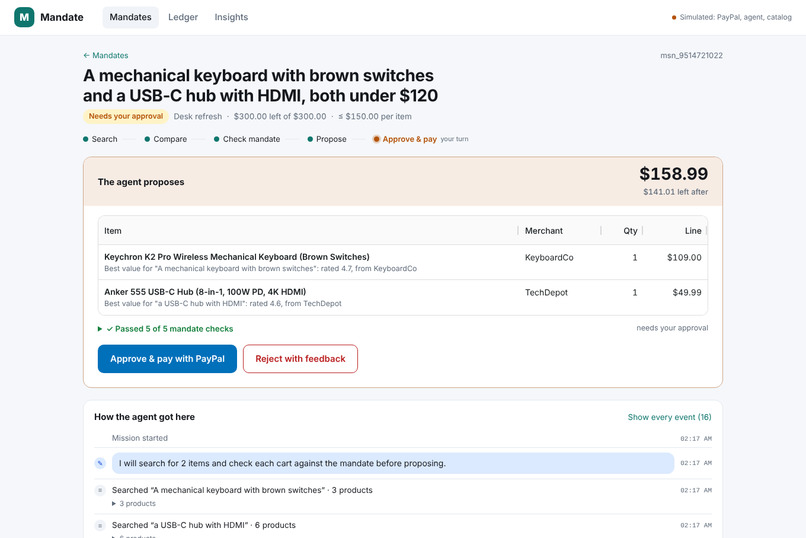
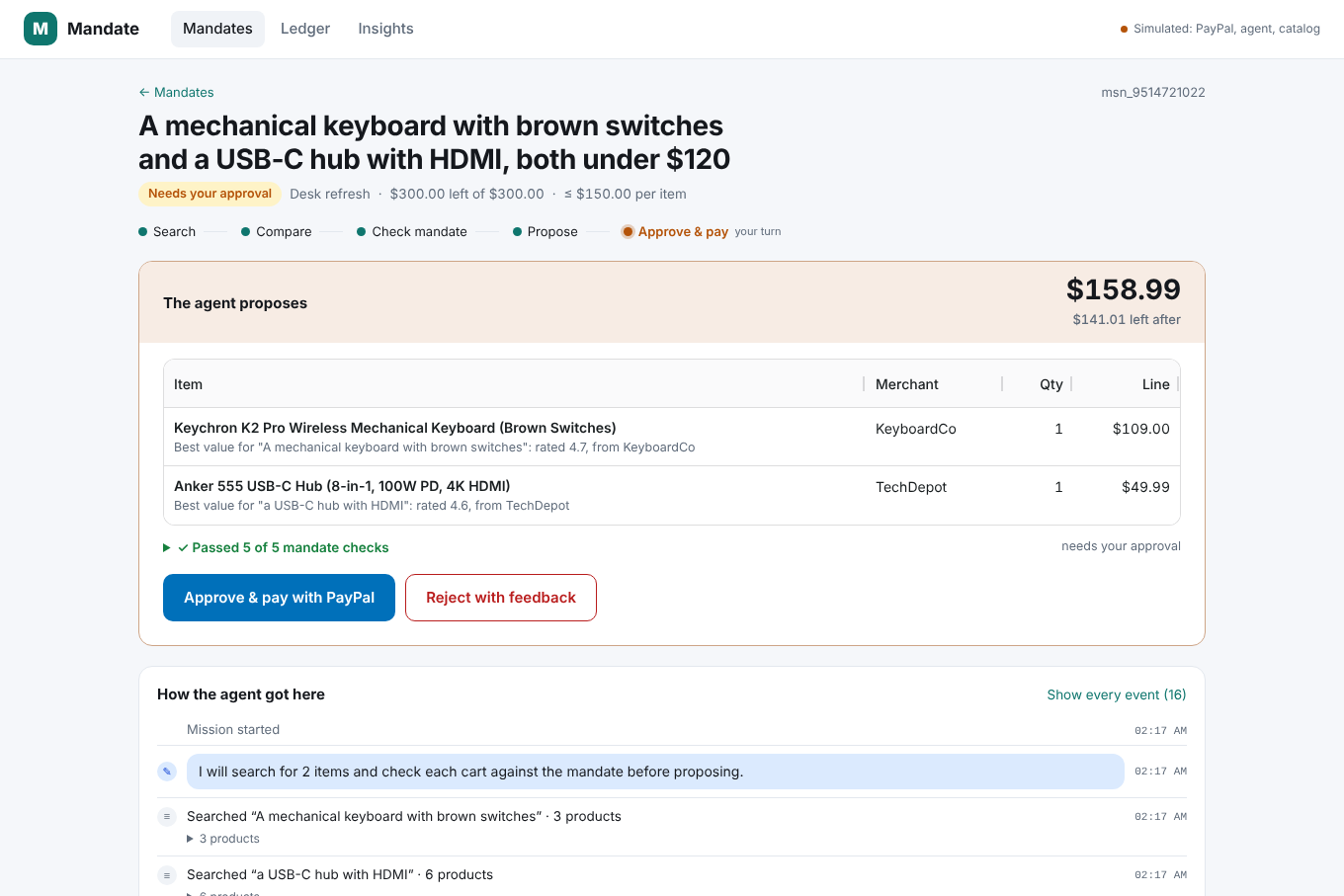
The agent proposes a cart that passed every mandate rule (offline demo). It cannot pay; only a human approval can.
-
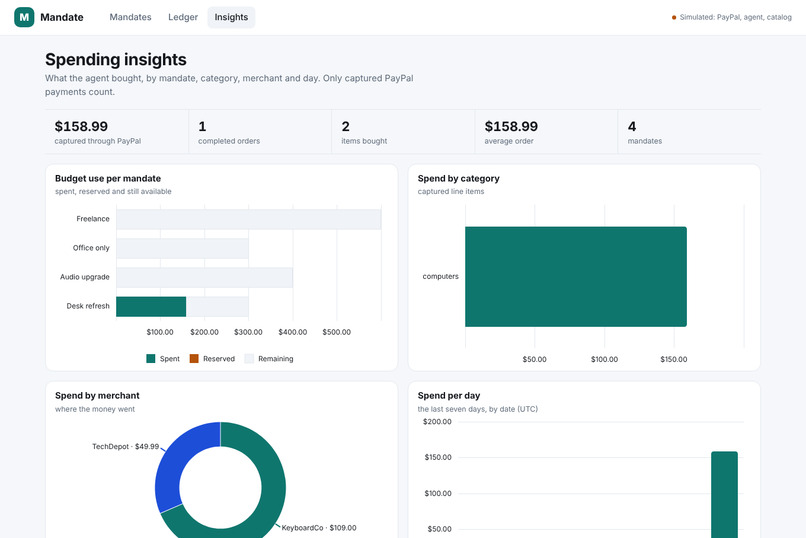
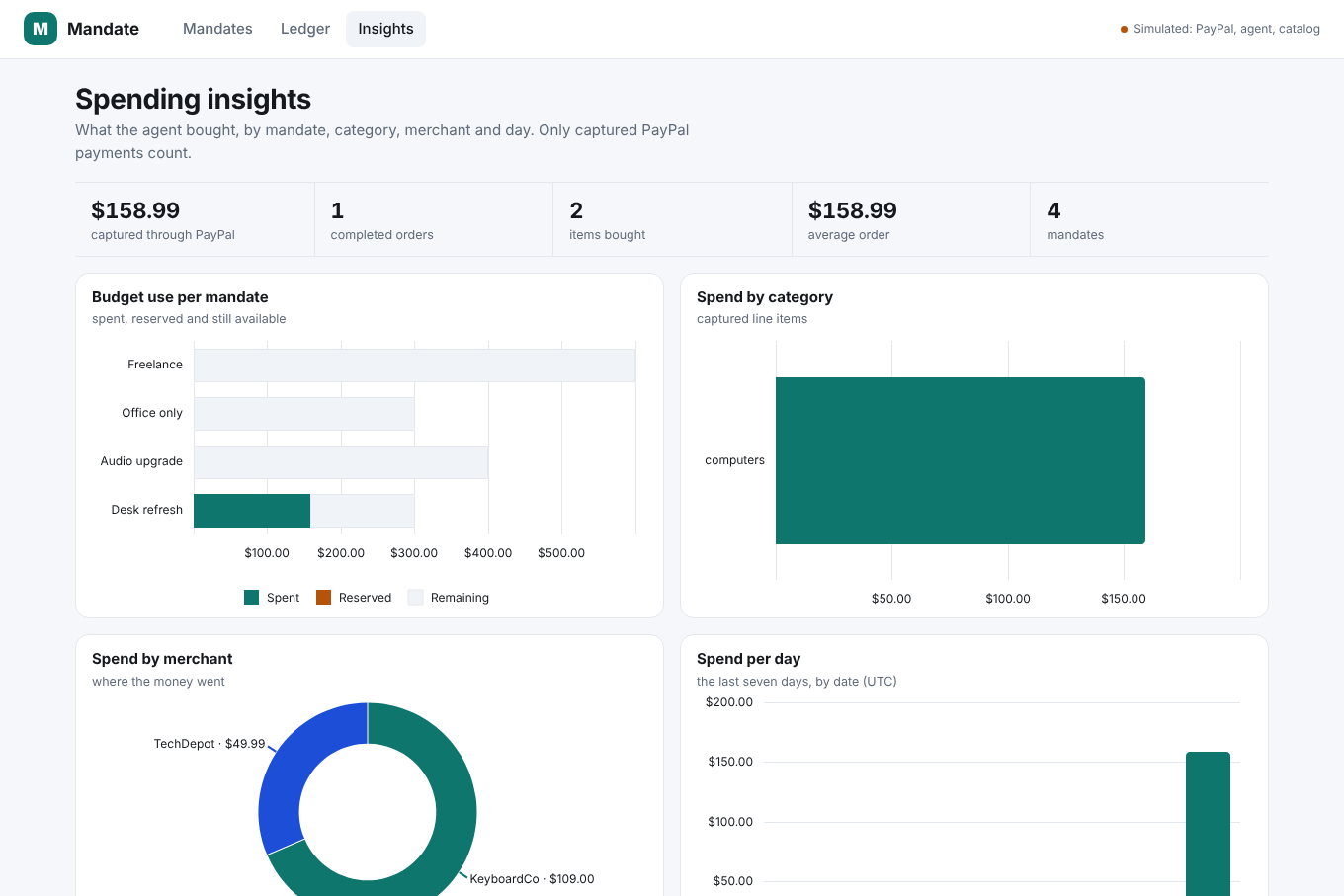
Insights with AG Charts (offline demo): budget use per mandate, spend by category, merchant and day.
-
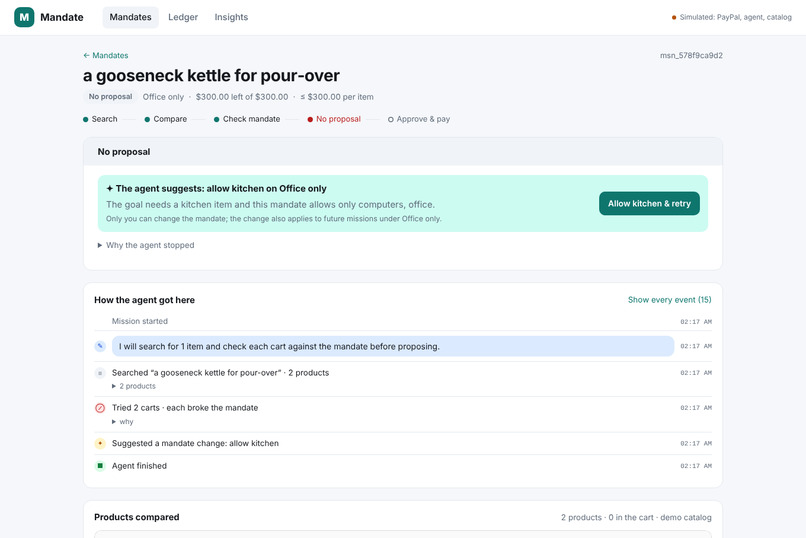
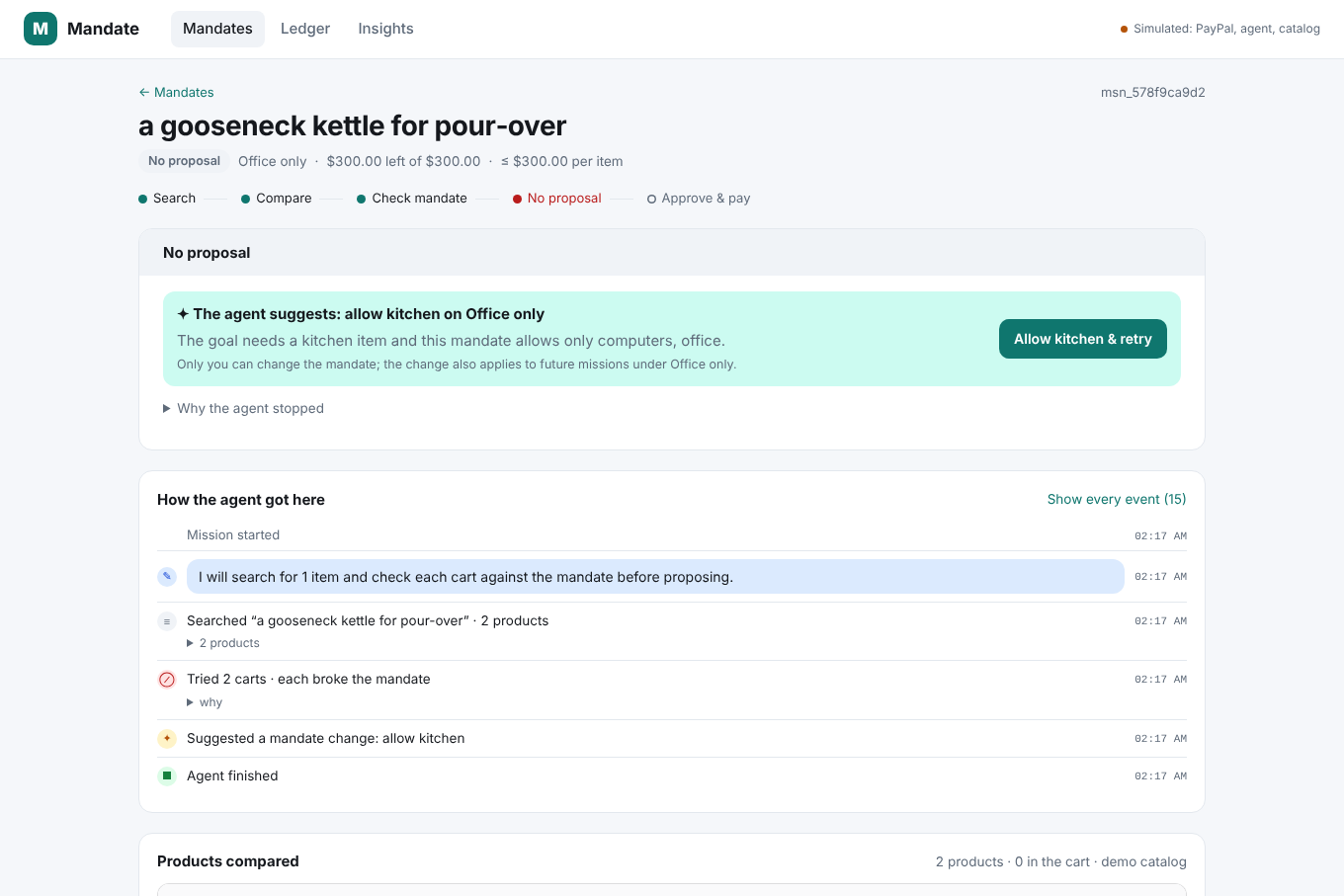
A goal outside the mandate: the agent suggests the smallest fix (offline demo). Only a human can apply it, in one click.
-
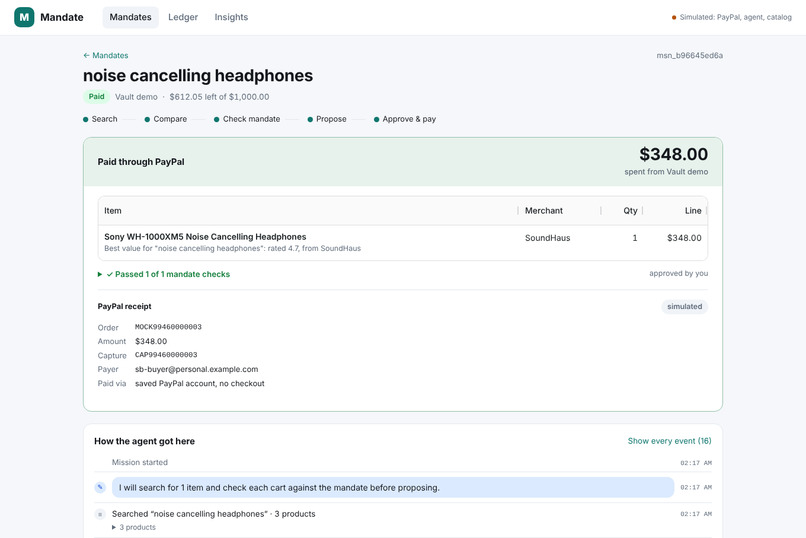
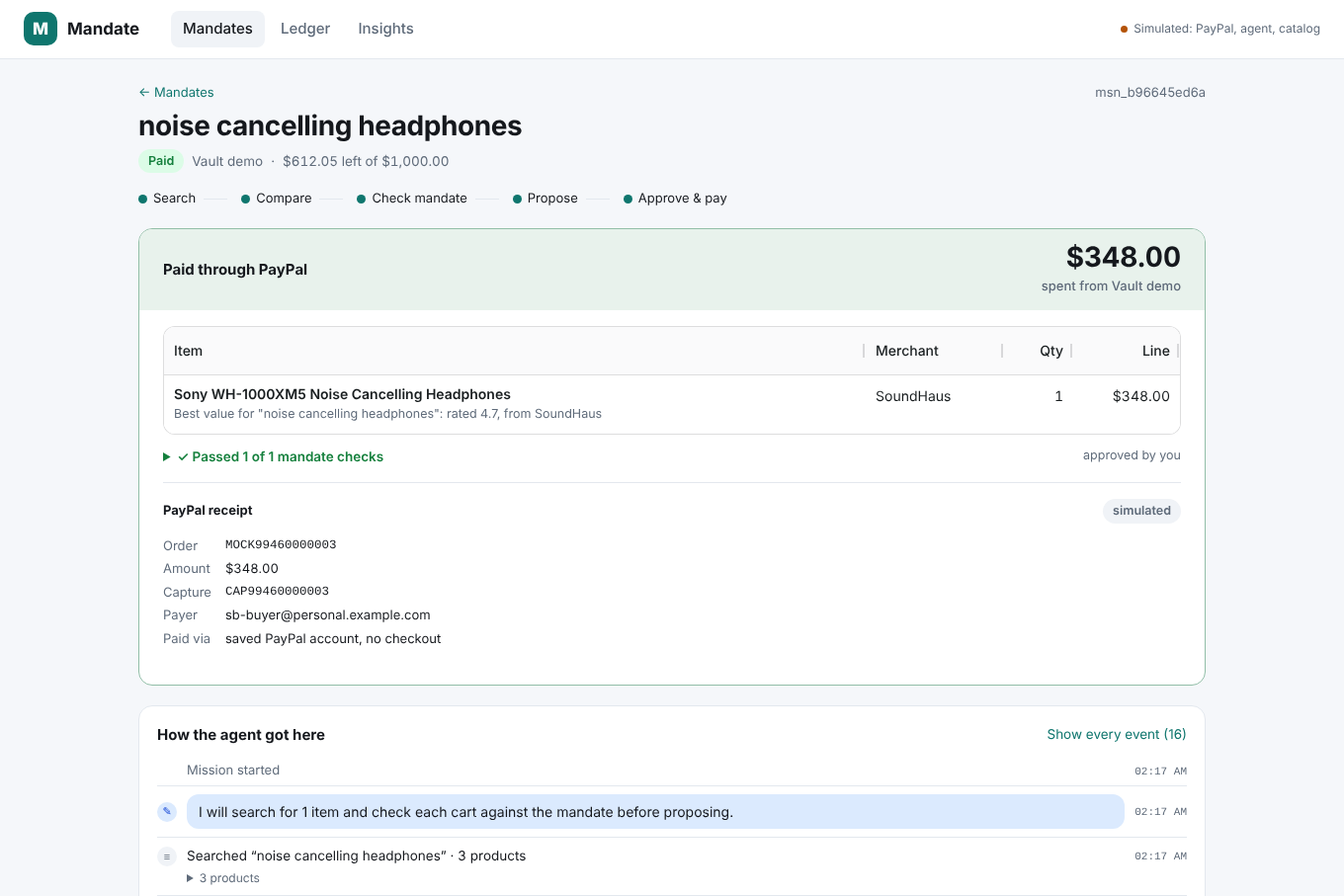
A saved PayPal account pays an approved cart in one click, no checkout (offline demo). The receipt shows the capture.
-
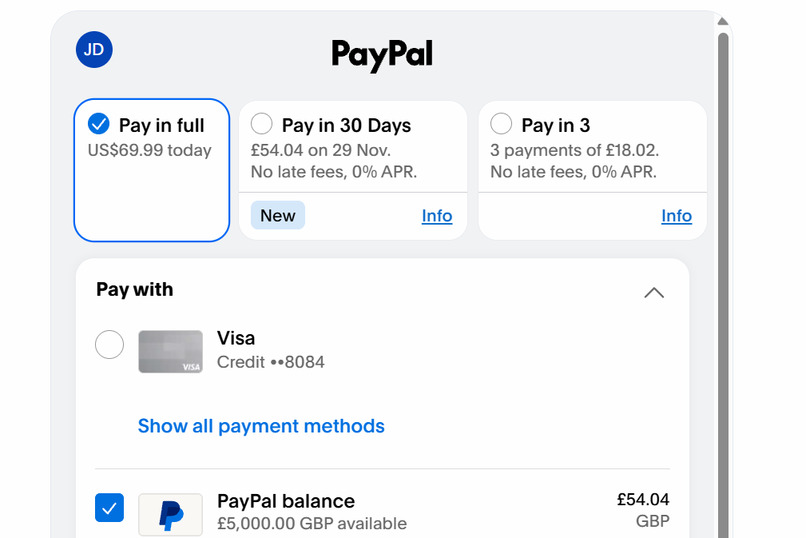
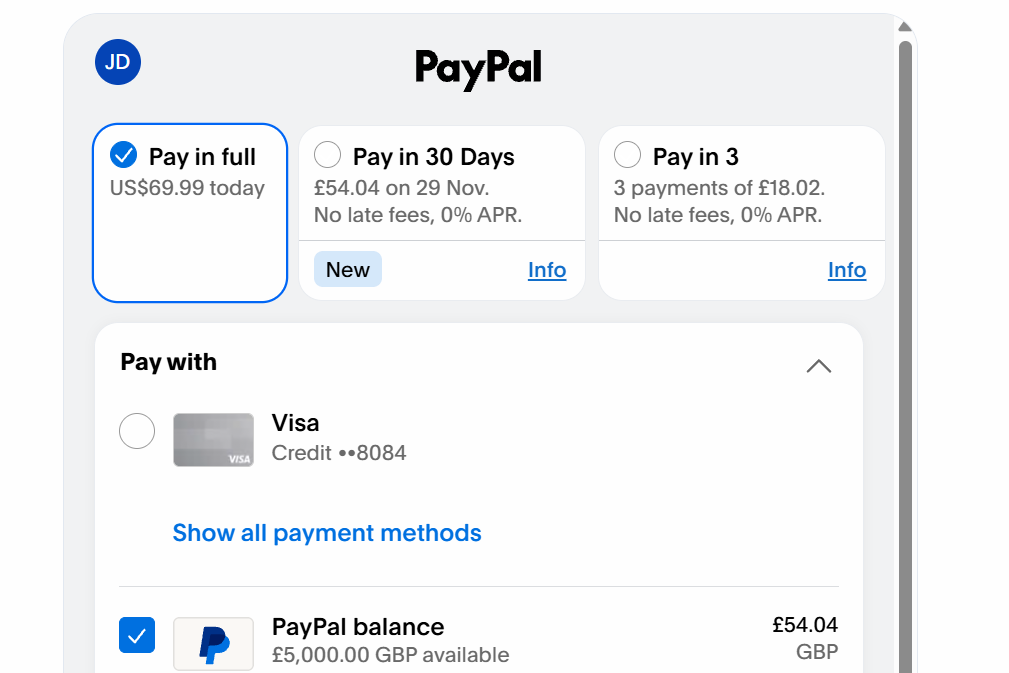
PayPal's own sandbox checkout: the buyer pays exactly the cart the human approved. No real money moves.
-
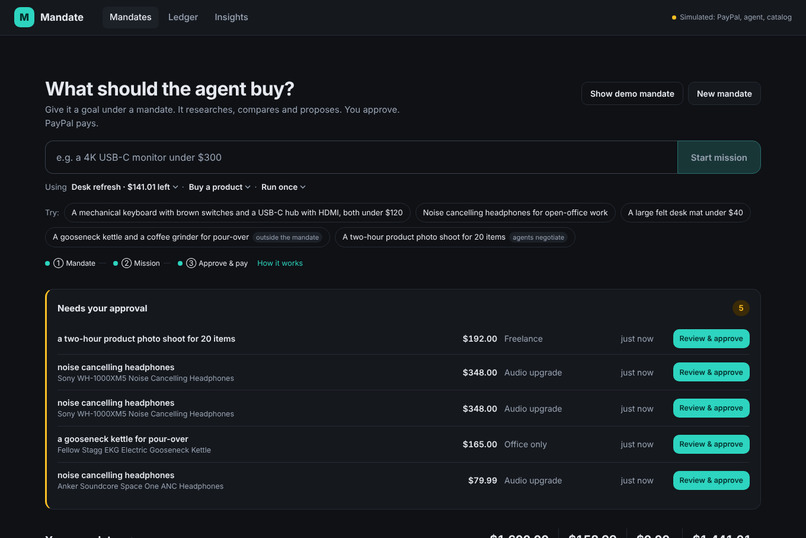
The same dashboard in dark mode with the AG Grid Theming API (offline demo).
-
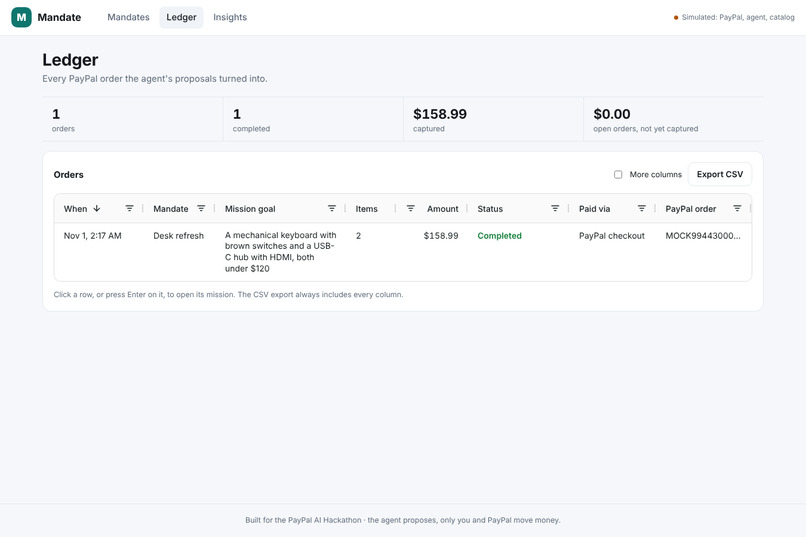
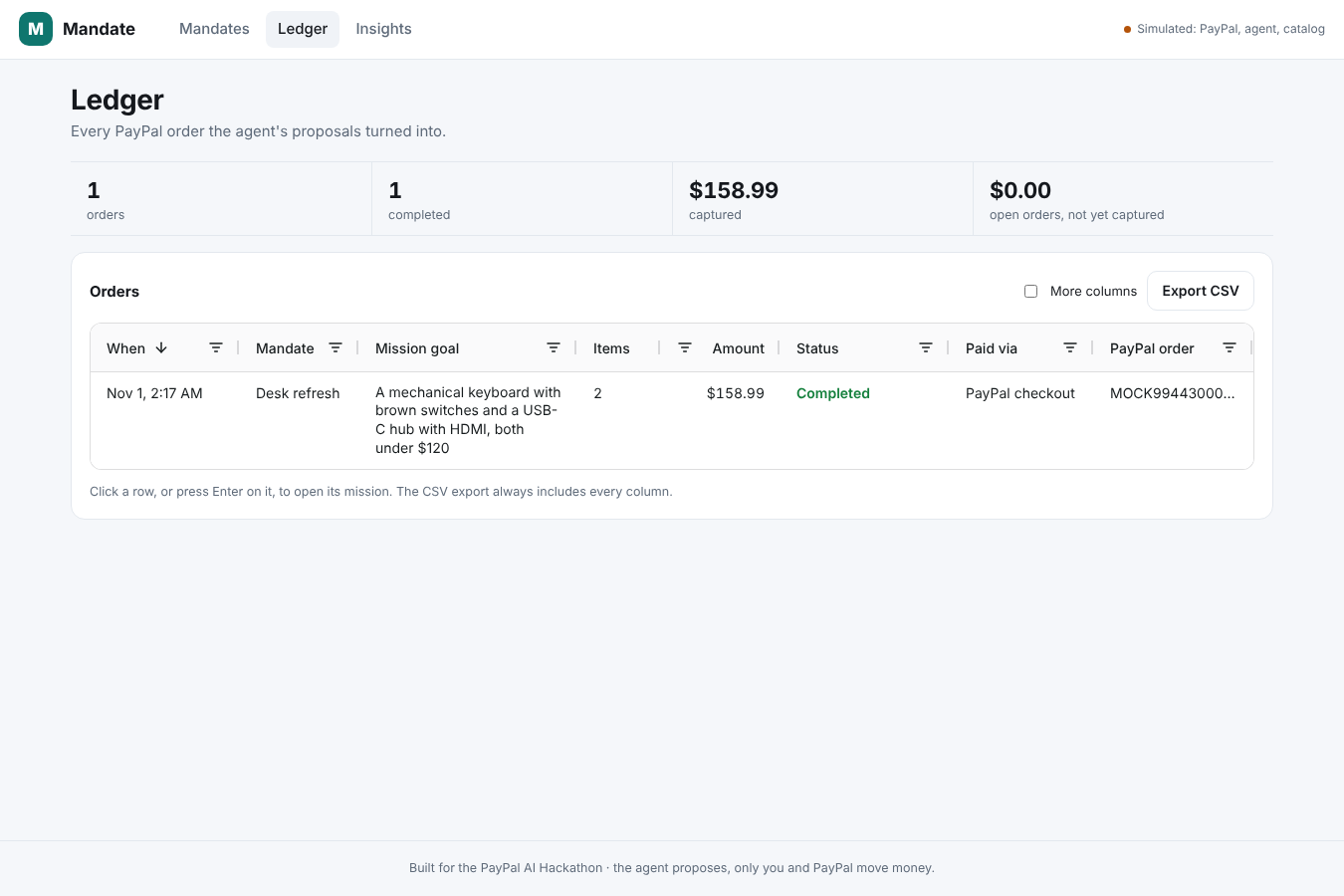
The ledger in AG Grid (offline demo): every order and capture with PayPal IDs, filters, CSV export and links to missions.
-
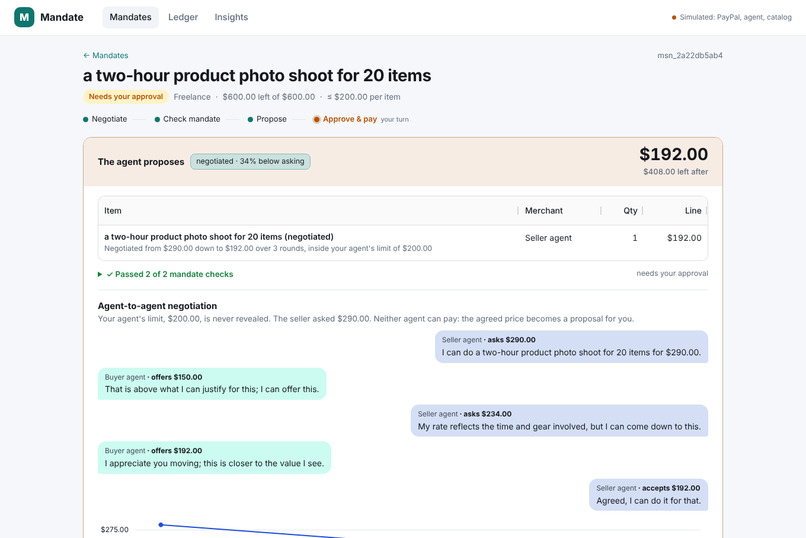
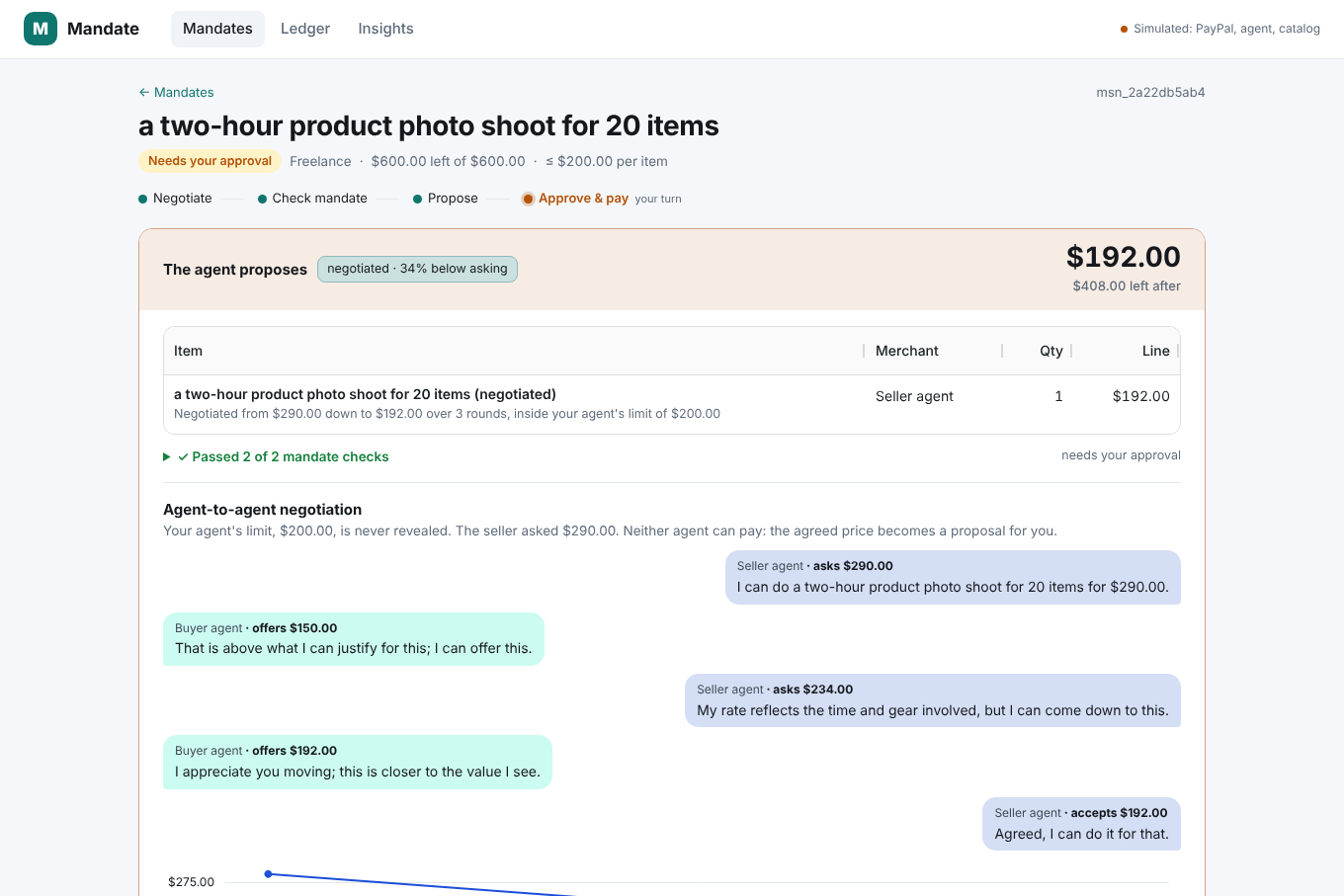
Two agents negotiate a price inside the mandate's limit (offline demo). The deal becomes a proposal a human approves.
Inspiration
Agentic commerce has a trust problem. Either the agent holds your wallet, or you do every checkout yourself. We wanted the middle: delegate a purchase the way you would to an assistant, with a mandate ("$250, nothing over $120, only computers and office gear, nothing from that merchant, rating 4.3+, ask me before paying") that is enforced in code rather than in a prompt. PayPal's own guidance for agent builders says to keep human oversight where judgment matters most; Mandate is that oversight, made into a product. It is also PayPal's Agent Payments Protocol in product form: the mandate is the intent mandate (human not present: budget, categories, timing), every cart you approve is a cart mandate (human present), and the PayPal order or vault payment is the payment credential tied to one proposal.
What it does
- You create a mandate: budget, per-item cap, auto-approve threshold, allowed categories, blocked merchants, minimum rating.
- You give the agent a mission in plain language.
- The agent (Claude, with five tools, none of which can pay) searches a real product catalog through Channel3, compares candidates, runs every cart through the policy engine, and proposes. You see its whole process live: searches, candidates in an AG Grid, mandate checks, the proposal with a reason per item and the alternatives it rejected.
- Approve creates a PayPal order for the exact cart and sends you to PayPal checkout. On return the order is captured and the budget is updated. Reject with feedback and the agent revises in the same conversation.
- When the goal cannot be met inside the mandate, the agent explains why and suggests the smallest change (a higher cap, an extra category, an unblocked merchant). It cannot change its own mandate; you click one button (for example Allow kitchen & retry).
- Save the account, pay with one click. A mandate can ask PayPal to save your PayPal account at the first checkout (PayPal vault). After that, carts you approve are paid with one click, and carts under the auto-approve threshold are paid with no click at all, with the mandate still deciding every cent.
- Agent-to-agent commerce. Choose Hire a service and a buyer agent, bound by your mandate, negotiates the price with a seller agent (PayPal's own inspiration list: "two agents negotiating and settling a payment"). The buyer never reveals or exceeds its hard limit; the transcript and the price curve are on the mission page; the agreed price becomes an ordinary proposal that you approve and PayPal settles. Neither agent can pay.
- Standing orders: start a mission with "repeat monthly" and the agent re-runs the goal on schedule. Each run is checked against the mandate; with a saved PayPal account and a cart under the threshold it completes with nobody in the loop, and it stops when the budget runs out. Run now and Stop are one click.
- A ledger lists every order with PayPal order and capture IDs, exportable to CSV, and an Insights page charts budget use per mandate, spend by category, merchant and day (AG Charts) over an AG Grid of every item bought.
- Ask about your orders. An order assistant answers questions like "did my last order get captured?" or "any refunds or disputes?" from the ledger and from PayPal itself, through PayPal's hosted MCP server (the PayPal Agent Toolkit). Only PayPal's read-only tools are enabled for it: it can look, never pay. Honest status: since 1 Nov 2026 PayPal's hosted sandbox MCP answers every tool call with an error on its side ("Unsupported cache mode: default"), so today the assistant answers from the ledger and says it could not check PayPal.
How we built it
- Go backend: policy engine, agent tool loop on the Claude Messages API (official Go SDK, prompt caching, server-side model fallback), PayPal Orders v2 client (OAuth2, create with items and breakdown, approve redirect, capture, reconcile, cancel, idempotency via
PayPal-Request-Id), PayPal vault (save the account at checkout, pay later withvault_id, fall back to checkout when a token dies), verified PayPal webhooks, PayPal's hosted MCP server through the Anthropic MCP connector with a read-onlymcp_toolset(the server does the MCP handshake itself at startup to verify credentials and discover tools), a minute scheduler for standing orders, JSON persistence, server-sent events. - React + TypeScript + AG Grid + AG Charts UI: dashboard with live budget bars and standing orders, mission page with activity stream, proposal grid and approval, ledger grid with CSV export, a spending insights page (four charts plus a grouped, filterable grid of every purchased item), and the order assistant panel.
- Channel3 product search API as the live catalog (search with price, availability and condition filters; product detail for verification). Every candidate in the UI links to the merchant's page, and the Channel3 product IDs travel into the PayPal order items.
- Mock PayPal simulator and a scripted agent make the entire flow testable without network:
go test ./...runs the end-to-end flow through real HTTP (checkout, saved-account payments, webhooks, suggestions, standing orders, insights, the MCP assistant), and Playwright scripts drive the UI. - Deployed on a small Linux server from a GitHub Actions release with a one-line install script; Docker Compose and a Render blueprint are included.
Challenges we ran into
- Making the agent safe by construction: the agent has no payment tool at all; payment is a server-side consequence of a human decision, and the policy engine re-runs at approval time because budgets move.
- Money accounting that survives real-world mess: budget reservations on order creation, release exactly once on capture, cancel, void or decline, capture-on-return with an
ORDER_ALREADY_CAPTUREDguard, serialised money transitions, and a reconciliation endpoint for buyers who approve but never come back. PayPal reports an order COMPLETED after any capture attempt, so the ledger books money on the capture's own status: a pending capture (eCheck, review) stays reserved until PayPal completes it, a declined one hands the cart back for a fresh approval, and a refund that arrives before its capture is parked and applied when the capture is booked. Every one of these paths has a test, and the suite runs under Go's race detector in CI. - Treating the catalog as hostile: product titles and descriptions are third-party text, so the agent is told to treat instructions inside them as noise, a product's category comes from the retailer's category path and never from its title, and the guards are code rather than prompt: one live cart per mission, none after a cart was paid, capped quantities and proposals. A hijacked agent can only propose, and with a saved PayPal account the auto-approve threshold the human chose is the most it could ever spend in one mission. The README has the full threat model.
- Leaving a demo with no logins on the public internet: every input is bounded (amounts, names, lists, goals, feedback, body size, number of mandates), there are per-address limits on agent runs, searches, PayPal calls and open event streams next to the global hourly cap, cross-site POSTs are refused, responses carry security headers, and the saved PayPal token id never leaves the server.
- Giving the agent more PayPal reach without more power: the order assistant reads PayPal through its MCP server, but the mutating tools (create, pay, refund, accept dispute) are disabled in the toolset, and the assistant falls back to the ledger when PayPal's sandbox MCP has a bad day.
- Keeping the demo honest: everything judges see in mock mode is the same code path as sandbox mode behind an interface.
Accomplishments that we're proud of
- A complete product, not a proof of concept: create → research → propose → approve → PayPal → ledger, with tests covering the whole chain (over a hundred end-to-end tests through real HTTP, run with the race detector in CI), eleven review passes and a security audit before submission.
- It runs live against the PayPal sandbox, Claude Opus 5.5 and Channel3's real catalog; the README shows a real run with a captured sandbox order.
- Two PayPal surfaces for the AI, with the money line drawn in code: the shopping agent proposes and the server pays through Orders v2 after approval; the order assistant reads PayPal through its MCP server with mutating tools disabled.
- Agent-to-agent negotiation that stays inside the human's mandate: the buyer agent cannot exceed its limit, the seller agent cannot go below its floor, and the settlement is a normal PayPal approval, so "two agents negotiating" never becomes "two agents spending".
- Agentic payments without giving the agent a wallet: the saved PayPal account turns a mandate into a real spending authority (one-click approvals, no-click auto-pay under the threshold, standing orders), and the policy engine still bounds every charge.
- The agent explains why a goal cannot be met inside a mandate and proposes the smallest fix; the human applies it with one click. The policy stays human-owned, but the loop is fast.
- Rejection with feedback continues the same conversation; the agent genuinely revises.
What we learned
- Spending controls belong outside the model. Prompts steer; policy engines enforce.
- PayPal's Orders v2 flow maps naturally onto "agent proposes, human approves": the approve link is the human gate, and the vault turns that one consent into a durable, bounded authority.
- Supervised and autonomous agentic commerce are the same product with one threshold: everything above it waits for a human, everything below it just happens, and the mandate bounds both.
What's next for Mandate
- Shared mandates for teams, with per-person limits inside one budget.
- Multi-currency mandates, Pay Later at checkout, and PayPal's Agent Ready checkout once it opens up to sandbox developers.
- Let the order assistant draft (never send) PayPal invoices and dispute responses for a human to approve, using the MCP tools that are disabled today.
Built With
- ag-charts
- ag-grid
- anthropic-sdk
- channel3
- claude
- docker
- go
- paypal
- paypal-mcp
- paypal-orders-api
- paypal-vault
- paypal-webhooks
- playwright
- react
- render
- typescript
- vite

Log in or sign up for Devpost to join the conversation.