Inspiration
Clinical findings are often difficult to describe precisely in text. Location, size, orientation, distribution, images, and changes over time can lose meaning when reduced to a few sentences.
The problem becomes harder in hands-busy clinical settings, where opening forms and repeatedly switching tools interrupts the encounter.
ManageMyCare turns anatomical documentation into a direct visual workflow.
What it does
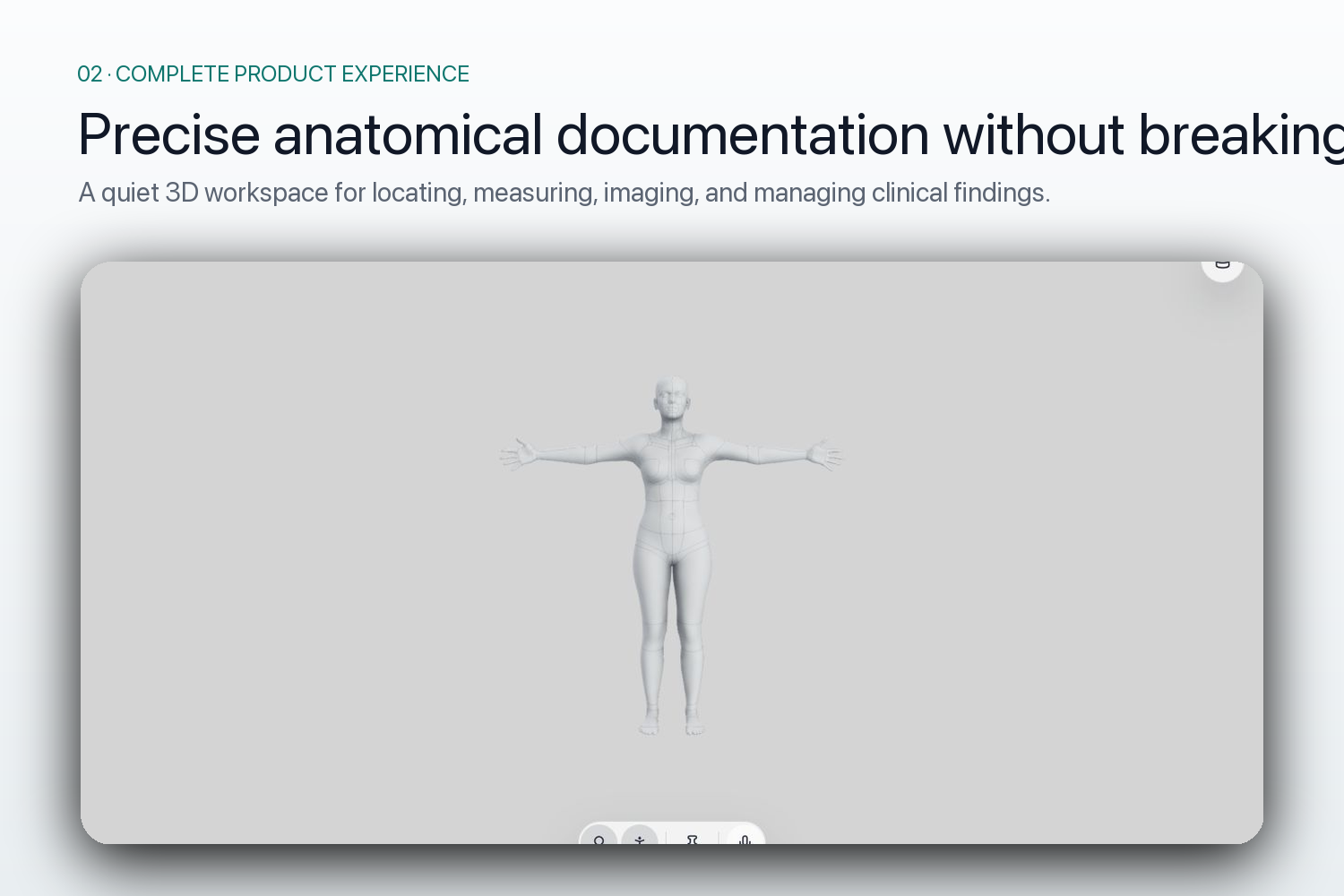
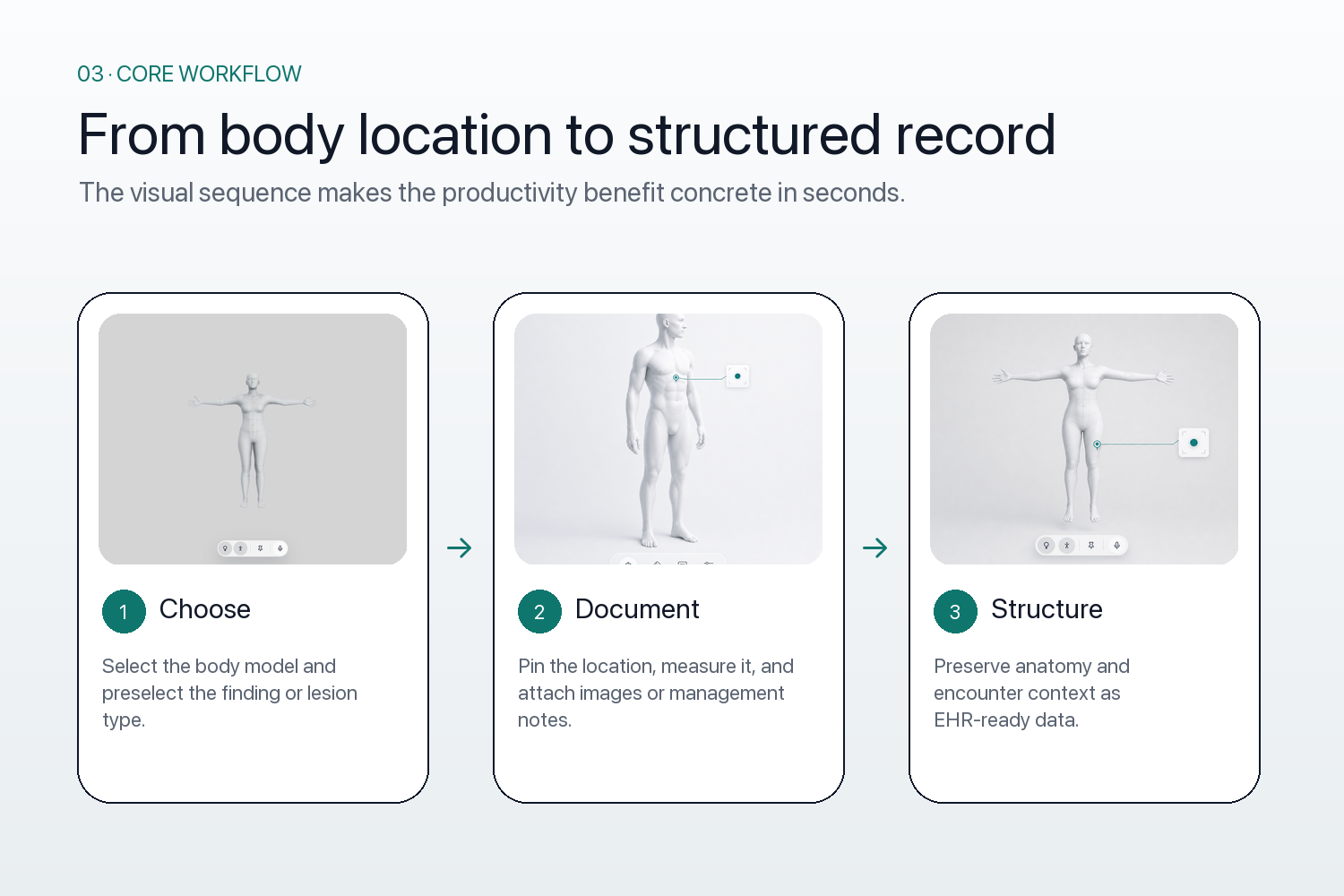
ManageMyCare is an interactive 3D clinical body map for documenting lesions, findings, measurements, images, and management plans.
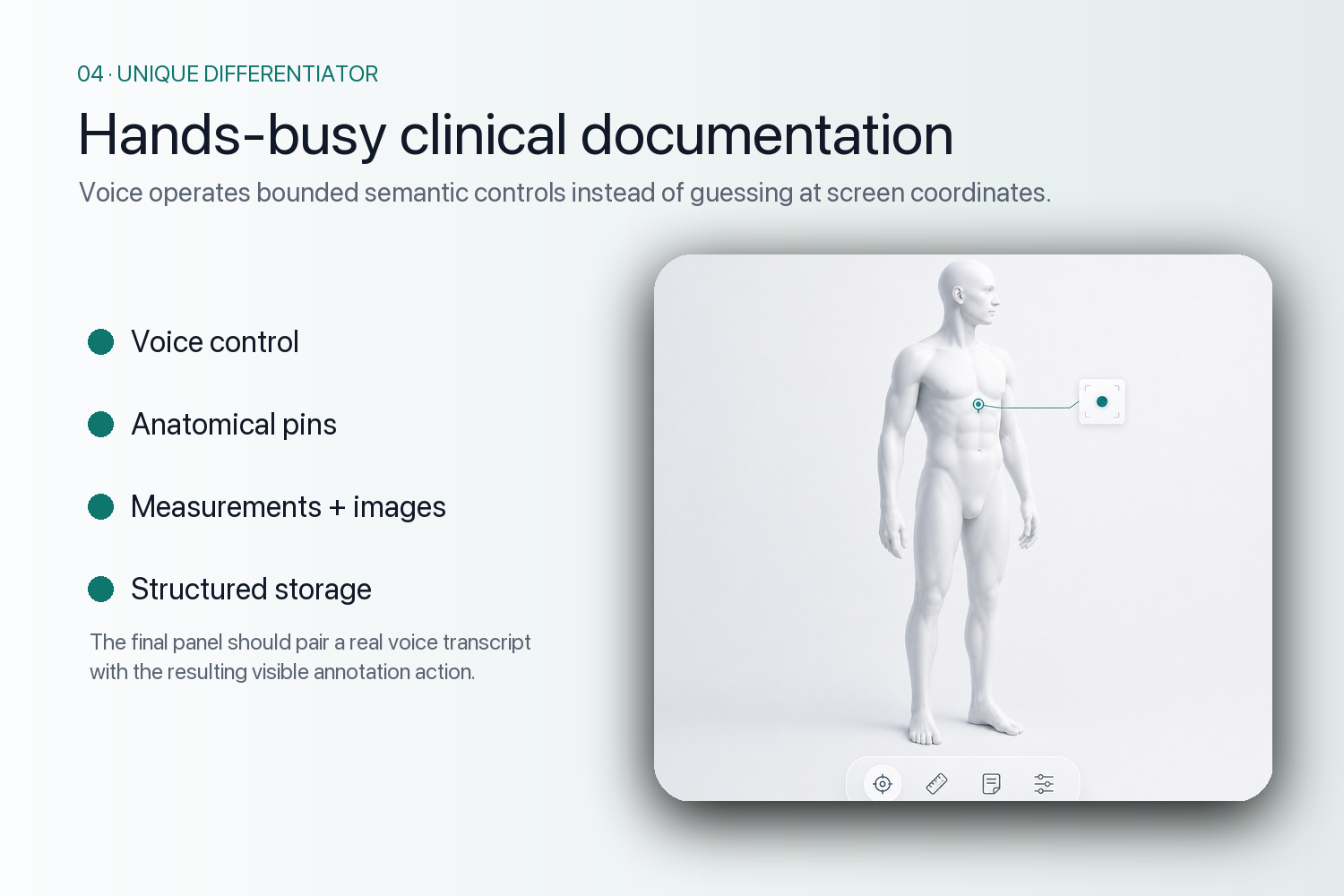
Clinicians can choose skin, oral-cavity, and skeletal models; select a lesion type before placing it; pin findings directly to anatomy; measure areas; attach images; and preserve the result as structured, patient-linked data.
Its agent and realtime voice controls can inspect the current application state and operate semantic controls. A clinician can navigate the model and add documentation without relying entirely on mouse and keyboard interaction.
This is useful anywhere anatomical location matters, including dermatology, wound care, emergency medicine, primary care, nursing, surgery, and longitudinal follow-up.
Structured clinical integration
ManageMyCare is designed to integrate into an existing EHR rather than become a disconnected image or drawing tool.
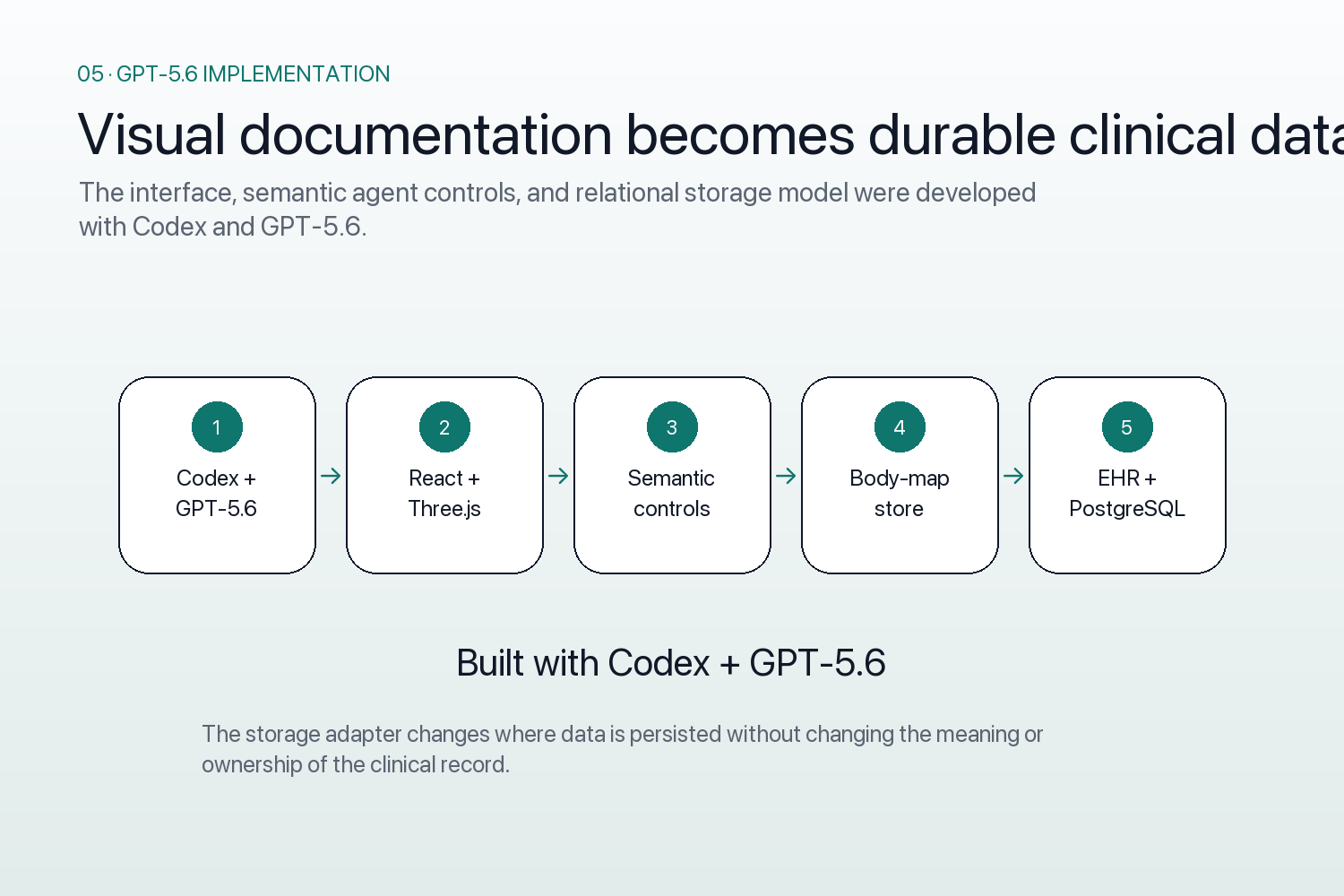
Its relational model preserves body maps, anatomical regions, labels, lesion categories, measurements, images, patient context, encounters, status, and model versions. IndexedDB currently supports local persistence while the same storage contract defines the transition to an EHR API and PostgreSQL.
How it was built
The application uses React, TypeScript, Three.js, React Three Fiber, and OpenHuman-derived anatomical assets. Agent operation uses the OpenAI Agents SDK with bounded semantic tools, while realtime voice supports hands-busy interaction.
I used Codex and GPT-5.6 to develop the 3D interaction system, agent controls, voice workflows, anatomical model integration, structured storage architecture, tests, and clinical documentation experience.
Challenges and lessons
The challenge was making a sophisticated 3D interface faster than ordinary documentation, not merely more impressive.
Presets reduce repetitive entry, semantic controls keep AI actions bounded, and the structured storage layer ensures that visual annotations can become durable clinical information instead of being trapped in a screenshot.
What's next
Next steps include production EHR integration, longitudinal comparison between visits, additional anatomical systems, richer image workflows, and validation with hands-busy healthcare professionals.
Built With
- codex
- gpt-5.6
- indexeddb
- openai-agents-sdk
- openai-realtime-api
- postgresql
- react
- react-three-fiber
- three.js
- typescript


Log in or sign up for Devpost to join the conversation.