ManageKaro (मैनेज करो)
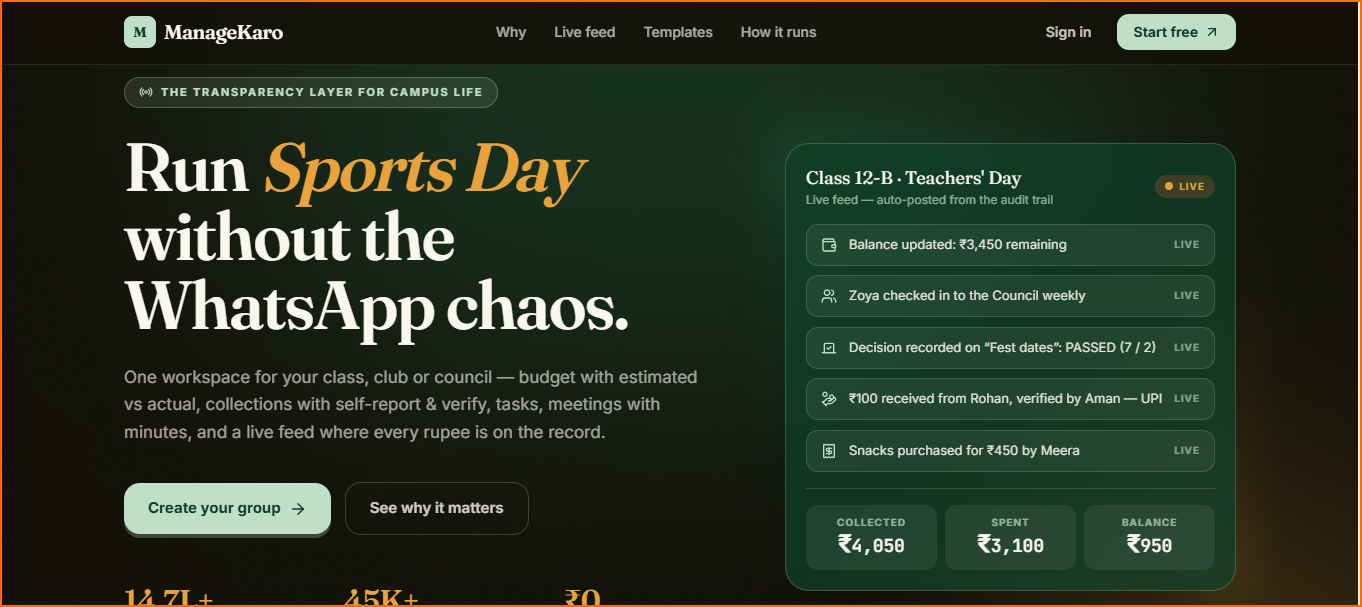
Every rupee and decision on the record. ManageKaro is the transparent operating system for campus events — budgeting, UPI collections, conflict-free venue booking, live meetings, and audit trails, all in one workspace built for student clubs.
Project story
Inspiration
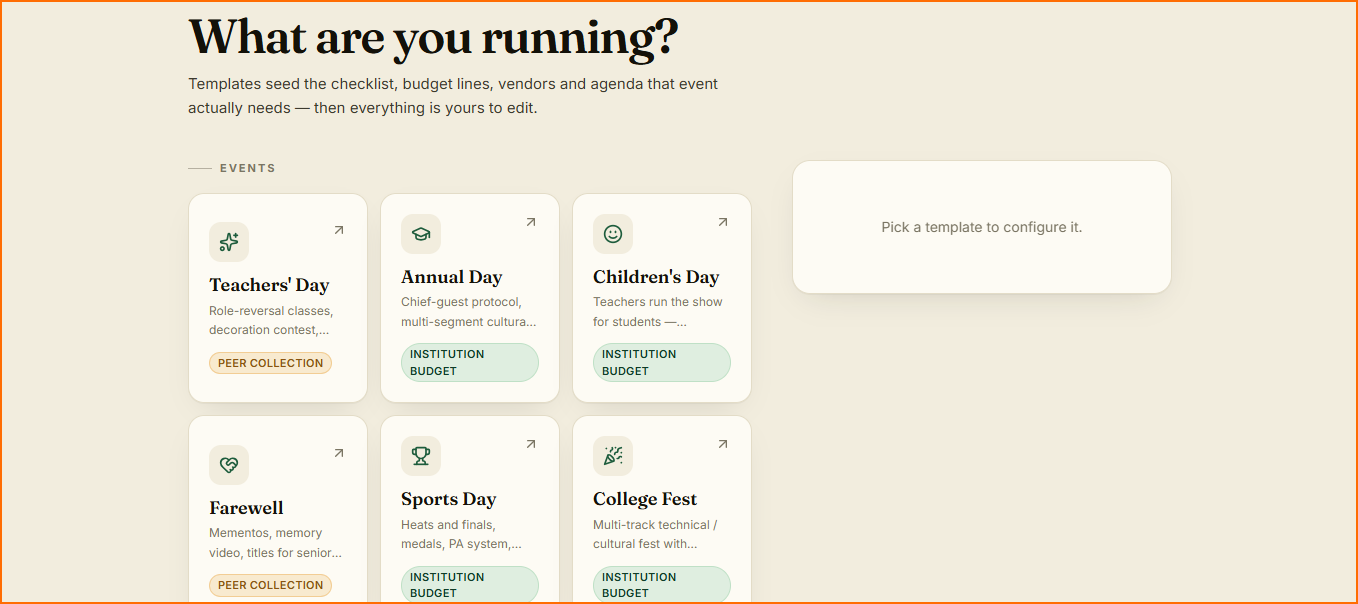
This year, I was put in charge of managing my school's Teachers' Day event. What followed was chaos: contributions were tracked in a Google Sheet nobody trusted, payments arrived as UPI screenshots scattered across three WhatsApp groups, two clubs nearly fought over the same auditorium on the same day, and our general body meeting ended with disputed vote counts and no minutes. The worst part came weeks later — the audits. Reconstructing who paid what, matching bills to expenses, and answering questions with nothing but screenshots and memory was exhausting.
That experience stuck with me. Schools and colleges run hundreds of events every year, yet student organizers have no dedicated system — they're stuck between institutional ERPs built for administrators and generic event apps built for ticket sales. I built ManageKaro to be the system I wished I had: a single transparent workspace where every rupee and every decision is on the record.
What it does
ManageKaro gives campus clubs, student councils, and department committees one home for running events:
- Transparent money — dynamic UPI QR collections with purpose tags, two-step payment verification against receipts, budget lines requiring admin sign-off, and an AI-assisted receipt vault.
- Conflict-free venue booking — a smart conflict engine that prevents double-booking auditoriums, labs, and equipment, with an institutional master calendar and faculty approval workflows.
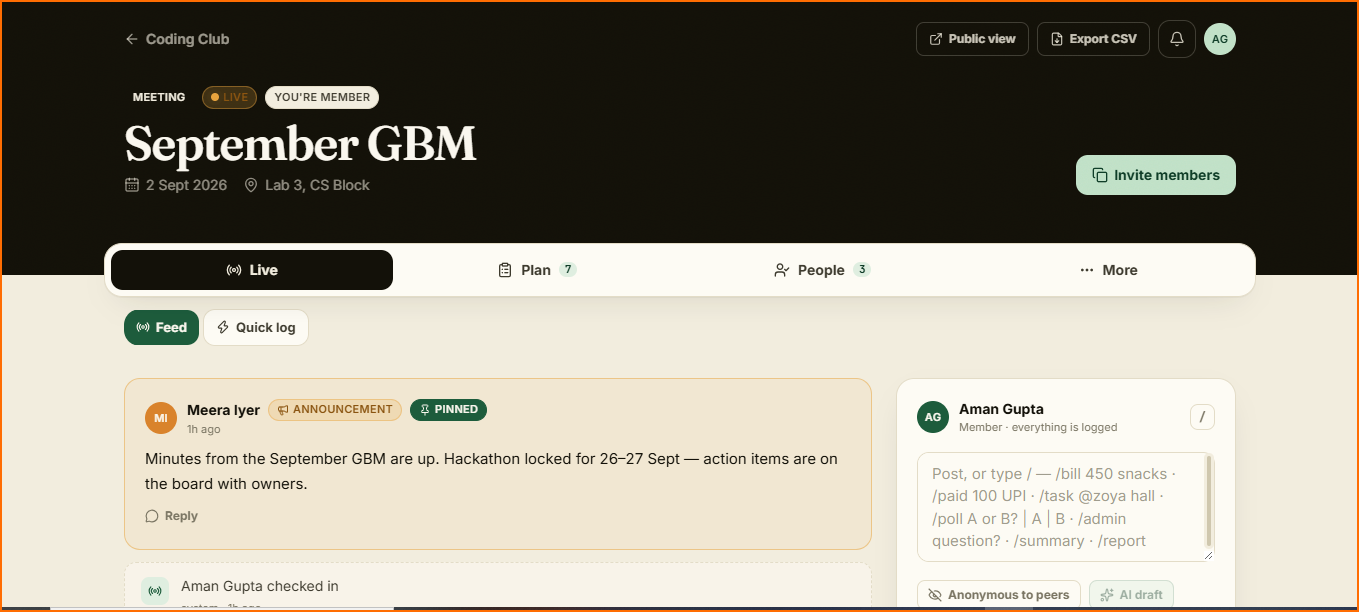
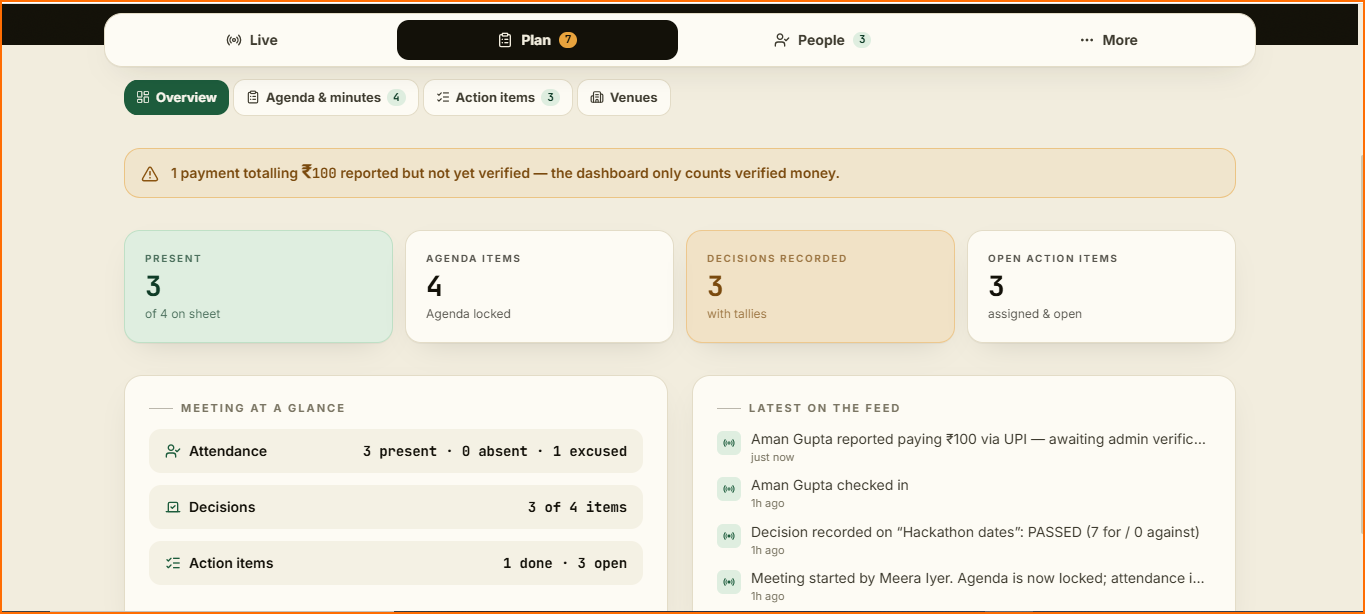
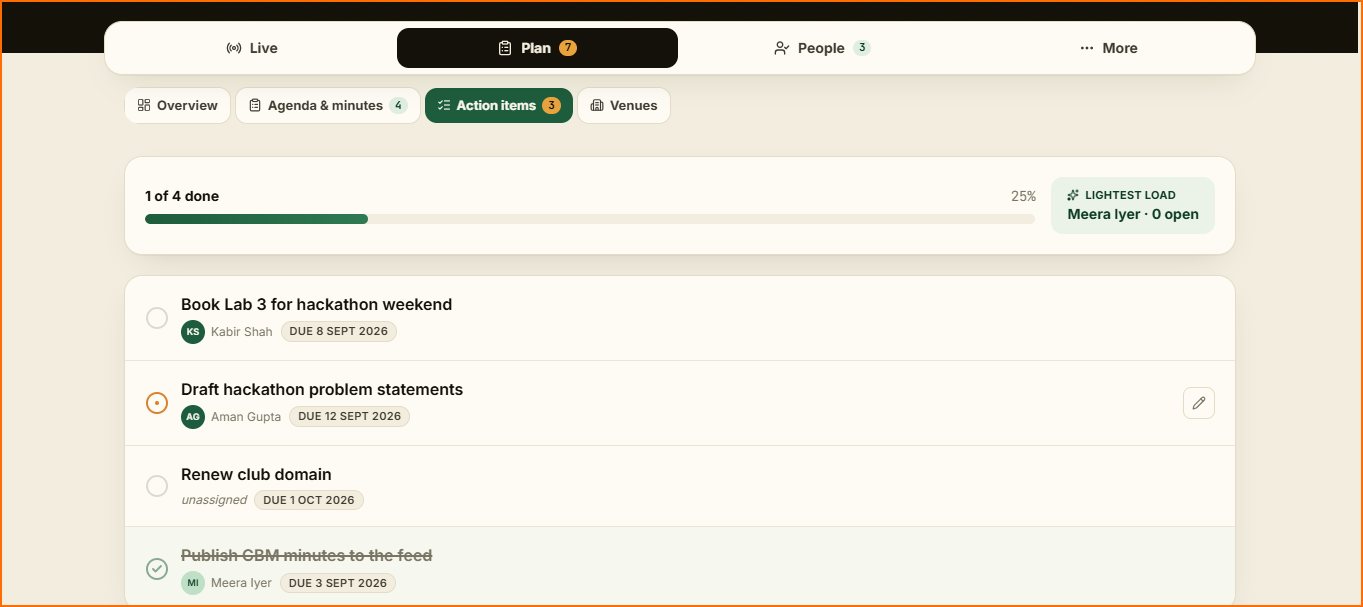
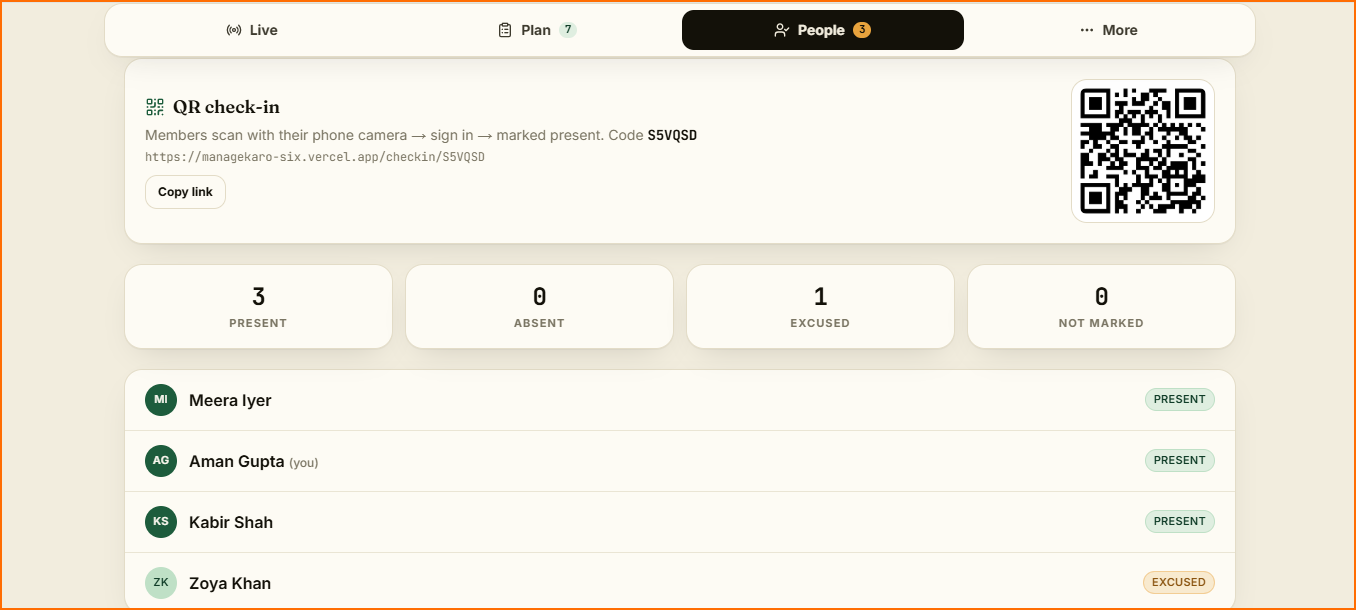
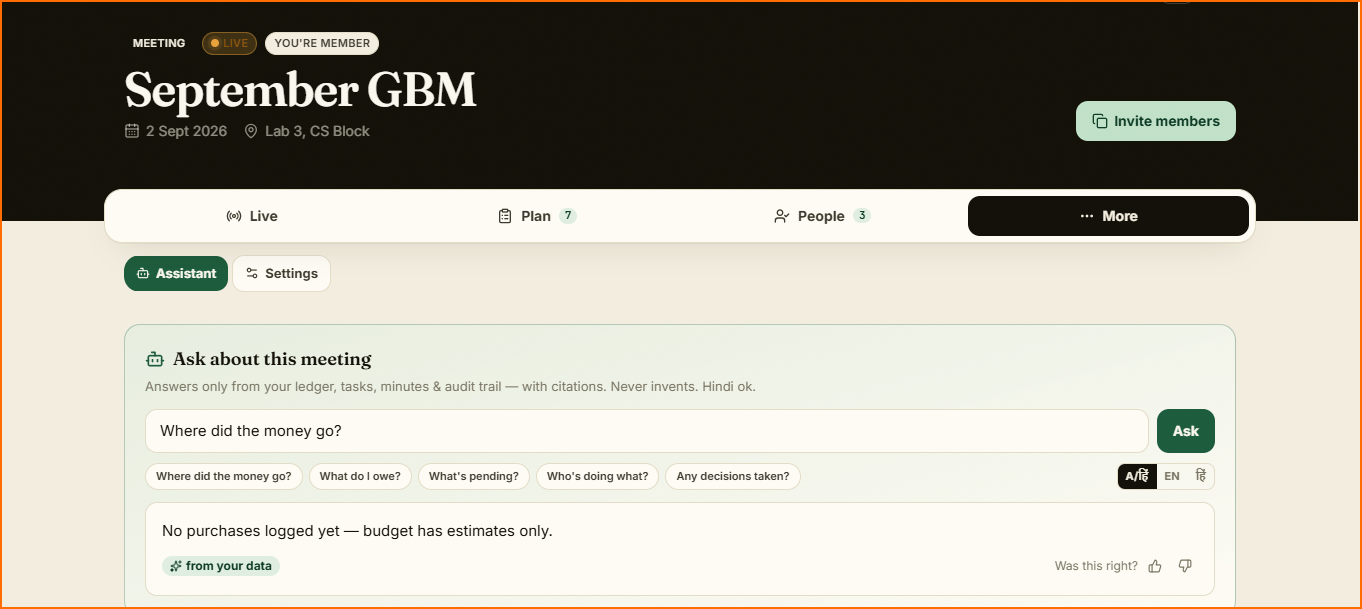
- Live meetings (GBM mode) — time-locked agendas, live voting with verifiable tallies, QR/GPS attendance check-in, and auto-generated participation certificates.
- Smart feed with SLA tracking — announcements, polls, tasks, and financial logs with visible resolution timers so queries never get ignored.
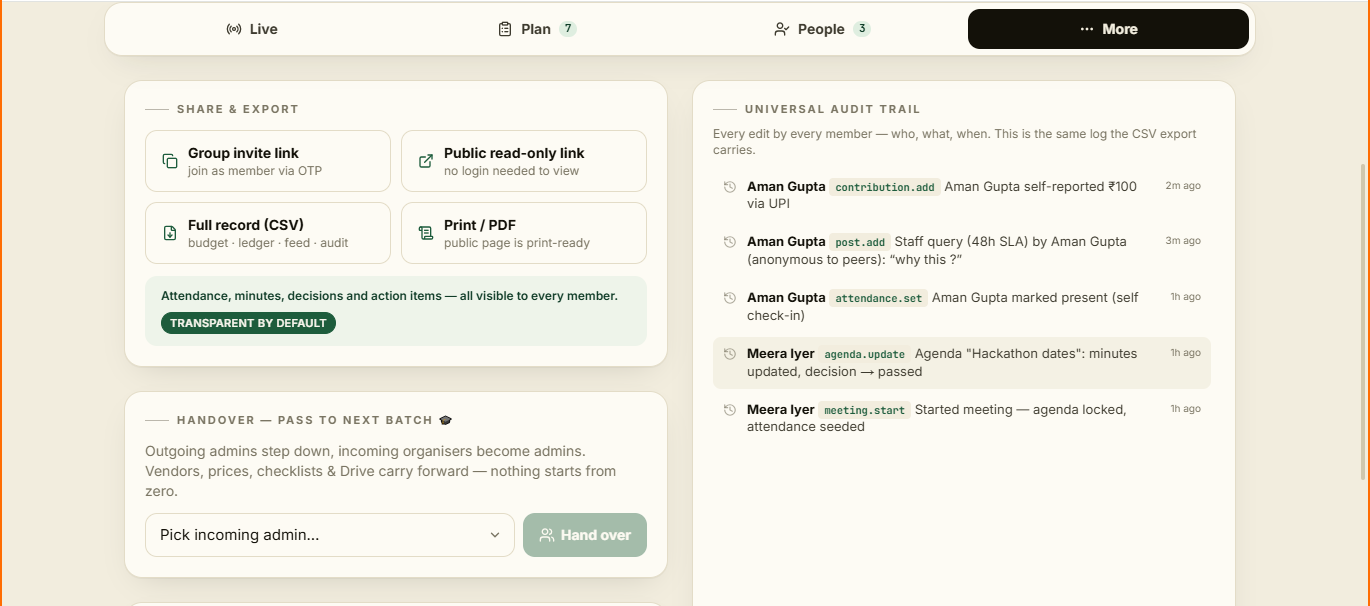
- Immutable audit trails — every change, verification, and approval is logged, so the end-of-event audit writes itself.
- Campus AI assistant — context-aware Q&A, one-click announcement drafting, and automatic meeting minutes, powered by Gemini with an offline fallback.
- PWA — mobile-first, offline-capable, with web push notifications for payments, announcements, and meeting starts.
The problem is real — and documented
This isn't just my experience. Student money in Indian institutions keeps making headlines for the same root cause: cash collected, no verifiable record of where it went.
- CAG audit, Delhi University (Aug 2026): a CAG report tabled in Parliament found three DU colleges — Ram Lal Anand, Shivaji, Shaheed Bhagat Singh (Evening) — had under-collected the University Development Fee for years, a cumulative shortfall of ₹2.01 crore, with weak university supervision cited as the root cause. One college had even diverted student-welfare funds to cover the gap.
- West Bengal (June 2026): after years of alleged mismanagement of student-union funds, the Higher Education Department ordered every state-run college and university to halt all "students' union fee" collection without an elected union, freeze existing collections in separate accounts, and submit audit reports within 30 days. Locked union rooms were ordered opened and inventoried on video.
- Himachal Pradesh: RTI activism uncovered PTA funds — collected from students for welfare — spent on unrelated items like curtains and tiling.
- Surendranath College (June 2026): undeclared cash discovered inside a locked student-union room, triggering demands for digital inventory systems and regular audits.
Here's what matters for this project: those cases are institutional, with auditors and newspapers watching. A single class's Teachers' Day fund or a club's event budget is smaller in rupees but less visible and less audited — nobody outside the group is watching. The same failure applies at every scale, and the informal end is less protected, not more.
The scale of the gap: ~14.71 lakh schools (24.69 crore students) plus 45,473+ colleges and 1,168+ universities in India — nearly every one runs student-organized events funded by informal collections. Institutional ERPs are admin tools students can't touch; Western student-org software is built for formal, card-paying US clubs; enterprise event platforms cost five figures. Nothing serves student-initiated, small, recurring, UPI-and-WhatsApp-driven collections with peer transparency as the core feature.
"Every year, Indian audits and student unions surface the same failure at the university level: money collected from students with no digital, verifiable record of where it went. That failure isn't limited to university administrations — it happens in every class WhatsApp group running a Teachers' Day collection, with even less oversight. We're not building another event-planning app. We're building the transparency layer that audits keep recommending — for the scale where nobody currently applies it."
How I built it
The stack is Next.js 16 (App Router, Turbopack) with React 19 and TypeScript, styled with Tailwind CSS v4 and animated with Framer Motion. Data lives in PostgreSQL accessed through Drizzle ORM, with a multi-tenant schema that isolates every club's data and enforces role-based access (admins, treasurers, members). Google Gemini powers the AI assistant with a deterministic offline fallback so core features never break without a network. Push notifications run on the Web Push API with VAPID keys, and a service worker makes the whole app installable and offline-capable.
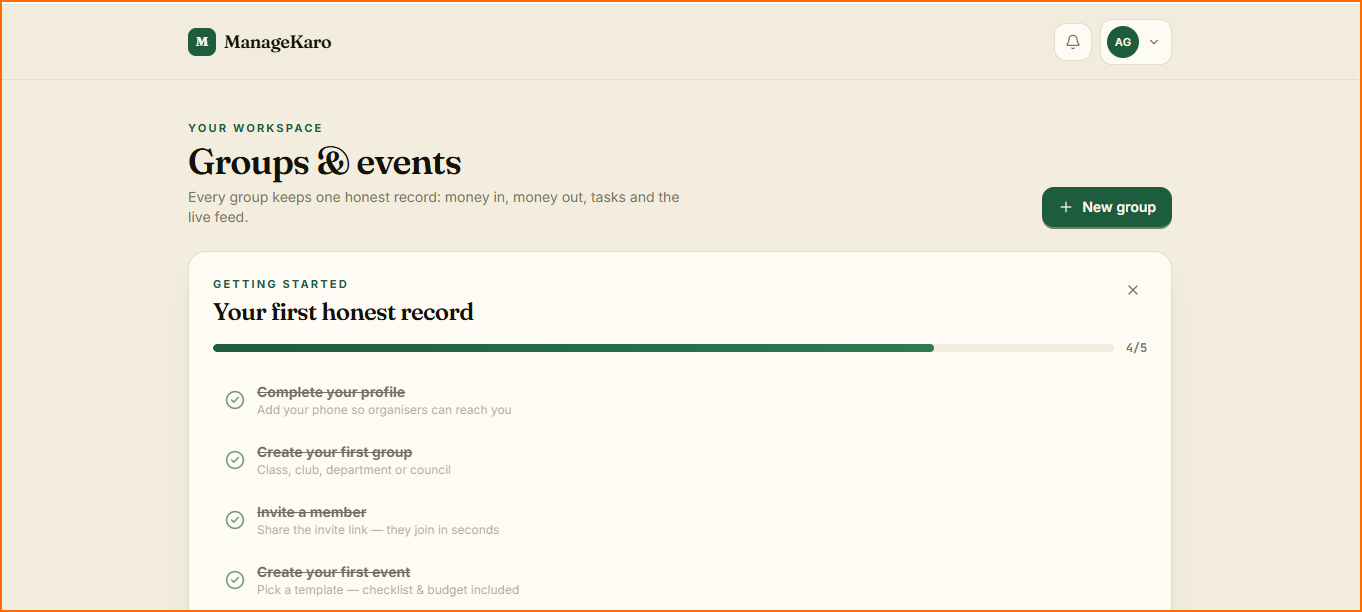
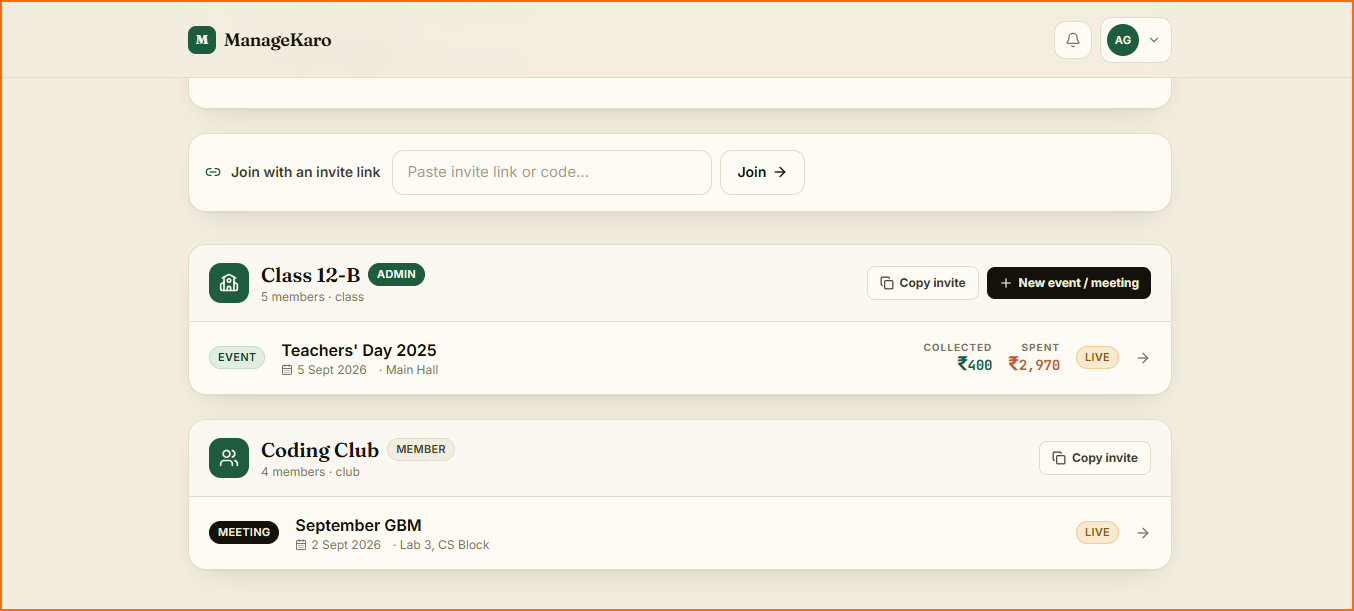
I seeded the database with demo clubs, users, and events so anyone can log in instantly as an organizer, coordinator, or member and walk through a full event lifecycle — from creating a budget to generating the final audit report.
Challenges I faced
The hardest problem was the conflict engine: detecting overlapping bookings isn't just comparing start and end times — it has to account for setup/teardown buffers, recurring bookings, and shared resources like projectors that move between rooms. Getting the time-window logic airtight took several rewrites.
Payment verification without a payment gateway was the second challenge. Student clubs can't integrate Razorpay, so I designed a two-step flow: dynamic UPI QR codes with pre-filled amounts and purpose tags, then organizer verification against receipts — trust, but verifiable.
Finally, making audit trails truly immutable while keeping the app fast meant designing an append-only log model from day one rather than bolting it on afterward — a decision I'm glad I made early.
What I learned
This project taught me how real-world schema design differs from tutorials — modeling multi-tenant data with proper isolation, writing conflict-detection logic that has to be correct (a double-booked auditorium is a real-world failure, not a test error), and integrating AI as an enhancement rather than a crutch, with graceful fallbacks. I also learned that the best product decisions come from lived pain: every feature in ManageKaro maps to something that actually went wrong during that Teachers' Day event.
👥 Demo Credentials
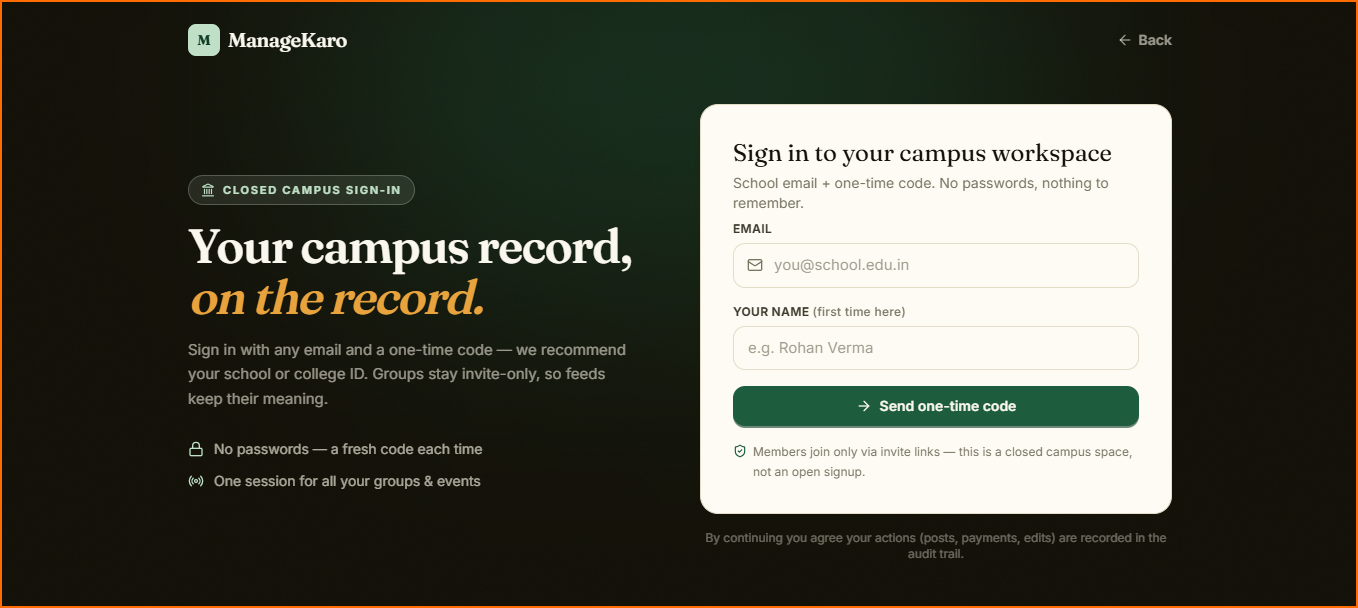
The seed script creates ready-to-test accounts (OTP is displayed directly on screen in development):
| Role | Permissions | |
|---|---|---|
| Admin / Organizer | [email protected] |
Full access, budget approvals, venue bookings, meeting host |
| Admin / Coordinator | [email protected] |
Full access, financial auditor, agenda moderator |
| Member | [email protected] |
Task assignee, meeting voter, attendee |
| Member | [email protected] |
Contribution contributor, attendee |
Sample Invite & Public Links
- Class 12-B Group Invite:
/join/class12b - Coding Club Invite:
/join/codeclub - Public Event Page:
/p/td12b2025pub - Public Meeting Minutes:
/p/gbmsept26pub - Campus Booking Calendar:
/calendar
What's next
I'd love to pilot ManageKaro with real clubs at my school, add inter-club resource sharing, and build a public transparency page so any student can see exactly how their event's money was spent.
Sources
- CAG flags ₹2 crore disparity in Delhi University colleges — New Indian Express, Aug 2026 (https://www.newindianexpress.com/cities/delhi/2026/Aug/14/cag-flags-rs-2-crore-disparity-in-delhi-university-colleges)
- West Bengal orders colleges to halt students' union fees, file audit reports in 30 days — Millennium Post / ET Education, June 2026 (https://www.millenniumpost.in/bengal/govt-orders-colleges-univs-to-stop-collecting-students-union-fees-662817)
- West Bengal orders opening of locked college union rooms, video-documented inventory — Millennium Post, June 2026
- ABVP allegations on West Bengal college fund mismanagement — Careers360, June 2026
- SFI/RTI findings on PTA fund misuse, Himachal Pradesh — The Tribune
- Surendranath College cash discovery and governance response — AcademicJobs.com, June 2026
- UDISE+ 2024-25 school statistics — Ministry of Education
- AISHE higher education statistics — PIB / British Council
Built With
- nextjs
- upi

Log in or sign up for Devpost to join the conversation.