-
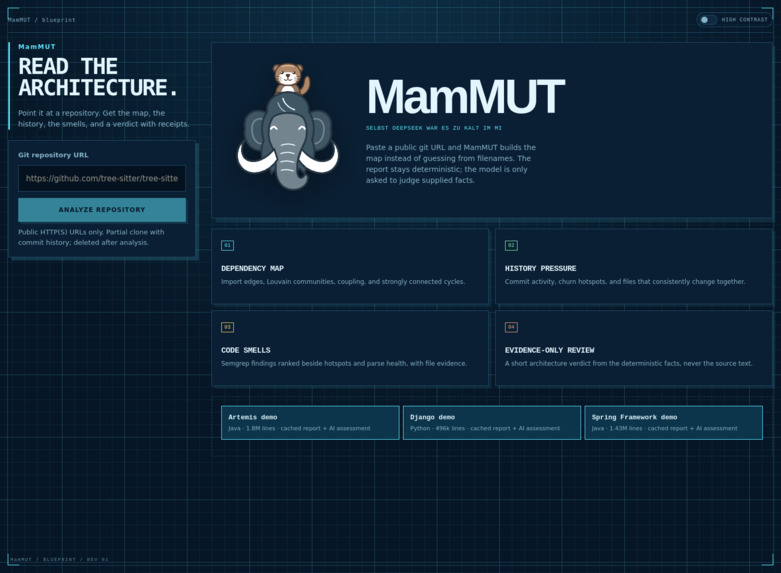
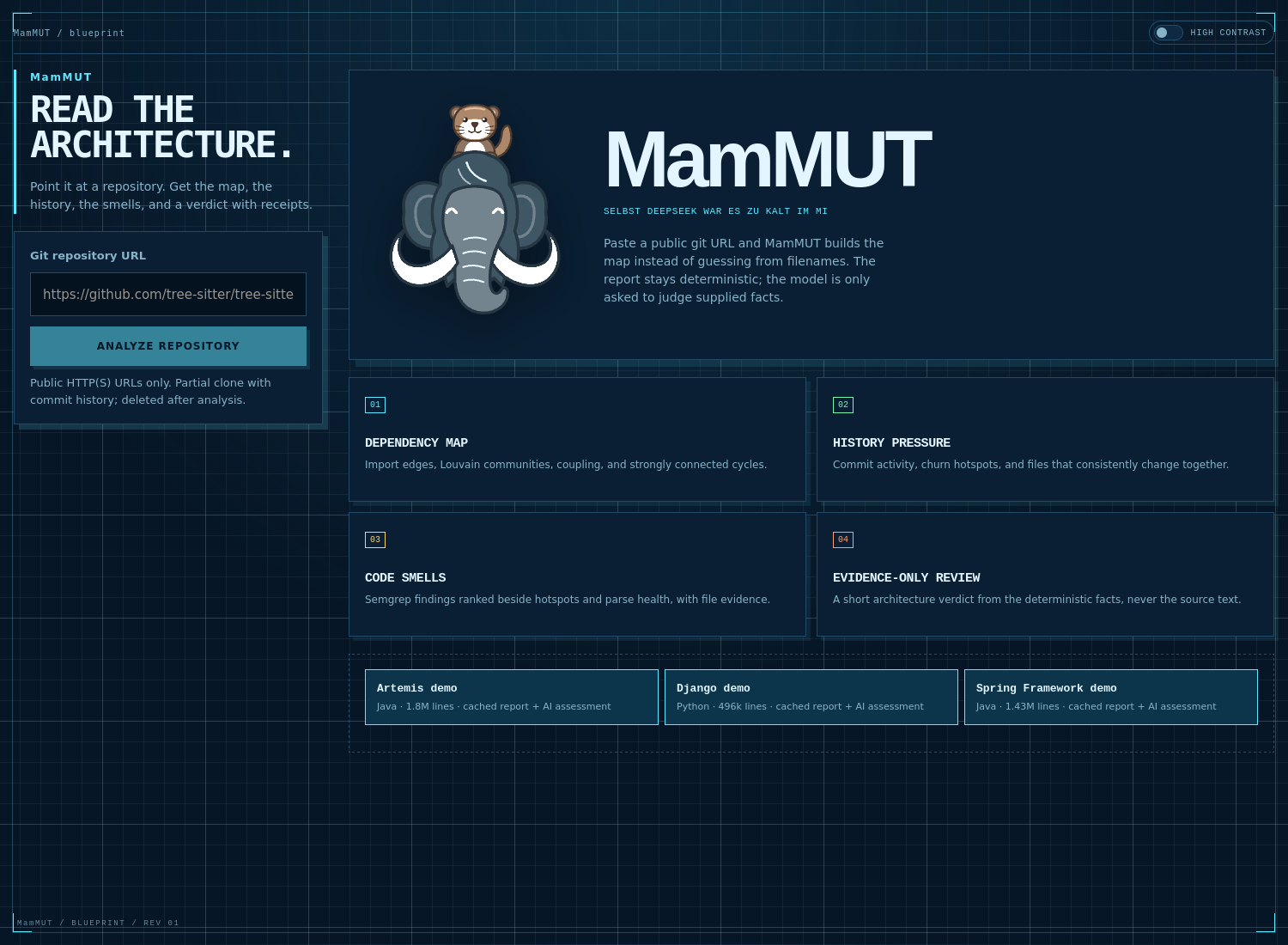
Paste a repository. Get a field report.
-
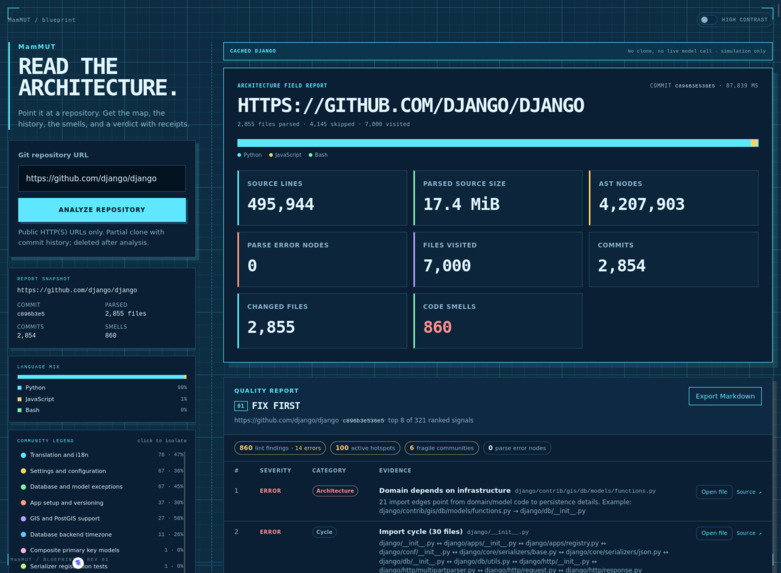
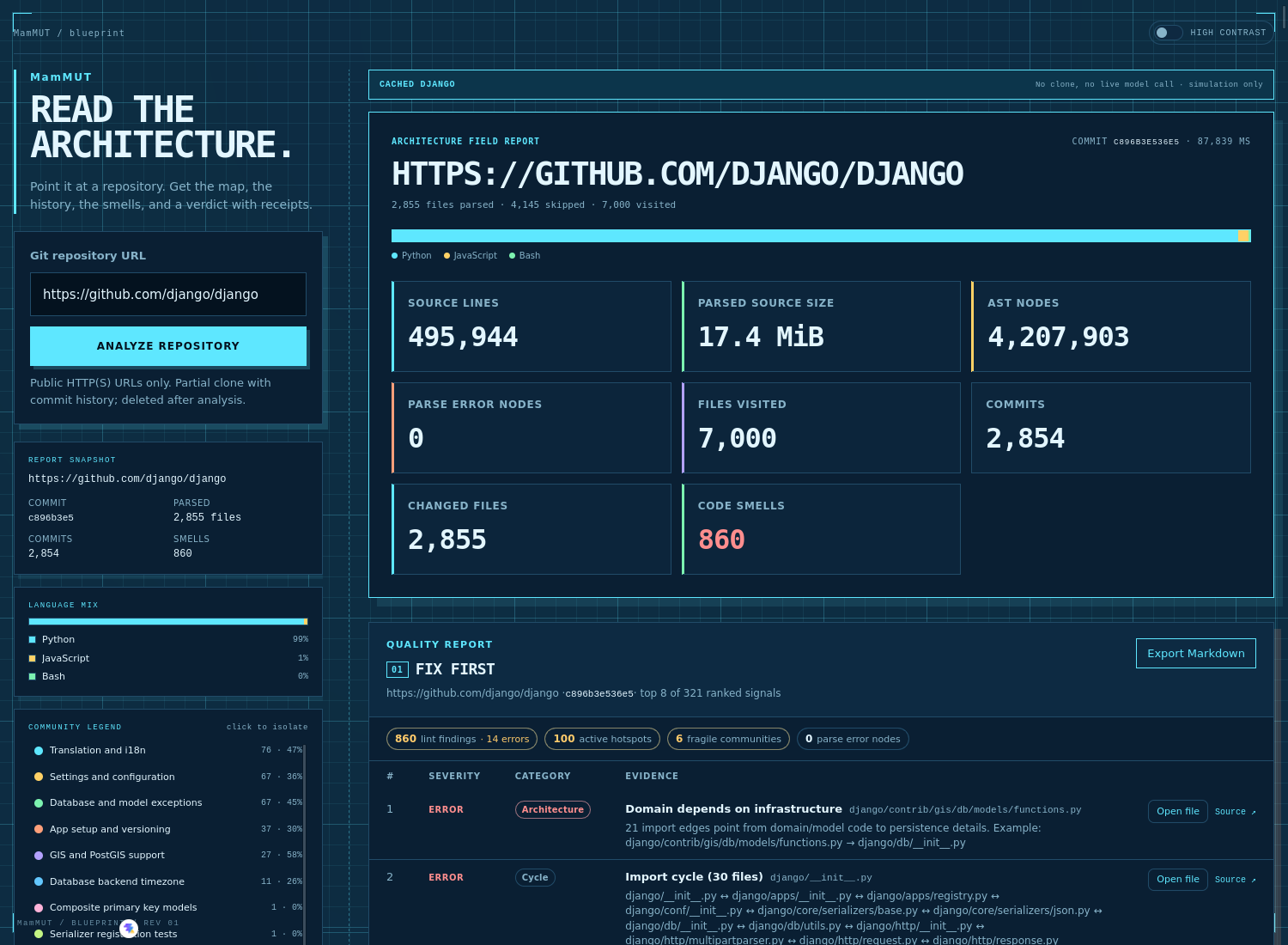
The architecture report: repository, history, language mix, and quality evidence.
-
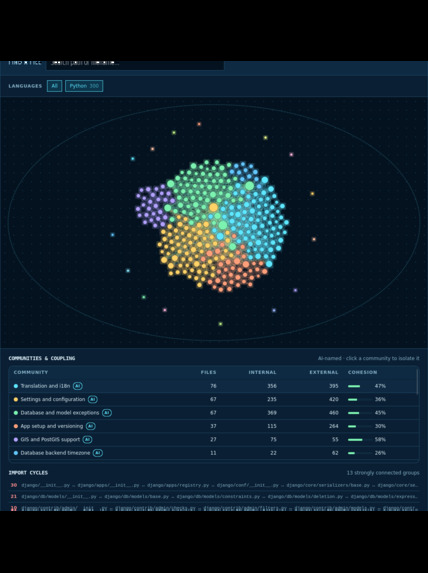
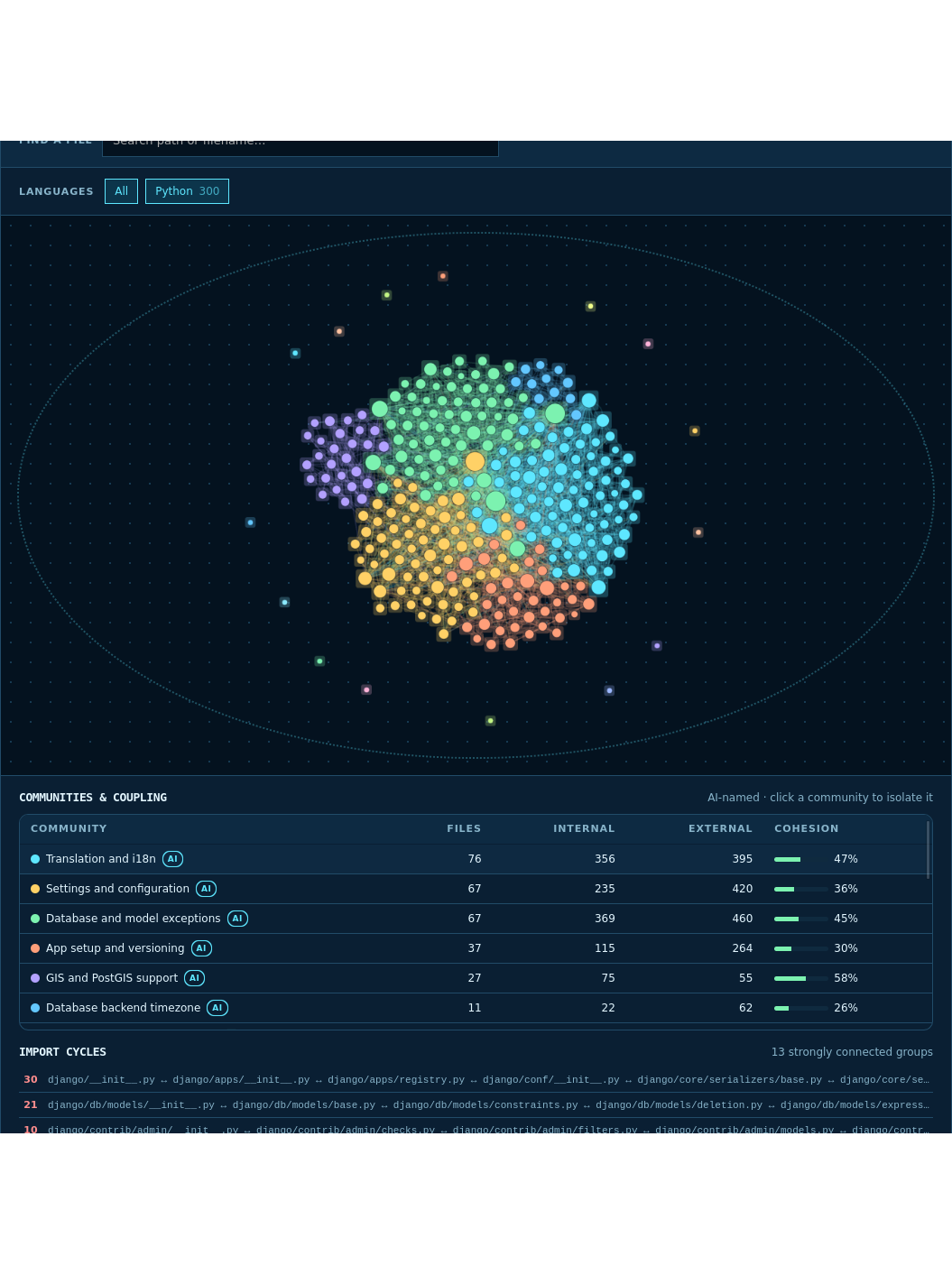
A spring graph of connected files, colored by Louvain community, with cohesion and coupling.
-
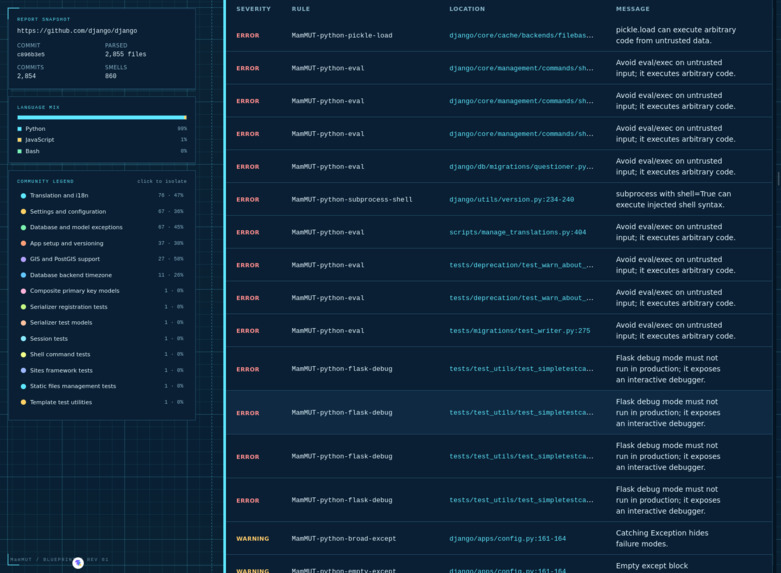
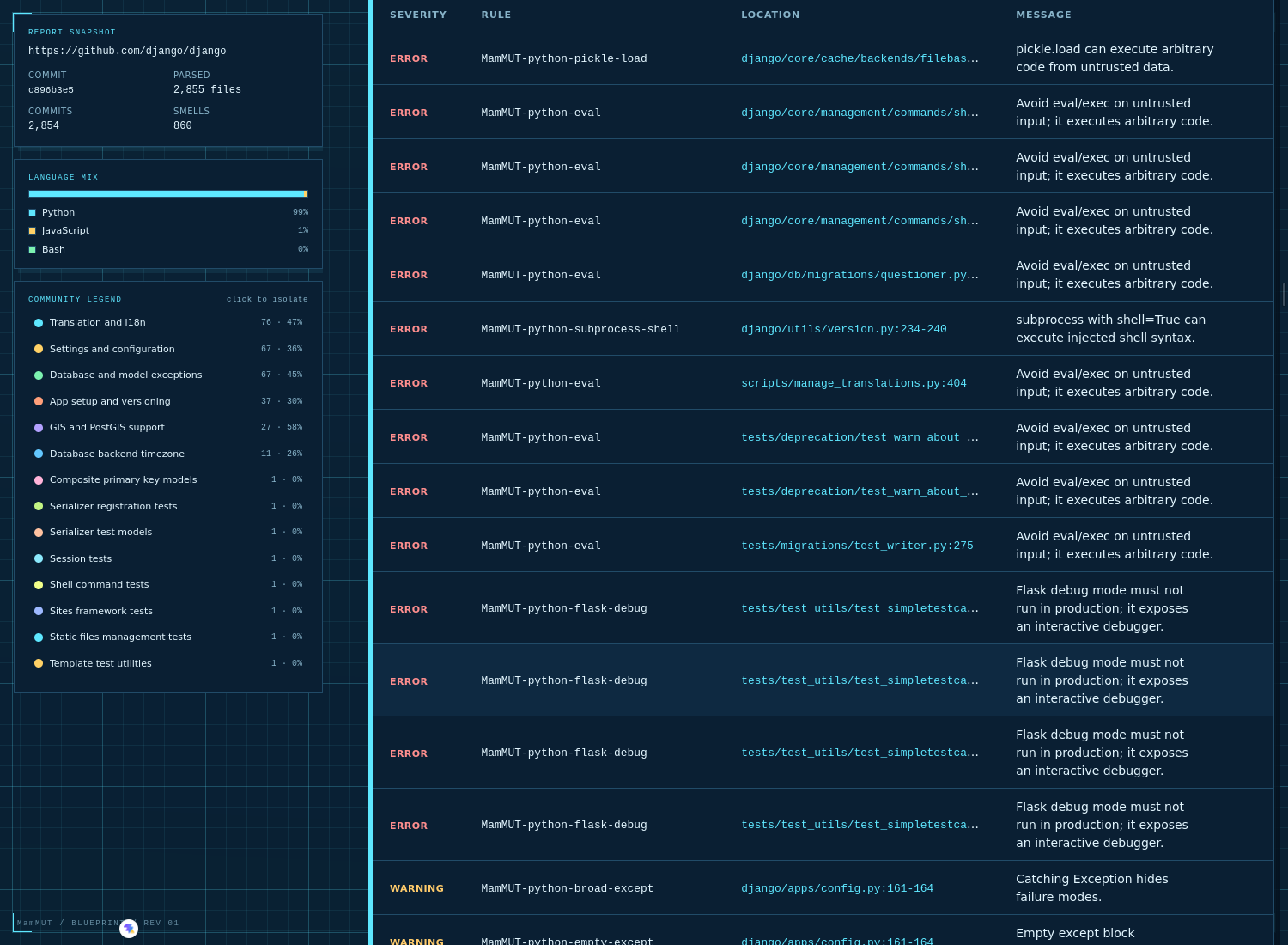
163 Semgrep rules with exact file ranges; multi-line findings open the right GitHub lines.
-
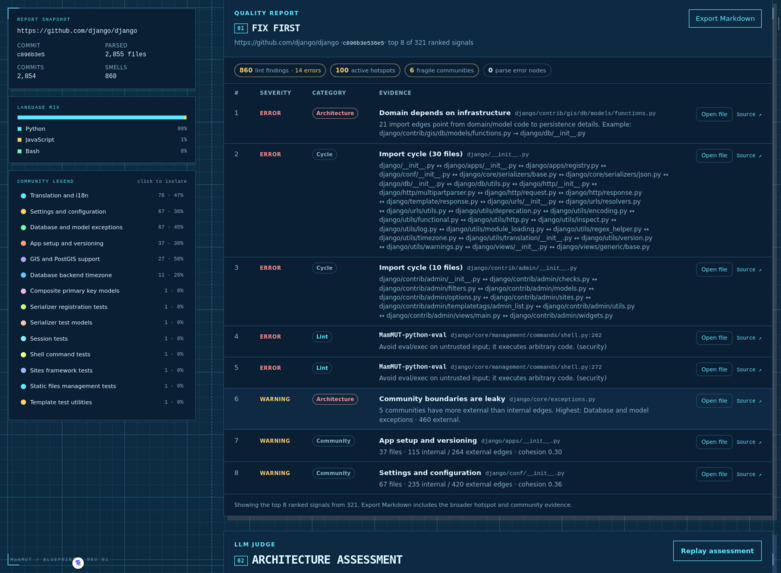
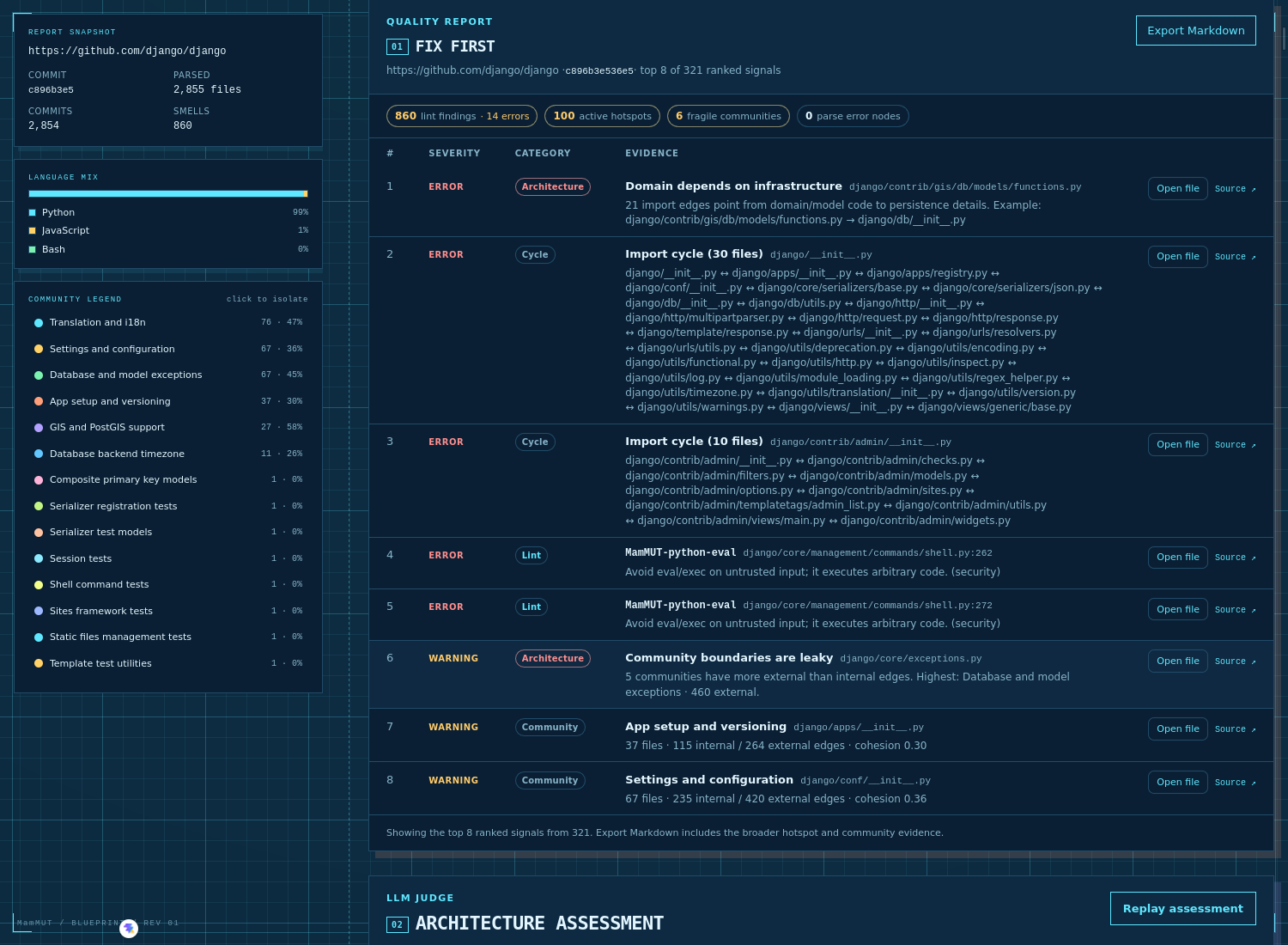
Fix first ranks lint, cycles, hotspots, communities, and architecture signals into one evidence table.
-
 GIF
The analysis site in motion: parse, history, lint, graph, naming, and memes.

Inspiration
Every unfamiliar repository starts with the same archaeology: clone it, grep for entry points, open forty tabs, and ask why one package depends on another. Existing tools show one slice—a graph, a linter report, or a chat summary—but they do not connect those slices into an answer you can defend.
We built MamMUT for CHECK24 hackaTUM around a simple question: what if onboarding started with evidence instead of vibes? Paste a repository URL and get the map, the history, the smells, and a verdict with receipts.
What it does
MamMUT analyzes a public Git repository and produces a blueprint-style field report:
- Dependency map — parses source with tree-sitter, resolves imports across 13 languages, builds a file-level graph, detects Louvain communities and strongly connected cycles, and renders an interactive spring graph.
- History pressure — total commits, recent activity, before/after period totals, churn hotspots, and files that frequently change together.
- Code smells — runs a bundled, reproducible set of 163 Semgrep rules and ranks findings in a deterministic “Fix first” quality report.
- Evidence, not just links — finding locations link to the exact GitHub/GitLab/Bitbucket/Codeberg file range, including multi-line anchors such as
#L234-L240; reports can be exported as Markdown. - Architecture read — derives layer traffic, architecture shapes, pattern-name signals, and structural risks from paths and resolved imports.
- Evidence-only AI — optional community naming and architecture review use a compact fact pack (cycles, coupling, hotspots, lint counts). Source text is never sent; the report remains useful with no API key.
- Built for a demo — three cached reports (Artemis, Django, Spring Framework) replay the analysis experience without cloning or calling a model.
- Safe by default — URL validation, private-address rejection, shallow blobless clone, strict size/time limits, isolated temporary workspace, and cleanup.
How we built it
- Go backend using Huma on the standard library: async analysis jobs, Server-Sent Events progress, and a typed OpenAPI client.
- Parsing pipeline: bounded worker pool, tree-sitter grammars, parallel parsing, import extraction, and path-based resolution. Special handling for Java wildcard imports, Go packages, C# namespaces, and TypeScript-style paths reduces false edges.
- Graph analysis: deterministic Louvain community detection, cohesion and external coupling, strongly connected cycles, language filters, and a capped 300-node/2,000-edge rendering graph backed by complete stats.
- History analysis: partial clones, name-only history, churn and co-change aggregation, and a before/after split for trend evidence.
- Quality layer: 163 local Semgrep rules across Go, Java, Python, JavaScript/TypeScript, Rust, C/C++, C#, Ruby, PHP, and Bash. Rules are versioned with the app so runs are offline and reproducible.
- Frontend: Vue 3, TypeScript, Vite, and Cytoscape for graph rendering. The blueprint design system has a sticky report rail, accessibility-first high-contrast mode, responsive evidence cards, local report history, and line-range source links.
- AI boundary: the model receives only structured facts and returns a constrained JSON assessment; failures fall back to deterministic output.
Challenges we ran into
- Import resolution is language-specific. A package import is not a file import: Java wildcards, Go package paths, C# namespaces, and deep directory layouts all needed deliberate resolution rules. Fixing these reduced graph noise more than any visual tweak.
- Large repositories break naive graph UIs. Artemis has over 11,000 parsed files and 64,000 resolved edges. We cap the rendered graph while keeping all stats complete, cluster communities with stronger inward springs, and provide filters and isolation so the picture stays readable.
- Lint at repository scale. Semgrep is fast until it meets hundreds of thousands of lines. We scan the parsed file list directly, exclude generated trees, cap jobs, apply per-file timeouts, and keep full counts even when findings are capped for the UI.
- Keeping AI honest. An LLM will happily invent a dependency if given prose. We send only facts, require compact JSON, and treat the deterministic report as the source of truth.
Accomplishments that we're proud of
- End-to-end analysis from a public URL to an interactive, source-linked architecture report.
- Validated on real repositories: Artemis (~1.89M lines; 11,813 parsed files; 1,790 lint findings), Django (~496k lines; 2,855 files; 860 findings), and Spring Framework (~1.43M lines; 9,250 files; 507 findings).
- 163 local Semgrep rules with severity, rule, location, and message, plus line-range evidence that opens the exact code.
- A deterministic quality ranking that mixes lint, hotspots, communities, cycles, and parse health instead of presenting an unranked wall of warnings.
- A blueprint UI that stays usable at 11,000-node scale, on mobile, and in high-contrast mode.
- A polished cached demo that runs without network access or model keys.
What we learned
- Architecture is only useful when it is tied to evidence; a graph without commits, smells, or source locations is decoration.
- The most valuable AI feature was restraint: give the model a small, bounded fact pack and make it cite what it was given.
- Performance is a design constraint. Graph caps, direct Semgrep targets, partial clones, and cached demos all shape what the product can promise.
- Cross-language import resolution is where static-analysis tools earn trust—and where the hard bugs live.
- A good demo is an engineering artifact: deterministic, cached, and designed independently of the live pipeline.
What's next for MamMUT
- Persistent, shareable report URLs and team workspaces.
- Richer import resolvers and broader language support with incremental analysis and custom per-language tooling.
- A more artifact-centric design.
- Baseline comparison across commits: what got more coupled, which cycle grew, and which hotspot cooled down.
- Rule-pack management and custom team policies on top of the bundled 163 rules.
Built With
- architecture
- check24
- cytoscape
- dependency-graph
- go
- huma
- louvain
- love
- semgrep
- static-analysis
- tree-sitter
- typescript
- vue
