-
-
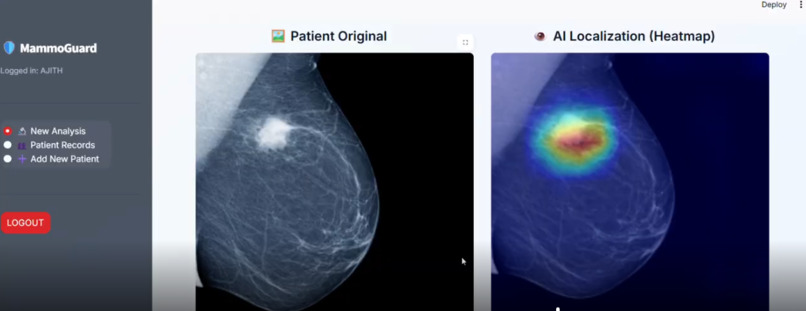
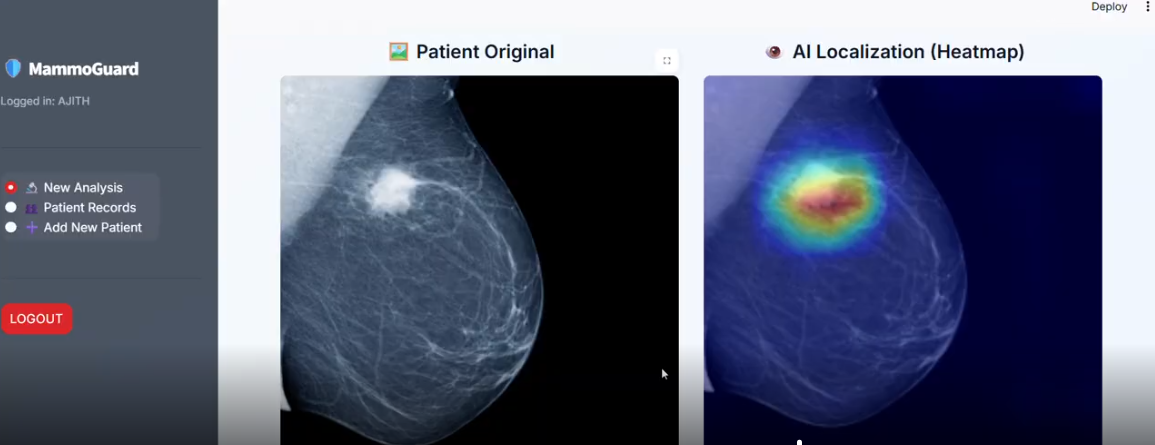
Mammo Guard AI highlights suspicious breast regions using an AI-generated heatmap for doctor-assisted assessment.
-
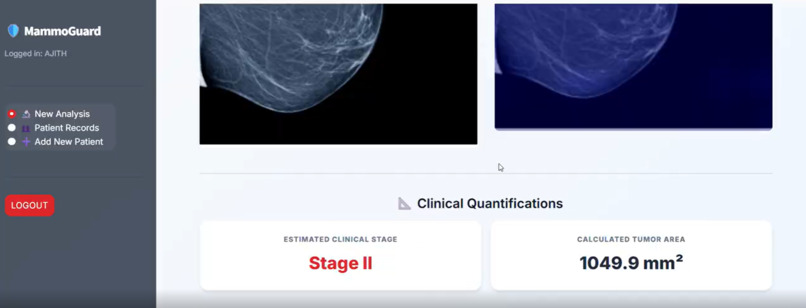
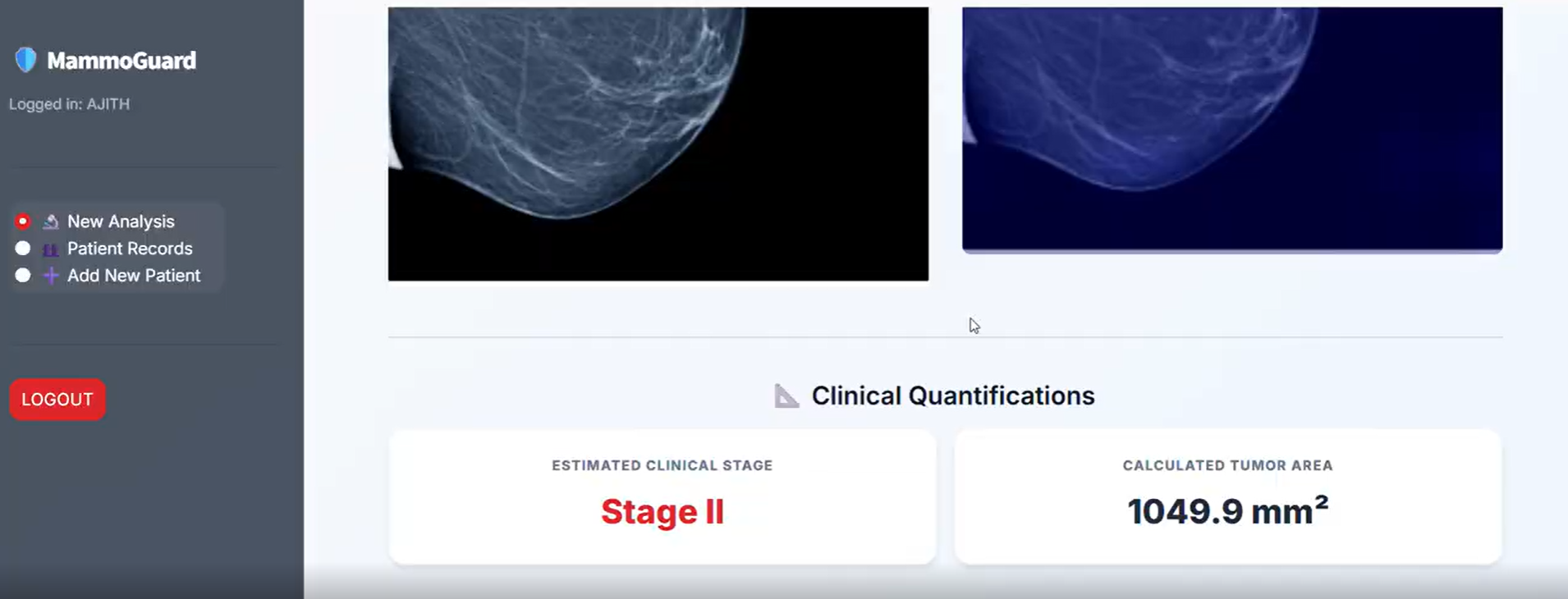
Mammo Guard AI displays estimated cancer stage and calculated tumor area to support clinical assessment.
Inspiration
Breast cancer can affect not only patients but also their families. Early identification of suspicious abnormalities can make a meaningful difference in diagnosis and treatment planning. We wanted to explore how Artificial Intelligence and Machine Learning could help doctors analyze breast images, identify suspicious regions, and understand AI-generated findings more clearly. This inspired us to create Mammo Guard AI, a project focused on making AI-assisted breast image analysis more informative and accessible.
What it does
Mammo Guard AI is an AI/ML-based system designed to analyze uploaded breast medical images using deep learning. It aims to classify tumors as benign or malignant and provide heatmap-based visualization to highlight suspicious regions. Where supported by validated models, it can also estimate the affected area and provide approximate staging information using relevant clinical data. The system presents these findings to assist doctors in reviewing medical images. AI supports the assessment, but the doctor always makes the final diagnosis and treatment decisions.
How we built it
Our approach uses deep learning and CNN-based image analysis. The planned workflow includes uploading a supported breast image, preprocessing it, passing it through the trained model, and displaying the prediction through a user-friendly interface. Heatmap visualization can help explain which image regions influenced the model's prediction. Additional capabilities, such as affected-area measurement and stage estimation, require appropriate models and validation. Our project materials report 96% accuracy for the classification task.
Challenges we ran into
One of our main challenges was understanding how to apply AI/ML techniques to medical images and turn model predictions into useful visual information. Classification, tumor localization, affected-area estimation, and cancer staging are different tasks that require suitable datasets and evaluation methods. We also recognized the importance of avoiding misleading predictions and ensuring that AI-generated results are interpreted responsibly. Building a system that supports doctors without replacing their expertise remains a key priority.
Accomplishments that we're proud of
We are proud to develop an AI/ML-based approach to an important real-world healthcare challenge. Our project brings together deep learning, medical image classification, and heatmap-based visualization in a single workflow. The project materials report 96% classification accuracy, and our broader vision is to go beyond a simple prediction by helping doctors visualize suspicious regions and review additional validated insights. We are especially proud of the doctor-in-the-loop approach, which keeps medical professionals at the center of every final decision.
What we learned
We learned how AI/ML can be applied to real-world problems using deep learning and computer vision. We explored the importance of image preprocessing, model training, performance evaluation, and visual interpretation. We also learned that accuracy alone is not enough for a medical AI system. Reliability, explainability, appropriate validation, and responsible use are equally important when building technology intended to support healthcare professionals.
What's next for Mammo Guard AI
Our next goal is to improve and validate the system using appropriate medical datasets and independent testing. We aim to strengthen heatmap-based localization, explore segmentation for affected-area estimation, and investigate staging support using suitable clinical information. We also plan to improve the user interface and develop a clear report for doctors to review. With further technical development and clinical validation, Mammo Guard AI aims to become a useful decision-support tool that combines AI-generated insights with the knowledge and judgment of medical professionals.
Built With
- artificial-intelligence
- cnn
- computer-vision
- deep-learning
- image
- machine-learning
- medical-image-analysis
- python
