-
-
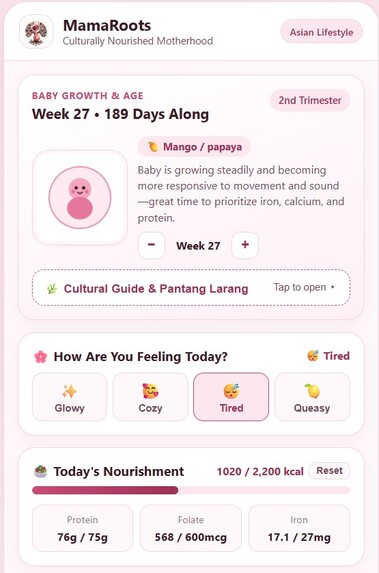
tab 1: Tracker
-
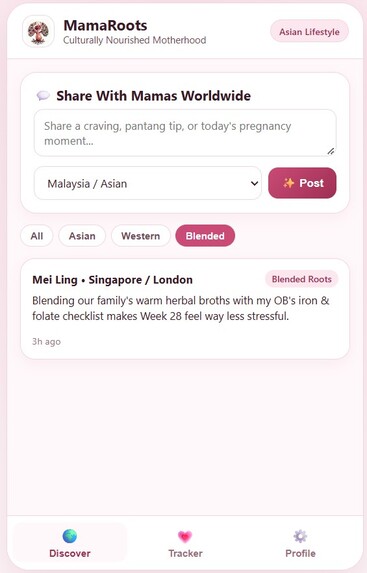
tab 2: Discover
-
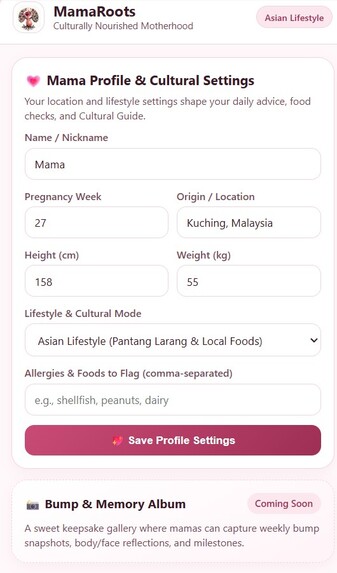
tab 3: Profile
-
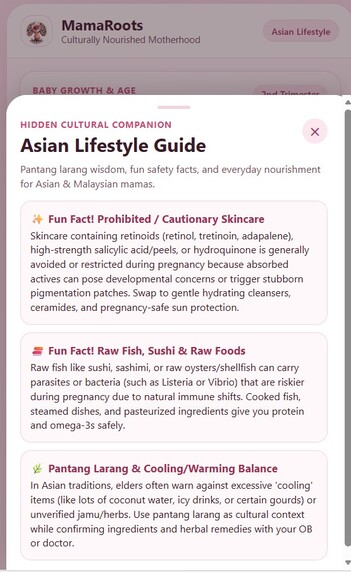
Special Features
-
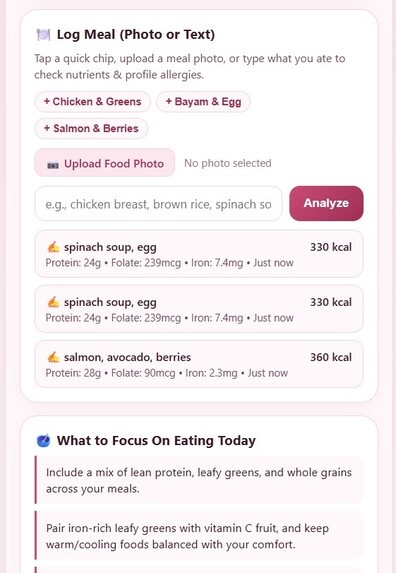
more features in Tab 1
Inspiration: Culturally Nourished Motherhood
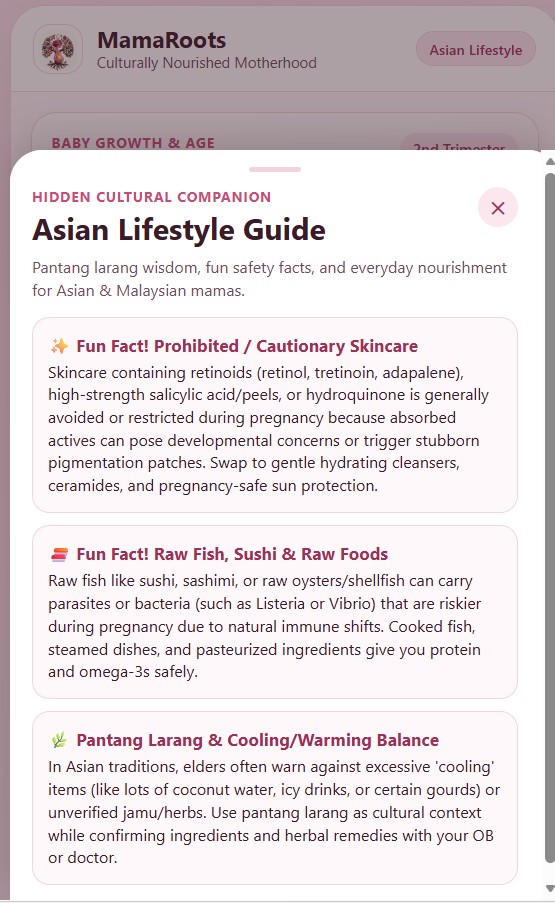
Expecting mothers—especially first-time moms—often get pulled between generic pregnancy apps that ignore their cultural background and well-meaning family advice that lacks modern context. Traditions like pantang larang and regional food taboos still shape what many mothers eat or avoid during and after pregnancy (Kamarudin, n.d.), while everyday choices around nutrition, risky foods, medications, alcohol, and skincare ingredients (such as topical retinoids) matter deeply for maternal and foetal health (Bozzo et al., 2011; Refsum et al., 2026; World Health Organization, 2016). I built MamaRoots so expectant mothers can make calm, informed daily decisions while staying grounded in their cultural roots and personal lifestyle.
How I Built It
I designed MamaRoots as a warm, mobile-first web app with a soft pink-and-white palette, custom SVG baby growth illustrations, and a custom brand header (logo.jpg):
- Frontend & UI: Built with HTML5 (
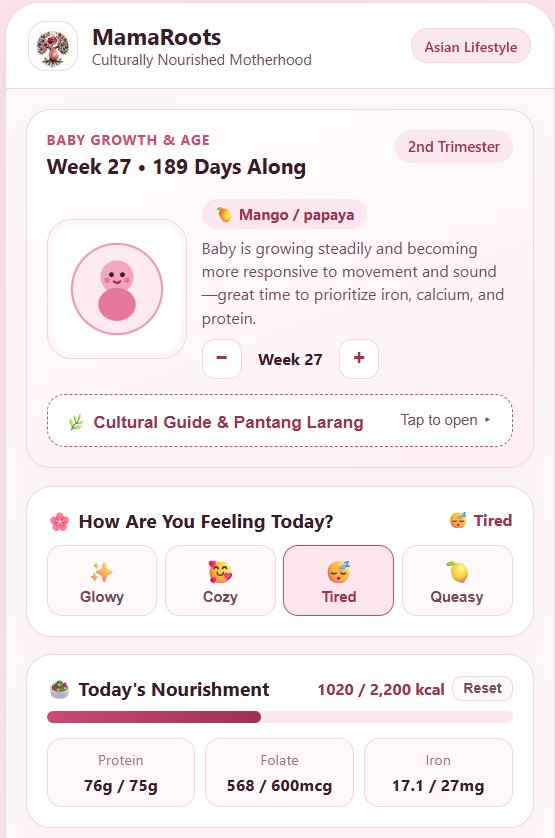
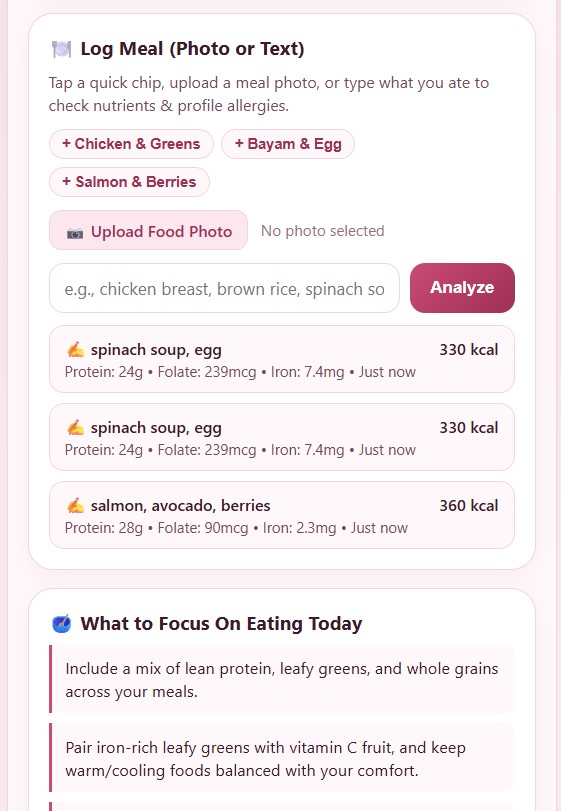
index.html), CSS3 (styles.css), and Vanilla JavaScript (app.js), using a familiar three-tab layout (Discover, Tracker, Profile), modal sheets, and pop-up mood/action feedback. - Tracker (Center Tab): Displays pregnancy week, days along, trimester badge, baby size comparison, and milestones with a week stepper; lets moms check in with their mood (Glowy, Cozy, Tired, Queasy); logs meals via quick chips, text, or photo preview with allergy checks; offers What to Focus On Eating Today and What to Do Today cards; and opens the Cultural Guide & Pantang Larang modal on demand.
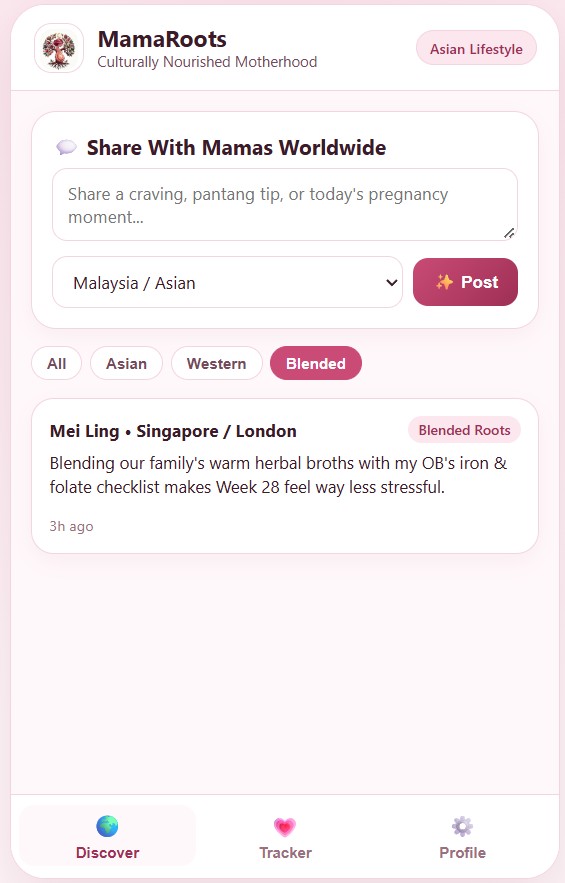
- Discover & Profile Tabs: Discover provides a community feed across
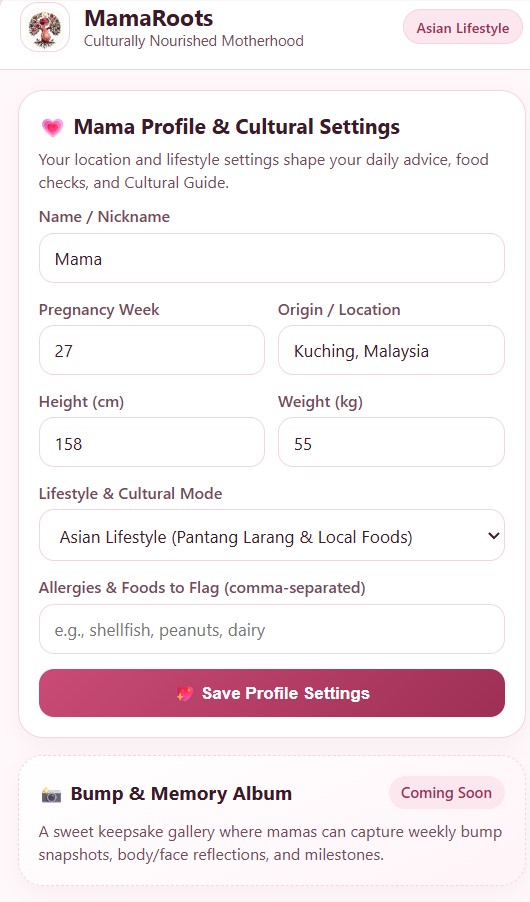
All,Asian,Western, andBlendedlifestyles, while Profile lets users customize their name/nickname, pregnancy week, location, height, weight, lifestyle mode, and allergies—alongside a Bump & Memory Album roadmap preview. - Data Persistence & Nutrient Logic: User profile settings, mood check-ins, logged meals, and community posts persist across browser refreshes via
localStorage. In this prototype, meal logging estimates daily totals using client-side keyword matching and additive nutrient totals:
$$N_{\text{total}} = N_{\text{base}} + \sum_{i=1}^{k} n_{i}$$
where \(N_{\text{total}}\) is the running daily total for a nutrient (calories, protein, folate, or iron) and \(n_{i}\) is the estimated contribution of each logged meal item \(i\), alongside profile allergy checks.
Challenges I Faced
- Balancing Culture & Clarity: Presenting pantang larang, cooling/warming balance notes, skincare cautions, and raw-food safety reminders without cluttering the daily tracker screen took careful editing and layout planning.
- File, Modal & State Polish: Getting file paths, CSS/modal visibility, responsive mobile-frame spacing, and
localStoragestate updates to work smoothly across refreshes required several rounds of testing and browser tweaks.
What I Learned
Building MamaRoots taught me how much everyday UX calm matters for expectant mothers—information should feel supportive and easy to scan rather than overwhelming. I also learned how valuable it is to pair cultural respect with clear safety context and honest prototype boundaries (such as clearly noting that current nutrient estimates and cultural safety cards are for educational/prototype demonstration and do not replace medical advice from a healthcare provider).
Future Roadmap
Next up is the Bump & Memory Album—a personal keepsake space for weekly bump photos, body/face check-ins, and milestones—followed by expanding regional cultural libraries, refining photo-based nutrient estimation, and growing the community feed across more cultures.
References
- Bozzo, P., Chua-Gocheco, A., & Einarson, A. (2011). Safety of skin care products during pregnancy. Canadian Family Physician, 57(6), 665–667.
- Kamarudin, N. F. (n.d.). Postpartum food taboos and dietary intake among Malay women [Master's thesis, Universiti Sains Malaysia]. EPrints USM. https://eprints.usm.my/57475/1/NUR%20FARIEHAN%20BIN%20KAMARUDIN-24%20pages.pdf
- Refsum, E., et al. (2026). Topical retinoid use in women of reproductive age and risk of major congenital malformations in exposed pregnancies: A Nordic cohort study. British Journal of Dermatology, 194(4), 640–647. https://doi.org/10.1093/bjd/ljaf500
- World Health Organization. (2016). WHO recommendations on antenatal care for a positive pregnancy experience. World Health Organization. https://www.who.int/publications/i/item/9789241549912
Built With
- css3
- gemini
- github
- html5
- javascript
- localstorage
- svg

