-
-
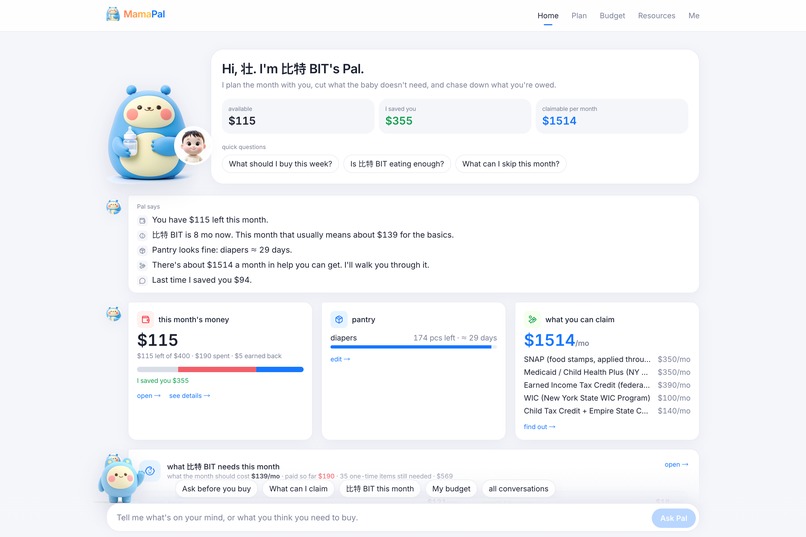
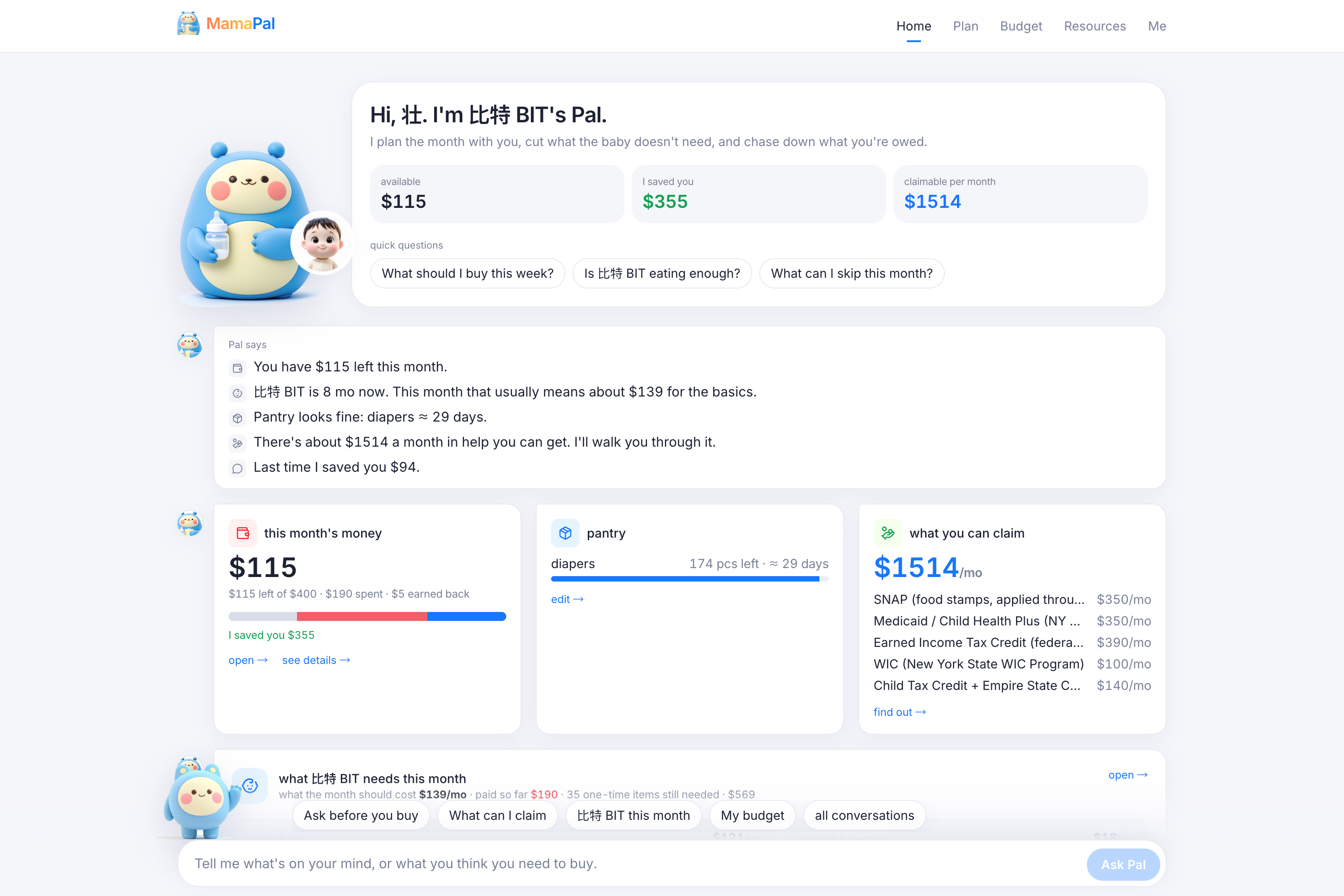
Home: Pal greets you, says the month in five lines, and hands you the cards: money, pantry, help you can claim.
-
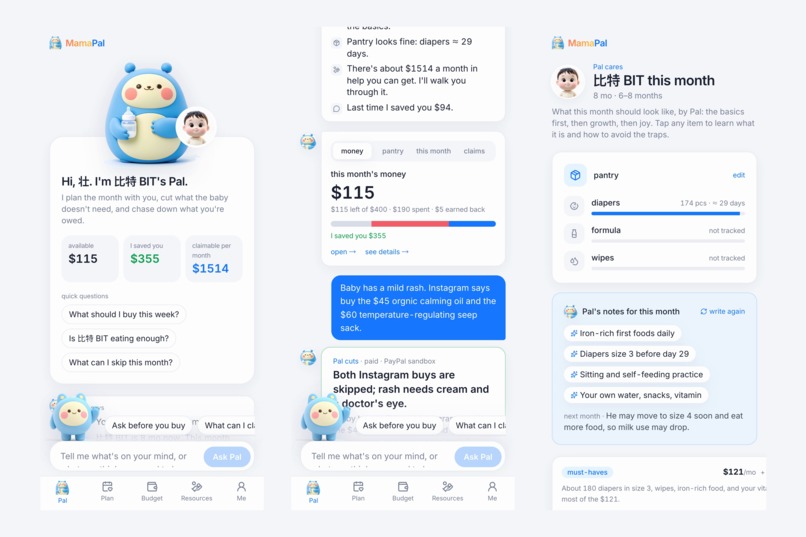
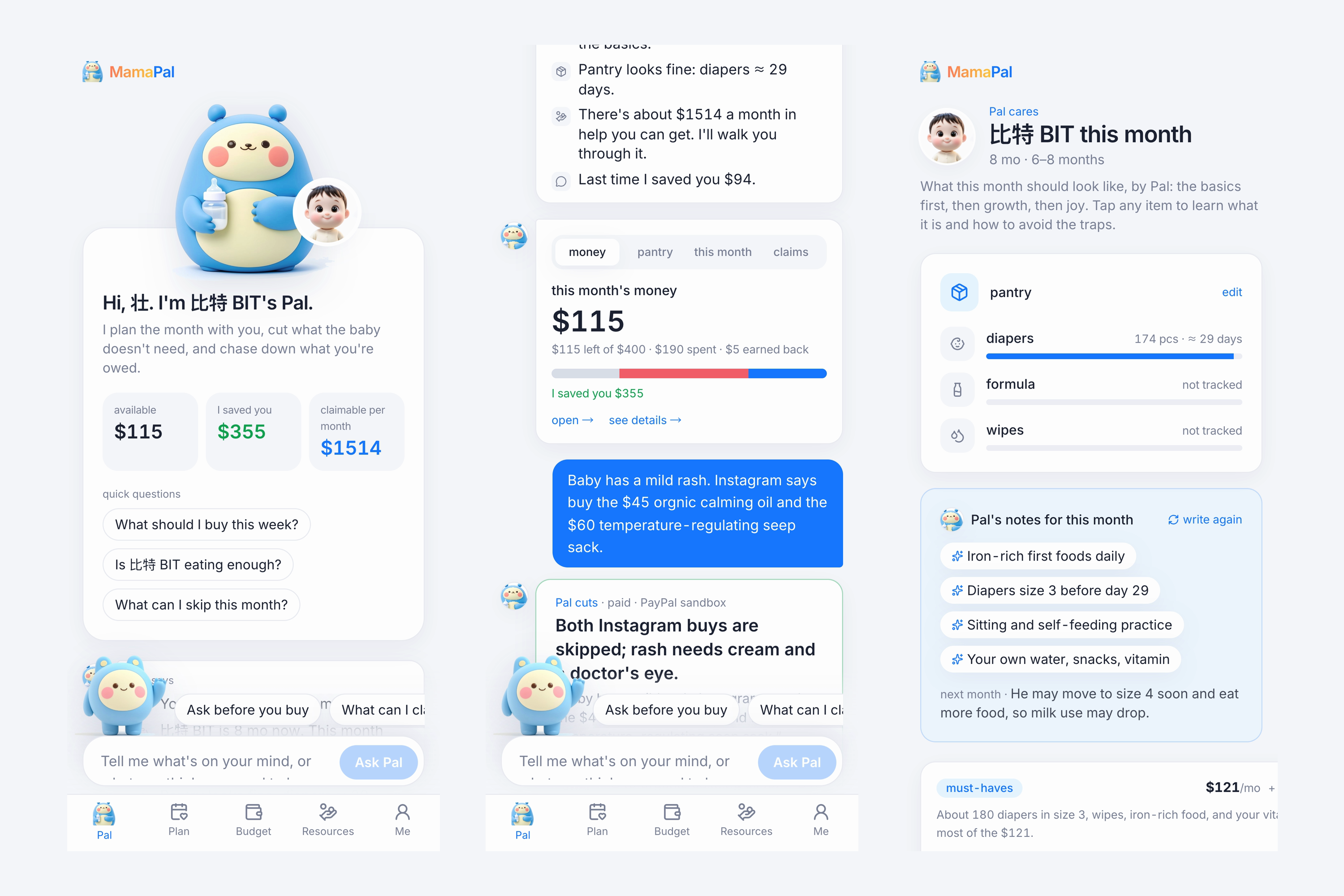
On the phone: the same conversation. Welcome card, Pal's bulletin, one card with tabs, and a verdict paid through PayPal.
-
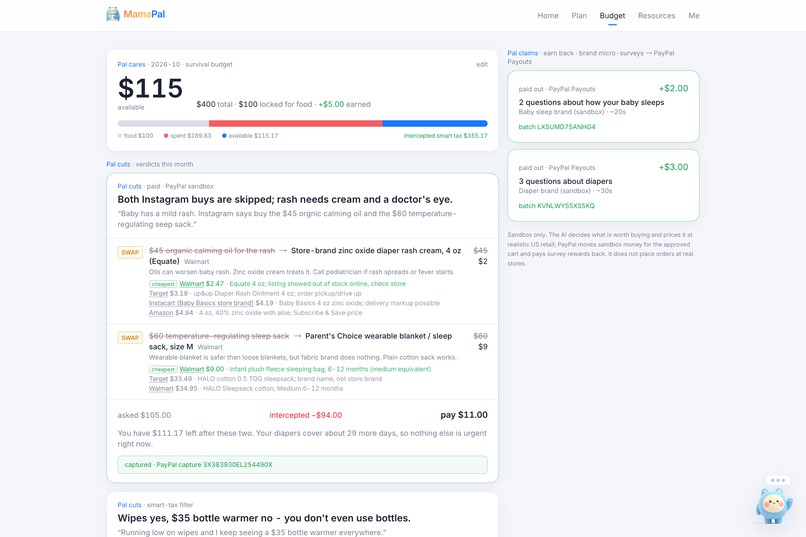
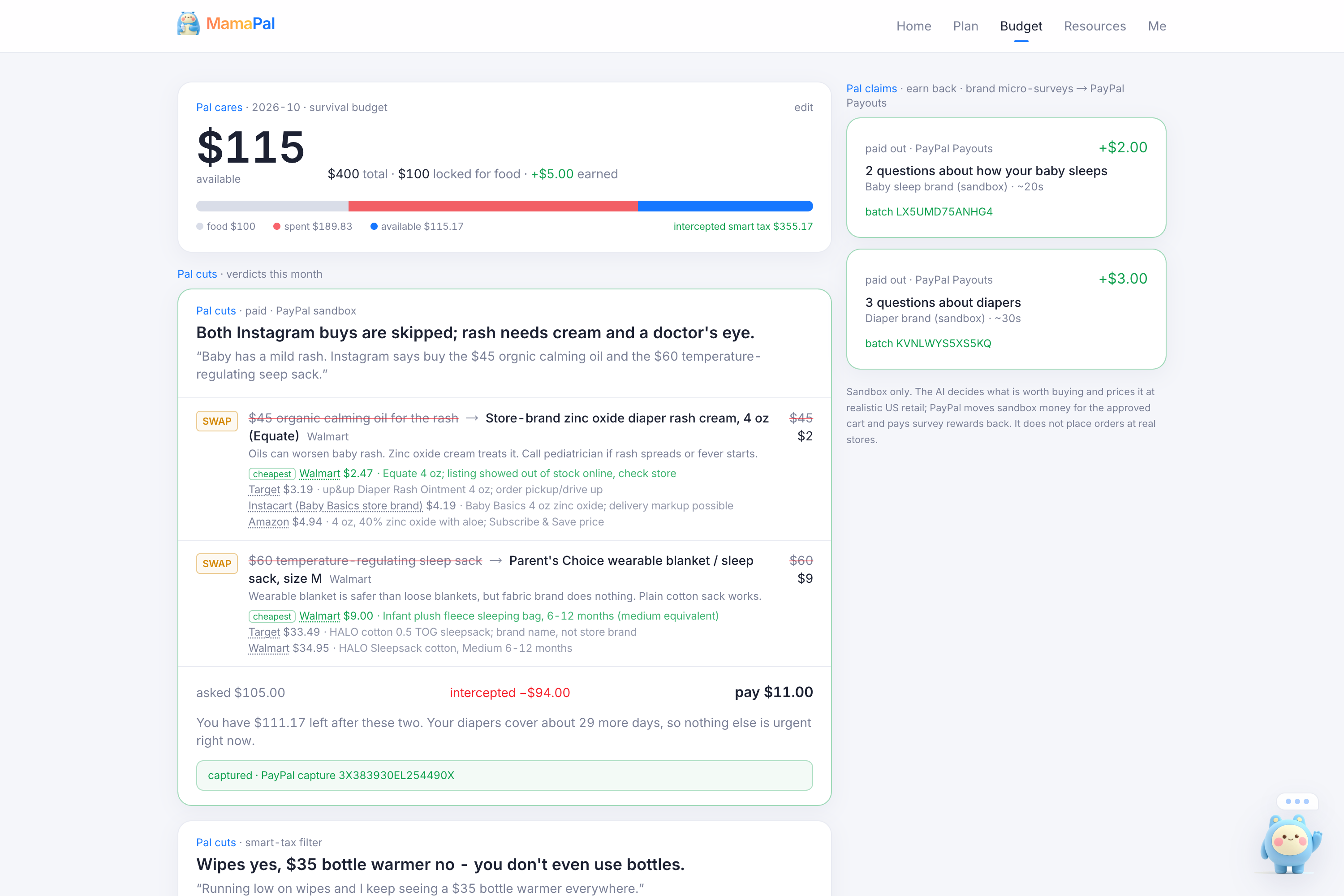
Pal cuts: $105 of feed-driven buys become $11. Store-brand twins, real prices with links, one PayPal button, capture id in the ledger.
-
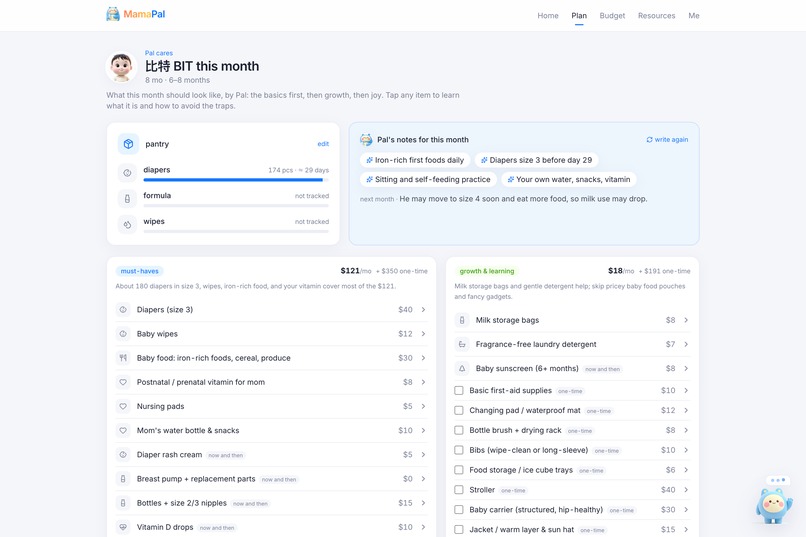
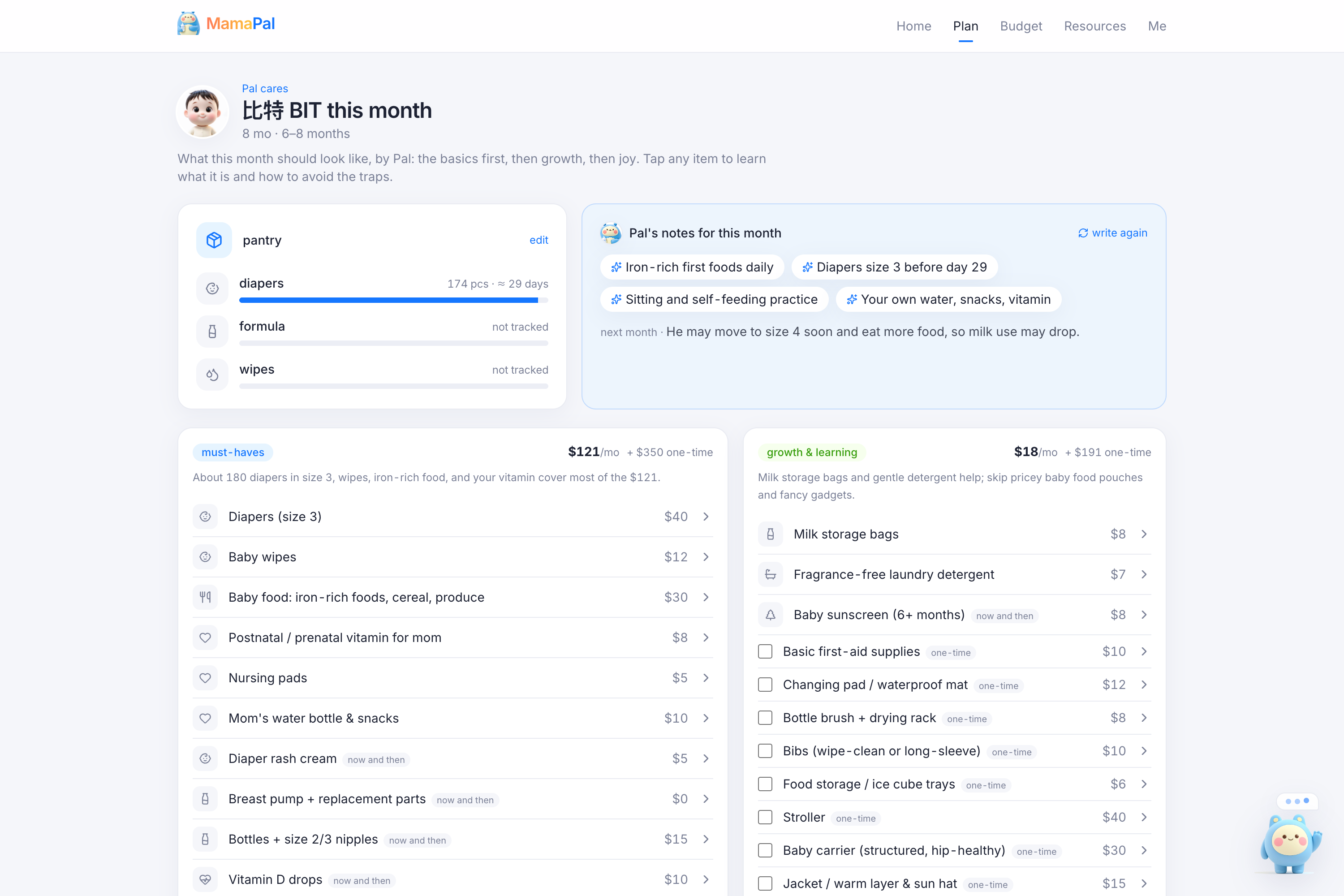
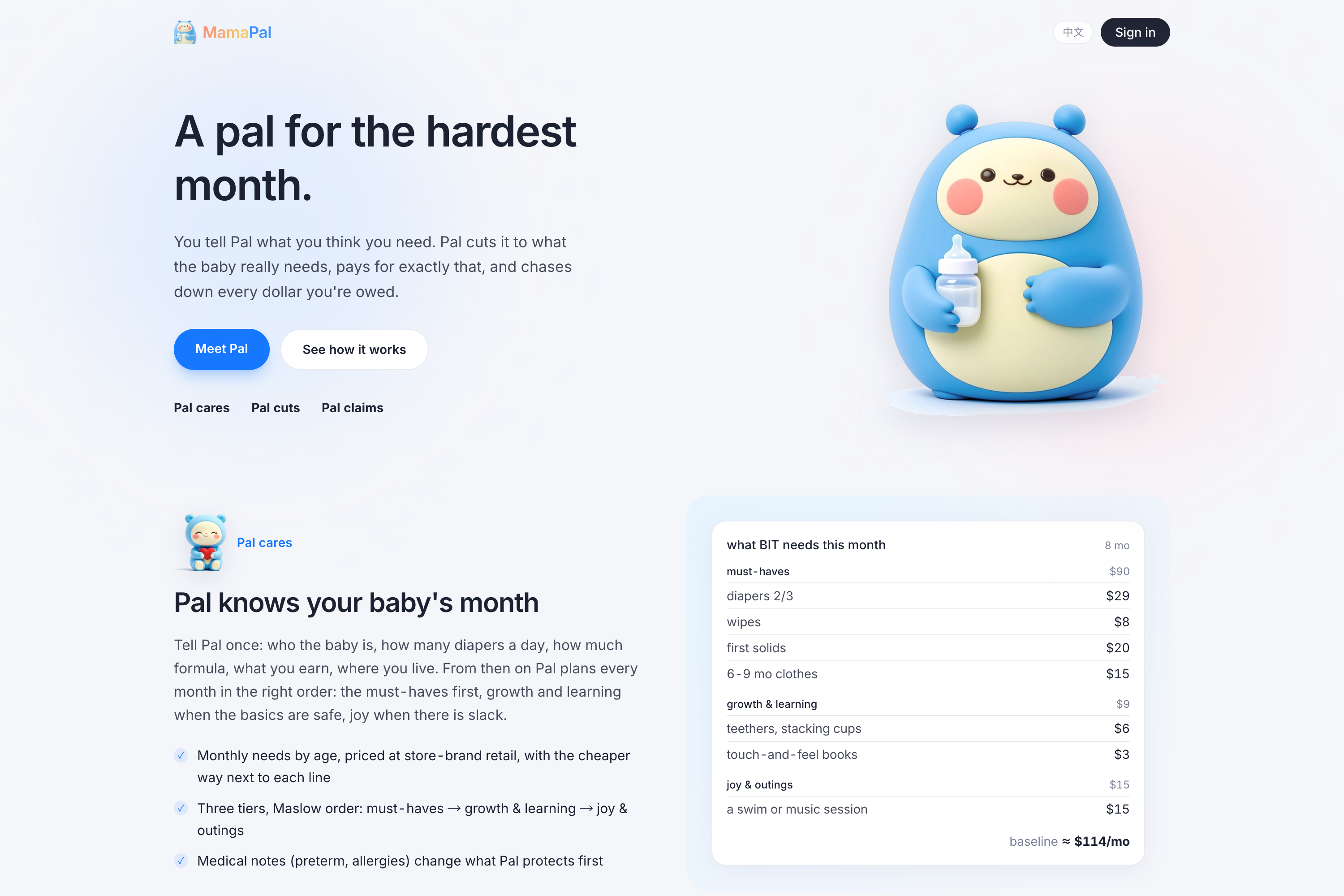
Pal cares: what this month should cost, in Maslow order. Must-haves first, then growth and learning, then joy. Pantry on top.
-
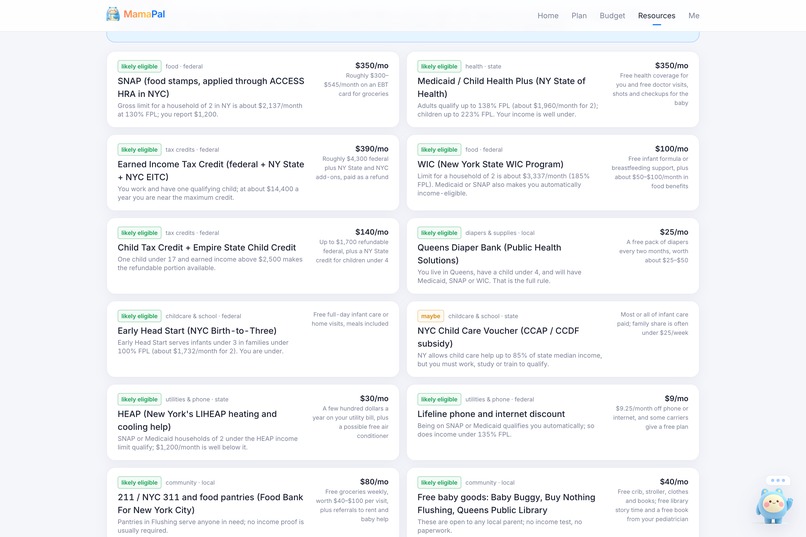
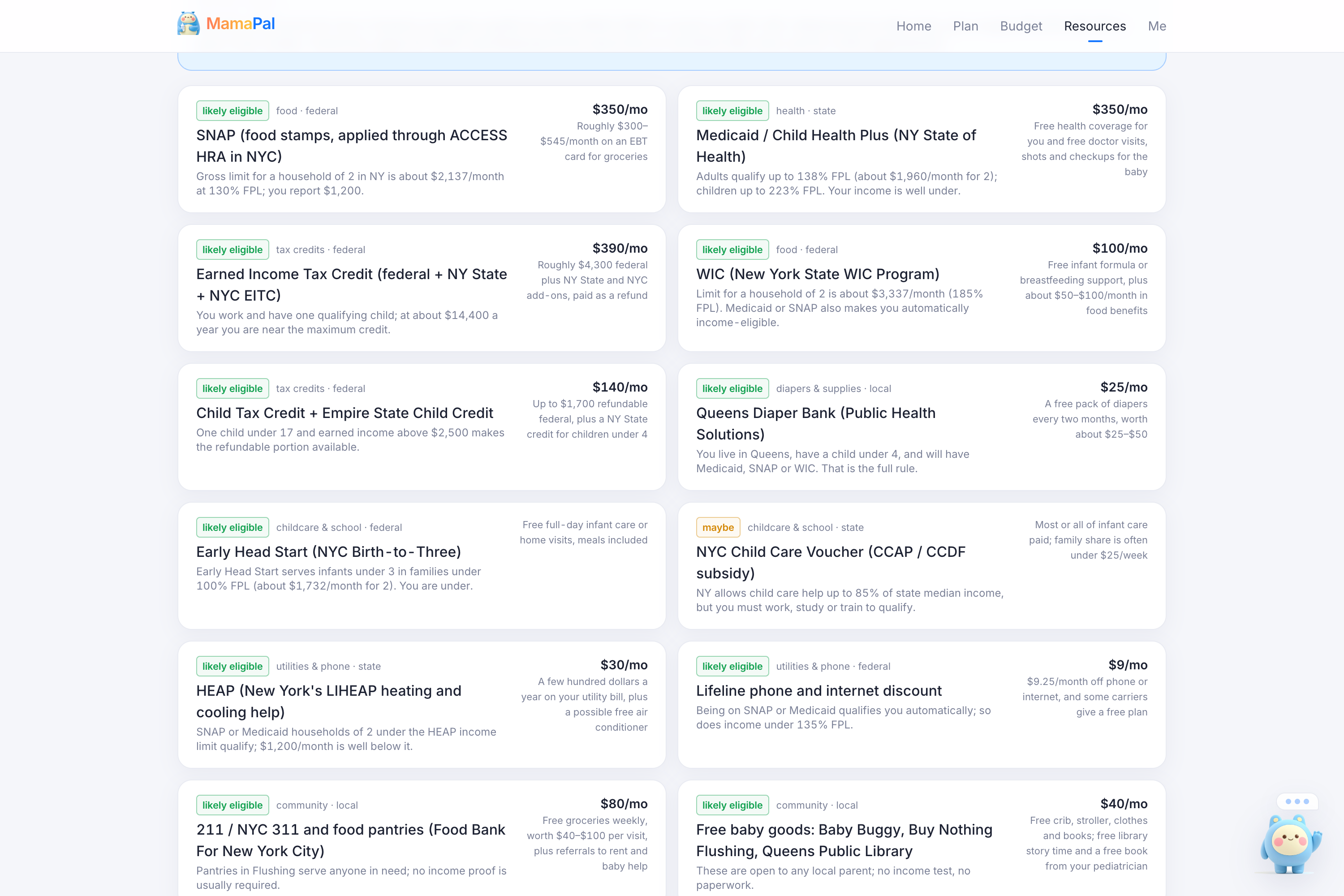
Pal claims: programs you likely qualify for where you live, with the one rule that decides each, what it is worth, and how to apply.
-
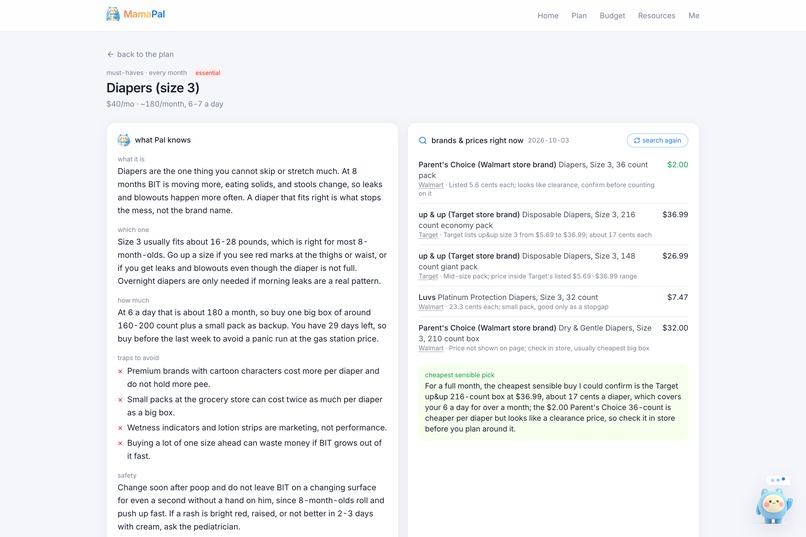
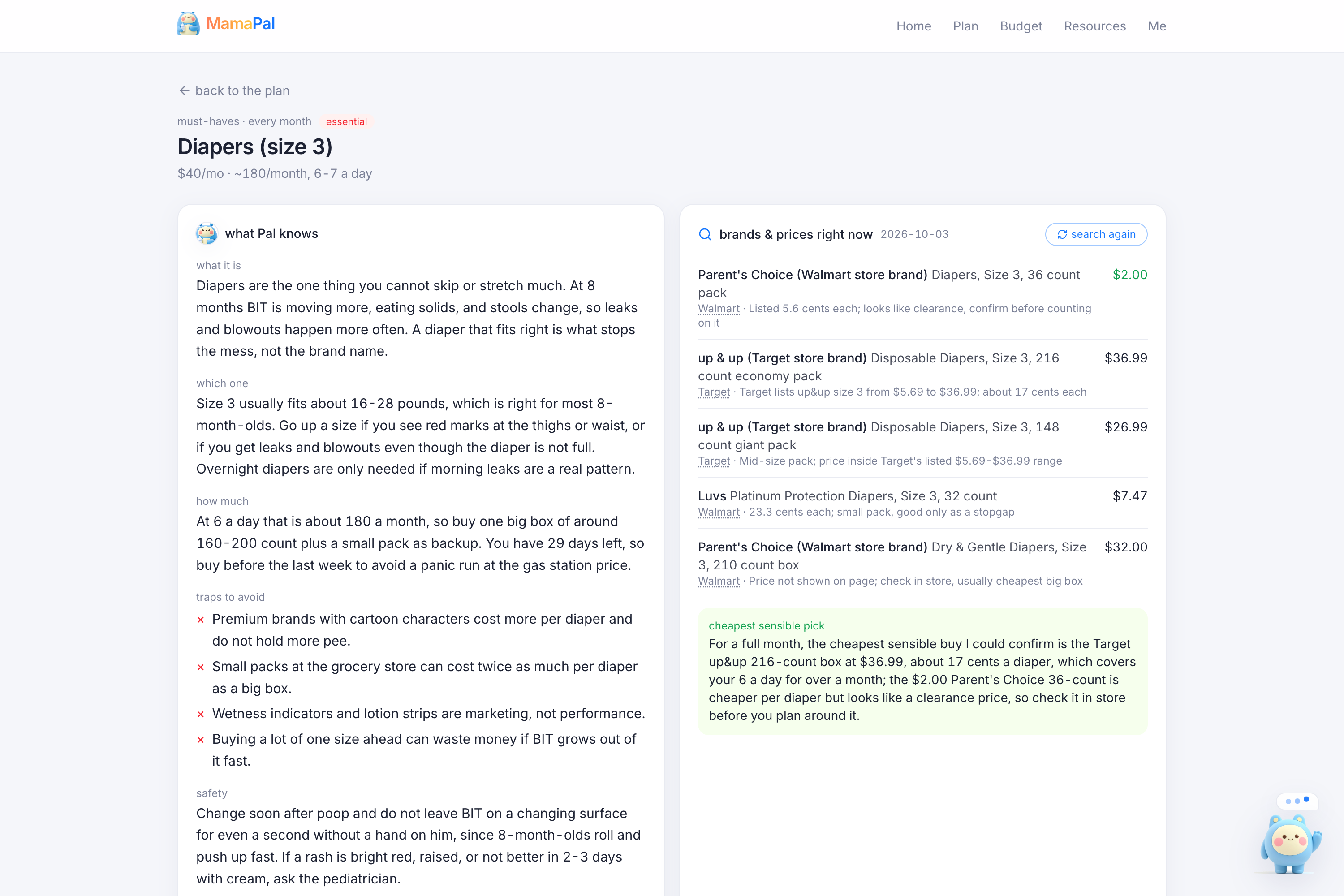
Every item opens: what it is, which size, how much, the traps, and today's prices from real stores.
-
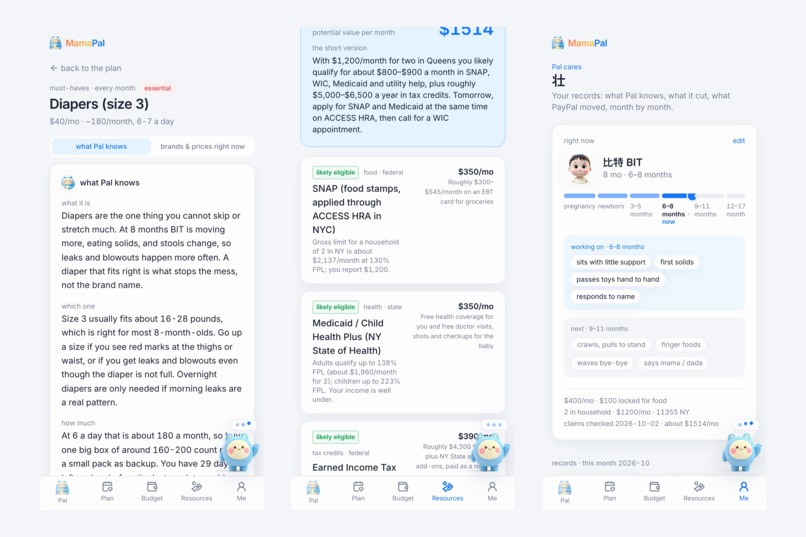
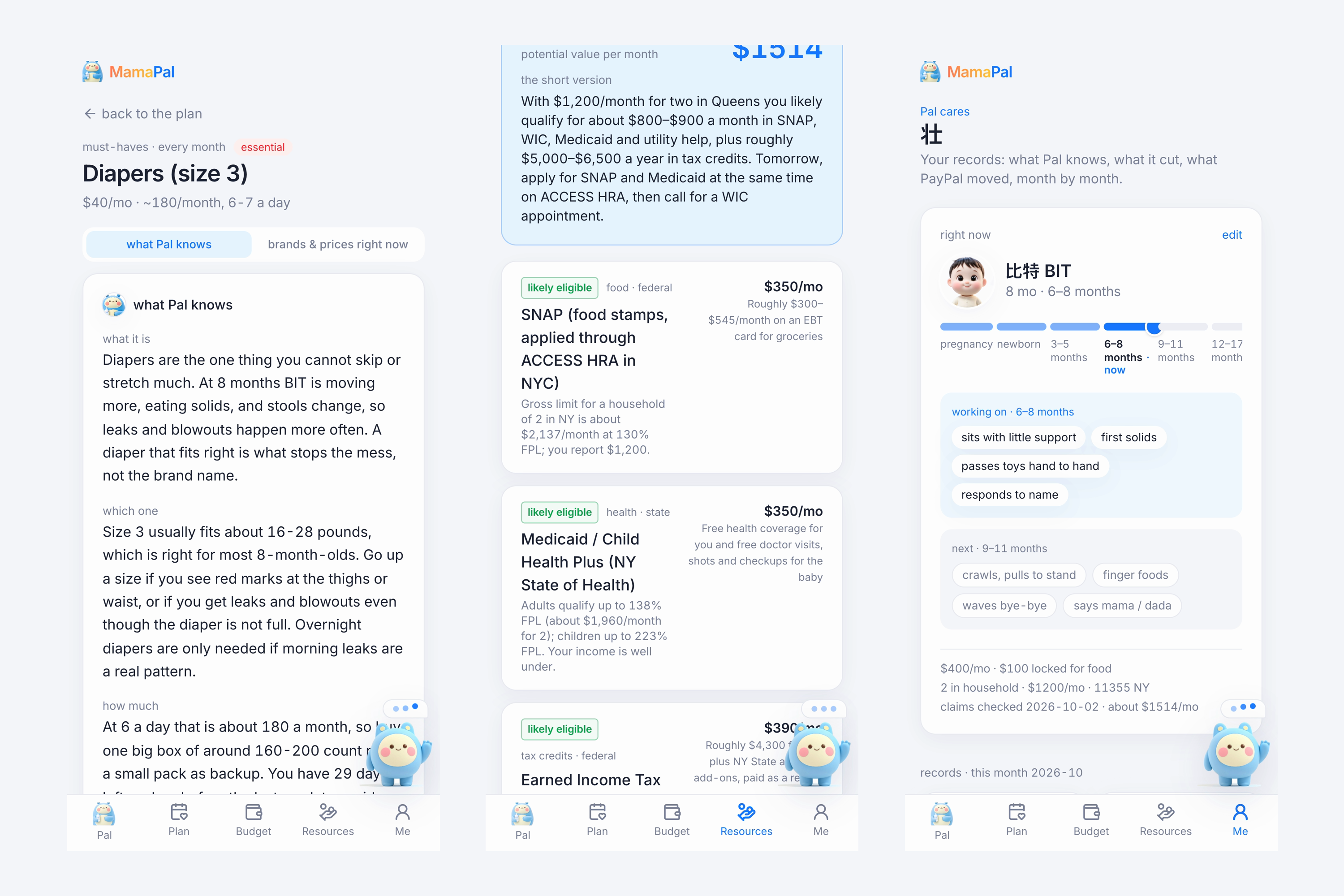
On the phone: item guide, benefits, and Me with the baby's growth timeline.
-
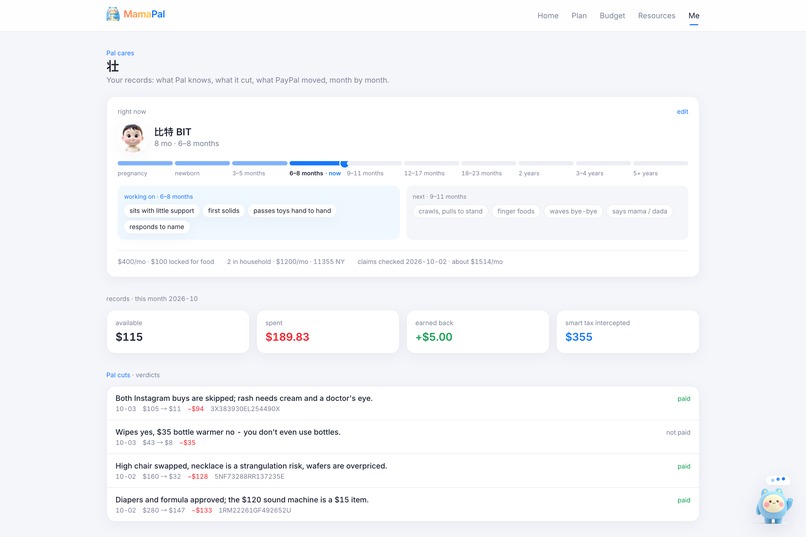
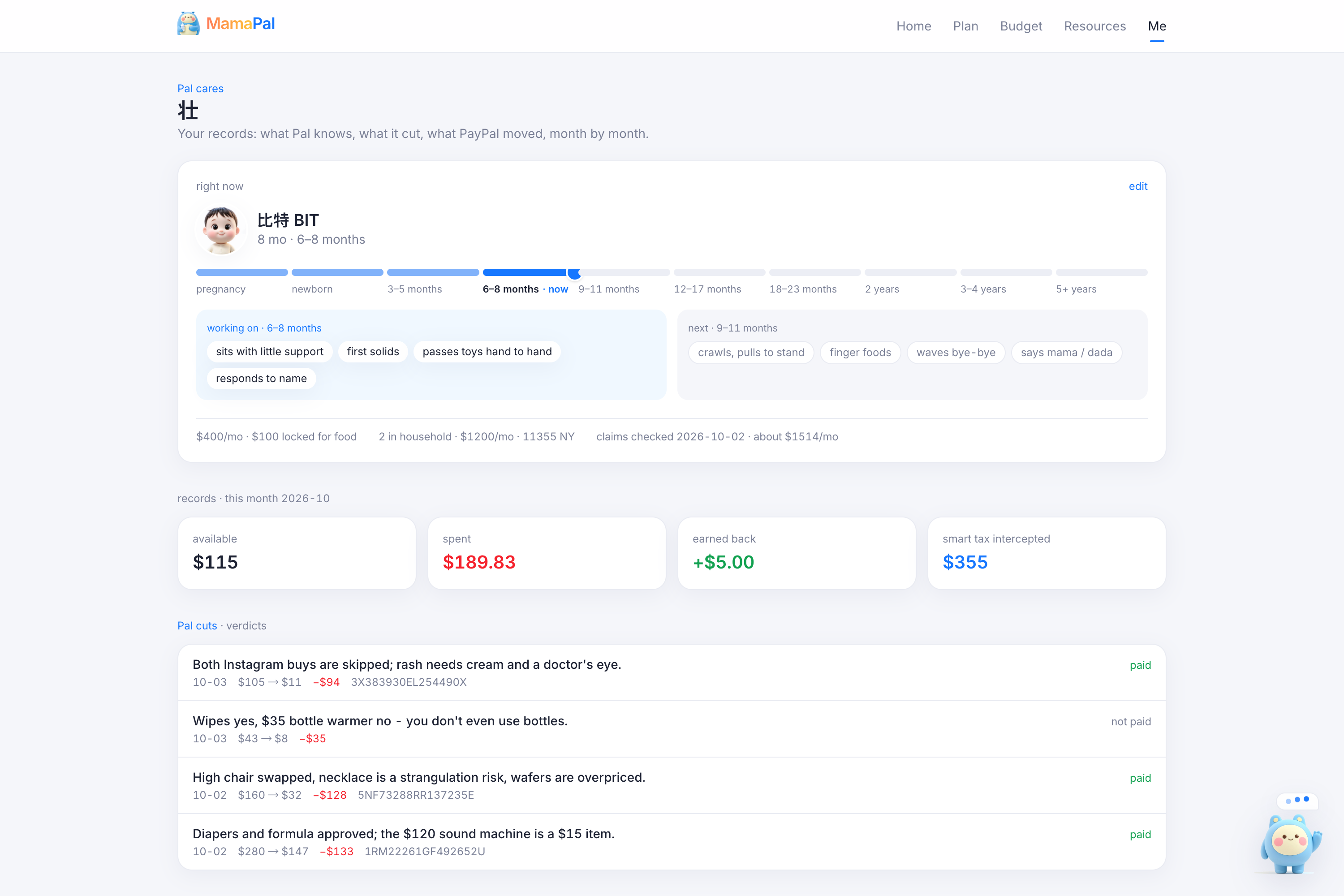
Me: the baby's growth timeline, this month's numbers, every verdict, and a ledger across months (AG Grid).
-
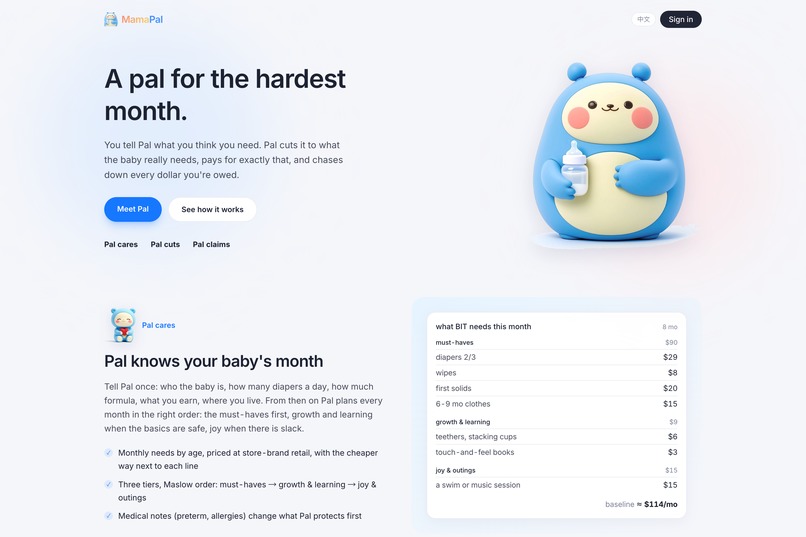
The landing page: Pal cares, Pal cuts, Pal claims.
Inspiration
I am the maker of this project and its first user. I am a mother on a very tight budget: about four hundred dollars a month for everything after rent. Every feed I open tells me the baby needs a $45 calming oil or a $120 sound machine, and when you are tired it is hard to tell marketing from need. At the same time there was real help I qualified for and did not know how to claim. MamaPal comes out of my own months of counting diapers and dollars: I built it because I needed it, and I have been living with it since the first day it ran.
What it does
MamaPal is an AI pal, not a dashboard. You talk to Pal; Pal answers in short sentences and cards.
Pal cares. Tell Pal once who the baby is, how many diapers a day, how much formula, what you earn and where you live. From a 505-item catalog (pregnancy through school age, the mother's own items included) Pal lays out what this month should cost in Maslow order: must-haves first, growth and learning second, joy and outings third. Every item opens into a plain-language guide: what it is, which size, how much, the traps, and today's prices from real stores. Pal keeps a pantry: every pack paid through Pal adds diapers, formula or wipes; daily use drains it; when a week is left, the welcome card says so.
Pal cuts. Say what you were told to buy. Claude returns a verdict per item (buy / swap / skip / defer) with a store-brand twin, a realistic price and a one-line reason. Money is recomputed server-side, never trusted from the model. "Check prices across stores" searches the web for the same item at Walmart, Target, Amazon, Costco, Aldi, dollar stores and pharmacies, lists real listings with links, and lowers the cart when it finds cheaper. One PayPal button pays for exactly the approved cart; the server captures the order, writes the capture id to the ledger, drops the budget bar and updates the pantry.
Pal claims. From ZIP, household size and income, Pal checks official sites and lists the programs you likely qualify for (WIC, SNAP under the state's name, Medicaid/CHIP, the nearest diaper bank, Head Start, LIHEAP, Lifeline, EITC/CTC, 211, pantries, free-goods groups) with the one rule that decides each program, what it is worth per month, the steps, the documents to bring and the official link. Twenty-second brand micro-surveys pay back into the mother's PayPal through Payouts.
The ledger across months lives in an AG Grid table (sort, filter, search, totals, CSV). Pal can be summoned from any page and knows where it was opened from. Bilingual: English and 简体中文.
How we built it
- Next.js 16 (App Router), Tailwind 4, TypeScript, deployed on Vercel.
- PayPal: Orders v2 (create + capture) for the approved cart, Payouts v1 for survey rewards, PayPal JS SDK buttons; all against the sandbox REST API from a thin client.
- Claude (claude-opus-5): structured outputs with Zod for verdicts, month notes and item guides; the web search tool for price checks and the benefits finder; one persona prompt (hard on products, warm and plain toward the mother).
- The catalog was generated by Claude stage by stage, reviewed by hand, and served from JSON.
- State in a Supabase row (single shared demo state); AG Grid Community for the ledger; the Pal mascot generated with Tongyi Wanxiang and cut out with a small flood-fill script.
Challenges we ran into
- Keeping money honest: the model proposes, the server computes every total, and only a PayPal id counts as paid.
- Long AI calls on a serverless host: streaming, two-step fallbacks, and caching guides and prices per stage, item and language.
- Cross-store prices are whatever the web shows that day; the UI says so instead of pretending.
- Making the home feel like one conversation on both a phone and a desktop without two codebases.
Accomplishments that we're proud of
- The full loop runs for real in sandbox: a $105 feed-driven wish becomes an $11 cart, gets cheaper after a price check, is paid through PayPal, and lands in the ledger and the pantry.
- A 505-item knowledge base that gives a tired parent concepts, not just prices.
- The benefits finder found about $1,500 a month of help for a Queens, NY profile on $1,200 a month, with official links.
What we learned
Mothers on a tight budget do not want a SaaS; they want a pal. Tone is a feature. And the cheapest sensible pick is usually the store brand, which an AI can say because it has no sponsor.
What's next for MamaPal
Real accounts and per-family data; a brand survey marketplace that pays mothers for honest answers; Channel3 as a product data source; sharing a month's plan with a partner or a caseworker; Spanish.
Built With
- ag-grid
- anthropic
- claude
- next.js
- paypal
- paypal-checkout
- paypal-payouts
- react
- supabase
- tailwind
- typescript
- vercel
- zod

Log in or sign up for Devpost to join the conversation.