-
-
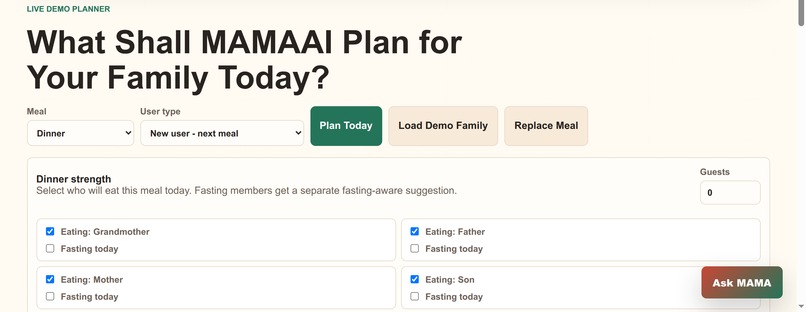
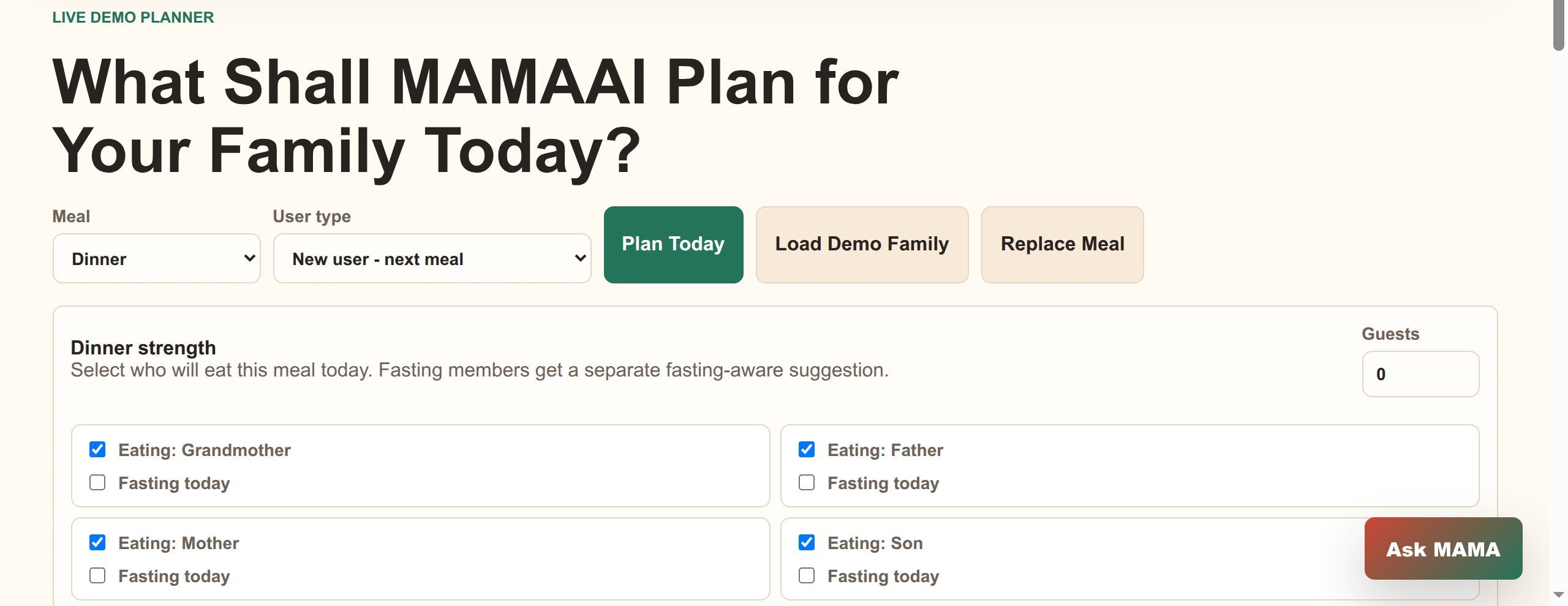
Meal Planner UI
-
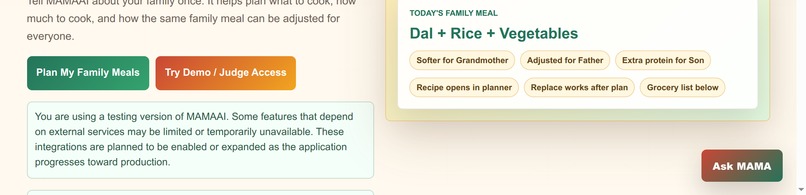
MAMAAI Meal planner
-
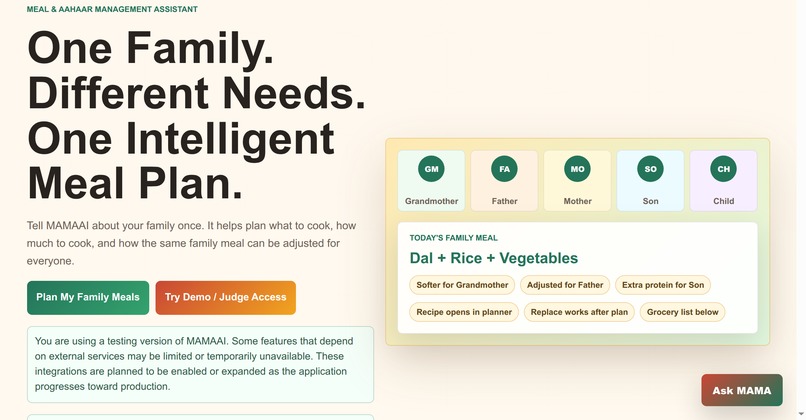
Meal Plan Assistant
-
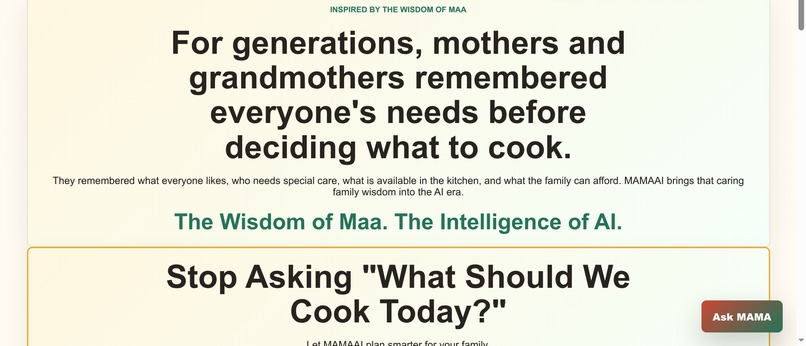
MAMAAI AI Cooking
Inspiration
The idea for MAMA AI started with a simple question heard in almost every home:
“What should we cook today?”
The question is simple, but the answer often isn’t.
A family may have children, working adults, elderly parents, someone trying to stay fit, or a person with special dietary needs. Everyone may eat from the same kitchen, but everyone’s needs are different. Cooking a completely separate meal for each person is usually not practical.
Most diet apps focus on one individual. That made us think:
What if AI could understand every family member individually, but plan food for the whole family together?
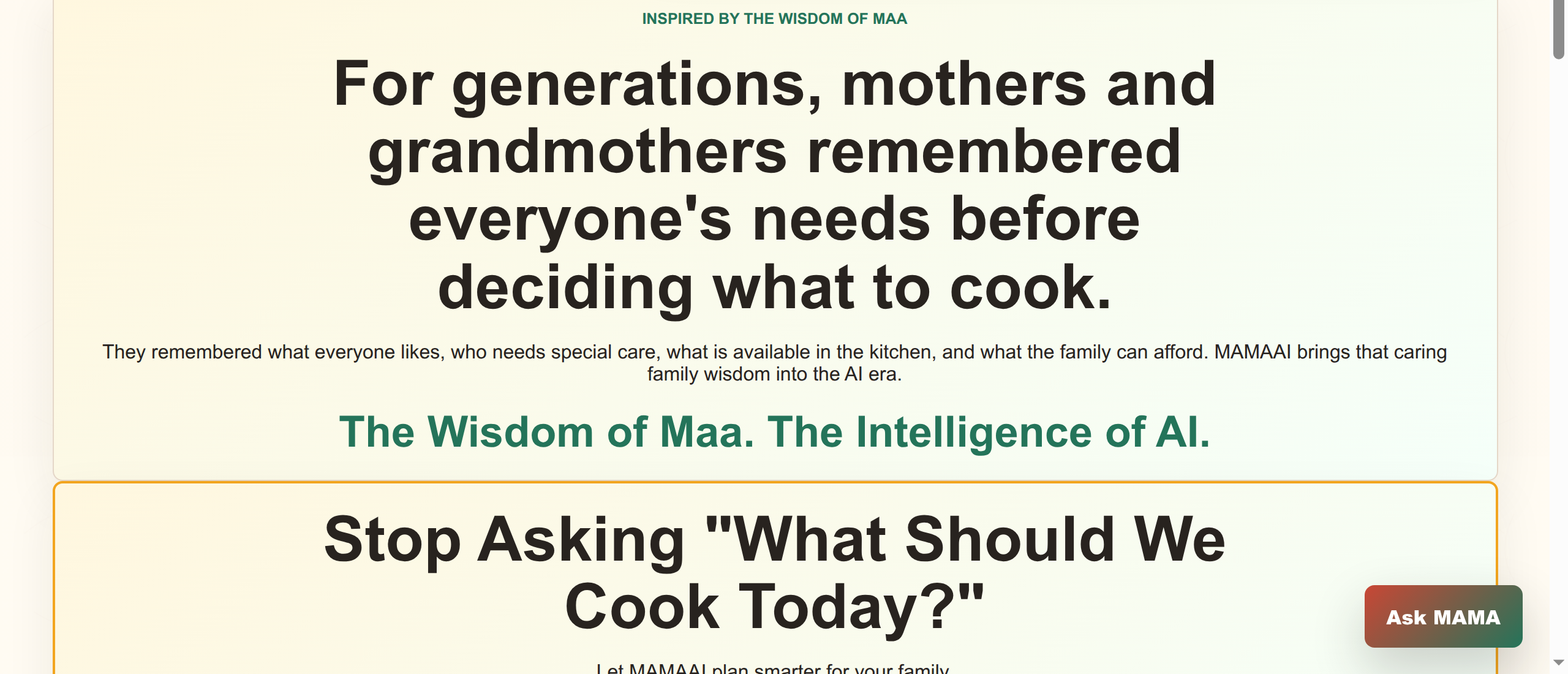
The idea is inspired by how mothers and grandmothers have traditionally managed family meals. They remember who likes what, who should avoid something, what was cooked recently, what is available in the kitchen, what suits the season, and what the family can afford.
MAMA AI tries to bring that caring, practical thinking into the AI era.
The Wisdom of Maa. The Intelligence of AI.
What it does
MAMA AI – Meal & Aahaar Management Assistant is an AI-powered family food planning platform built around one idea:
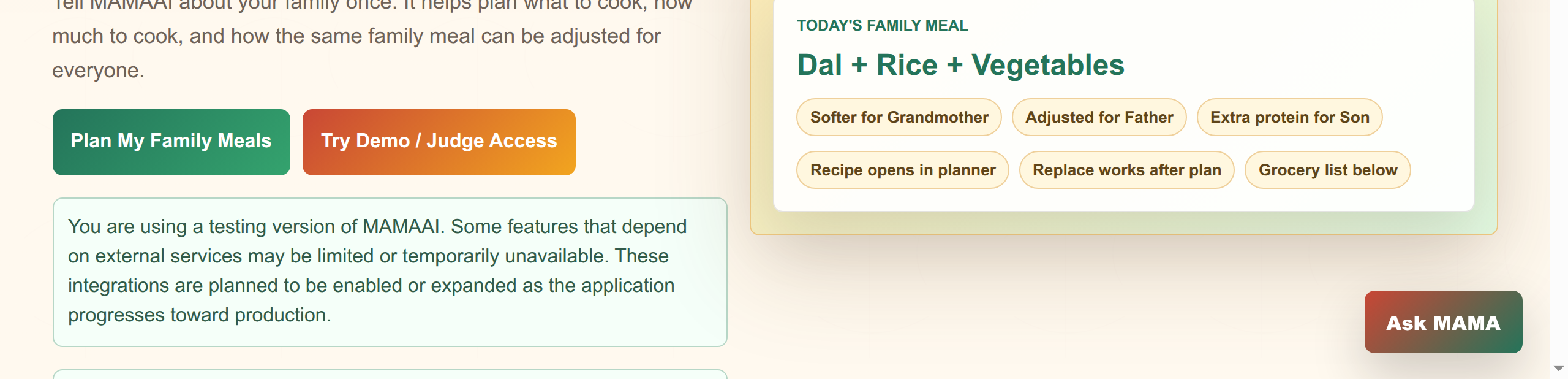
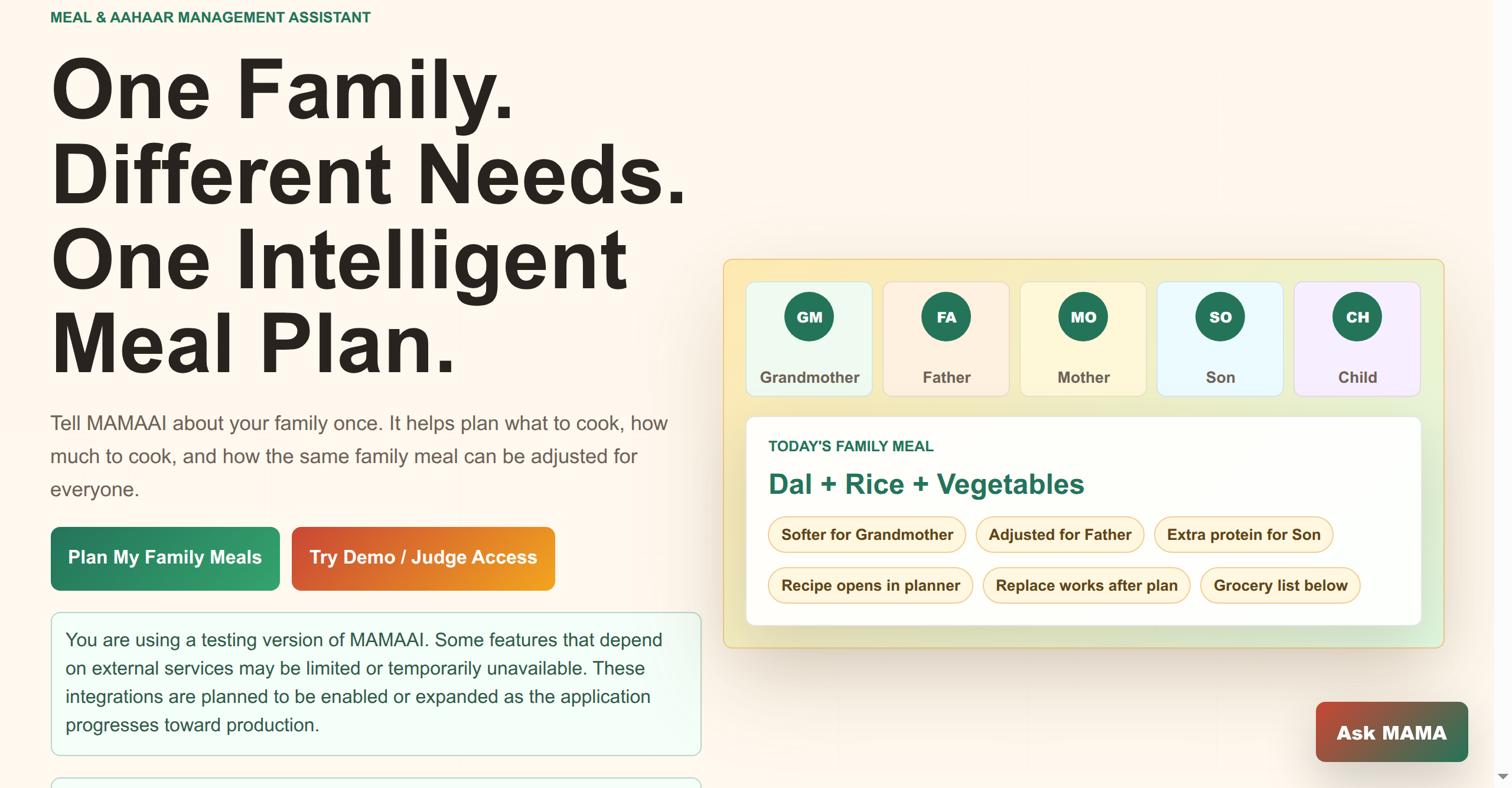
One Family. Different Needs. One Intelligent Meal Plan.
Instead of simply generating separate diet charts for every person, MAMA AI looks at the family together.
It can consider information such as age, height, weight, activity, food preferences, allergies, dislikes, dietary requirements and other relevant details provided for family members. It also considers practical factors such as cuisine preference, region, season, food availability and budget.
The goal is simple:
Common Family Meal + Individual Modification + Individual Portion
For example, a family might have the same basic dinner, but an elderly member may need a softer preparation, a child may need a smaller age-appropriate portion, and an active young adult may need additional protein.
MAMA AI is designed around everyday family needs such as:
- Daily, weekly and monthly meal planning
- Personalized portions and meal adjustments
- Food allergies, dislikes and preferences
- Regional and seasonal food choices
- Fasting-aware meal planning
- Fruits and hydration recommendations
- Ingredient quantities based on family strength
- Recipes and cooking guidance
- Meal replacement and alternatives
- Grocery planning
- Optional previous-meal history to reduce repetition
For health-sensitive situations, MAMA AI is intended as food-planning support, not as a replacement for a doctor or qualified dietitian.
How we built it
We started with the real-life problem first and then created a detailed Product Requirements Document around it.
A major part of the development was done through an AI-assisted, agentic development workflow using OpenAI Codex.
Codex helped us move from an idea to an actual application by supporting architecture planning, coding, feature implementation, debugging, testing and continuous improvements.
The project uses a modern web stack including technologies such as Next.js, React and TypeScript, together with OpenAI-powered intelligence for the AI experience.
One important design decision was not to treat MAMA AI as just another chatbot.
Family information needs to become structured context so the system can reason about the family as a group and produce useful outputs such as meals, member-specific adjustments, portions, ingredients and related recommendations.
We also designed the project so that the user interface, AI logic, backend services and data layer can evolve independently as MAMA AI moves from a hackathon MVP toward production.
Challenges we ran into
The biggest challenge was something that sounds simple:
How do you personalize food for several people without asking a family to cook several completely different meals?
Planning for one person is relatively straightforward. Planning for a family means balancing different ages, tastes, allergies, dietary requirements, portions, budgets and lifestyles at the same time.
This challenge led to our central concept:
Common Meal + Individual Modification + Individual Portion
Another challenge was dealing with food preferences intelligently.
If one person simply dislikes paneer, should the whole family stop eating paneer? Probably not. MAMA AI therefore needs to distinguish between a preference, which can often be handled with an alternative, and an allergy or serious restriction, which must be treated much more carefully.
Regional diversity was another challenge. A family living in London may prefer Indian food, British food, or a mixture of both. Location alone cannot decide what people want to eat.
Finally, time was a major challenge. A hackathon gives us a limited window, while the complete vision for MAMA AI is much larger. We had to focus on demonstrating the core idea first and clearly separate working MVP functionality from features planned for production.
Accomplishments that we're proud of
We are most proud that MAMA AI approaches food planning from a family perspective, rather than simply becoming another calorie tracker or recipe generator.
The idea can be summarized in four words:
Understand individuals. Plan together.
We developed a concept where AI can consider multiple family members and try to make one practical family meal work better for everyone.
We are also proud of bringing together things that families actually think about when deciding food:
Nutrition, taste, allergies, dislikes, portions, region, season, budget, fasting, ingredients and cooking effort.
Another accomplishment was turning a broad idea into a working hackathon project with the help of Codex in a very short development period.
Most importantly, we transformed a question families ask every day—
“What should we cook today?”
—into a problem that AI can help solve in a more practical and personalized way.
What we learned
One of our biggest lessons was that good AI is not just about generating more information. It needs to make useful decisions within real-life limitations.
A nutritionally perfect meal recommendation is not very useful if:
- The ingredients are unavailable
- The family cannot afford it
- Nobody likes eating it
- It takes too much effort to cook
- It ignores cultural food habits
- It conflicts with an allergy or restriction
- It requires cooking a separate meal for everyone
We learned that family food planning is really a balancing problem:
Nutrition + Taste + Health Context + Budget + Availability + Culture + Season + Cooking Effort
We also learned how powerful AI-assisted development can be. With a clear idea, structured requirements and continuous iteration, Codex helped us move much faster from concept to implementation.
Perhaps the most important hackathon lesson was:
It is better to make the core idea work well than to pretend every future feature is already finished.
What's next for MAMA AI
The hackathon is the starting point for MAMA AI, not the finished product.
Our next goal is to take the MVP toward production through deeper testing, stronger nutrition validation, improved security and feedback from real families.
The roadmap includes:
- Live subscription and payment integration
- Stronger regional and seasonal food intelligence
- Multilingual support
- More advanced daily, weekly and monthly planning
- Smarter grocery and budget optimization
- Pantry and leftover-food management
- Better recipe and cooking assistance
- Voice interaction: “MAMA, what should we cook today?”
- Food and ingredient recognition
- Learning from family likes, dislikes and rejected meals
- Android and iOS distribution
- Appropriate professional dietitian involvement for specialized use cases
Some external API-dependent and production features are intentionally left for the next stage rather than being presented as completed hackathon functionality.
Our long-term vision is to make MAMA AI more than a meal planner.
We want it to become an intelligent Family Food Operating System that helps families answer four everyday questions:
What should we eat?
How much should each person eat?
What do we need to buy?
How can one family meal work better for everyone?
At the heart of the idea remains something very human:
The Wisdom of Maa. The Intelligence of AI.
One Family. Different Needs. One Intelligent Meal Plan.
Built With
- amazon-cognito
- amazon-web-services
- aws-dynamodb
- aws-lambda
- dataapi
- github
- google-play-billing
- next.js
- openai-api
- openai-codex
- razorpay
- react
- revenuecat
- typescript
- vercel
- youtube
- zod


Log in or sign up for Devpost to join the conversation.