

Inspiration
Every day, millions of files are downloaded, shared, and deployed — yet most people and small organizations have no reliable, privacy-respecting way to scan them. Enterprise antivirus tools are expensive, cloud-based scanners send your sensitive files to third-party servers, and most open-source alternatives are either too complex to set up or produce so many false positives that they become useless.
We were inspired by a simple frustration: why does local, fast, and trustworthy malware detection have to be so hard?
The cybersecurity community has already done the hard work — thousands of high-quality YARA rules exist for detecting known threats. We just needed a clean, scriptable engine to put them to work. We built Malware_Scanner because every developer, researcher, and security analyst deserves a tool they can actually trust — one that runs offline, respects their data, and gives clear, actionable results.
What it does
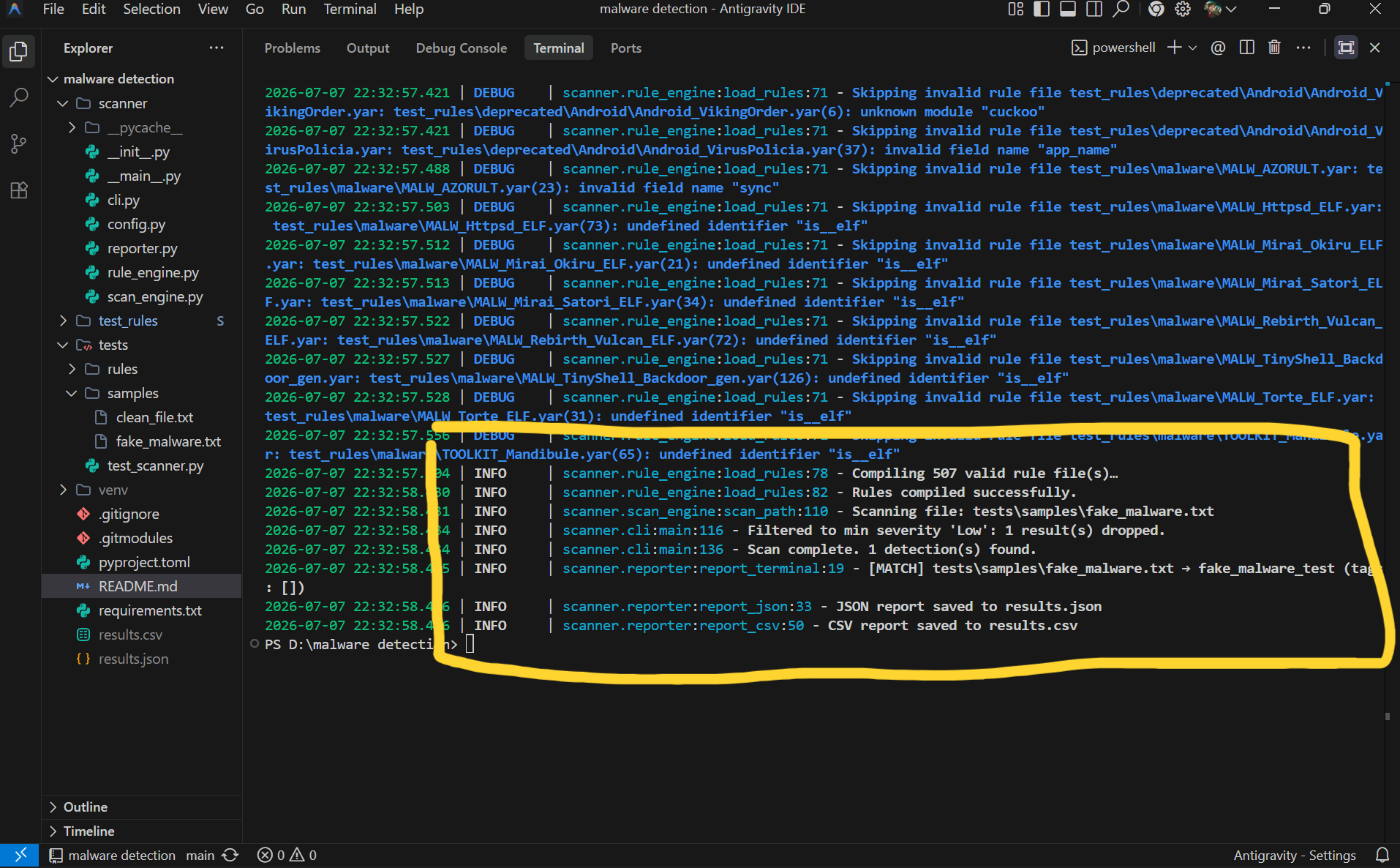
Malware_Scanner is a YARA-based signature detection engine that scans files and entire directory trees for known malware patterns — fast, offline, and with zero noise.
- 🔍 Scans individual files or full directory trees recursively using YARA signature rules
- 📚 Auto-compiles hundreds of
.yar/.yararule files from a rules library — no manual loading required - 🔕 Smart noise filtering — suppresses low-quality
Unknown-severity rules by default; tunable with--min-severity - 📊 Multi-format reporting — generates terminal output, JSON, and CSV reports simultaneously in a single scan run
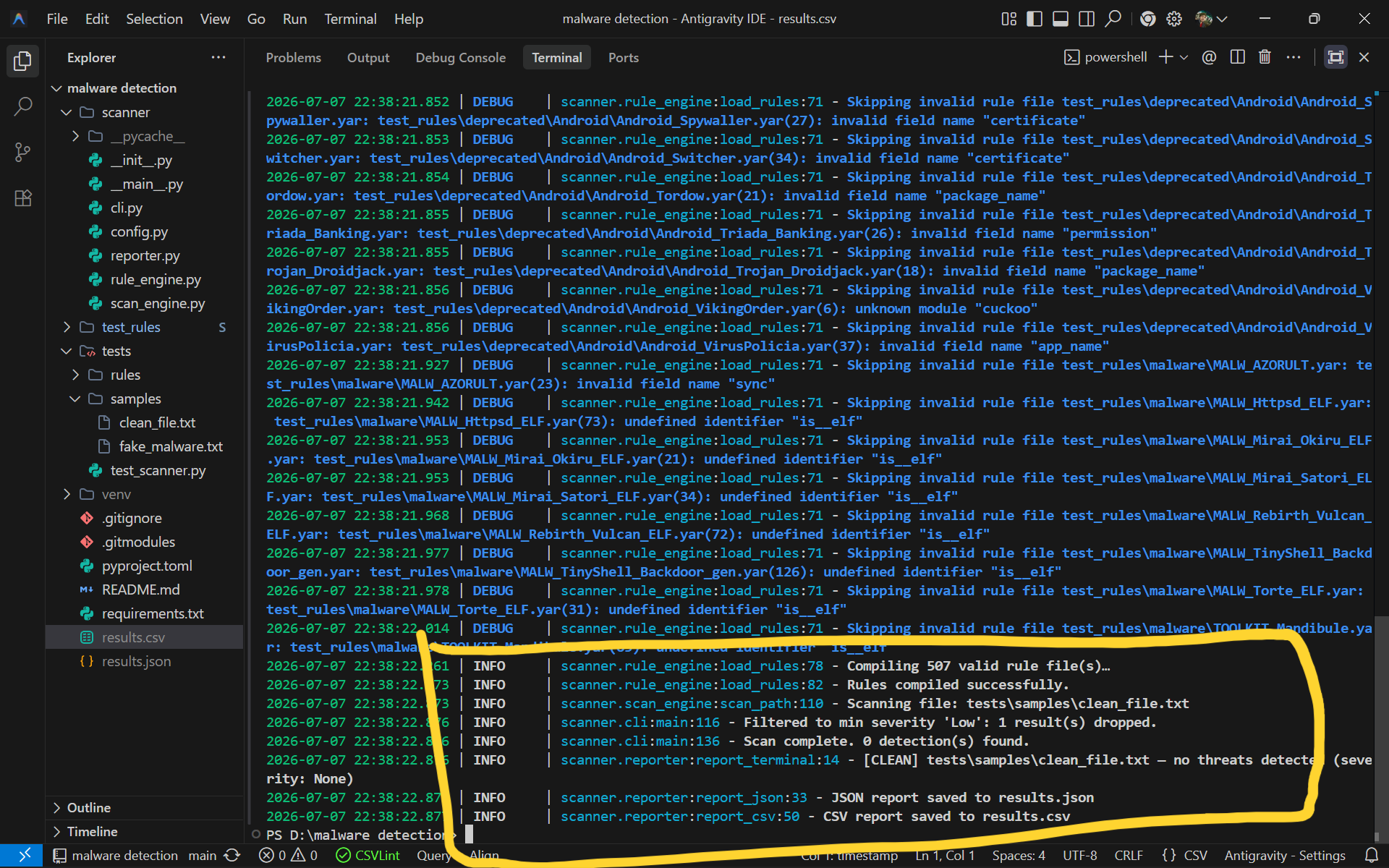
- 📋 Complete audit trail — every scanned file appears in reports, even with zero detections, so nothing is hidden
- 🚫 Rule exclusion — skip specific rules by name using
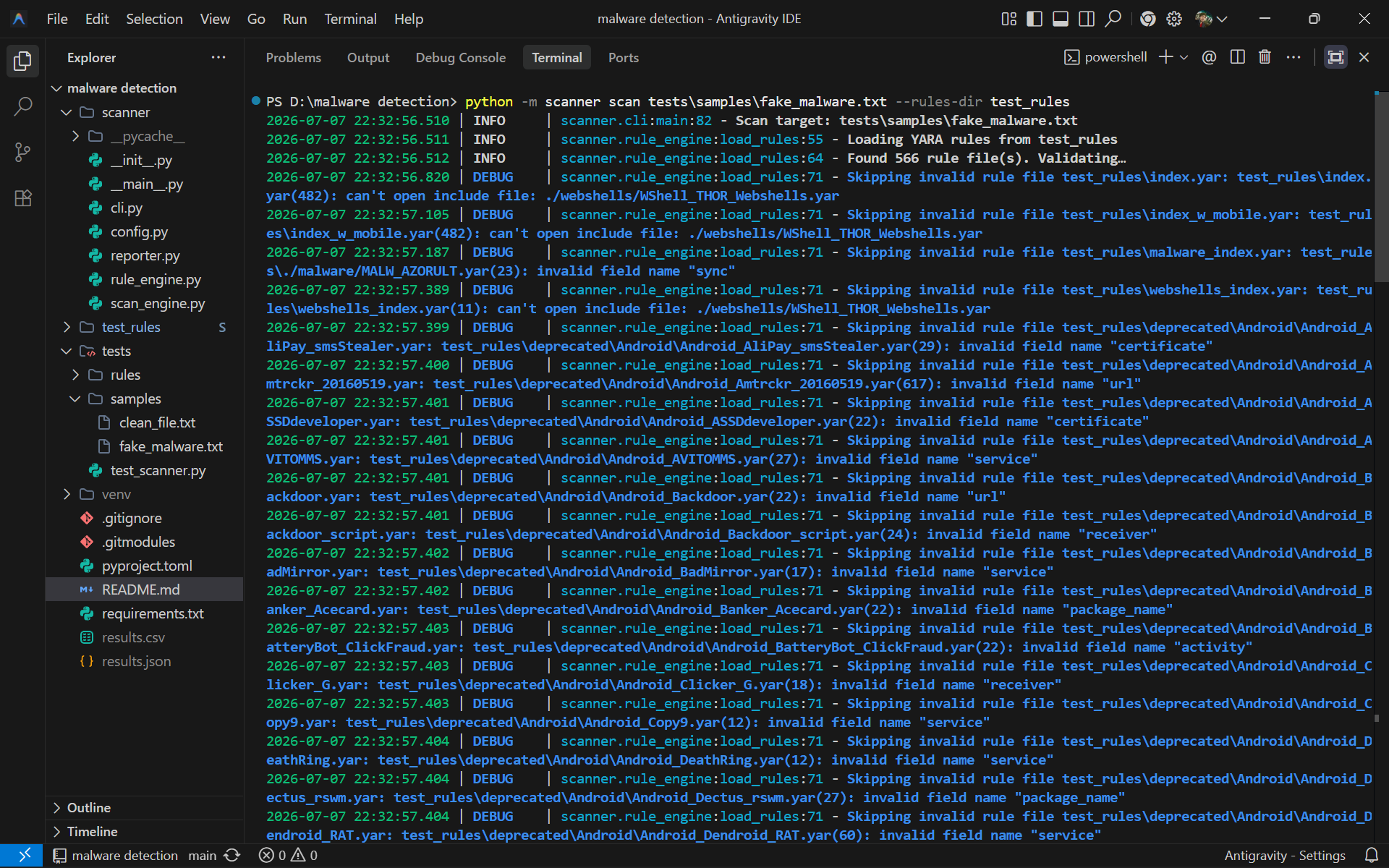
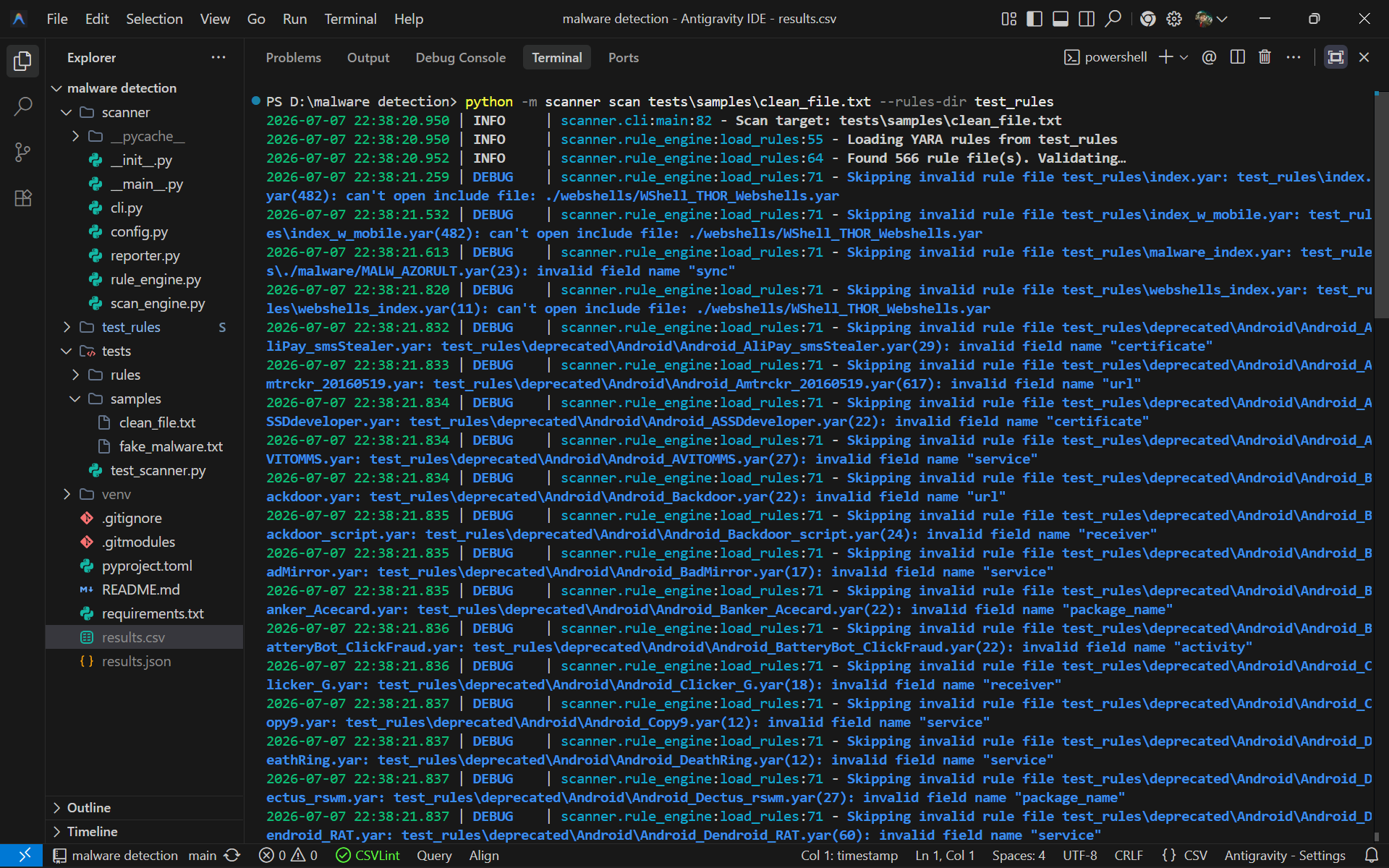
--exclude-rulesfor fine-grained control - 🛡️ Graceful validation — invalid or incompatible YARA files are skipped individually without aborting the entire scan
- 🔒 100% offline — no network calls, no telemetry, your files never leave your machine
How we built it
We built the scanner in Python 3.10+, keeping the architecture modular and clean:
| Module | Responsibility |
|---|---|
cli.py |
Argument parsing & scan orchestration |
rule_engine.py |
YARA rule discovery, validation & compilation |
scan_engine.py |
File traversal & YARA pattern matching |
reporter.py |
Terminal, JSON, and CSV output formatters |
config.py |
Tuneable constants — paths, size limits, exclusions |
Key technical decisions:
- Used
yara-python(the official Python binding for YARA) for high-performance rule compilation and matching - Used
logurufor structured, coloured logging that makes debugging scan runs intuitive - Designed the rule engine to validate rules individually before compilation — so a single broken
.yarfile never kills an entire scan - Built severity filtering as a first-class feature using rule metadata tags to filter noise at the match level
- Used
pyproject.tomlfor modern Python packaging, exposing a cleanmalware-scannerCLI entry point
Challenges we ran into
- YARA rule quality is wildly inconsistent. The open-source YARA rule ecosystem contains thousands of rules, but many have syntax errors, deprecated features, or incompatible conditions. We had to build a robust per-file validation and skip mechanism so one bad rule doesn't crash the engine.
- Severity metadata is not standardised. Different YARA rule authors use different metadata fields (
severity,level,criticality). We had to normalise these across hundreds of rules and make sensible defaults when metadata was missing. - False positives at scale. Running broad rule sets against large directories produced enormous amounts of
Unknown-severity noise. Designing the--min-severityfiltering system required careful thought about UX — sensible defaults without hiding real threats. - Reporting completeness vs. performance. Ensuring every scanned file appears in output (even clean ones) required careful tracking across the scan engine and reporter without significant memory overhead on large directory trees.
- Cross-platform path handling. File path normalisation across Windows and Linux in YARA match results required extra handling to produce consistent, readable output regardless of platform.
Accomplishments that we're proud of
- 🏆 Built a production-grade, modular scanner from scratch with a fully tested codebase
- ✅ Achieved 100% file coverage in reports — zero blind spots, every file accounted for
- ⚡ Successfully compiles and runs against large YARA rule libraries without crashing on bad rules
- 🔕 Implemented a severity-based noise filter that dramatically reduces false positive alert fatigue
- 📦 Packaged as a proper Python package with a clean
malware-scannerCLI entry point - 🧪 Shipped with a complete unit and integration test suite including synthetic malware samples and dummy YARA rules
- 🔒 Delivered a tool that is entirely offline — a genuine privacy-preserving alternative to cloud scanners
What we learned
- The YARA ecosystem is powerful but fragile at scale — defensive engineering (graceful failure, per-file validation) is essential when consuming community-contributed rules
- Noise is the enemy of security tools. A scanner that cries wolf on every file trains users to ignore alerts — severity filtering isn't optional, it's critical to trust
- Modular architecture pays dividends fast. Separating rule compilation, file scanning, and reporting into independent modules made debugging and extending the tool dramatically easier
- Output format is UX. Offering JSON and CSV alongside terminal output unlocks integration into pipelines, SIEMs, and dashboards — turning a CLI tool into a platform primitive
- Complete audit trails matter. Logging clean files alongside detections is the difference between a scanner and a forensic tool
What's next for Malware_Scanner
- 🤖 Behavioural / ML layer — complement YARA signature matching with a lightweight ML model trained on file structure, entropy, and import patterns to catch zero-day and obfuscated threats
- 🌐 REST API + Web Dashboard — wrap the scanner in a FastAPI service with a real-time web UI showing scan progress, threat maps, and historical reports
- 🔄 Auto-updating rule subscriptions — integrate with community rule feeds (e.g., YARA-Forge, Malpedia) to keep the rule library current without manual updates
- 🐳 Docker image — ship a pre-configured container with the scanner + rules pre-loaded, ready to drop into any CI/CD pipeline
- 🔗 CI/CD plugin — GitHub Actions / GitLab CI integration to automatically scan build artefacts and uploads on every pipeline run
- 📧 Alert integrations — Slack, email, and webhook notifications when high-severity threats are detected
- 🗂️ Quarantine mode — automatically move detected files to a sandboxed quarantine directory with a one-command restore workflow
Built With
- loguru
- python
- yara

Log in or sign up for Devpost to join the conversation.