Malus - The website about an apple
MALUS — Project Story
Inspiration
Latin has two words that look identical in writing. mālus is an apple tree.
malus is evil. They differ only by a vowel length that Latin stopped writing
down — which is very likely why the unnamed fruit in Genesis became an apple.
A pun turned into two thousand years of iconography.
That got me interested in the apple as a subject, and then something else did.
Most 3D showcases pick a subject that is already impressive: a spaceship, a supercar, a fantasy city, a neon skyline. The subject does half the work. Put a starship on screen and it is interesting before you have written a line of shader code.
So I wanted to try the opposite. Take the most ordinary object I could think of — the thing in the fruit bowl that nobody looks at — and try to earn the same reaction anyway. If I could make people stare at an apple for eight minutes, that would mean something the spaceship never could.
What it does
MALUS is a 3D essay in seven acts. You scroll; the fruit is taken apart.
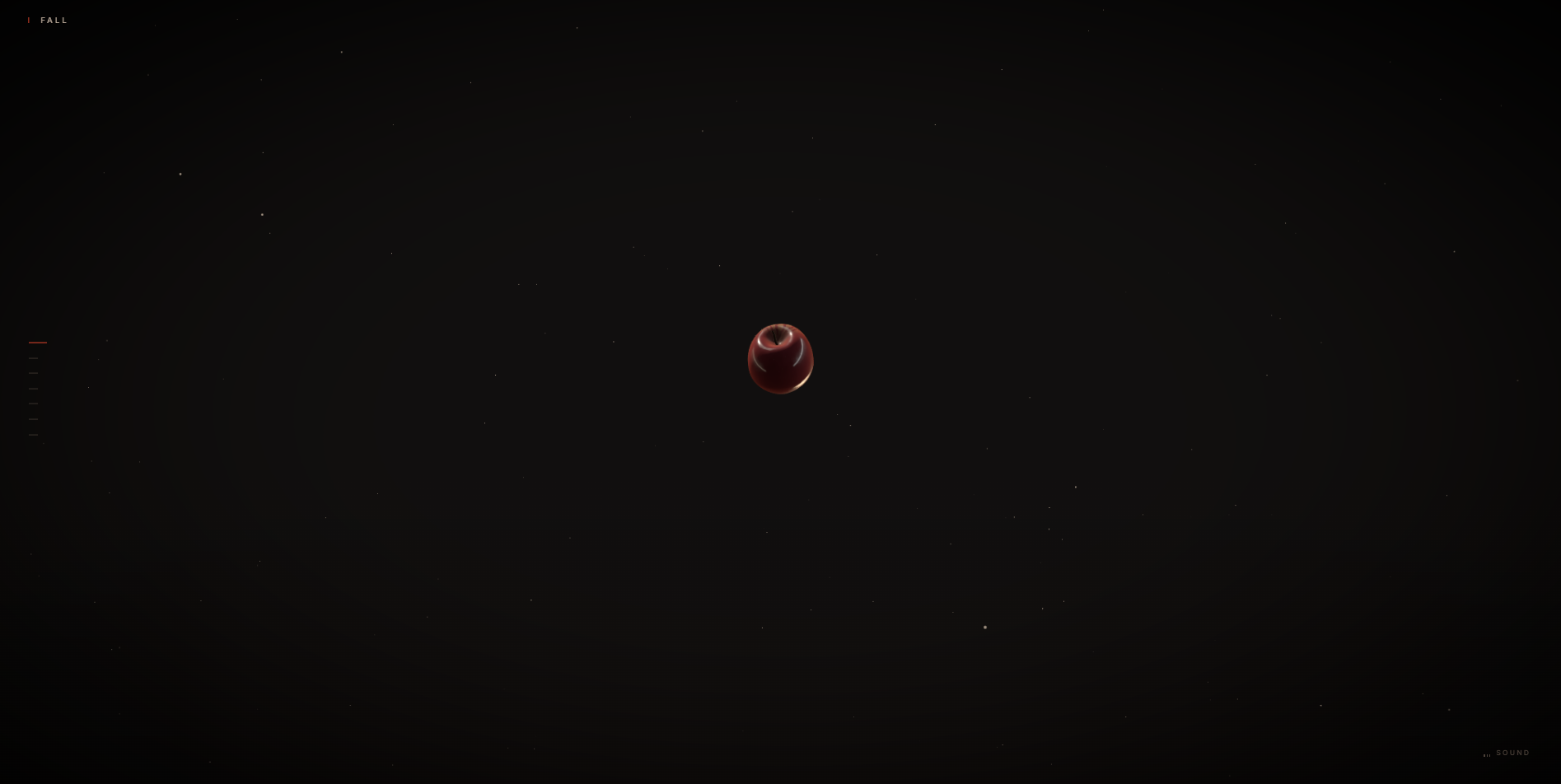
I — FALL. Scrolling is gravity. The distance the apple has fallen grows with the square of how far you have scrolled, so its speed climbs steadily. That is free fall, and you are supplying it.
II — SKIN. Macro on the cuticle while three numbers come up one at a time. You watch an apple become glossy — which is something nobody has ever seen, because in life all three arrive at once.
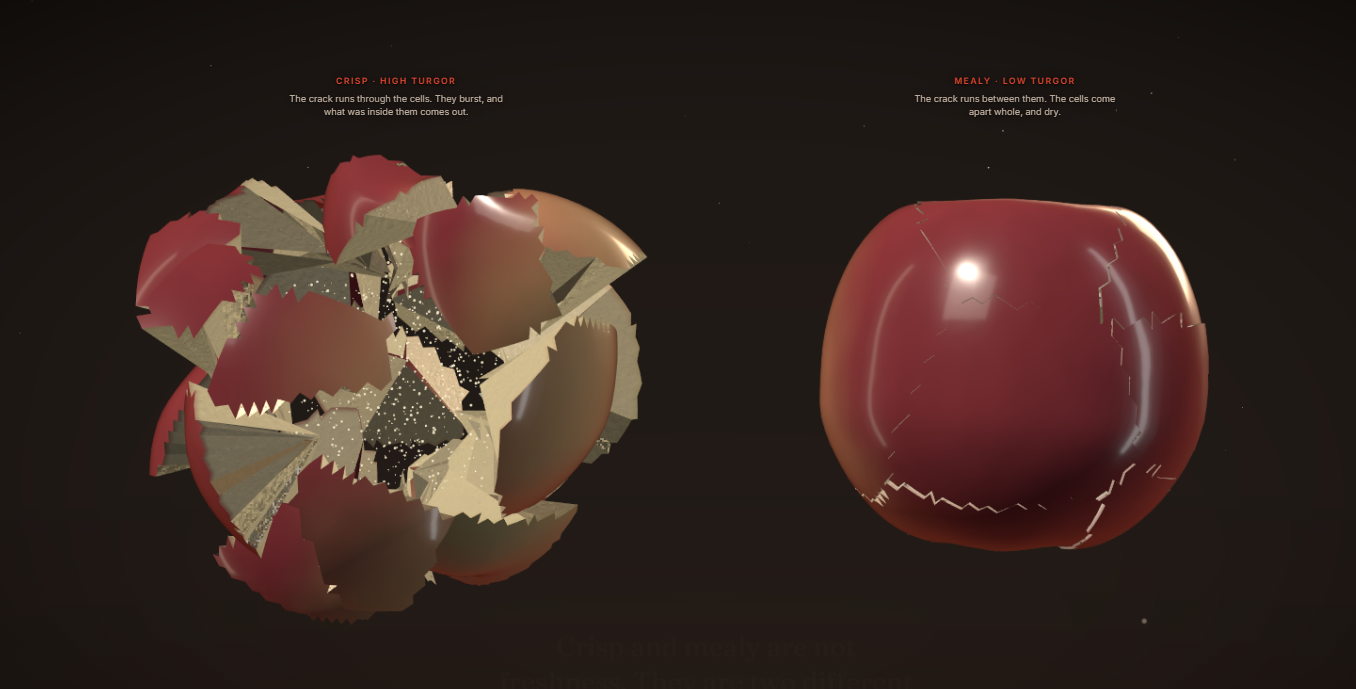
III — BITE. Two apples, side by side, broken in the same instant by the same force. One is turgid and one is not, and they do not break the same way at all.
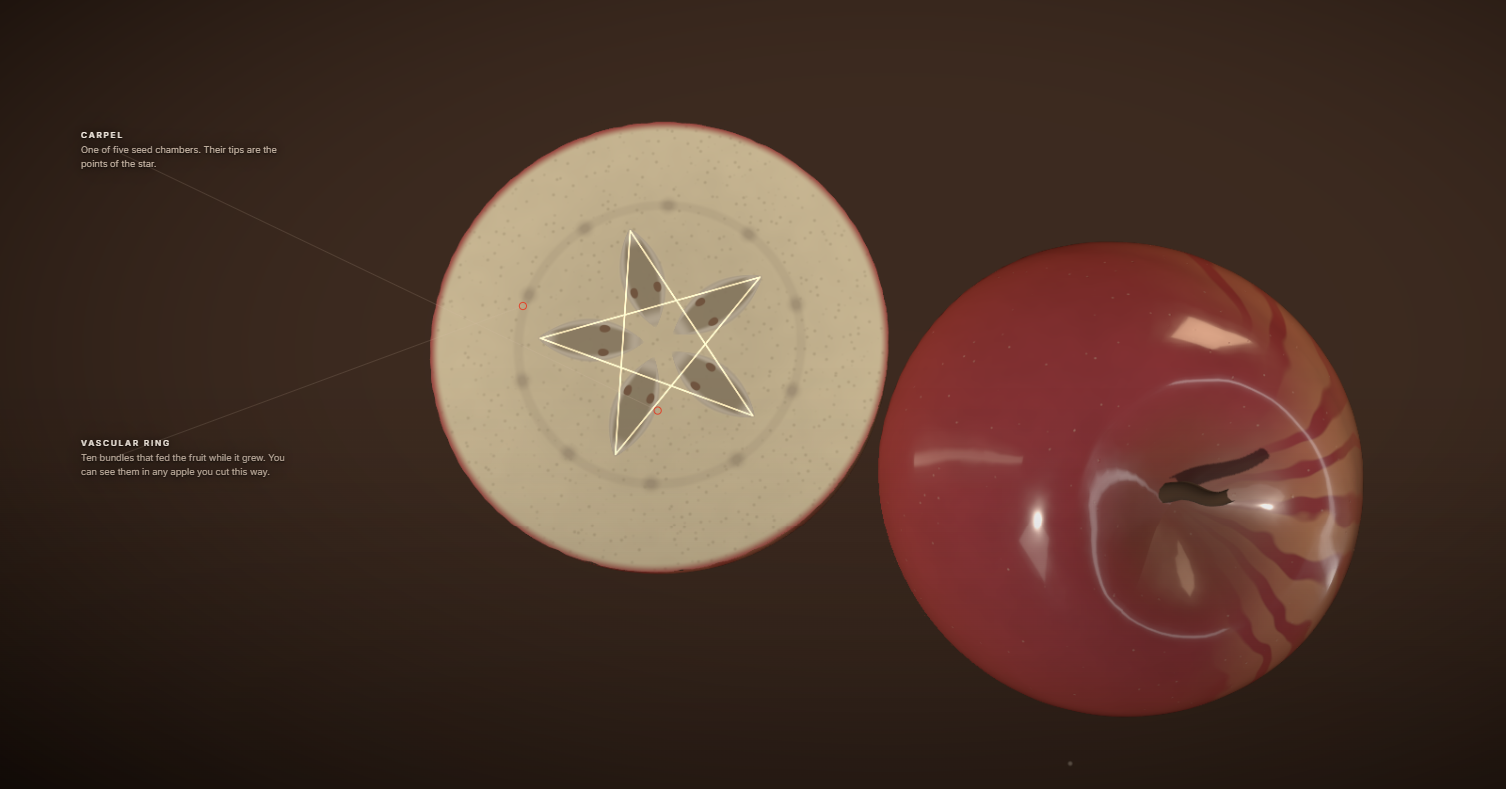
IV — STAR. The same fruit opened slowly along one plane. Five carpels, a ring of vascular bundles, and a figure that closes exactly.
V — TIME. The cut face browns as you scroll. It is not rot. A drop of ascorbic acid turns it back.
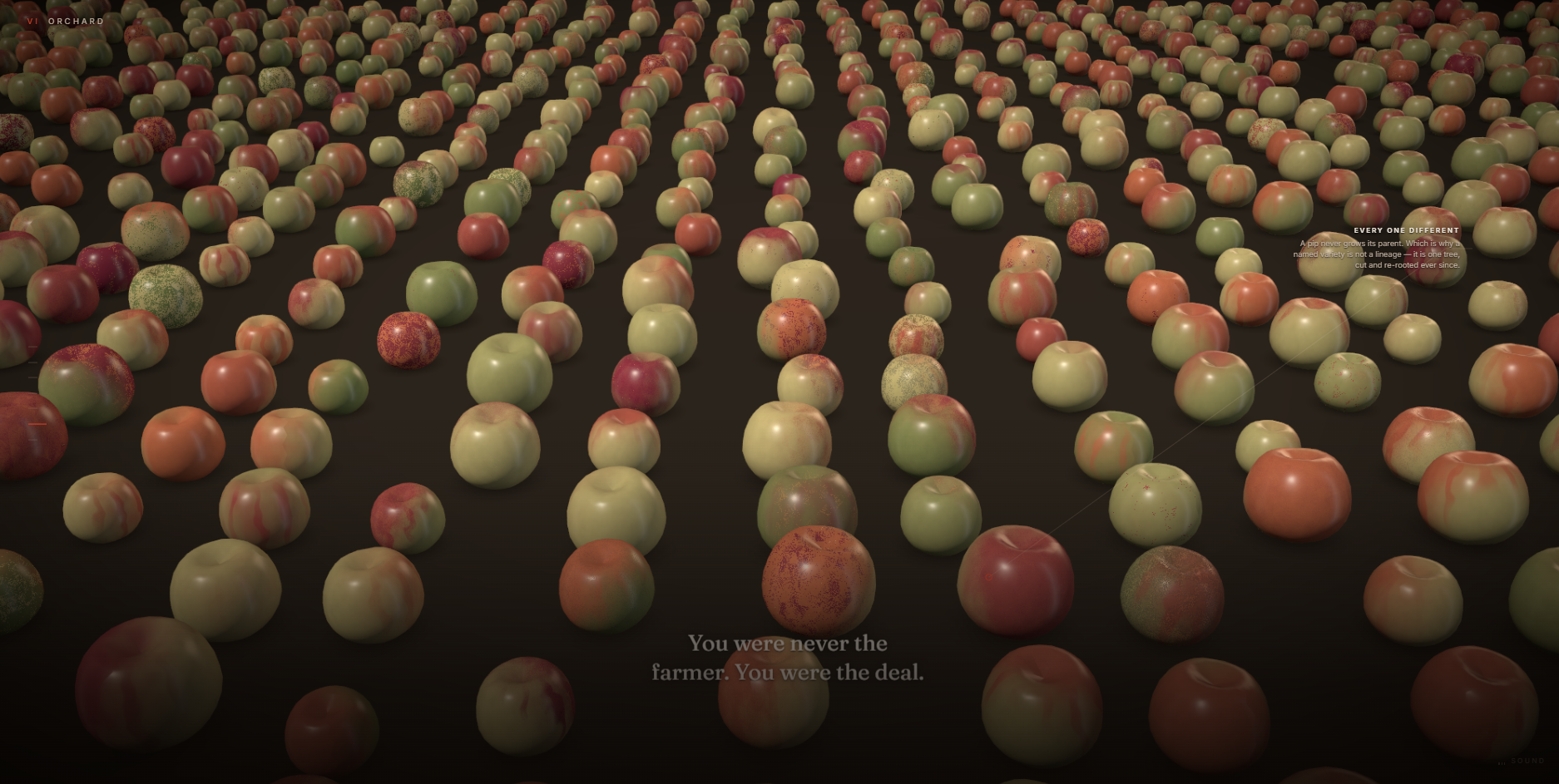
VI — ORCHARD. Thousands of individually distinct apples in planted rows. Then it goes out, fruit by fruit, and a handful never do.
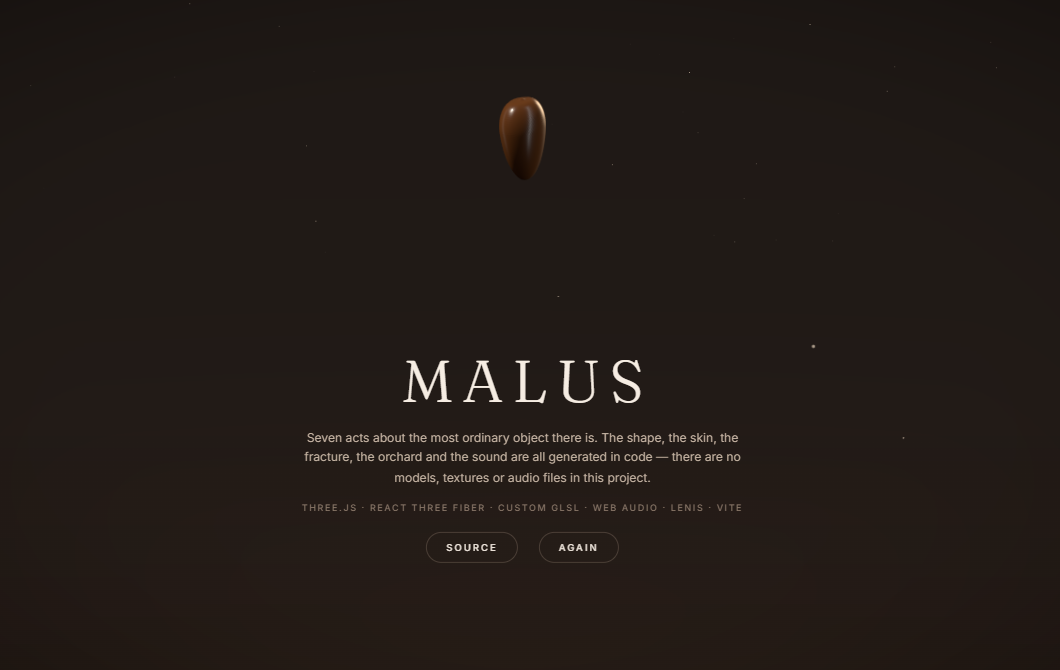
VII — SEED. The loop closes on a single point of light that turns out to be a pip.
There is sound, and it is worth turning on: the crunch is synthesised, not recorded.
The part I did not expect
I did the research before writing any code — 228 papers pulled from arXiv and OpenAlex across material rendering, perception psychology, and the botany of the fruit. I expected it to give me accurate captions. Instead three findings rewrote the design.
Gloss has dedicated neurons. Cells in the inferior temporal cortex respond selectively to gloss, and their selectivity is organised along exactly three physical reflectance parameters: specular reflectance, diffuse reflectance, and the spread of the specular highlight. So the skin shader exposes those three by name instead of "roughness" and "metalness", and act II sweeps them one at a time. I am not adjusting a material. I am moving through a perceptual space the brain built dedicated hardware for.
Crisp and mealy are not freshness. They are two different ways for a crack to travel. In a crisp apple the fracture runs through the cells: they burst under their own pressure, and what was inside them comes out — that is the juice, and that is the noise. In a mealy one the crack takes the easier path between them, so the cells separate whole and dry. Same fruit, same force, completely different event. That finding is the entire third act.
Domestication ran the other way round. It is best modelled as a plant's evolutionary answer to being eaten: the apple became sweet, large and red because that recruited a species which would carry its seeds across continents. It was a trade — sugar for distribution.
You were never the farmer. You were the deal.
That sentence is where the piece stops being a nice visual and becomes an argument, and it is why the act about lost varieties lands as a broken bargain rather than as nostalgia.
Nothing in it was downloaded
The rules allow finished assets, AI-generated models and templates, and most entries will use them. This one has none. Not as a rule I set myself for purity — it started as a licensing problem and turned out to be the more interesting path.
- The shape is a deformed icosphere: a silhouette profile, a five-lobe modulation from the five carpels, two cavities placed as functions of distance from the axis, and gradient noise for the lopsidedness no real fruit is without. It is seeded, which is what makes act VI's thousands of individually distinct apples possible at all.
- The skin is GLSL: an anthocyanin blush laid over a yellow-green ground colour, varietal striping that only exists in the transition band where real striping lives, lenticels from a cellular noise field, russeting in the cavities.
- The fracture is written from scratch. The obvious off-the-shelf library has no licence file, which makes it all-rights-reserved and unusable — and it could not have expressed the crisp/mealy distinction anyway.
- The sound is synthesised. A real bite is not one event but a burst of cell walls rupturing, so the crunch is a cloud of micro-impulses whose centre frequency, attack, decay and density all move together with turgor.
- The lighting is a lightformer rig baked into a procedural environment map. No HDRI, no CDN.
- Even the noise is written from the definition rather than pulled from a library.
Two woff2 fonts, one CSS file and one JS bundle. That is the entire network log.
How I built it
I do not write shader code. Every line here was produced by working with an AI agent (Claude Opus) from a research brief — and proving that this is now possible was part of why I started.
The interesting part is not that it compiled. It is how much of the work turned out to be looking.
The single most valuable thing I set up was a headless verification loop: Playwright with SwiftShader gives real WebGL 2.0 with no GPU, so every change could be rendered and actually examined instead of reasoned about. Later I added a tool that reads pixels back out of the framebuffer, because "is this dark or is it simply not being drawn" is not a question a screenshot can answer.
Almost every real bug in this project looked completely correct in source.
Challenges I ran into
A floor that fell with the apple. In act I the ground, the shockwave and the dust were children of the group carrying the fruit's fall position. They inherited it: the floor fell with the apple, came to rest at the fruit's own centre height, and sliced it in half at the equator — while spending the whole fall hovering fifty-eight units in the air. It looked exactly like a transparency sorting bug and cost hours before a decisive test found it.
A curtain measured in frames. The opening fade eased by 5.5% per frame. That is a third of a second at 300fps and over a minute on a slow renderer. The frames I kept reading as "the scene is unlit" were a perfectly lit scene behind a half-closed black veil. I chased the wrong cause for a while.
One apple exploding twice. Act III originally broke one fruit, ran the pieces backwards into a whole apple, and broke it again with the turgor turned down. The science was right and the staging was wrong: nobody can compare two things they saw thirty seconds apart, so it read as one apple exploding twice, and the rewind in the middle looked like a glitch. Rebuilding it as two fruits breaking side by side fixed it completely.
Facts I had to throw away. Several things everybody repeats about apples — cultivar counts, the extinction rate, "apples are 25% air" — were not verifiable in the research library I had built. They are listed in the repo under unverified and kept off the site. Act VI shows the orchard going dark and puts no number on it, deliberately. One line was cut for gesturing at witch-trial history that appears in no source. On a page that presents itself as scientific, one wrong number costs more than the fact is worth.
Accomplishments I am proud of
That the subject is boring and it works anyway.
That the third act makes a real distinction visible rather than asserting it — you can see that a crisp break and a mealy break are different events, and nobody told you to read a caption to get there.
And that the honesty held. It would have been easy to put an impressive-sounding number under the dying orchard. There is no number there, and the image carries it without one.
What I learned
Research before code changes what you build, not just what you write in the captions. All three findings above arrived before a single shader existed, and each one redirected the design.
Looking beats reasoning. I have a long list of bugs in this project that were invisible in source and obvious in a render.
And measuring beats looking, when the question is quantitative. The moment I stopped squinting at screenshots and started reading pixel values out of the framebuffer, a problem I had been circling for an hour resolved in one number.
What's next
An honest list, because there is one.
The apple is good but not photoreal — it still reads slightly lacquered up close. Act III's fragments have the right physics and their flesh could be wetter. There are a couple of dark stretches between events that read as atmosphere when you scroll slowly and as a bug when you scroll fast. And I would like one more moment of direct manipulation, where you turn the fruit yourself.
The pip is the argument in one object: an apple grown from seed is never its parent, so every seed is a genuinely new individual, and every named variety is one tree that has been copied by grafting ever since.
It seemed like the right thing to end on.
Built With
- claude
- hermesagent
- homeserver
- vercel

Log in or sign up for Devpost to join the conversation.