MalobaBridge – Speak Any Language. With Your Own Voice.
What is MalobaBridge?
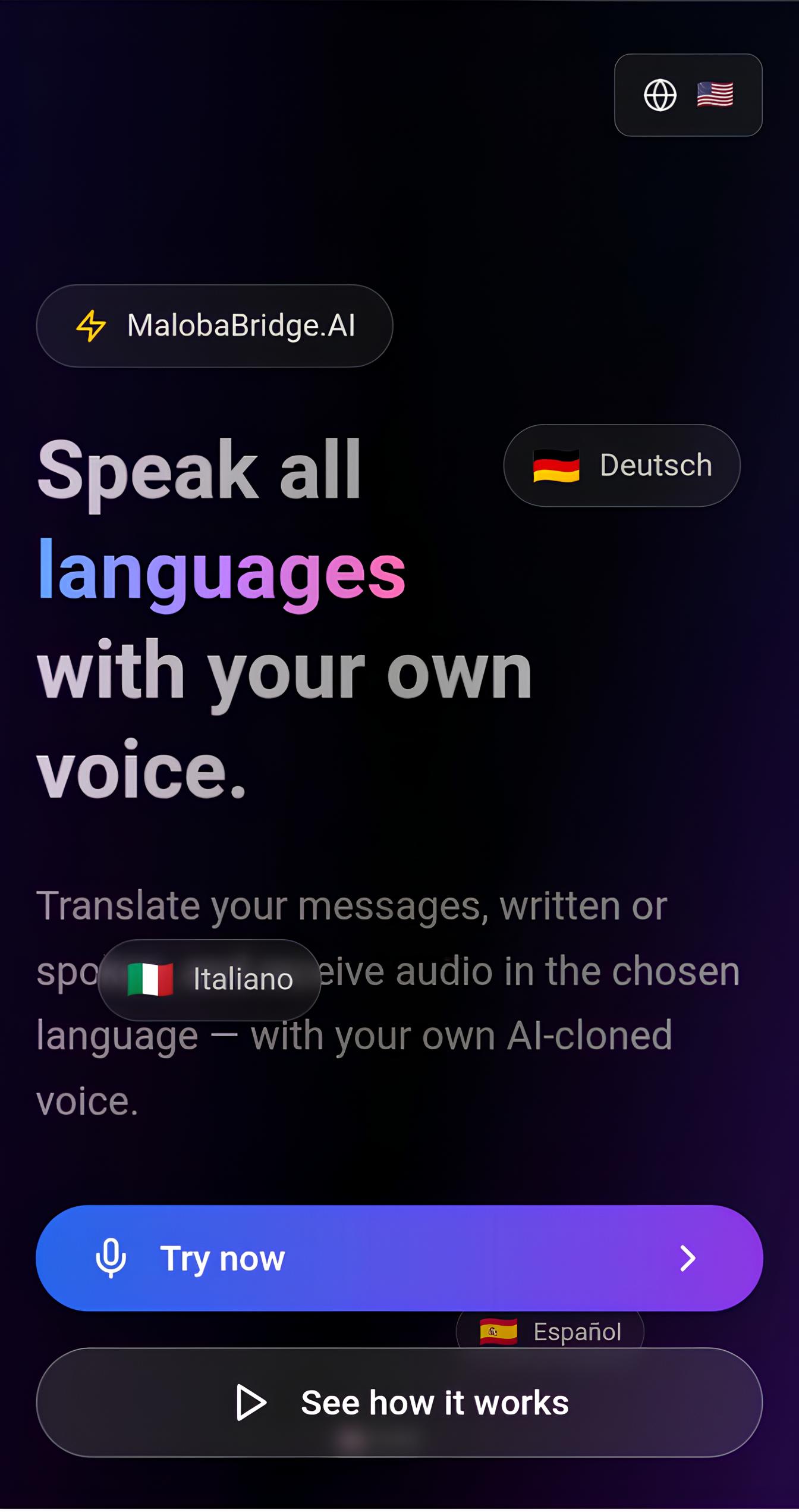
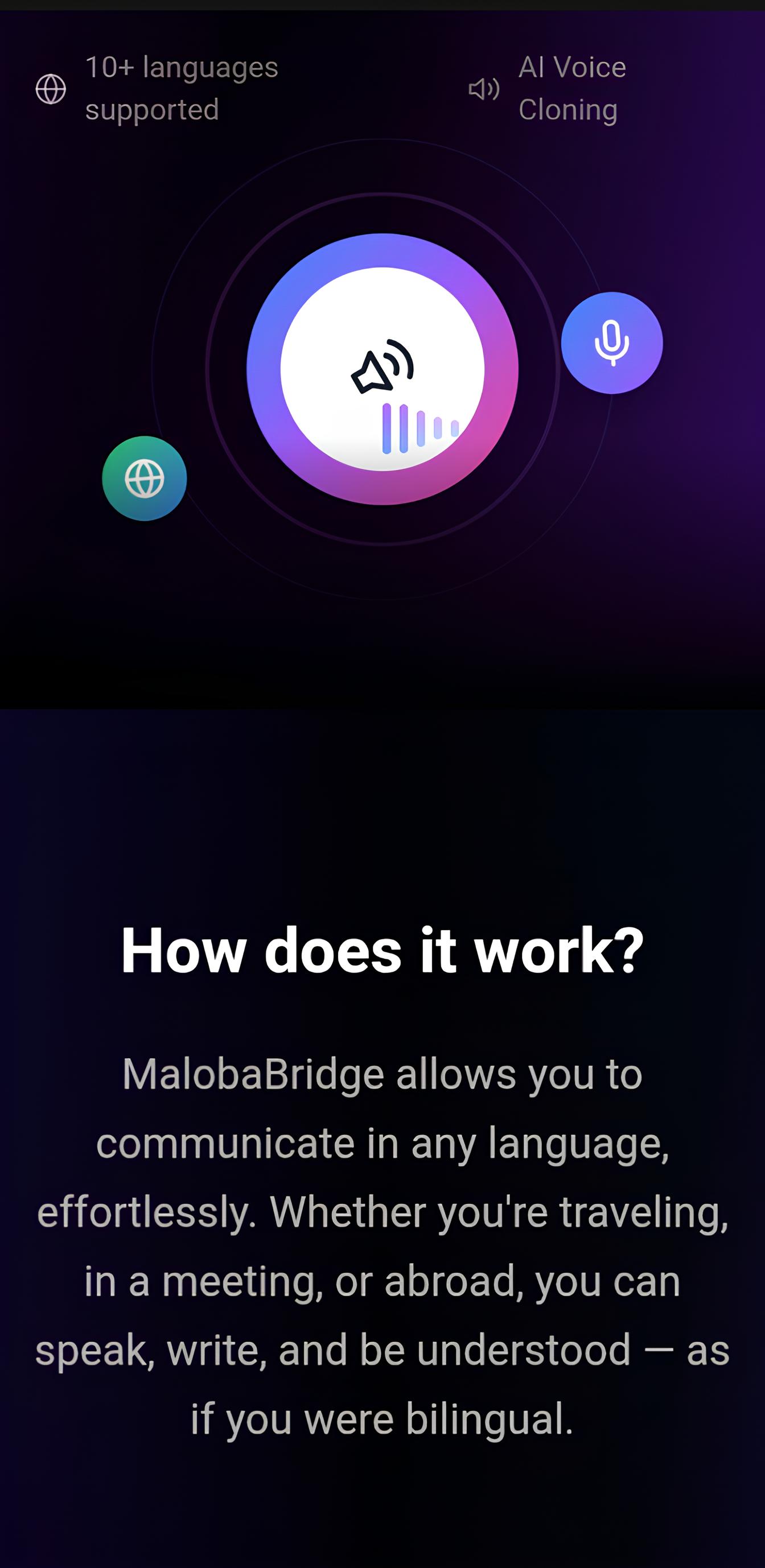
MalobaBridge is a smart web application that allows anyone, anywhere in the world, to speak in a different language — while keeping their own voice.
The user can:
- Type or record a message in their native language,
- Select a target language (e.g. English, Spanish, Swahili...),
- And the app translates the message, then speaks it using their own cloned voice.
It’s like your voice suddenly speaks every language on Earth.
Why the name “MalobaBridge”?
- "Maloba" means “words” or “speech” in Lingala, a language spoken in Central Africa.(DRC)
- "Bridge" symbolizes a connection — between people, cultures, and ideas.
MalobaBridge is the bridge between languages, powered by AI, built for human connection.
What is the goal?
To break language barriers and make communication natural, inclusive, and human, while preserving each user's unique vocal identity.
This app is made for:
- Travelers
- International professionals
- Multilingual families & students
- Global content creators
- Anyone who wants to connect beyond borders
## Example use cases
-An African entrepreneur pitches globally in English — without losing their authentic voice.
- A grandmother speaks to her grandson in Japanese, even though she never learned it.
- A tourist asks for help in Arabic or Mandarin — naturally.
In a nutshell
MalobaBridge lets you speak any language — without changing your voice.
It makes global communication personal, smooth, and inclusive.
“Your voice. Every language. One bridge.”
Throughout the project, we gained deep insight into:
- Multilingual challenges when switching between major and low-resource languages
- How to connect multiple AI services in real-time: translation, transcription, and synthesis
- The importance of UI simplicity when dealing with complex audio tasks
- use of AI tools and their different API (eleven labs, google text-to-speech, speech-to-text, google translate)
This app is built with React and Tailwind, and uses Supabase for authentication and storage. We also used Eleven Labs for text-to-speech, Google Translate for translation and the app also call a second service which is google text-speech if elevenlabs fails to generate the audio
Challenges We Faced
- Latency issues: real-time audio processing between transcription, translation, and synthesis.
- Multilingual accuracy: some languages lacked perfect support
- Creating a fluid user experience: switching between text and voice modes without confusion.
- Combining multiple AI services in a frontend-first architecture.
Despite these challenges, we built a prototype that works — and more importantly, a vision that speaks for something bigger.
What's next for MALOBA_BRIDGE_AI
MalobaBridge is not just a voice translation app — it’s the beginning of a cultural movement. Our long-term vision is to make MalobaBridge a powerful linguistic preservation tool, especially across African nations ( for example in Democratic Republic of Congo (DRC), we have over 200 native languages and dialects)
Language is identity. And identity must be protected.
Many of these local languages are being forgotten — replaced by French, English, or other dominant tongues. As elders pass away, their language, expressions, and cultural wisdom risk disappearing forever.
What if Artificial Intelligence could understand and speak those endangered languages?
What if a child in Kinshasa, Dakar, LAgos, ... could learn their ancestral tongue using AI?
This is what we envision:
MalobaBridge will become the bridge between generations, between languages, between forgotten dialects and future voices.
Because a language that is remembered is a culture that survives.


Log in or sign up for Devpost to join the conversation.