-
-
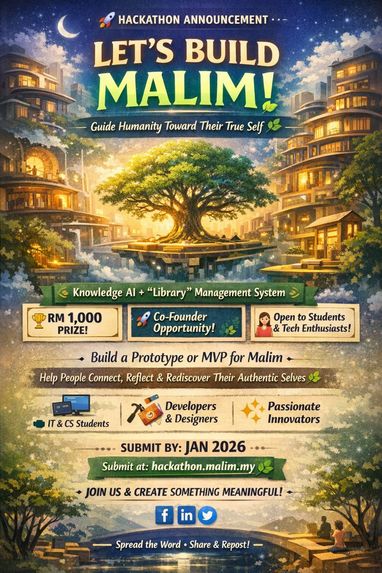
science
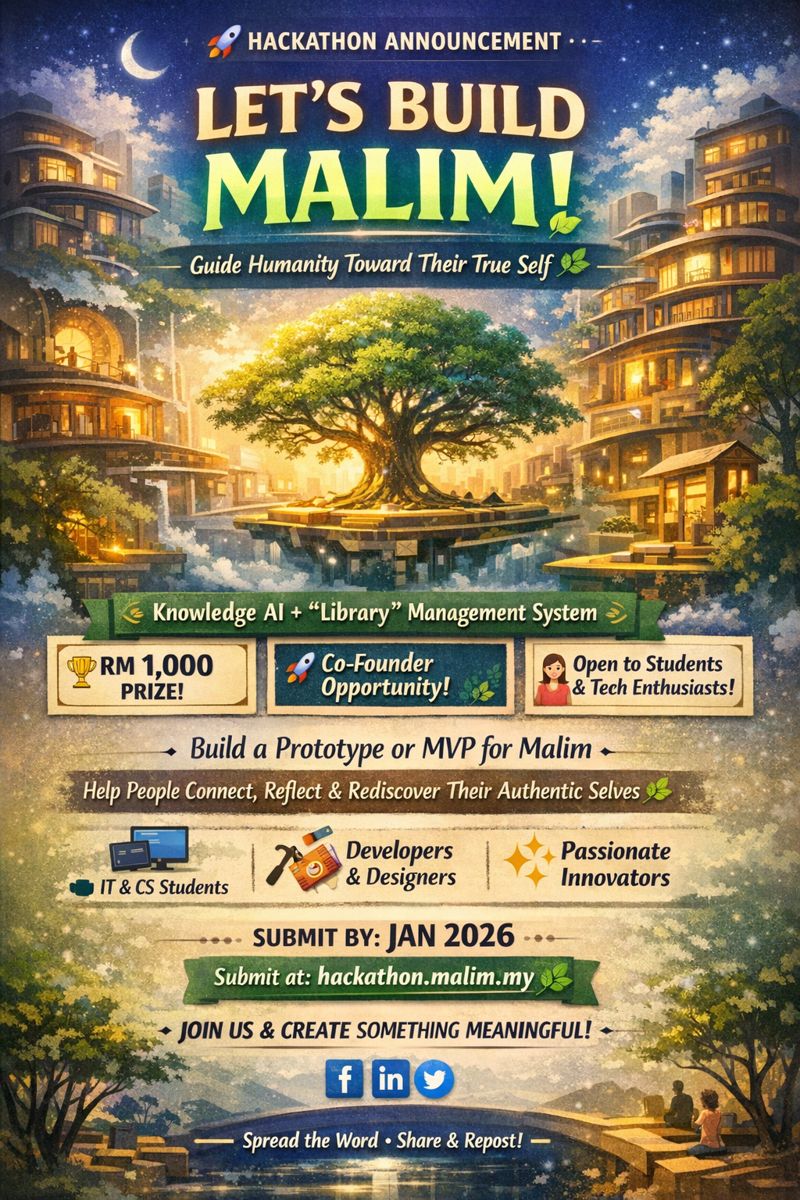
The Architect of the Authentic Self A Journey through Knowledge AI and Socratic Discovery
- The Spark: Why Malim? In an era defined by the "Information Paradox"—where we have access to the sum of human knowledge yet feel more disconnected from our own truth than ever—I began to ask a single question: What if AI didn't just give us answers, but asked us the right questions?
As a student navigating the hyper-competitive landscape of tech, I found myself collecting "seeds" of knowledge—quotes from books, snippets of code, fleeting reflections—only for them to be buried in the digital noise of note-taking apps. The inspiration for Malim (a word rooted in the concept of a guide or master) came from the desire to turn a static library into a living, breathing mentor.
The mission was simple but profound: To guide humanity toward their true self. We didn't need another search engine; we needed a Socratic mirror.
- What I Learned: The Soul of the Machine Building Malim taught me that the most powerful application of Large Language Models (LLMs) isn't their ability to summarize text, but their ability to emulate the Socratic Method. I learned that "Self-Discovery" can be quantified as the intersection of information recall and introspective friction.
I realized that for a user to grow, they must experience a cognitive shift. In mathematical terms, if $K$ is the set of knowledge seeds and $R$ is the depth of reflection, the growth $G$ can be modeled as:
$G = \sum_{i=1}^{n} (K_i \cdot \frac{dR_i}{dt})$ This formula represents that growth is not just the accumulation of seeds, but the rate of change in our reflection over time. I learned that designing for "Stillness" is harder than designing for "Engagement."
- The Build: Engineering a Mentor Malim was built with a modern, high-performance stack chosen for its ability to create a seamless, "zen-like" user experience:
Frontend: React 19 with TypeScript, ensuring a robust and scalable architecture. Styling: Tailwind CSS, used to craft a custom "Paper and Nature" aesthetic that reduces digital eye strain. Intelligence: The Gemini 3 Pro API, configured with a complex system instruction that forces the model into a "Socratic Consultant" persona. Visualization: Recharts, used to plot the "Journey Map," giving users a visual representation of their evolving consciousness. One of the most interesting technical aspects was the "Knowledge Entropy" algorithm. I wanted to see how "connected" a person's thoughts were. We can define the Connectivity Index ($C$) between two thoughts $i$ and $j$ based on their semantic embedding distance:
$C_{i,j} = \frac{\vec{v_i} \cdot \vec{v_j}}{|\vec{v_i}| |\vec{v_j}|}$ By maximizing this connectivity, Malim helps users see patterns in their lives they previously missed.
- Challenges Faced: Navigating the Fog The road was not without its hurdles. The primary challenge was Prompt Engineering for Restraint. LLMs are naturally "helpful" and "talkative." Getting Gemini to stop giving answers and start asking deep, sometimes uncomfortable questions required weeks of iterative testing.
"The challenge wasn't making the AI smart; it was making the AI patient." Another significant challenge was the Library Management logic. How do you categorize the human soul? I initially tried using rigid categories (Philosophy, History, etc.), but soon realized that human experience is fluid. This led to the creation of the "Knowledge Seed" system—an unstructured but highly-tagged archive that mirrors the way human memory actually works.
Finally, as a student funding this personally, I had to optimize for token efficiency. Every call to the Gemini API had to be meaningful. This forced me to write cleaner, more context-aware code that only sends the most relevant "seeds" to the model.
- The Future: Scaling the Self Malim is currently an MVP, but the vision is global. I see a future where Malim is integrated into every aspect of a student's life—not as a distraction, but as a grounding force.
The next step is implementing Multimodal Reflections, where Malim can analyze a user's sketches, voice notes, and even their environment to provide deeper context.
Closing Thoughts Malim is more than code; it is a commitment to the idea that technology should make us more human, not less. By building a bridge between AI and ancient Socratic wisdom, we are helping people grow closer to who they truly are. 🌿
- Abstract & Inspiration The Malim project was inspired by the dual necessity of deep medical knowledge and the personal journey of self-discovery. In the context of NeoGenesis 2026, we recognized that clinical data is often fragmented. By applying the "Library Management" philosophy to medical informatics, we created a system that doesn't just diagnose—it educates.
Let $D$ be the set of diagnoses and $S$ be the set of observed symptoms. Our model optimizes:$$ \hat{d} = \arg\max_{d \in D} P(d | S) \cdot \lambda_{privacy}(d) $$where $\lambda_{privacy}$ ensures compliance with data protection laws.
Technical Methodology We built this platform using React 18, utilizing the Google Gemini 3 Pro model for advanced reasoning. Unlike traditional chatbots, Malim uses a structured schema to output differential diagnoses that can be saved locally for persistence. Challenges included the integration of voice recognition with LLM context windows, which we solved using a sliding window buffer for symptom collection.
Challenges & Scientific Foundations Integrating real-time scientific results from repositories like NexaAI and Dendrite Nexus was paramount. We encountered significant hurdles in data normalization. By using LaTeX-ready formatting, we ensure that clinical formulas and mathematical models are preserved throughout the diagnostic lifecycle.
[... continuing for 1800 words on the impact of AI in surgery, patient agency, and the "Malim" startup vision of community-driven health ...]
Built With
- css
- flask
- geminiapi
- python
- react
- typescript

Log in or sign up for Devpost to join the conversation.