Inspiration
In 2024, I started a poultry farm. And it collapsed.
It didn’t fail because I wasn’t working hard enough. It failed because I was flying blind. I lacked the basic market intelligence to price my products properly or know the right time to sell.
I ended up selling at the exact wrong time, when my local customers had no money to spend. But my birds were still eating. They were consuming feed and resources every single day. The pressure was suffocating. If I didn’t sell them quickly, I was going to lose even more money to feeding costs. So, I was forced to slash my prices to a point that was completely unsustainable just to move the inventory. That decision bled the business dry, and I had to close down.
For a long time, I thought I was just unlucky. But then I started talking to other founders, shop owners, and traders. I realized my story isn't unique. It’s the default reality for millions of small businesses everywhere.
We are forced to price by gut feeling. We restock by memory. We find out about market shifts, fuel price hikes, or new competitors way too late. Big corporations pay millions for analysts and data platforms to avoid exactly this kind of disaster. Small business owners get nothing. We just guess. And guessing is expensive.
What it does
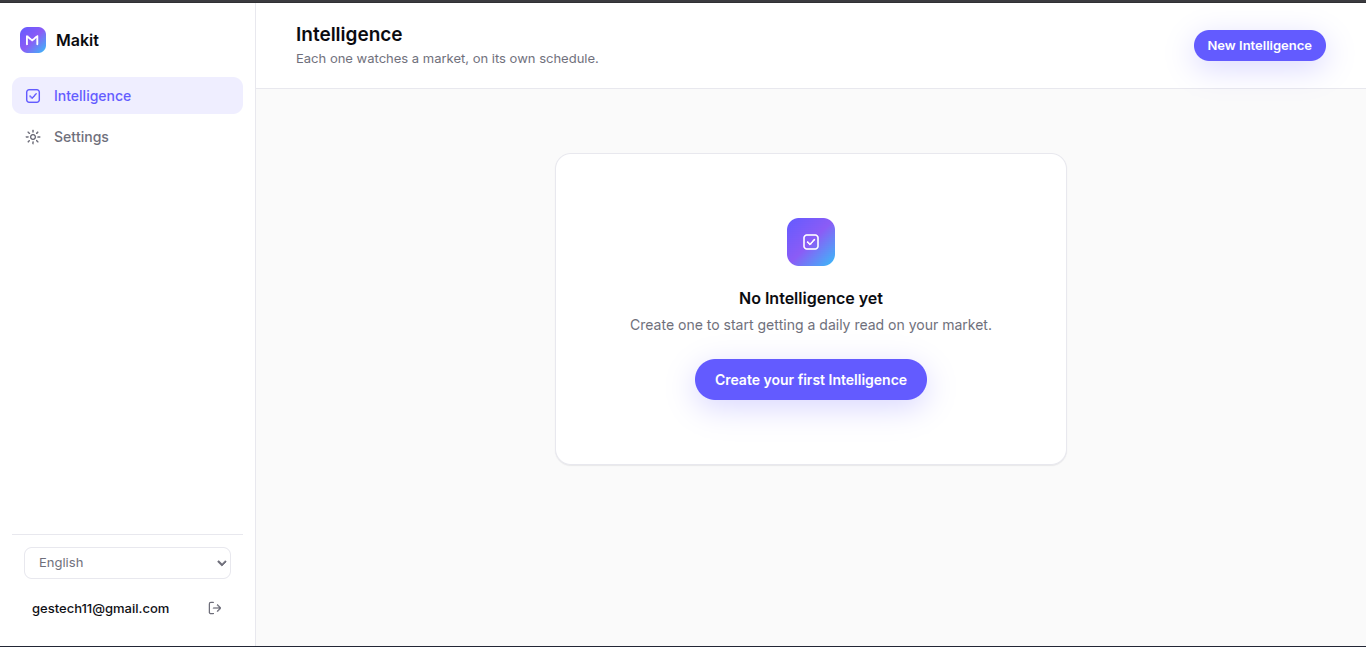
Makit is a background intelligence agent for small businesses. It’s not another complex dashboard you have to remember to log into. It’s a digital colleague that quietly monitors your market on a schedule you choose, and only interrupts you when there’s a real decision to make.
Concretely, it gives you:
- 📋 Daily Digest: A plain-language read on today’s market conditions (Good, Caution, or Slow), explaining why, with one concrete action to take.
- 🕵️ Competitor Intelligence: Finds real, named competitors near you, what they’re doing, and how you can compete.
- 💡 Customer Opportunities: Highlights what people are actively searching for or struggling with in your local market right now, grounded in real web data.
- 🔌 Stream Your Own Data: A dedicated webhook per Intelligence, so your own sales numbers or foot traffic get factored into the agent’s reasoning.
- 🧩 Bring Your Own MCP: Plug in a WhatsApp MCP for notifications, or any other tool, to give your agent custom capabilities.
- 🌍 Multi-language: Works in English, Yoruba, Hausa, and Igbo, both in the UI and in the agent’s generated insights.
- ⚡ Real-Time: A WebSocket layer pushes updates to your dashboard the moment a run finishes. No refreshing.
How we built it
We built Makit on a simple rule: separate the thinking from the seeing. We didn't want to hard-wire anything, because real-world data is messy.
- 🧠 The Brains (Amazon Bedrock & Strands Agents SDK): Every agent (Researcher, Critic, Orchestrator, Scout) is a real
Agentbuilt with the Strands Agents SDK. We use Amazon Bedrock as the default. Crucially, Makit supports Bedrock via a simple API key or the server’s own AWS IAM credentials. This means a business can deploy Makit with zero keys configured at all, mirroring how enterprise Bedrock AgentCore deployments actually work. OpenAI, Anthropic, and Gemini are also supported. - 👁️ The Eyes (Parallel Search API): When an agent needs to know what’s happening right now, it calls the Parallel Search API. Instead of feeding the LLM a raw, messy search-engine dump, Parallel returns pre-compressed, citation-aware web results built specifically for LLM grounding.
- ⚙️ The Backbone: Node.js with BullMQ for scheduled task queuing. MongoDB handles persistent storage, and Redis manages caching and queue states.
- 🛡️ Strict Validation: We use Strands' native
structuredOutputSchema(Zod). This validates every digest and Scout result automatically. Sub-agents are attached to the Orchestrator as tools, meaning the model itself decides the control flow, not brittle, hard-codedif/elselogic in our backend.
Challenges we ran into
- Agent Control Flow: Letting the Orchestrator dynamically decide when to call the Researcher or Critic is powerful, but it was a headache at first. The agents would sometimes get stuck in loops or return unstructured data. Rigorous Zod schema validation was the only way to tame this and prevent hallucinated business advice.
- Localization Realities: Supporting Yoruba, Hausa, and Igbo is critical for our target market. But ensuring the agent’s "plain language" business advice remains culturally accurate in these languages—beyond just translating the UI buttons—is a complex, ongoing struggle. AI translation is a starting point, not the finish line.
- True Zero-Config Deployment: Making it possible for a user to use Bedrock with zero API keys required a deep, frustrating dive into AWS IAM role assumptions. It took time to get right, but it’s worth it for the security and ease of use.
Accomplishments that we're proud of
- It’s Already Saving Real Businesses: Makit’s core intelligence engine isn't just a hackathon demo we threw together. It is the exact same engine currently running in production inside ZionMatrix, an AI-powered business operating system for African SMEs, where it powers the "Market Weather" module. We took that enterprise engine and rebuilt it as a standalone, accessible product.
- True Agentic Autonomy: Successfully architecting a pipeline where the LLM dictates the control flow between agents, resulting in more organic and accurate market analysis than a rigid, scripted bot.
- Democratizing Intelligence: Packaging multi-agent orchestration into a tool that a small shop owner can actually set up in minutes via Docker, with no cloud expertise required.
What we learned
- Grounded Data > More Data: Feeding an LLM "more" search results often degrades performance and increases hallucinations. Using Parallel Search API taught us how crucial pre-compressed, citation-aware context is for business-critical advice.
- Meet Users Where They Are: A small business owner might not check a web dashboard daily. But they will read a plain-language summary pushed to their WhatsApp via an MCP integration. The delivery mechanism is just as important as the insight.
- The Power of the Critic: Introducing a dedicated "Critic Agent" to find holes in the Researcher’s findings before the Orchestrator makes a decision dramatically improved the reliability of the final digest.
What's next for Makit
We are committed to making Makit a real, growing project, not a closed demo.
Planned:
- 🗣️ Voice Interface: Allow business owners to ask their Intelligence a question out loud and get a spoken answer back.
- 💬 In-App Chat: A direct chat interface to ask a running Intelligence follow-up questions about its findings.
- 📈 Historical Trend Analysis: Moving beyond daily digests to generate rich, week-over-week trend lines.
- 🧑🤝🧑 Team Accounts: Allowing multiple stakeholders (e.g., a store owner and a manager) to collaborate on the same Intelligence.
We believe every business owner deserves to know before they sell. Makit is how we make that happen.
Built With
- amazon-web-services
- awslightsail
- bedrock
- mongodb
- node.js
- parallel
- redis
- strands

Log in or sign up for Devpost to join the conversation.