-
-
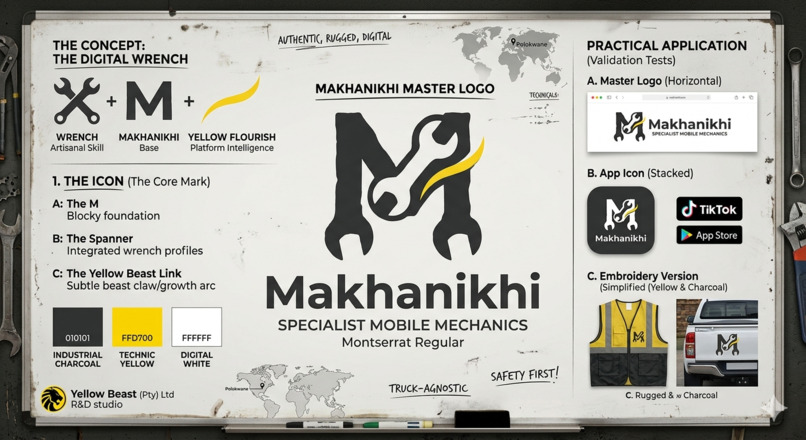
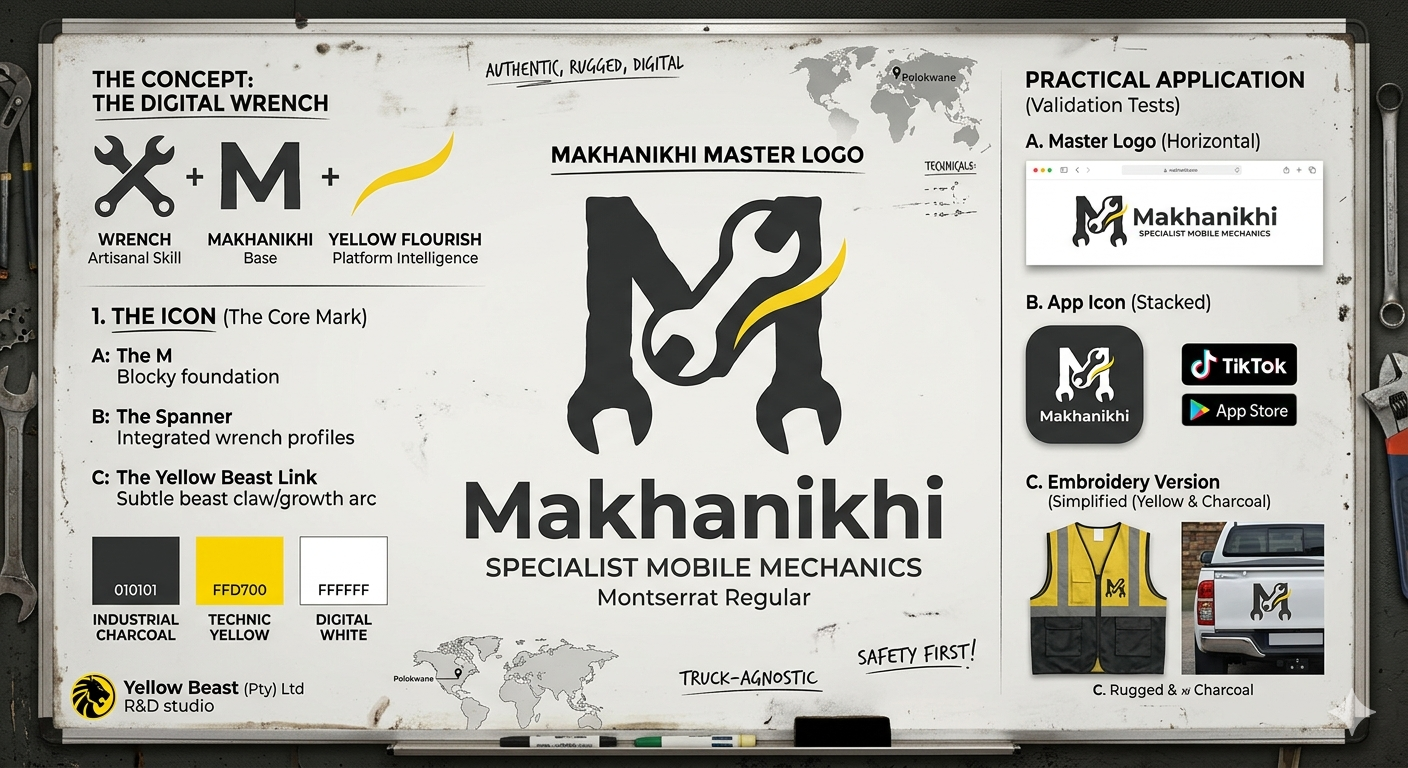
these are conceptual notes on the branding design and how it would look on apparel, etc.
Makhanikhi: Voice-Assisted On-Chain Escrow & Logistics for Mobile Mechanics
What Inspired Me
I experienced the problem firsthand. First as an out-of-warranty bakkie (pick-up) owner unable to afford main-dealer service rates, and later by actively shadowing and apprenticing alongside a local mechanic in Polokwane townships. While working under the vehicle chassis in grease-covered coveralls, I saw mechanics struggle with a fundamental physical barrier: you cannot safely type, look at a smartphone screen, or search for parts when your hands are covered in oil. In high-density South African townships, millions of out-of-warranty vehicles depend on informal mobile mechanics. However, this informal economy operates under severe structural friction:
- Client Vulnerability: Vehicle owners face zero repair transparency, deposit fraud risk, and untracked second-hand parts.
- Mechanic Risk: Skilled mechanics do heavy physical labour without guaranteed payment, facing client default or delayed call-out fees.
- Operational Hazard: Mechanics lose billable time wiping hands to order parts, log repair steps, or calculate quotes on mobile screens. I built Makhanikhi to replace this high-friction "gig trap" with a hands-free, voice-activated, escrow-backed protocol that protects payments, verifies genuine parts, and builds an immutable digital resume for mechanics.
How I Built It
Makhanikhi combines Amazon Developer technologies, decentralised finance infrastructure, modern Web2 frontends, and AI workflows:
- Hands-Free Chassis Voice Agent (Alexa+ Track): Built a custom Alexa+ Agent Skill that enables mechanics to query parts compatibility, log telemetry steps, and trigger escrow releases entirely through voice prompts while working under the car ("Alexa+, ask Makhanikhi to record oil filter replacement and check ZARU escrow balance").
- Cloud Infrastructure (AWS Builder Challenge): Deployed backend microservices on AWS using AWS Lambda serverless functions and Amazon DynamoDB for real-time state synchronisation between Alexa+ voice intents, web clients, and on-chain program logs.
- Smart Contracts & Escrow Vaults: Built using Rust on the Solana blockchain (Anchor framework), leveraging Program Derived Address (PDA) vaults to lock Rand-backed SPL stablecoins (ZARU) for sub-cent micro-settlements.
- Frontend & Mobile Access: Developed as a responsive web application hosted on Vercel, integrating @solana/wallet-adapter for client and mechanic wallet authentication.
- Immutable Logs: Vehicle maintenance records and SAPS-compliant parts serial numbers are pinned off-chain via IPFS to create an immutable digital logbook for each vehicle.
- Generative AI Copilot: Accelerated development using Google AI Studio (Gemini) to prototype state-machine logic, map Alexa+ agent slot intents, and generate robust test suites.
The Economics & Math Behind Makhanikhi
To ensure trust without introducing predatory platform fees, Makhanikhi uses a dual-sided micro-fee settlement model for every completed job $J$:
Let $V_J$ be the agreed total job value locked into the PDA escrow vault. The net mechanic payout $P_m$ and client cost $C_c$ are defined as:
$$P_m = V_J \cdot (1 - \phi_m)$$$$C_c = V_J \cdot (1 + \phi_c) - R_{co}$$
Where:
- $\phi_m = 0.025$ ($2.5\%$ mechanic service fee deducted upon instant settlement).
- $\phi_c = 0.025$ ($2.5\%$ client platform facilitation and dispute protection fee).
- $R_{co}$ is the Co-Pilot Inspection Rebate ($10\%$ rebate unlocked when the client inspects work and signs off on step-by-step repair telemetry):
$$R_{co} = 0.10 \cdot V_J$$
This formula mathematically aligns incentives: mechanics are guaranteed immediate liquidity upon job sign-off, while clients are rewarded for verifying repair progress.
Challenges I Faced
- Hands-Free Workflow UX in Noisy Environments: Developing the Alexa+ agent voice interaction required designing fault-tolerant voice intent slots that could parse the mechanic's commands despite ambient driveway background noise (power tools, roadside traffic).
- Real-World Operational Disconnects: Field testing with local mechanics revealed deep-seated friction around call-out fees, fuel costs, and informal financial management. These dynamics required pivoting protocol rules away from loose verbal agreements toward strict automated escrow triggers, Alexa+ voice confirmations, and transparent cost-calculator rules.
- Web3 Abstraction: Abstracting Web3 wallet complexity for township drivers and mechanics so the underlying PDA vaults operate silently behind standard ZAR stablecoin balances.
What I Learned
Fieldwork taught me that technology alone cannot bridge a trust deficit, because it must fit the physical realities of human labour. By integrating Alexa+ voice capabilities, I learned that true accessibility for field technicians means removing screen dependencies altogether while keeping payments secure and transparent.
Built With
- alexa-plus
- alexa-skills-kit
- amazon-dynamodb
- amazon-web-services
- anchor-framework
- automotive
- aws-lambda
- fintech
- gemini-api
- google-ai-studio
- ipfs
- llm
- logistics
- next.js
- pda-escrow
- react
- rust
- social-impact
- solana
- solana-wallet-adapter
- spl-token
- tailwind-css
- typescript
- vercel
- web3

Log in or sign up for Devpost to join the conversation.