Inspiration
Vibe coding has made software dramatically easier to create, yet we keep rebuilding the same tiny products: another currency converter, task list, reminder, tracker, or travel calculator. Most people do not want another repository, build pipeline, account, and App Store download. They want one small capability that fits their life right now.
MakeYour asks a different question: what if those repeated apps were not separate products at all? What if anyone could describe the tool they need, use it immediately inside one trusted iPhone app, and reshape it later with another sentence?
Try it
Public TestFlight — MakeYour 1.0.0 build 4
https://testflight.apple.com/join/3Rnqg5Ds
The seeded tiny apps work without an OpenAI key. Bring your own key only when you want GPT-5.6 to create or redesign a tiny app from a prompt. The key is stored in device-only iOS Keychain storage.
Source and setup instructions:
https://github.com/gn00295120/make-your-ios
What it does
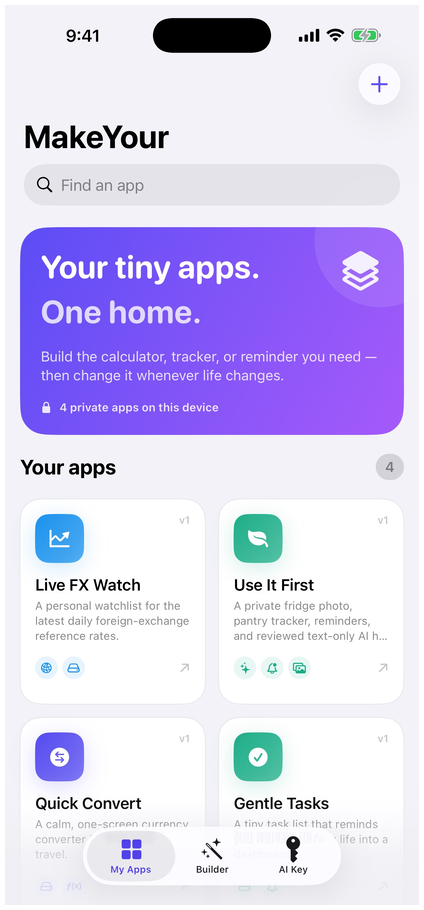
MakeYour turns natural language into private, native tiny apps that live together in one iPhone app.
- GPT-5.6 converts a prompt into a strict, versioned AppDocument through Structured Outputs.
- A validator checks the document before activation. If a candidate is invalid, MakeYour sends concrete diagnostics back to GPT-5.6 and continues a validator-guided repair loop until the app is valid or the user cancels.
- A deterministic SwiftUI runtime renders only precompiled native blocks. Generated output is data, not arbitrary Swift, JavaScript, or WebAssembly.
- Users can keep multiple tiny apps, switch between them, duplicate them, edit them through conversation, and give each one its own style.
- Design Genome v2 supports semantic light/dark palettes, typography, type scale, backgrounds, page layouts, navigation, controls, motion, surfaces, spans, emphasis, and renderer-compatible variants.
- Design Studio adds live iPhone preview, presets, custom colors, layout, icon, motion, undo/redo, and private project-local photos.
- GPT-5.6 Design-only proposals are merged through host-owned code that preserves every feature, value, action, binding, data configuration, capability, and local-media slot.
- Reviewed capabilities include records, reminders, exchange rates and alerts, tasks, ledgers, news, market data, maps, calendar creation, document export, camera and QR scanning, local voice notes, on-device transcription, App Intents, deterministic games, and reviewed text-only AI assistants.
Proof: one prompt became TripPilot
For the latest end-to-end test, we asked GPT-5.6 to build TripPilot, a three-page travel command center combining exchange rates, budget, itinerary, on-site tools, and AI features.
The first structured candidate contained an incompatible expression. The user did not have to start over: MakeYour kept the prompt, generated validator diagnostics, requested repair revision 1, validated the replacement, reviewed its requested capabilities, and opened the completed tiny app.
The resulting app contains:
- 3 native pages
- 31 components
- 21 reviewed capabilities
- A working currency calculator verified against the persisted generated project at 100 USD = 3,250.00 TWD and 1 USD = 32.50 TWD
- Validation that rejects duplicate, unknown, missing, zero, non-finite, or incomplete currency-rate tables and guarantees distinct initial currencies
This is the core product promise: from now on, a person can own small software shaped around their needs without building every app from scratch.
How we built it
natural-language intent
  → GPT-5.6 strict JSON AppDocument
  → semantic validator + automatic repair
  → capability review
  → deterministic native SwiftUI runtime
The useful “new language” is not syntax users must learn. Natural language is the interface; JSON Schema is the generation boundary; typed Swift models are the execution boundary.
The runtime currently exposes 30 precompiled native UI blocks and 21 declared capabilities. Side effects stay in host-owned adapters. API keys never enter generated documents, prompts, or logs, and an exact-payload review appears before in-tiny-app AI requests.
How Codex accelerated the build
Codex was not used only to scaffold the project. It acted as the engineering agent across the full workflow:
- Turned the product thesis into the AppDocument architecture, capability boundary, native renderers, and SwiftUI product experience.
- Implemented and repeatedly expanded the component and capability catalog.
- Diagnosed a real persisted-data currency bug: generated rows used opaque component IDs while the runtime expected ISO currency IDs.
- Fixed runtime compatibility and then independently hardened the whole rate model against duplicate rows, invalid ISO codes, identical starting currencies, non-finite values, and overflow.
- Built the validator-guided GPT-5.6 repair loop and aligned generation-time validation with runtime behavior.
- Added regression tests, ran simulator UI tests against the actual saved TripPilot document, kept strict SwiftLint clean, and verified signed release artifacts.
- Recorded the complete live GPT-5.6 generation run, prepared the public repository and Devpost materials, archived and uploaded build 4, updated TestFlight review metadata, and rechecked the live App Store Connect state.
GPT-5.6 is the product's intent-to-app designer. Codex created, tested, debugged, packaged, documented, and released the system that makes those designs safe and useful.
Technical verification
The current source and public build 4 have been verified with:
- 244/244 unit tests passing
- A persisted TripPilot currency UI test passing
- Strict SwiftLint: 0 violations across 173 Swift files
- Apple package validation and upload processing passing
- External TestFlight state:
BETA_APPROVED - Public TestFlight group confirmed to contain build 4
- Formal App Store submission intentionally preserved at build 1 while it remains
WAITING_FOR_REVIEW
Challenges
The hardest problem was not generating UI; it was defining the boundary between content and code. A general-purpose generated language would be difficult to secure, test, and ship on iOS. MakeYour uses a non-Turing-complete document format, an allowlisted capability runtime, bounded values, strict validation, automatic repair, and last-known-good versions.
A second challenge was making BYOK honest. The key uses kSecAttrAccessibleWhenUnlockedThisDeviceOnly, is never written to app documents or logs, and is injected only into the direct provider request.
A third challenge was making generated apps feel authored rather than templated while keeping accessibility and side effects deterministic. Design Genome v2 separates visual direction from semantic app behavior, so styling can evolve without silently breaking functionality.
Accomplishments
- A coherent, runnable native iOS product rather than a static prototype
- Real GPT-5.6 Responses API Structured Outputs generation
- Automatic validator-guided repair instead of exposing raw model failures
- Persistent multi-app library and version replacement
- 30 native blocks, 21 reviewed capabilities, and Design Genome v2
- Project-local images, voice notes, on-device transcription, notifications, App Intents, and reviewed AI helpers
- Public, externally approved TestFlight build 4
- A real complex TripPilot generation and persisted runtime verification
- A release workflow completed by Codex from implementation and testing through recording, GitHub, App Store Connect, and Devpost
What's next
- Richer schemaful relationships, filtering, and iteration for local records
- Versioned patch-based feature edits and cross-version rollback
- Per-project SQLite namespaces and migrations
- Broader accessibility and snapshot diagnostics fed back into the repair loop
- More precompiled App Intents, media workflows, and reviewed HTTPS providers
Built With
- codex
- gpt-5.6
- json-schema
- keychain
- openai-responses-api
- swift
- swiftui
- usernotifications

