Inspiration
When people want custom-tailored clothing, they usually bring a phone full of Pinterest boards, fashion sketches, or AI image generations to their local tailor. The image looks stunning on screen, but it creates an immediate communication gap. An AI-generated image shows pixels, not physical reality. It cannot show how heavy the fabric is, how the armhole is cut, whether the collar pattern is physically stable, or what seam allowance is needed.
When a client tells a tailor, "make me this," the tailor has to guess. The result is often miscommunication, wasted fabric, awkward fittings, or disputes when the finished garment looks different from the digital render.
We built MakerBrief to solve this exact breakdown. We wanted a platform where virtual try-on is not treated as a finished blueprint, but as an exploratory baseline that leads into an honest, maker-reviewed commission. By connecting personal YouCam try-on previews to structured maker reviews, discrepancy notes, and version-locked quotes, we turn digital inspiration into agreed reality.
What it does
MakerBrief connects remote buyers and independent custom garment makers through an auditable, collaborative studio:
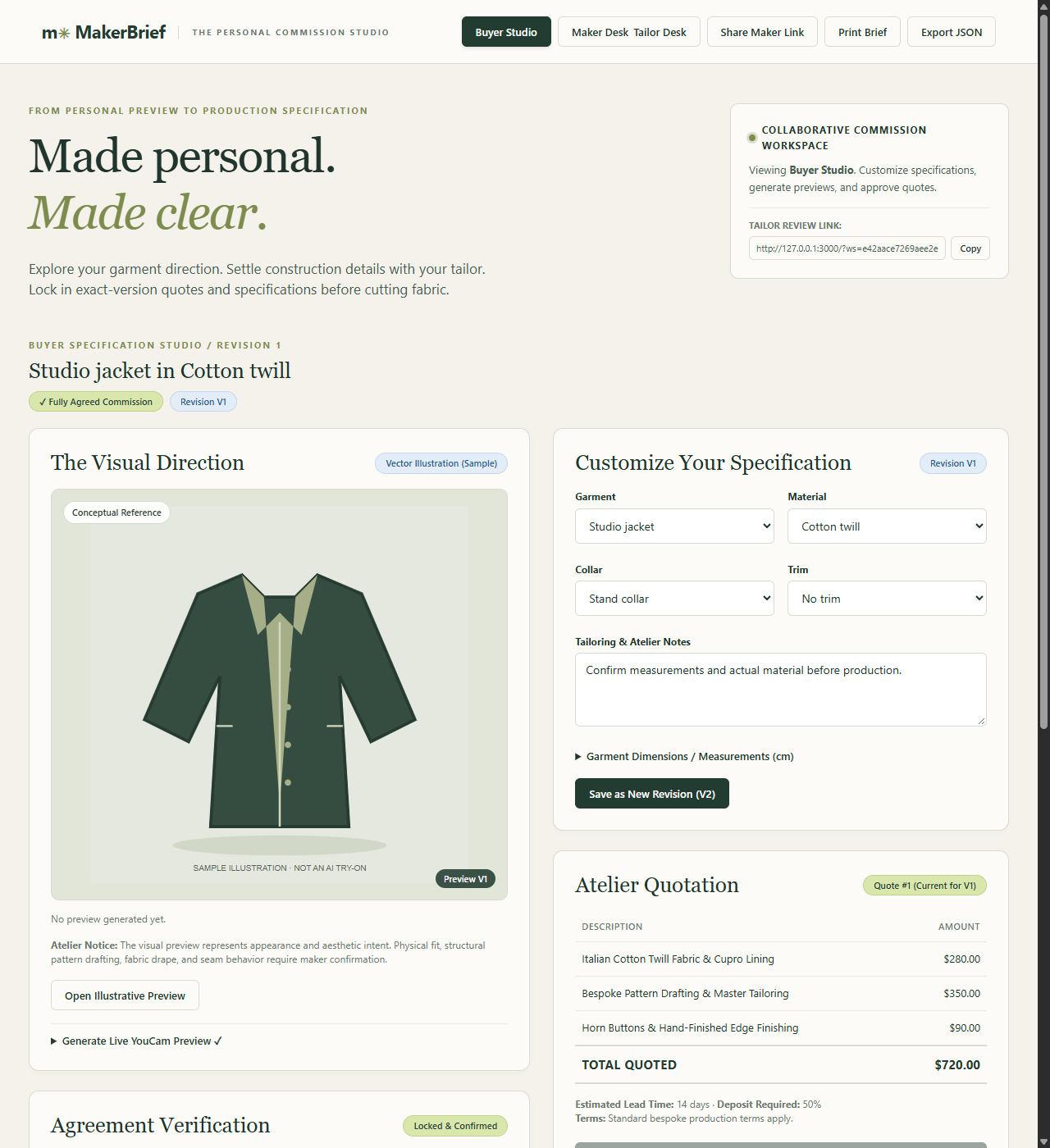
Personal Virtual Try-On: The buyer picks their preferred garment silhouette, fabric blend, collar style, and trims, enters their body measurements (chest, shoulders, sleeves, length), and uploads a portrait. Using YouCam Clothes V4, the app creates a realistic virtual try-on preview. Crucially, the preview is clearly marked with atelier guidance: it represents aesthetic direction, not physical pattern drafting.
Collaborative Tailor Desk: The buyer shares an authenticated review link with their tailor. The tailor opens their private view to inspect the design, check the client's dimensions, and verify construction feasibility.
Discrepancy Tracking: If the AI preview rendered a lapel or seam that cannot be cut from that physical fabric, the tailor logs a Construction Discrepancy (for example, "Preview shows an open notch lapel; physical sample will be drafted with a traditional 3.5cm stand band"). Any unresolved discrepancy blocks final agreement until the tailor provides a practical resolution.
Binding Quotations: The tailor creates an itemized quote broken down into materials, craft labor, and finishing, with lead times and deposit terms.
Exact-Version Agreement: The buyer reviews the itemized quote and accepts that specific revision. Once agreed, the brief locks into a confirmed commission.
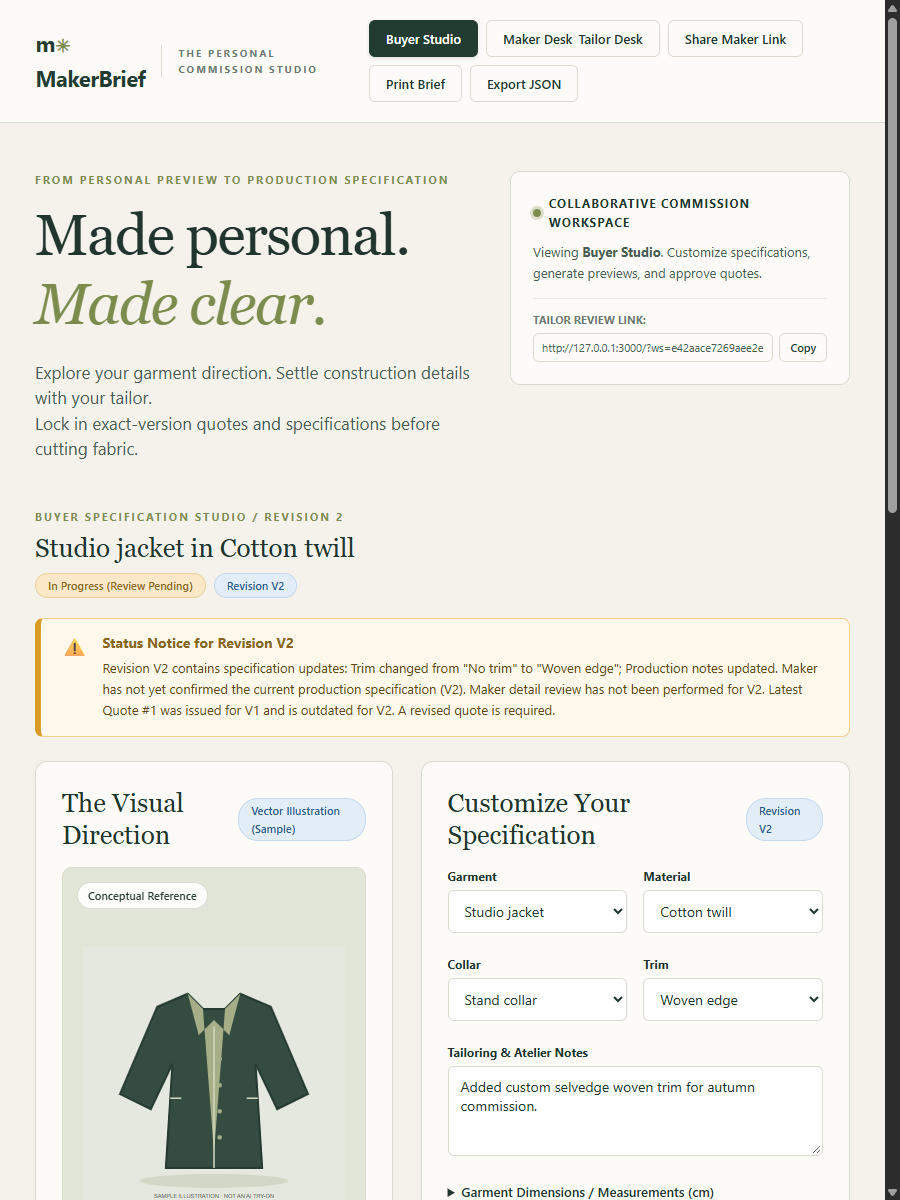
Intelligent Invalidation (The Core Feature): If the buyer modifies any specification later (such as changing the trim in Revision 2), the app automatically revokes the prior agreement and marks Quote #1 as outdated. Both parties receive an explanation of why the quote is stale and what needs re-confirmation.
Printable Production Brief: At any point, both parties can export a clean, printable workshop brief complete with dimensions, discrepancy notes, quotation terms, and physical signature lines.
How we built it
We designed MakerBrief to be reliable, fast, and self-contained:
YouCam Clothes V4 Integration: The backend talks directly to Perfect Corp's server-to-server task endpoint (https://yce-api-01.makeupar.com/s2s/v2.0/task/cloth-v4). We configured it with
garment_category: "outer", strict multi-person filtering, and Bearer token authentication. An asynchronous worker polls the task status endpoint until completion and normalizes the resulting asset URL.Native Node.js Architecture: We built the entire server and domain logic using pure Node.js ES modules with zero third-party npm dependencies. It starts in under a second and runs on any standard Node runtime without downloading hundreds of external packages.
Dual-Role Cryptographic Authorization: Each commission workspace generates separate tokens for the buyer and the tailor. The backend enforces permissions strictly: buyers cannot confirm feasibility or issue quotes, and tailors cannot approve quotes on the buyer's behalf.
Transactional Persistence: Workspace data is written atomically using temporary files and renames, paired with per-workspace in-memory locks to eliminate race conditions during concurrent updates.
Responsive Atelier Interface: The frontend is built in vanilla HTML5, CSS3, and modern JavaScript, featuring high-contrast typography, field-level status badges, and non-destructive background polling that never interrupts active user typing.
Challenges we ran into
The biggest challenge was reconciling AI virtual try-on behavior with the realities of physical tailoring. Diffusion models generate attractive images, but they frequently blur seams or invent lapels that cannot be stitched from real cloth. We realized early on that pretending the AI is perfect would hurt the user. Instead, we built the Discrepancy Tracker so craftsmen can explicitly document what differs between the preview and physical production.
Another hurdle was managing state invalidation. In a custom commission, an agreement is only valid for an exact set of choices. If a customer changes their sleeve measurement or switches from cotton twill to a wool blend, any previous price quote or feasibility sign-off is no longer valid. Enforcing this required strict revision numbering, optimistic concurrency checks, and writing an automated test suite of 16 tests to guarantee no stale approvals slip through.
Accomplishments that we're proud of
- Successfully executing live Clothes V4 virtual try-on inference and streaming the resulting high-resolution output directly into the customer's commission brief.
- Creating a genuine cross-device collaborative workflow: a buyer on a desktop can create a brief and send a single link to a tailor on a phone, who can immediately review and quote it.
- Passing 16 comprehensive automated tests in about 500 milliseconds with zero external npm dependencies.
- Delivering a dedicated printable commission brief that looks like a high-end bespoke atelier specification sheet.
What we learned
We learned a great deal about managing asynchronous AI pipelines in production, including bounded polling intervals, timeout recovery, and credit rate-limit budgets. More importantly, we learned that transparency is the most valuable feature in generative e-commerce: customers and tailors trust AI tools far more when the platform makes clear distinctions between visual concepts and physical commitments.
What's next for MakerBrief
- Atelier Material Swatch Catalogs: Allowing tailoring houses to upload their own fabric references and garment silhouettes.
- Milestone Payments: Adding integrated deposit and escrow holds that unlock once the customer approves the physical fitting stage.
- Multi-Angle 3D Fit Previews: Using multi-pose try-on models to inspect shoulder drape and back vent construction.
Built With
- clothes-v4
- css3
- e-commerce
- html5
- javascript
- node.js
- tailoring
- virtual-try-on
- youcam-api
