Inspiration
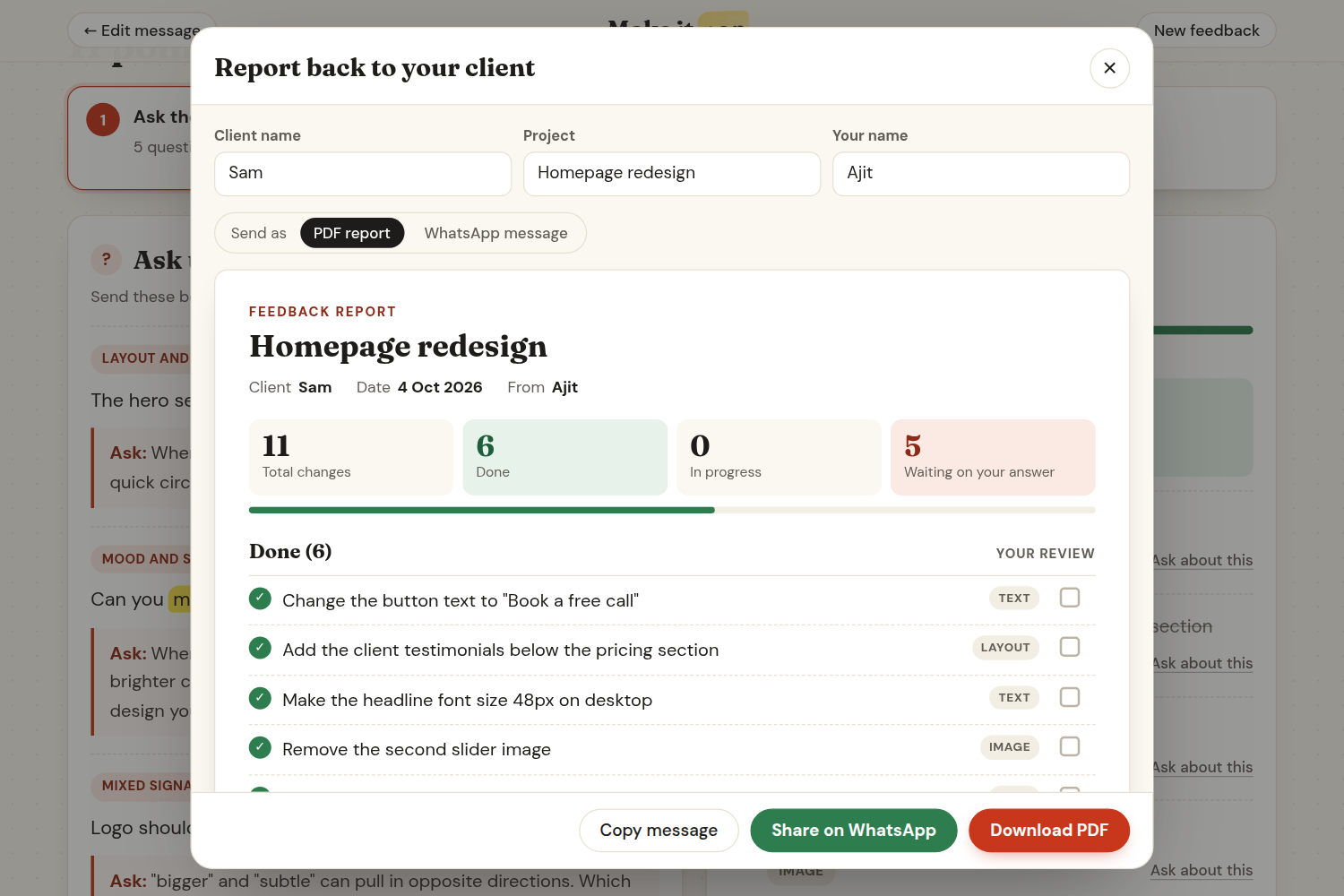
For the past 7 years I have been working as a freelancer, and I have worked with 100+ clients. 60% of my clients mostly talk on WhatsApp in an informal way, which means they give feedback and changes informally, and that is a bit hard to track and understand. So I thought, why not build a tool where the client's WhatsApp changes can be added and turned into proper tasks, so it is easier for me to track what I have done and what is finished, and so I can send the client a report: you gave this feedback, and I have made these changes. That way we can generate a proper, professional report and send it to the client, and the client can look at the report and review the changes one by one, which makes the process smoother. My friends who are freelancers themselves face this exact problem too.
What it does
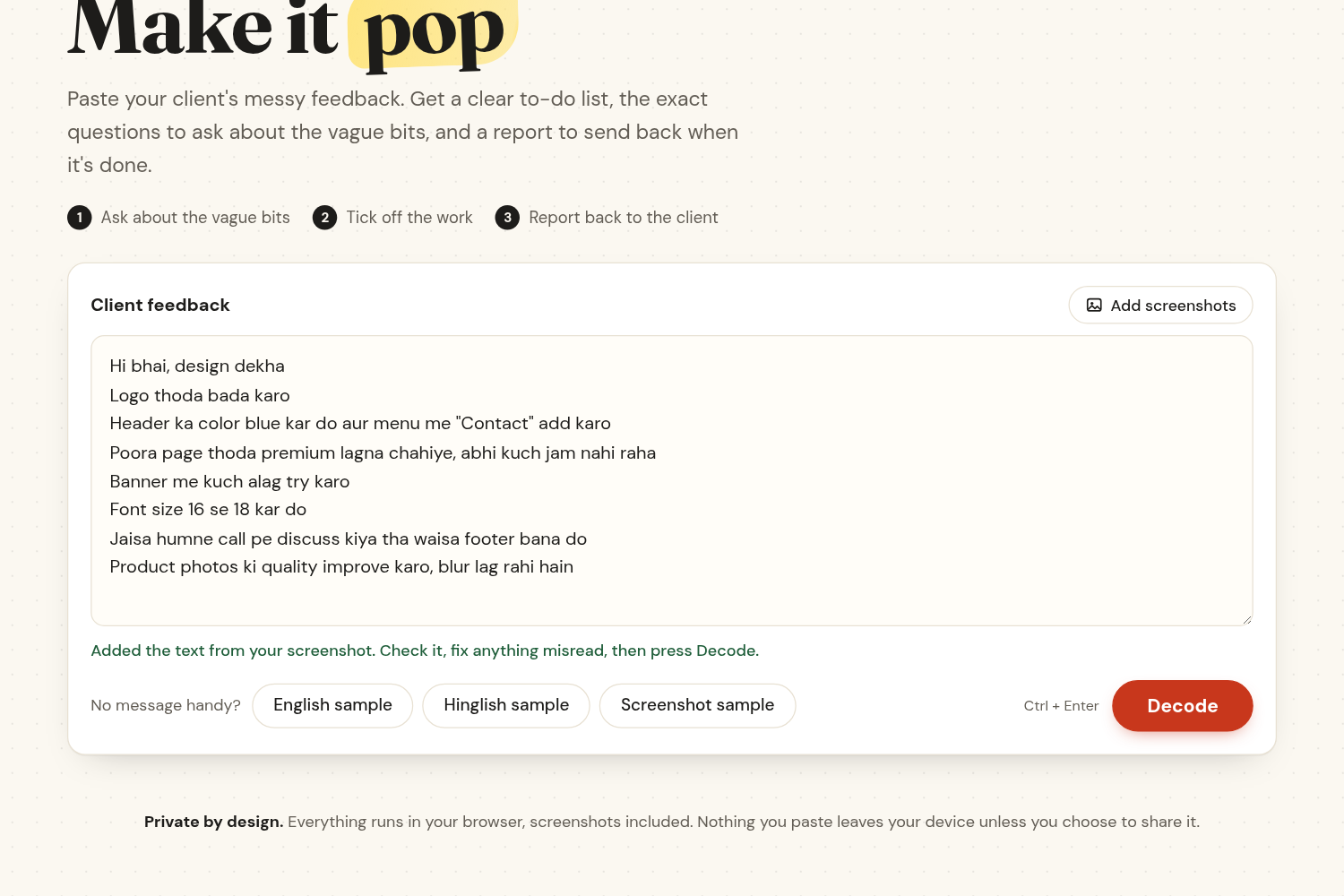
- Paste the client's message, or add a screenshot of the WhatsApp chat. Screenshots are read on your device, and only the client's messages are kept.
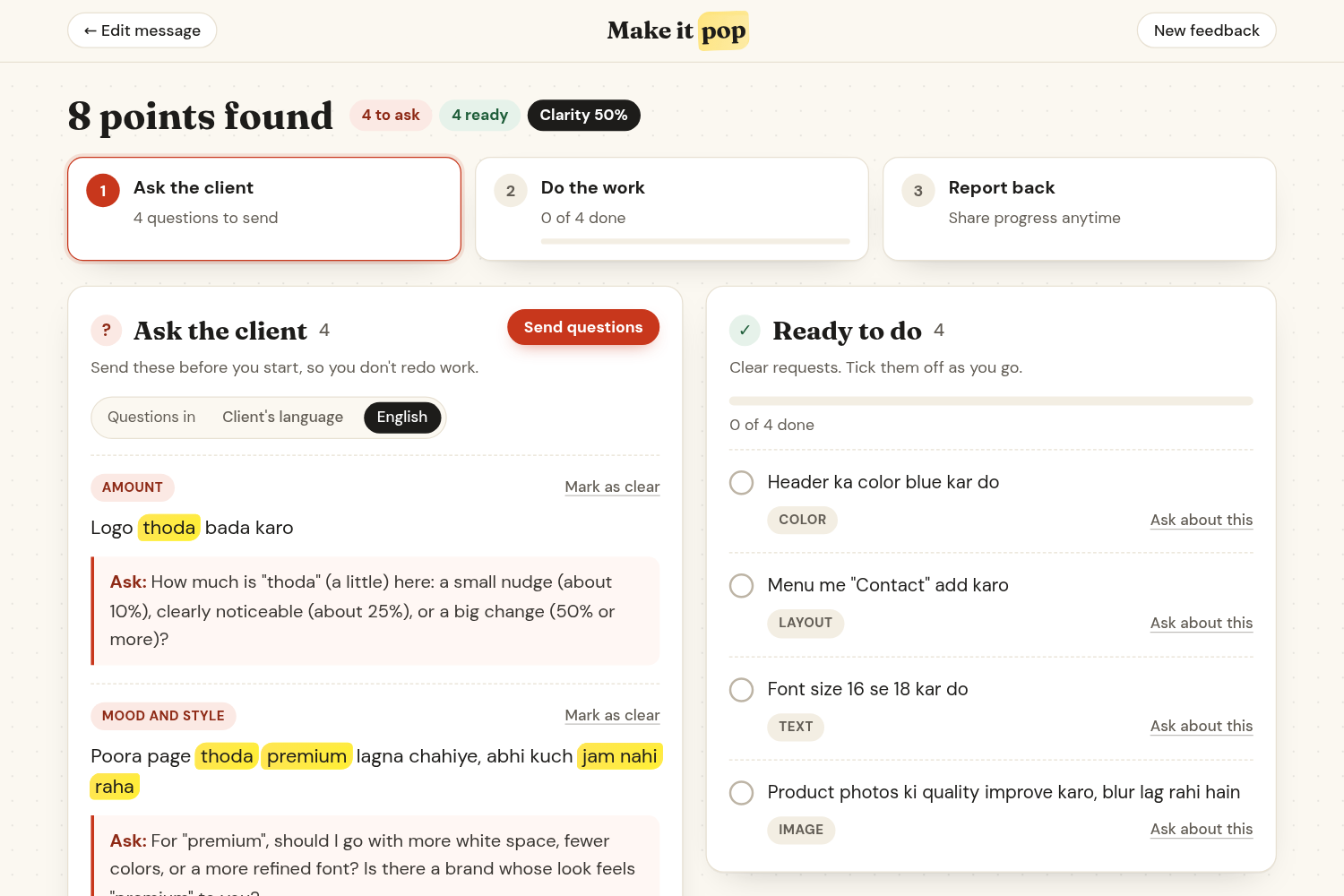
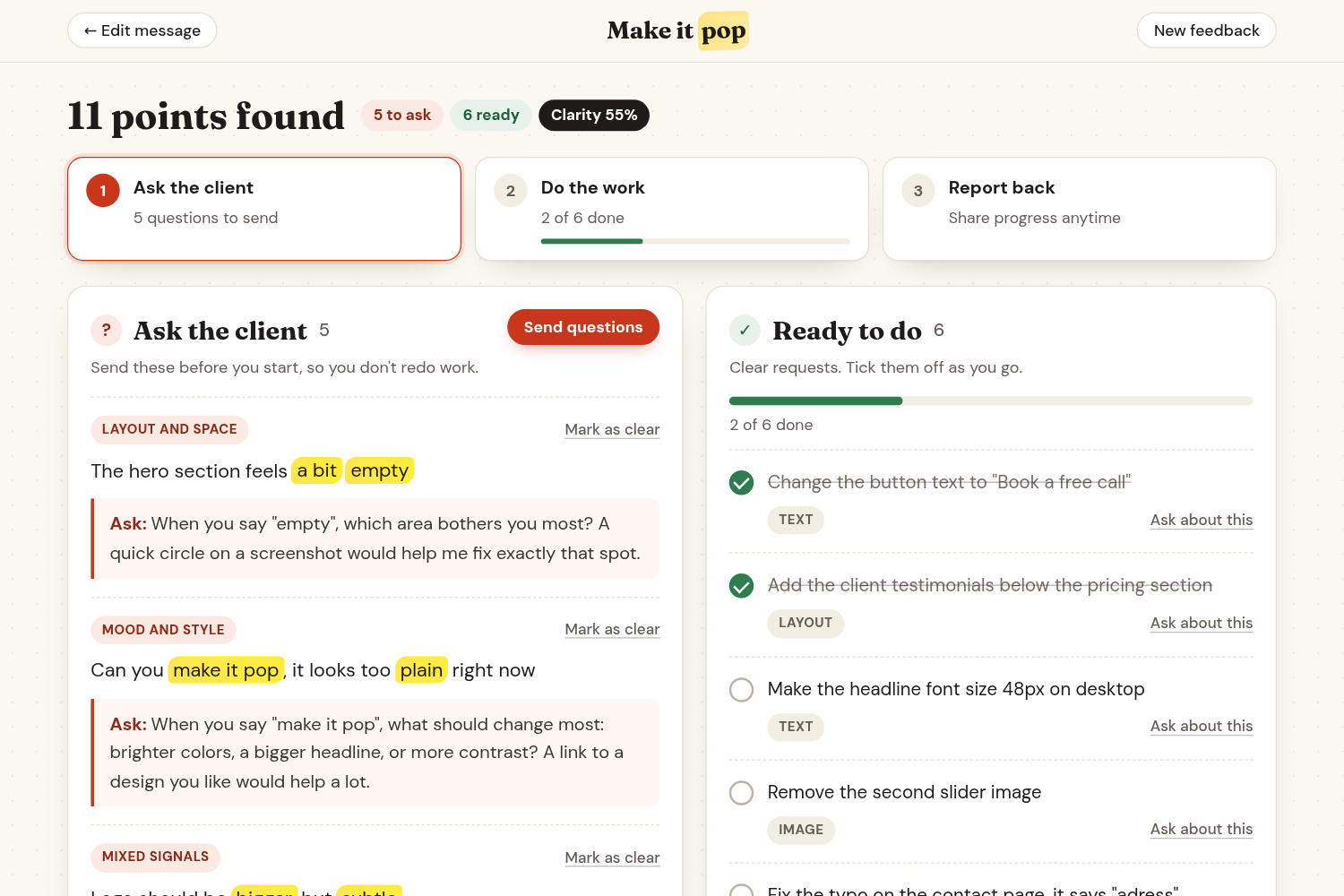
- Decode sorts every point into Ask the client (the vague words are highlighted, with one clarifying question that quotes the client's own words) and Ready to do (a checklist).
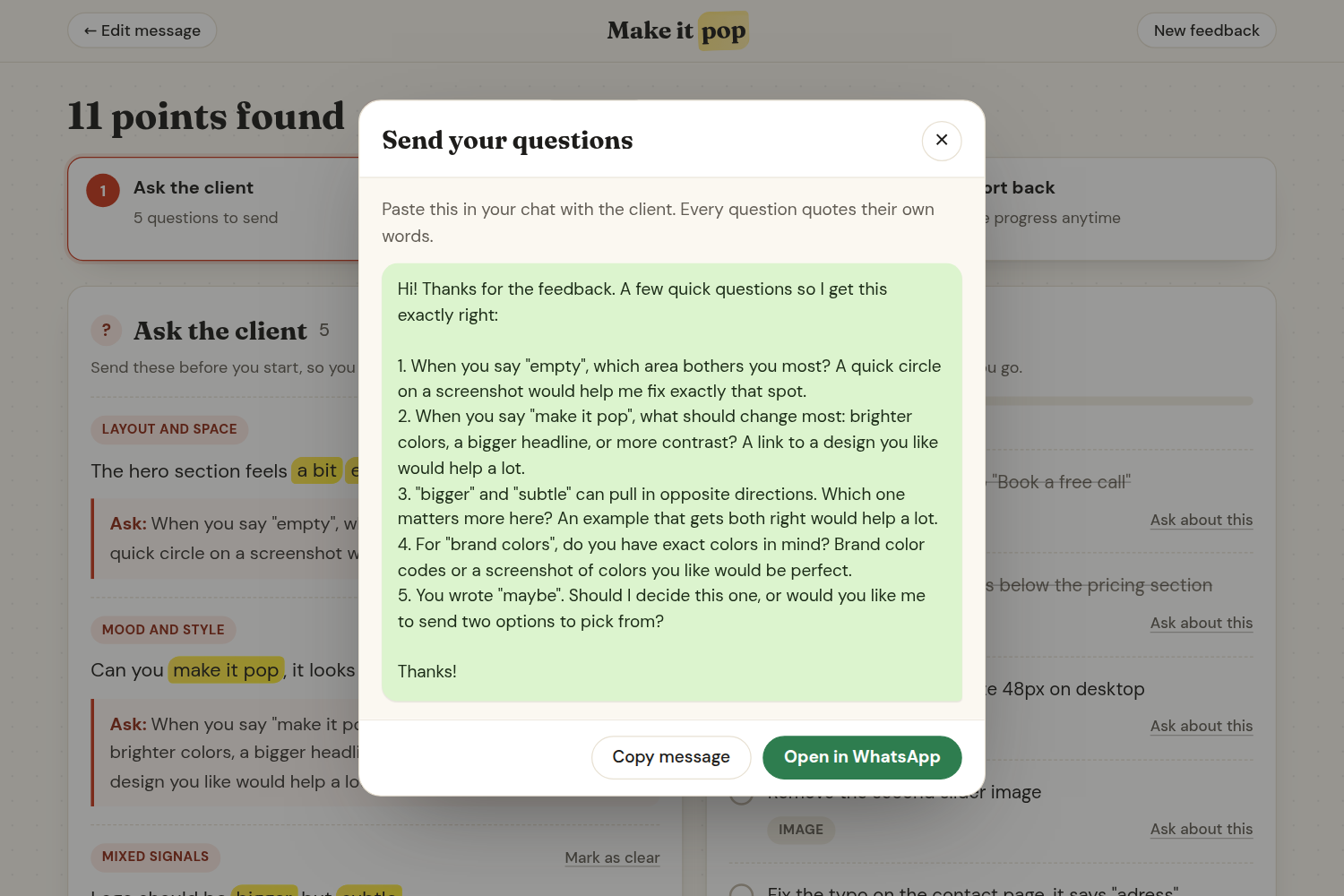
- Send questions gives one ready message to copy or open in WhatsApp. Questions come in the client's language (English or Hinglish), or all in English, with meanings for Hinglish words.
- Tick tasks off as you work. If the app guessed wrong, one tap moves a point to the other list.
- Report back: a PDF the client can review change by change, or the same report as a WhatsApp message.
- A clarity score shows how much of the feedback you can act on right away.
- Everything runs in the browser: free, private, no login.
How we built it
- Planned first with the Devpost Learn skill pack (scope, PRD, spec and a build checklist, all in the repo's
devpost/folder), then built step by step with Claude as my coding agent. - Plain HTML, CSS and JavaScript. No framework and no server.
- Instead of an AI API, a hand-made library of English and Hinglish vague phrases ("make it pop", "premium", "thoda", "kuch alag", "bigger but subtle") with question templates. It is instant, free, predictable and private.
- Screenshots are read on the device with Tesseract.js, and the app keeps only the client's chat bubbles.
- 33 automated tests plus browser checks on laptop and phone sizes.
Challenges we ran into
Building it didn't feel difficult at all. In fact, I really enjoyed it, especially turning the problem into a solution. What I had to think about was how to let people add text or a screenshot, and how to turn that into proper tasks. That took some brainstorming.
What we learned
In this project I used Claude, and I really learned the process of how to use Claude to develop a design and make it smooth and responsive: brainstorming what the problem was and how to reach a solution, committing everything to GitHub, and then reviewing whether a real user would be able to use it properly.
What's next
- Save feedback rounds on the device, so each project keeps its history.
- A live link where the client approves each change.
- Phrase packs for video editors, writers and social media managers.
- Hindi script (Devanagari) and voice-note feedback.
Built With
- css3
- github
- html5
- javascript
- node.js
- tesseract.js

Log in or sign up for Devpost to join the conversation.