-
-
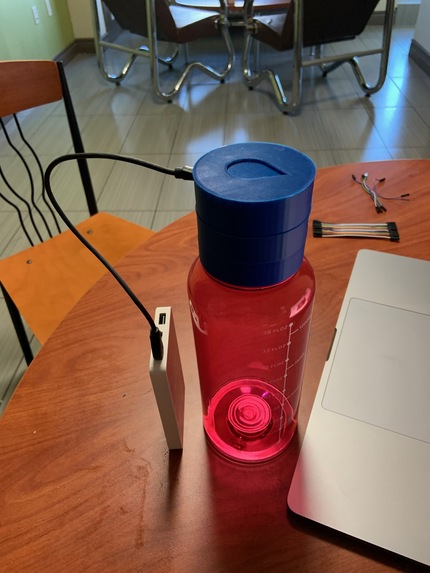
Aquamate Water Bottle (final product)
-
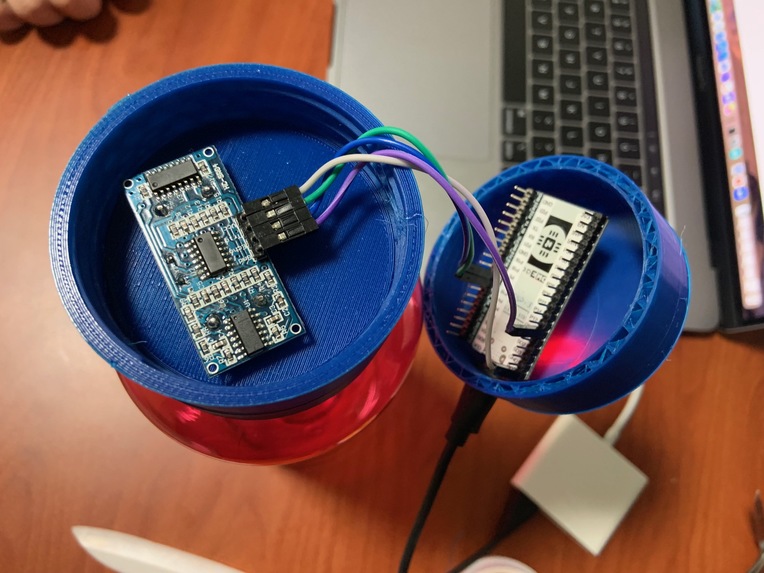
Interior of Cap Where the Sensor is Attached (bird's eye view)
-
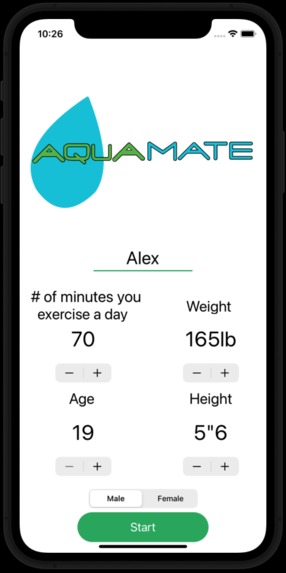
Image of App


Inspiration
Water is the most essential resource we can possess. It helps improve digestion, boosts metabolism, aids in weight loss, flushes out toxins, and is vital to human survival. In today's society, people are very busy and often forget how important it is to drink water. They could be dehydrated at some point during their day and be completely unaware of it. To keep people accountable to their own wellbeing, Aquamate was created.
What it does
Aquamate is a water bottle with an attached ultrasonic sensor. The sensor measures the volume of fluid that you consume while you drink through the bottle. Then, the data is sent wirelessly to the Aquamate iOS application that will show the calculated information to the user through visually-engaging icons.
The iOS application asks the user for their age, weight, sex, and any specific needs to calculate a range of possible, daily water intakes that is recommended to the user.
How we built it
Hardware We connected an ESP32 board to an ultrasonic sensor and placed it in a 3D-printed waterbottle cap. The ultrasonic sensor measures distance to the nearest physical thing which, in our case, was the water in the waterbottle. The ESP32 board itself was programmed through Arduino to take input from the echoPin and output from the trigPin (both found on the ultrasonic sensor). The time between the input/output was used to calculate distance. The ultrasonic sensor sends and receives pulses which helps calculate the distance of a nearby object. Furthermore, the ESP32 board is connected to the internet and sends data through an IoT platform called Thingspeak.
Software For the iOS application part of this project, the app itself was programmed in Swift using Xcode.
Challenges we ran into
A few challenges associated with the hardware aspect of this project included:
- connecting the ESP32 board to the internet
- syncing sensor readings to Thingspeak
- wirelessly running code from Arduino to the ESP32 board
A few challenges associated with the iOS aspect of this project included:
- transferring the API from Thingspeak to Xcode
- using steppers in Xcode
- setting defaults for steppers
- keeping constant maximum and minimum values for all steppers
Accomplishments that we're proud of
None of our teammates have any app development experience. Programming an app from start to finish is an accomplishment we are proud of.
What we learned
For the hardware aspect of this project, we learned several things, which include:
- learning how to integrate sensor with a microcontroller (ESP32 board)
- learning how to set up a remote network
- learning how to use an iOT software (Thingspeak) to collect and analyze data
- learning how to take accurate measurements of an object to properly model on Solidworks
For the iOS application portion of the project, we learned how to code in Swift and use Xcode to kickstart our application.
What's next for Aquamate Water Bottle Project
To begin, a plan for next steps include replacing the large battery pack that charges the smart water bottle with a smaller, more efficient battery pack. We also plan to re-engineer the sensor-reading method such that the sensor only takes measurements if the bottle cap is sealed through circuit integration.
Built With
- arduino
- esp32
- solidworks
- swift
- thingspeak
- xcode


Log in or sign up for Devpost to join the conversation.