Makan Kaki: the post-game makan agent
Tagline: A taste-aware agent that settles the 10:30pm "where do we makan?" argument: Qloo scores every spot for every player, and halal, no-pork and late-night rules hold.
Try it: https://makan-kaki-production.up.railway.app. Sample group in one click: https://makan-kaki-production.up.railway.app/?autorun Code: https://github.com/phyllicai/makan-kaki (MIT)
Inspiration
In Malaysia, badminton doesn't end at the last rally. It ends at the mamak. Every week our group stands outside the court, sweaty and starving, having the same negotiation:
- one kaki needs halal;
- one is vegetarian;
- one wants char kway teow, another wants a burger;
- and the place has to still be open after we've showered and driven over.
We usually give up and go to the same 24-hour mamak again.
A general chatbot gives you "popular restaurants nearby". It knows nothing about these four people, and it will happily send a halal-eating friend to a bak kut teh shop. Qloo's taste graph can predict what a specific person will like from what they already love. So we built an agent that treats group dining as a taste problem with hard safety rules, not a search problem.
What it does
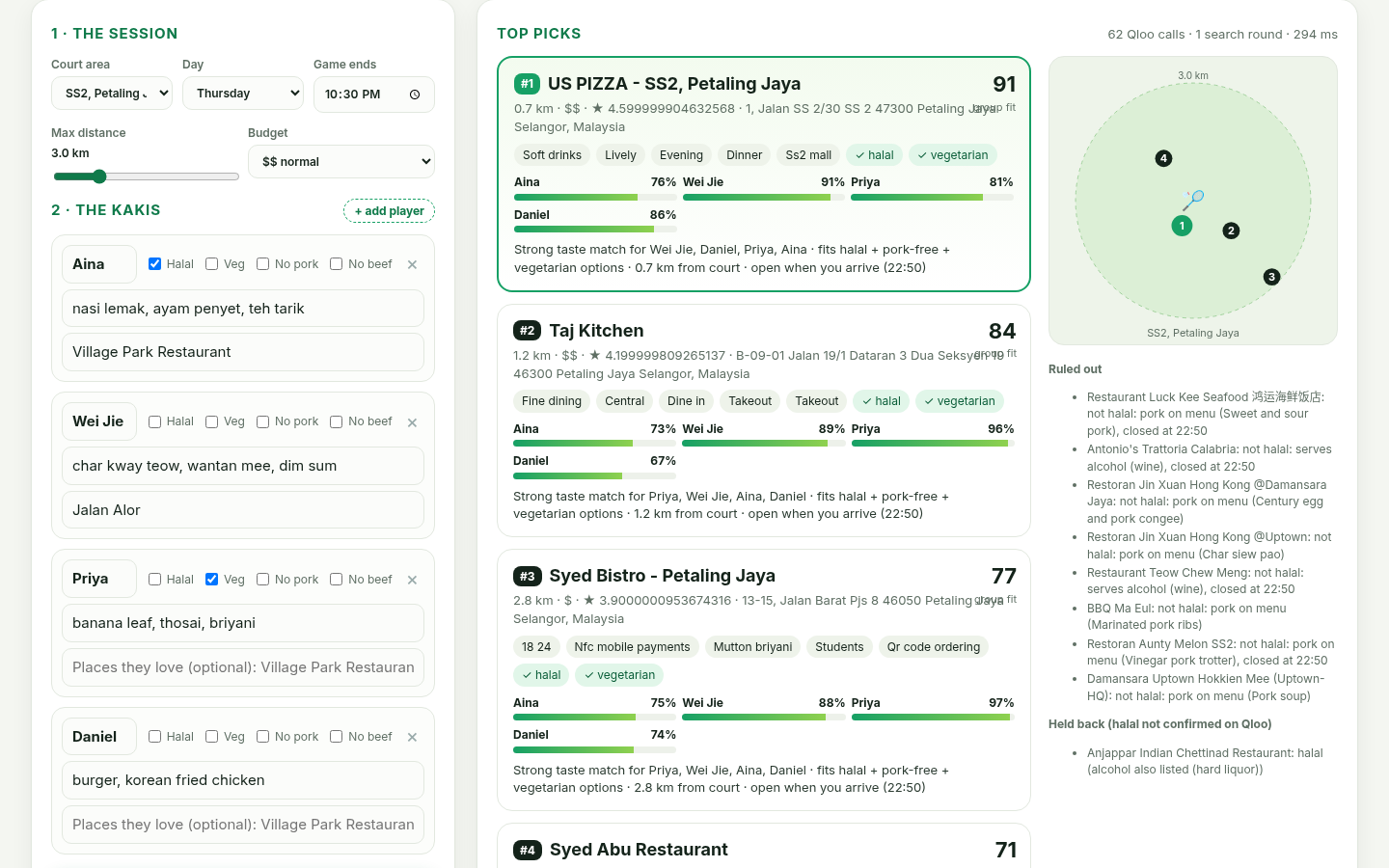
- Input: the court area, day, game end time, distance and budget. For each player: cravings ("nasi lemak, teh tarik"), places they love, and dietary needs (halal, vegetarian, no pork, no beef).
- Taste signals: the agent turns each player's taste into Qloo signals. Cravings become place tags (
/v2/tags), and loved places become Qloo place entities (/search). - Group candidates: it asks Qloo Insights for places near the court that fit the whole group's taste, filtered by opening day and price. If someone needs halal, it makes a second pull filtered to Qloo's halal tags.
- Per-player scores: it asks Qloo once per player to score every candidate, so it knows how much Aina vs. Wei Jie vs. Priya would like each spot.
- Diet guard: every venue is checked against Qloo's own tags, keywords and specialty dishes.
- Pork evidence fails halal and no-pork. That covers English, Malay and Chinese terms: pork, bak kut teh, char siu, siew yoke, lard, babi, 猪, 肉骨茶, and more.
- A bar, pub or brewery fails halal.
- Negative evidence beats a positive tag. A place tagged halal that also lists "pork ribs noodles" is ruled out.
- Places with no pork evidence but no halal tag are held back, not silently passed.
- Ranking: a fairness blend of average happiness plus "least misery", so nobody gets sacrificed. There's a bonus for verified constraints and for being close (tired legs).
- Reflection: if fewer than three spots fit everyone, it widens the radius, then the budget, and searches again.
- Output:
- the top picks, with per-player match bars and a mini map;
- what got ruled out, with evidence (e.g. "not halal: pork on menu (Pork ribs noodles)");
- what was held back;
- a full agent trace of every Qloo call and decision.
How we built it
- Agent: a plan → act → observe → reflect → explain loop (
src/agent/agent.js) that uses Qloo endpoints as its tools.- The controller is deterministic, so results are reproducible and judgeable.
- An optional LLM (any OpenAI-compatible endpoint) can parse free-text notes and write a one-line pitch strictly from a verified-facts JSON. The hosted demo runs without one.
- Qloo calls:
GET /v2/tags,GET /searchandGET /v2/insightson the hackathon API, with:filter.type=urn:entity:place,filter.location(WKT point) andfilter.location.radius;signal.interests.tagsandsignal.interests.entities;filter.tagswithoperator.filter.tags=union(the halal pull);filter.results.entities(per-player scoring, chunked to Qloo's 50-result limit);filter.hours,filter.price_level.maxandfeature.explainability.- A typical plan makes 18–66 Qloo calls.
- Diet guard:
src/diet/rules.jsis a pure, unit-tested function. It turns Qloo tag IDs, tag names, keywords, descriptions and specialty dishes into halal, pork-free, no-beef and vegetarian verdicts, each with evidence. - Scoring: pure, tested functions (
src/agent/scoring.js) for constraints, past-midnight opening hours and the fairness score. - App: a zero-dependency Node server with a vanilla JS/CSS front end and a per-IP rate limit. It's hosted on Railway in live Qloo mode.
- Tests: 20
node --testtests cover:- scoring and the diet rules (English, Malay and CJK pork terms, negations like "pork-free" or "beef bacon", bars, alcohol);
- reflect-and-widen;
- the LLM fallback;
- the exact live request format;
- a fake-API end-to-end run that proves a halal group never gets a pork place.
Challenges we ran into
- Real taste data is noisy about diet. On live Qloo data, our first halal group got a bak kut teh place ranked #1. Qloo also tags some places halal while listing pork bone soup or beer. We built the diet guard on Qloo's own evidence, and made negative evidence override positive tags.
- Silent API limits. Per-player scores all came back as 0 once the candidate list passed 50, because
takeis capped at 50 and the 400 error was swallowed. Chunking candidate IDs fixed it, and scores now span roughly 0.6–0.9. - Group taste isn't an average. A pure average picks the place three people love and one person hates. Scoring each player through Qloo and adding a least-misery term fixed that.
- Time is a constraint too. "Open" has to mean open at arrival (game end + 20 minutes), including places that close after midnight.
- Malaysian food words. "Malay" vs. "mala", "mee" vs. "mamak", and "Hamid" vs. "ham" all needed word-boundary parsing.
Accomplishments that we're proud of
- We verified the halal rule on live Qloo data in Kepong, SS2 and George Town: the halal group got no pork places. Rejected places included Restoran Bak Kut Teh Klang, Kheng Bak Kut Teh, a wine bar, and Korean BBQ.
- Every pick is explainable per player, and every rejection shows the Qloo evidence behind it.
- The agent visibly corrects itself when constraints are too tight, and it's honest when halal can't be confirmed.
- It works fully without an LLM. Qloo is the intelligence, not a garnish.
What we learned
Cultural taste is the missing input for group decisions. Search engines know what's nearby and LLMs know what's generally popular. Only a taste graph knows what these people will enjoy. And for food in Malaysia, taste without trust is useless: the agent has to be conservative about dietary rules and show its evidence.
What's next for Makan Kaki
- A WhatsApp / Telegram bot: everyone in the group chat taps their cravings, and the bot posts the pick.
- JAKIM halal-certification lookup to upgrade "verify" to "certified".
- Remember each player's history, so "we went there last week" lowers a venue's score.
- Other post-activity moments: futsal, hiking groups, office lunches, family dinners with grandparents' needs.
Built with
qloo · node.js · javascript · html5 · css3 · railway · github
Built with substantial AI coding assistance, then reviewed and tested by the author.
Built With
- css3
- github
- html5
- javascript
- node.js
- qloo
- railway

Log in or sign up for Devpost to join the conversation.