-

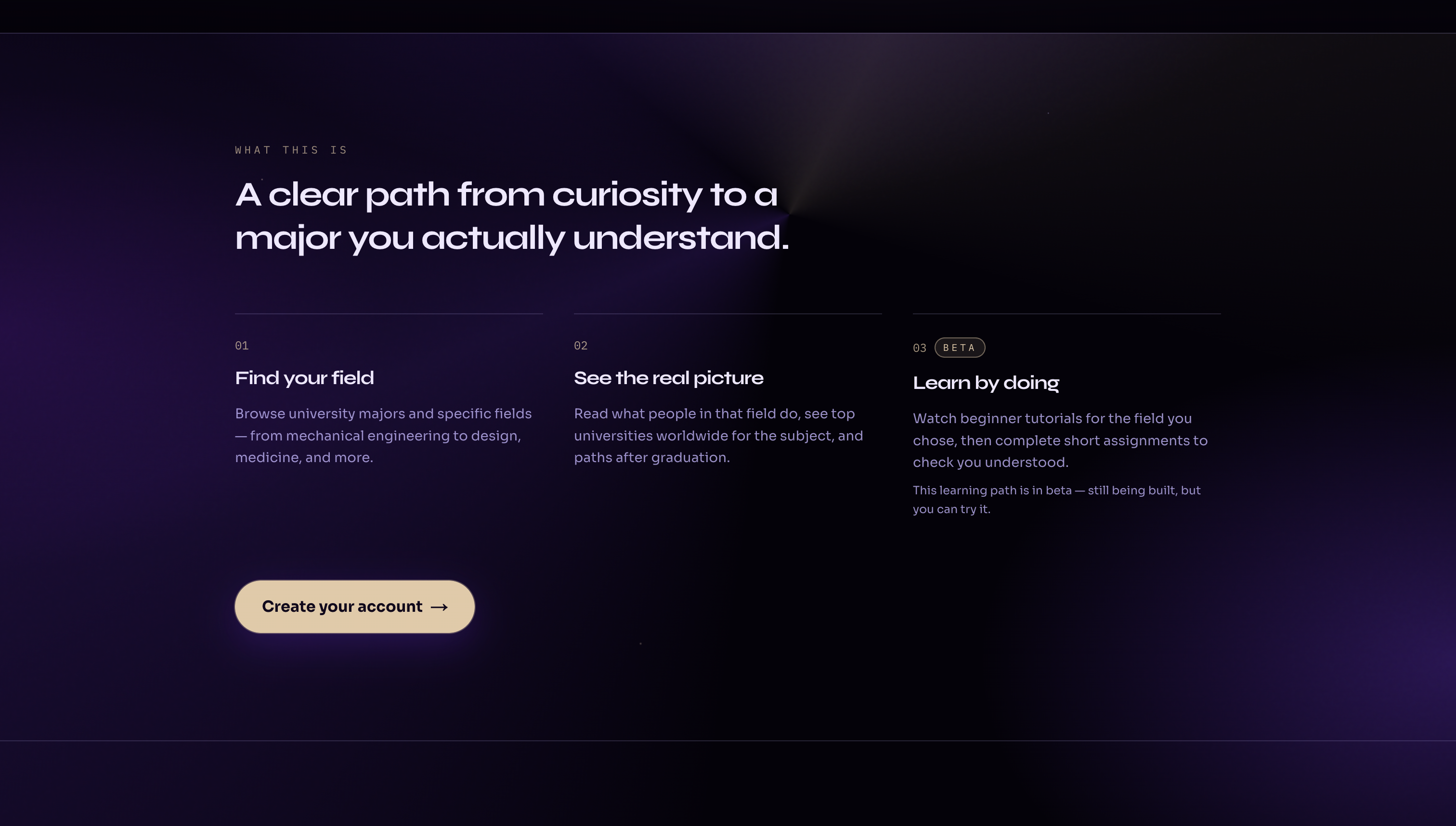
A quick overview of the home page of the website
-
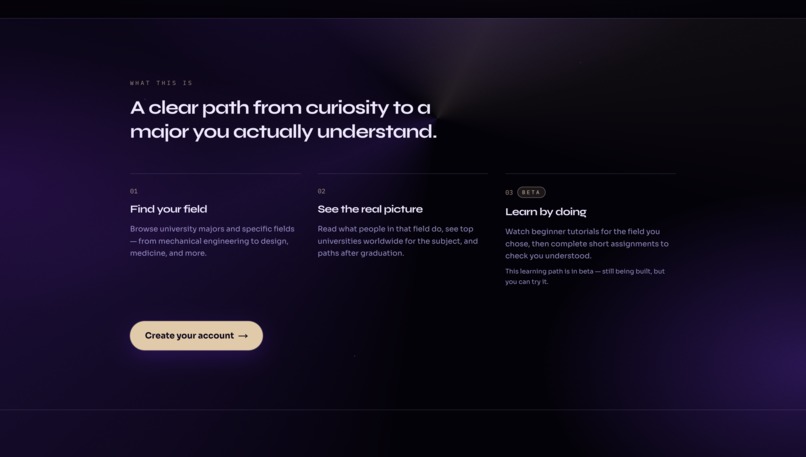
Go and check out the platform fully with the link!

Major Selection Issue.
High school students are routinely told to follow their interests when choosing a university major, yet informal observation suggests that they usually don't have any clear interest to follow. When I informally surveyed my classmates during my junior year, asking simply whether they had chosen a major, the majority said no, except some group of people who answered "business", which is still not a proper ambition in this context. I thought that this pattern is worth analyzing rigorously, because it is increasingly becoming a severe problem: students are not lacking information about majors, they are lacking a mechanism for discovering genuine interest before making a decision. This essay analyzes that failure through three behavioral economics concepts, which are choice overload, thinking short-term, and the absence of low-cost information trials, and argues that the standard tools available to students, such as career quizzes, brochures, and rankings fail because they solve the wrong problem. The first explanation is choice overload. A student choosing a major is not selecting from a handful of options but from dozens, each described in abstract, heavy language ("systems engineering", or like "applied linguistics") that conveys little about day-to-day experience. Behavioral economics research on choice has repeatedly shown that when the number and abstraction of options increase, decision quality does not improve, but rather, it degrades.
This behavior is driven specifically by the availability of options. When cognitive processing capacity is exhausted by excessive options, decision-makers default to the choices most readily available in their cultural environment. For example, "Business" becomes a catch-all proxy for general economic stability rather than an evaluation of specific operational disciplines like supply chain logistics, finance, or corporate accounting. Standard guidance counselors typically attempt to fix this by handing students comprehensive course catalogs, but this exacerbates the underlying overload. The practical implication is that reducing the number of options a student actively considers, by first narrowing to a smaller, personalized set, should improve decision quality far more than simply dumping more raw information onto an already overwhelmed student.
The second explanation is present bias, which is the well-documented tendency to weight immediate costs more heavily than delayed benefits. Exploring a potential major requires an upfront time cost, which is like reading a textbook chapter, watching a lecture, or basically sitting through an unfamiliar subject. However, the benefit of this is a well-matched, satisfying career, which is years away and uncertain. When I asked classmates why they hadn't looked into majors more seriously, the most common answer was that they were busy with their schoolwork or other immediate activities. At first, it looked like it's just about scheduling problem. But when I started overthinking, I realized that people don’t care about some matters simply because they don’t care it as much as other things, like their schoolwork, as given earlier as an example. After that, I concluded that I had to alarm them about the cost of not taking it serious.
The third and most overlooked issue is the absence of a low-cost trial mechanism. In consumer behavior, people are far more willing to try a product after a free sample or trial period than after reading a description of it, because trial resolves uncertainty that no amount of written information can. University major selection has no equivalent. Students choose based on a title and a course catalog description, never a sample of the actual intellectual work involved. A preference quiz alone doesn't fully fix this either. All it can do is match what someone says about themselves to a major. That's exactly the problem, since choice overload and present bias are already messing with how people answer those questions in the first place. So what this really shows is that you need two different things to actually fix this: something that narrows down the options first (to deal with choice overload), and something that lets people actually try a field out (to deal with the fact that no one gets a real trial run before picking). A quiz by itself just isn't enough. This isn't just theory to me either. During my internship at Jobster, where I worked as a data analyst, most of my job was related to checking individuals’ behaviour and how it affects the company. I checked datasets against raw platform logs, looked for missing info, and tracked where users dropped off along the way. That job taught me not to trust a single number as proof that something's working. A report can look clean and still be hiding the exact point where things actually fall apart. If I apply that same thinking here, finishing a quiz doesn't really mean much on its own. It just shows someone was curious enough to click through, not that they're actually interested. To know if someone's really into a major, you'd have to look past the quiz score and check what they do after: do they actually click on the reading recommendation, do they spend time reading it, do they come back and check out more stuff in that field. If someone finishes the quiz but instantly bounces off the very first article about that major, the quiz score doesn't mean anything. So the real measure isn't whether someone finishes the quiz, it's whether they stick around and engage with what comes after.
Afterall, those are basically one of the major reasons why I started building my own platform. It's a free quiz that narrows down majors based on what you actually care about instead of just vague labels like simply “business”. After you get your results it doesn't just stop there. It gives you short reading samples and videos for each recommended major so you can actually test if you like the subject before picking it. I'm tracking how people move through it just like I learned to do at Jobster. Not just whether they finish the quiz but whether they actually read the samples and come back for more.
Right now I'm working on finding good resources for each major and reaching out to schools in Tashkent to test it out. Although we didn't yet buy domain and host it, it is still possible to view the beta version, My goal is to make this free and available to as many students as possible so they don't spend two years confused like me and my classmates did.
Built With
- next.js
- react
- tailwind
- typescript
- uzbek

Log in or sign up for Devpost to join the conversation.