Inspiration
Multi-agent debate has a dirty secret: on a single backbone it mostly re-buys self-consistency at ~10× the cost (arXiv:2502.08788, 2604.02460). We wanted a society that debates only where it pays — and can prove when it's safe to skip.
Majalis is an original project built new during the Submission Period — the society, the learned world model, the benchmarks, and the Alibaba Cloud ECS deployment were all created for this entry.
What it does
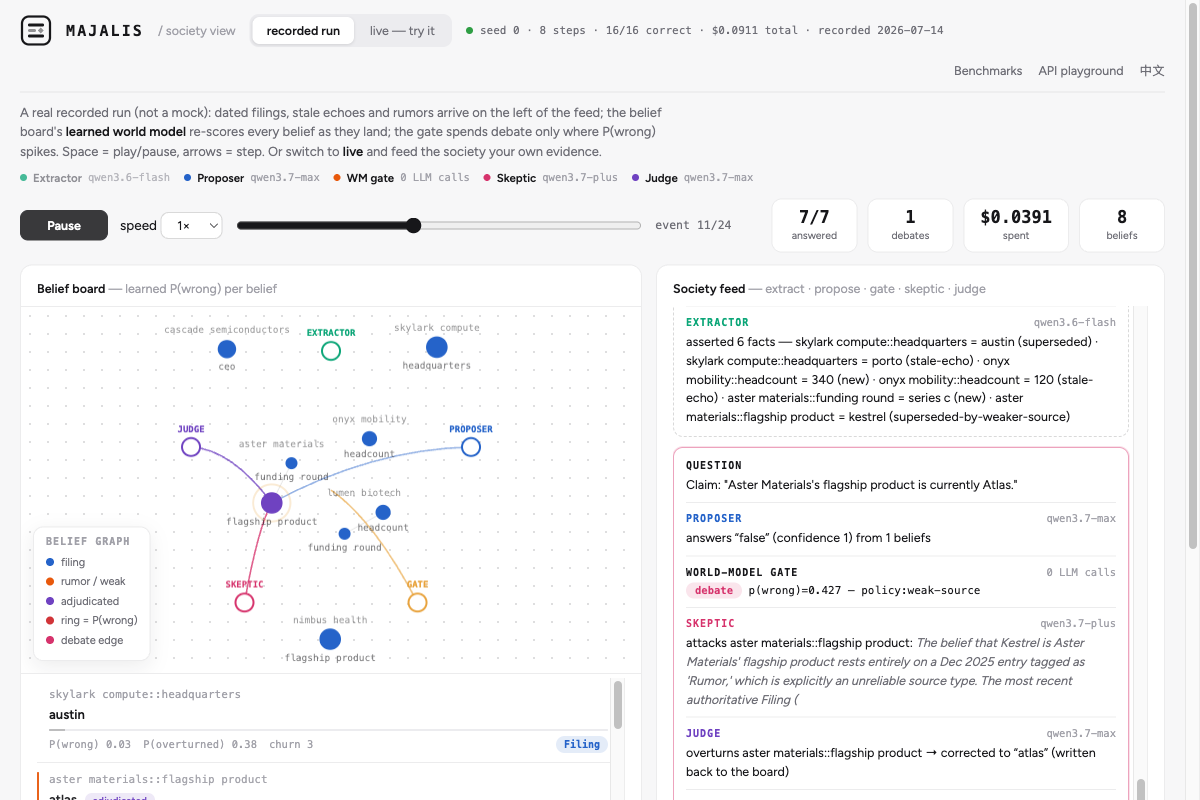
Majalis is a society of heterogeneous Qwen agents (qwen3.7-max / plus / 3.6-flash) whose debates are governed by a shared world model: a persistent belief board with keyed supersession, per-belief survival estimates, provenance dockets, and a conformally calibrated accept gate. The world model decides whether to debate (calibrated risk + a deterministic rule for known policy violations), what to challenge (expected information gain), who argues (skeptic on a different backbone than proposer/judge — author≠validator by construction), when to stop, what to commit (E[error | committed] ≤ α, distribution-free), and writes the resolution back so the next question starts smarter.
- Task division (roles): a flash extractor structures evidence into the board; a max proposer answers from beliefs; a plus skeptic attacks doubted beliefs by decomposing each challenge into 2–4 binary sub-questions; a max judge adjudicates from the key's docket; a flash planner decomposes composite resolutions into atomic sub-checks. A deterministic Python orchestrator is the only writer — star topology, typed handoffs, no free agent-to-agent chat (dodges MAST's inter-agent-misalignment cluster, 2503.13657).
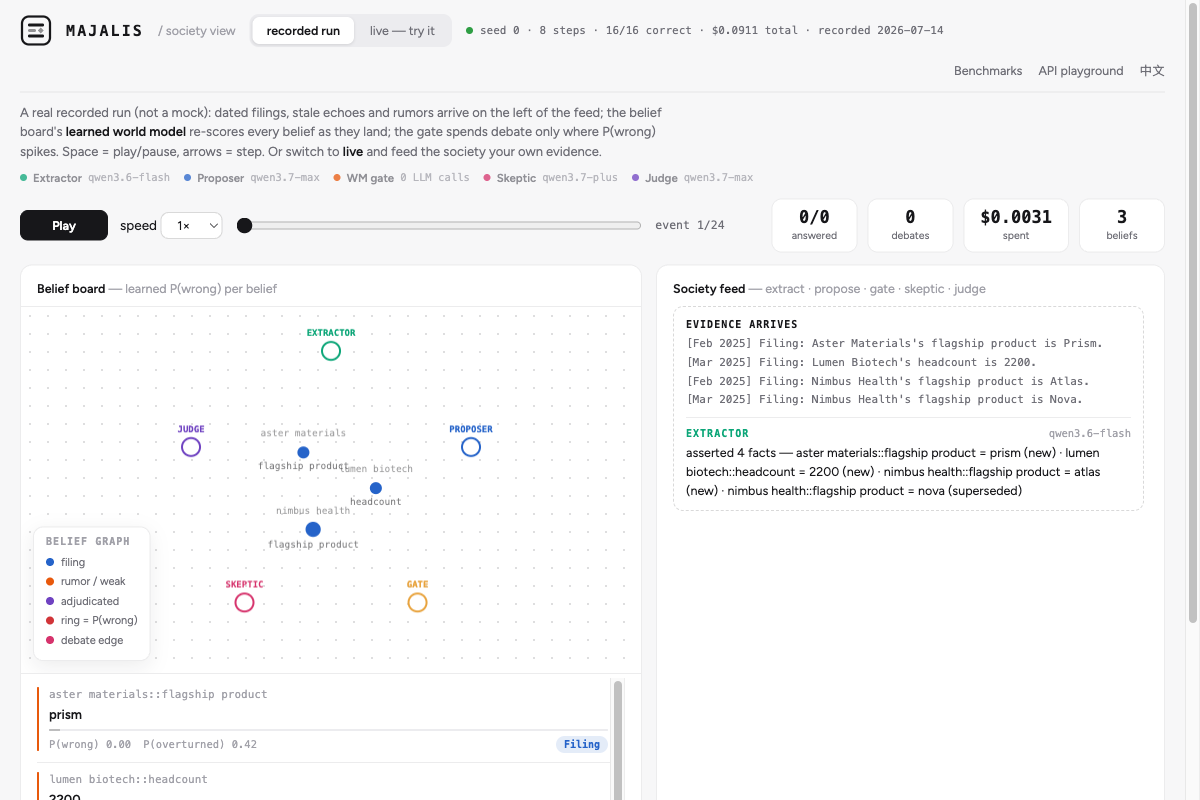
- Disagreement resolution: unreliable sources (rumors postdating filings) poison the board by date-supersession; the board flags the displacement, the gate mandates adjudication, the judge resolves from the docket under an explicit source-authority policy, then supersedes the belief.
How we built it
- Three Qwen backbones via the OpenAI-compatible DashScope API (model heterogeneity is the one debate lever with robust evidence — 2502.08788's "universal antidote").
- Backend deployed on Alibaba Cloud ECS (
src/majalis/api.py), systemd-managed, live dashboard +/ingest+/askAPI, real Qwen Cloud pricing in the cost ledger. - A real world model, measured organ by organ: calibrated state estimation (
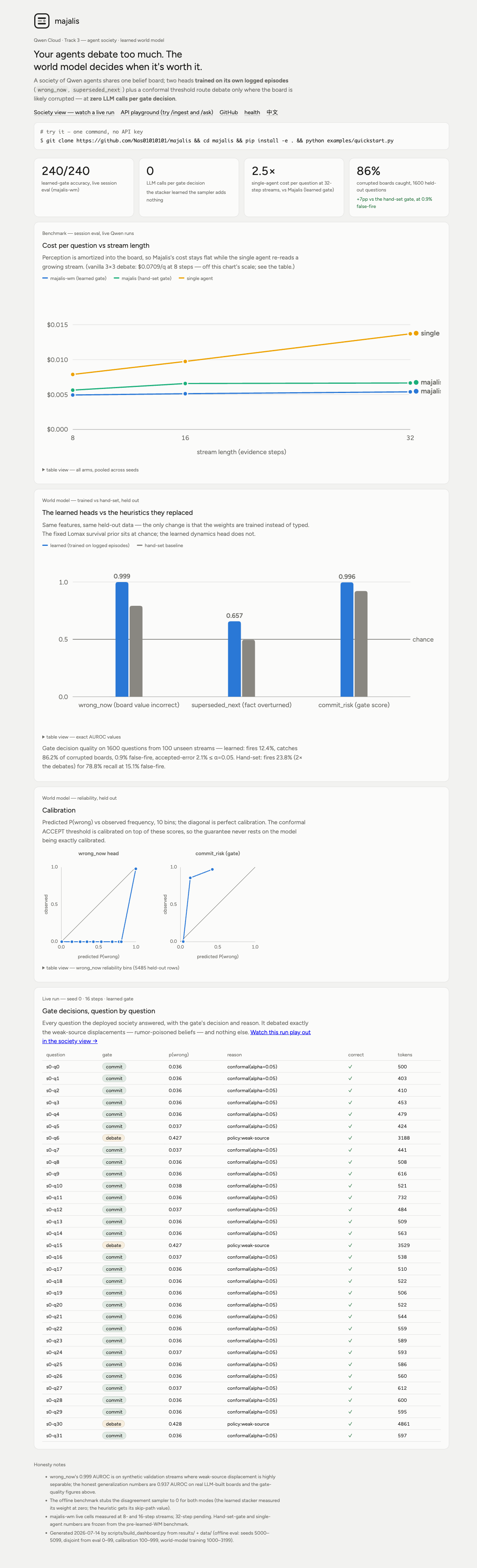
wrong_now, 0.937 AUROC on real LLM-built boards), a multi-horizon forward-dynamics hazard curve (AUROC 0.63/0.66/0.70 at k=1/2/4, ECE < 0.01), an action-conditioned outcome head on 592 mined counterfactual pairs (debate helps 4.6%, hurts 0/592), and planning in imagination — maintenance policies auditioned inside the model at $0 (no-maintenance 92.2% → learned-risk 99.5% vs oracle 99.9%, n=1,600).
Challenges we ran into
- Proving the gain, not asserting it. One command, Wilson 95% CIs, identical events + a shared token/USD ledger per arm. Result: the learned world-model gate ships 448/448 correct at a flat $0.0049–0.0054/q across 8/16/32-step streams (2.5× under the single agent at 32 steps) — with zero LLM calls to decide the gate, while vanilla 3×3 MAD costs 12.6× more.
- Keeping ourselves honest: two pre-registered-style nulls (planned gate ⊁ reactive; hazard-planning ⊁ myopic) are reported at the same prominence as the wins.
Accomplishments that we're proud of
- First agent society (to our knowledge) whose collaboration policy is governed by a learned world model of its own shared memory — stateful, predictive, plannable, and safe (conformal accept) — vs. the 2025–26 selective-debate systems (DOWN, iMAD, SELENE, ARMOR-MAD) that gate per-query, statelessly, on a fresh answer's confidence.
- The measured errors in the debate-ablated system are exactly the rumor-poisoned beliefs; every gated arm corrects all of them.
What we learned
Debate cost becomes a flat curve over an evidence stream — not a per-query discount — once a learned world model over the shared belief state controls the collaboration. It's the classic blackboard control problem (Hearsay-II) solved with a learned model instead of hand-written scheduling.
What's next
Belief-base hygiene as a product for any evolving corpus (KBs, CRM state, threat intel): maintenance mode repairs boards in windows at 112/112 with zero ask-time debates ($0.0092/q); the conformal accept bound is the SLA-style guarantee platform teams can deploy against.
Built With
- alibaba-cloud
- dashscope
- fastapi
- function-compute
- langgraph
- llamaindex
- lora
- mcp
- model-context-protocol
- openai-sdk
- qwen3.7-plus
- sentence-transformers
- text-embedding-v4


Log in or sign up for Devpost to join the conversation.