MaintainerOS
Inspiration
Maintaining an open-source project involves far more than writing code. Maintainers spend countless hours triaging issues, reviewing pull requests, updating documentation, preparing releases, and deciding what deserves attention next. Existing AI tools are great at generating code, but very few understand the day-to-day workflow of maintaining a repository.
We wanted to build something that acts less like a chatbot and more like an operating system for maintainers—a workspace that understands repository context, prioritizes work, and safely automates repetitive maintenance tasks while keeping maintainers in control.
What it does
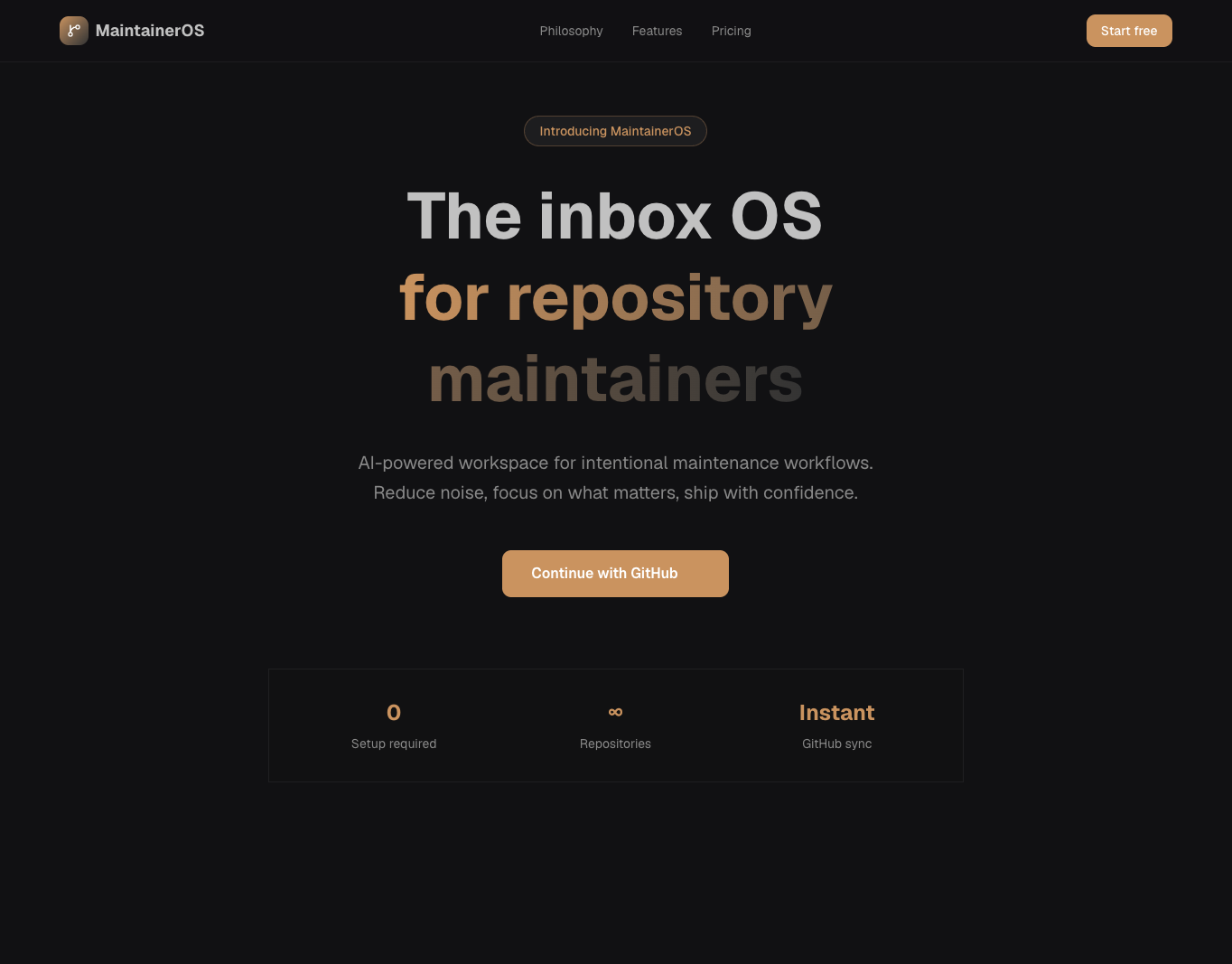
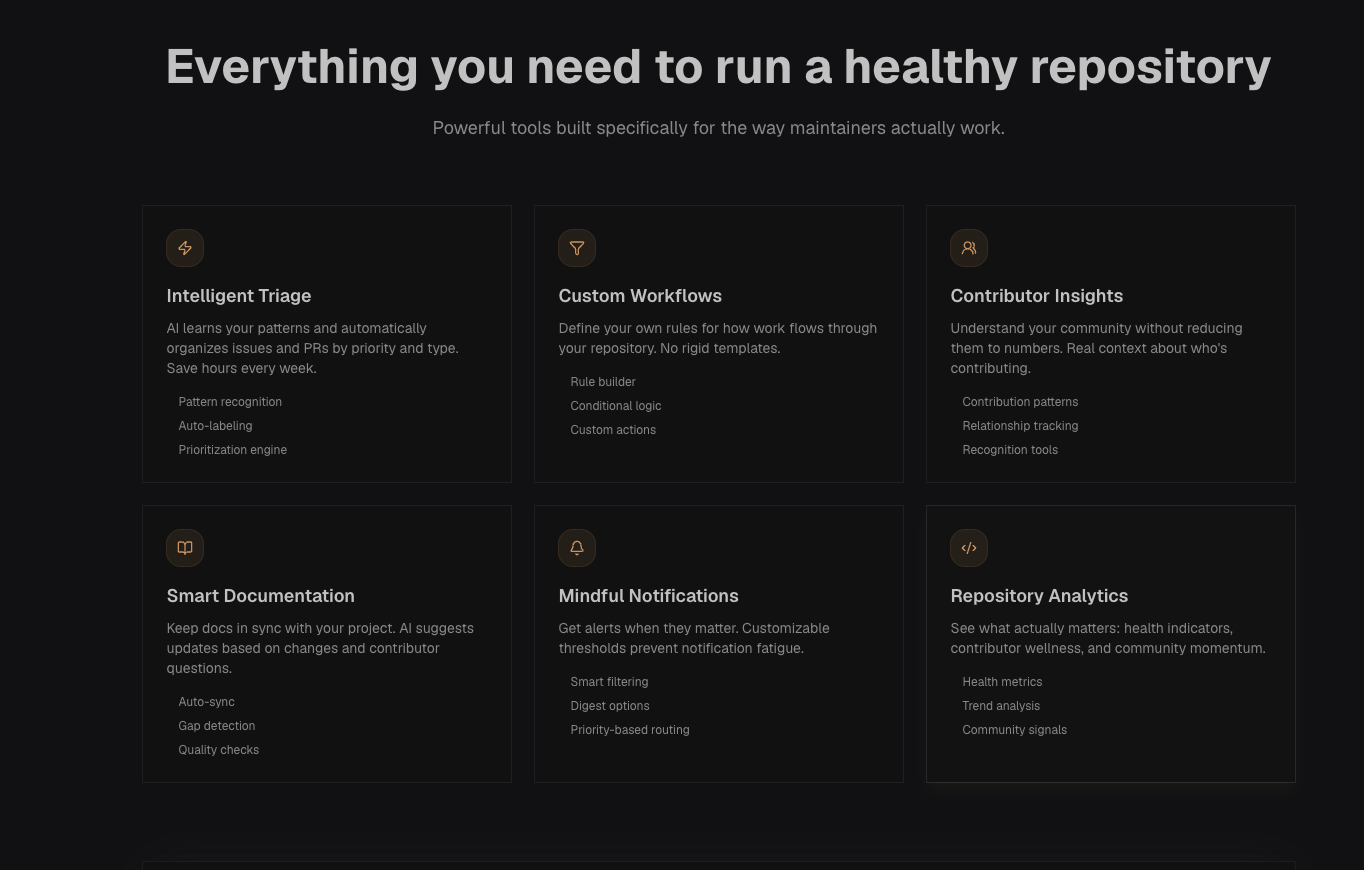
MaintainerOS is an AI-powered workspace built for GitHub maintainers.
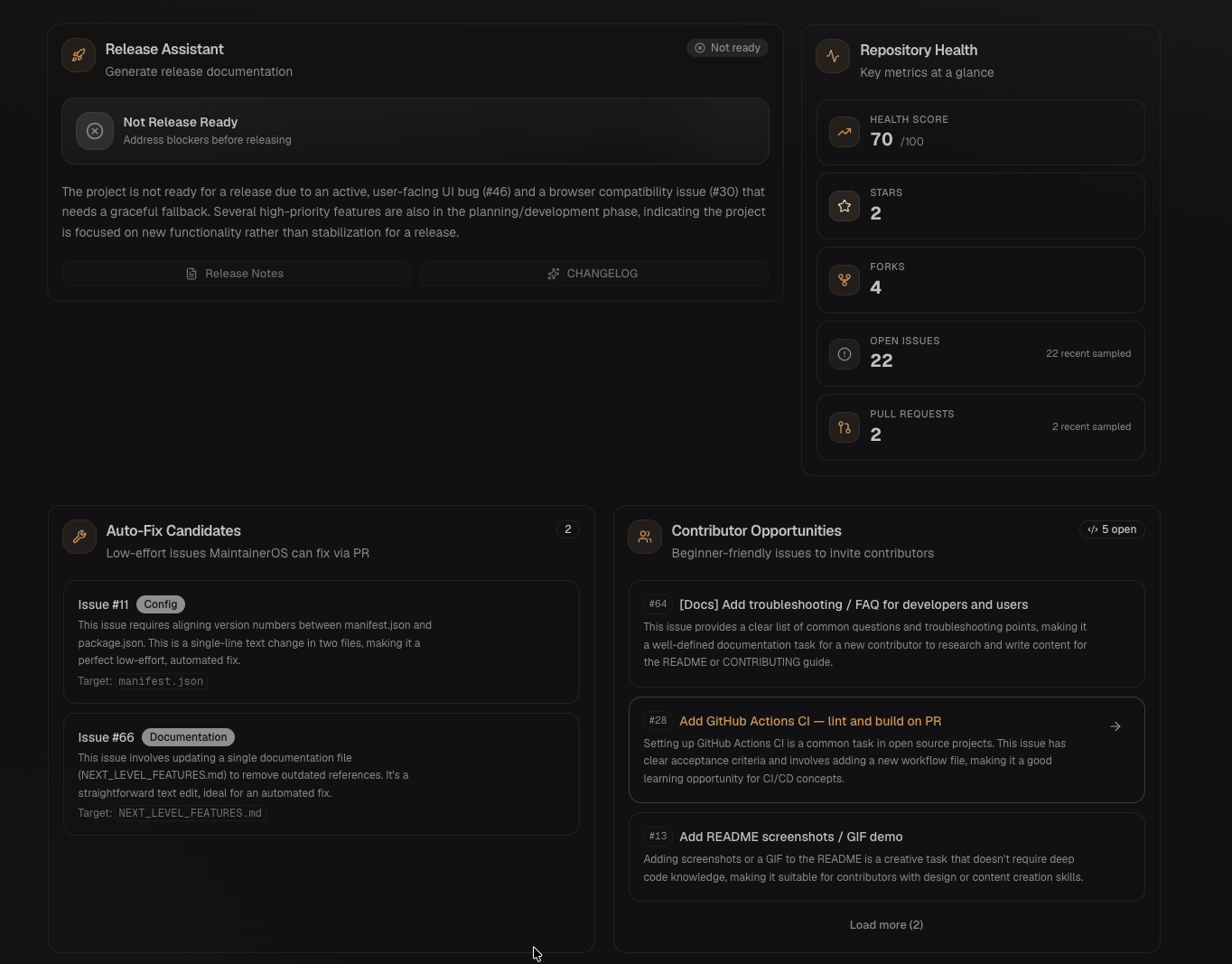
It analyzes repositories and generates an AI Maintainer Briefing highlighting repository health, merge readiness, documentation opportunities, release readiness, security insights, and prioritized maintenance tasks.
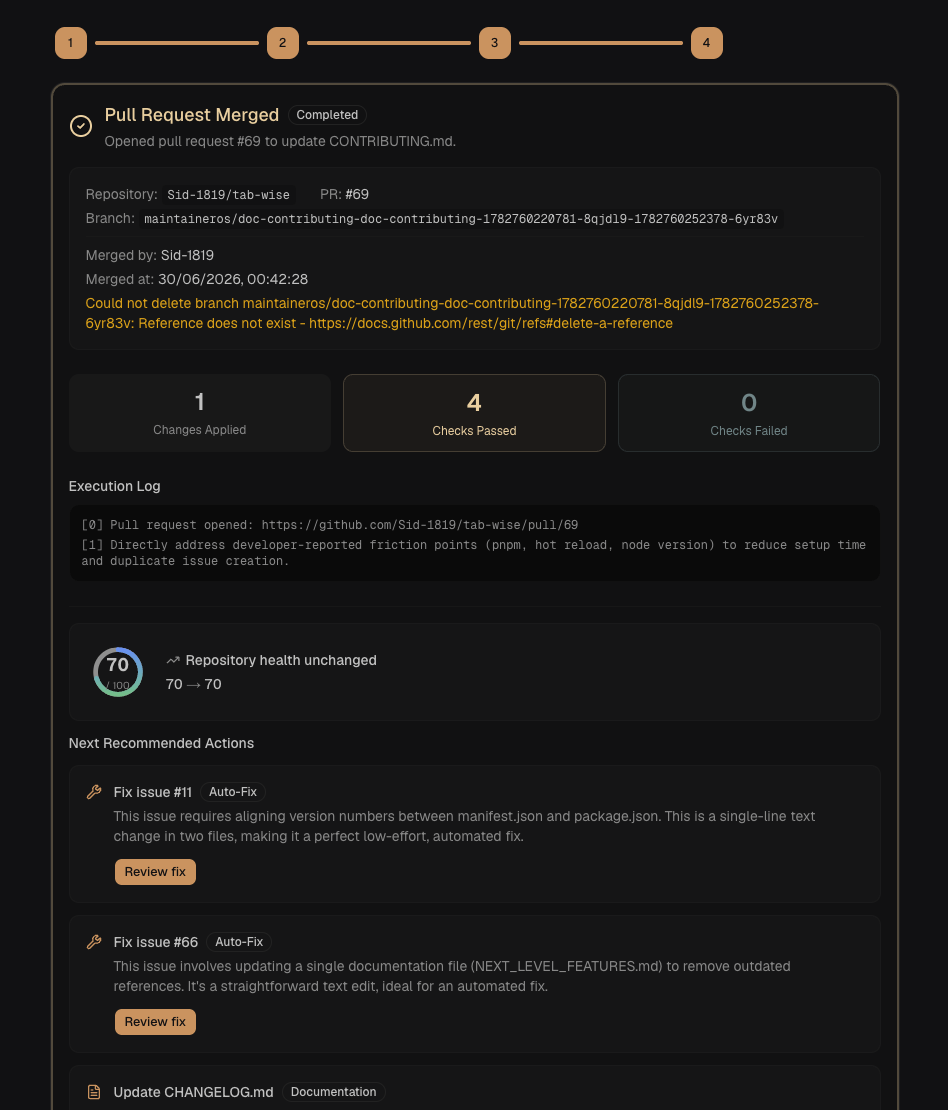
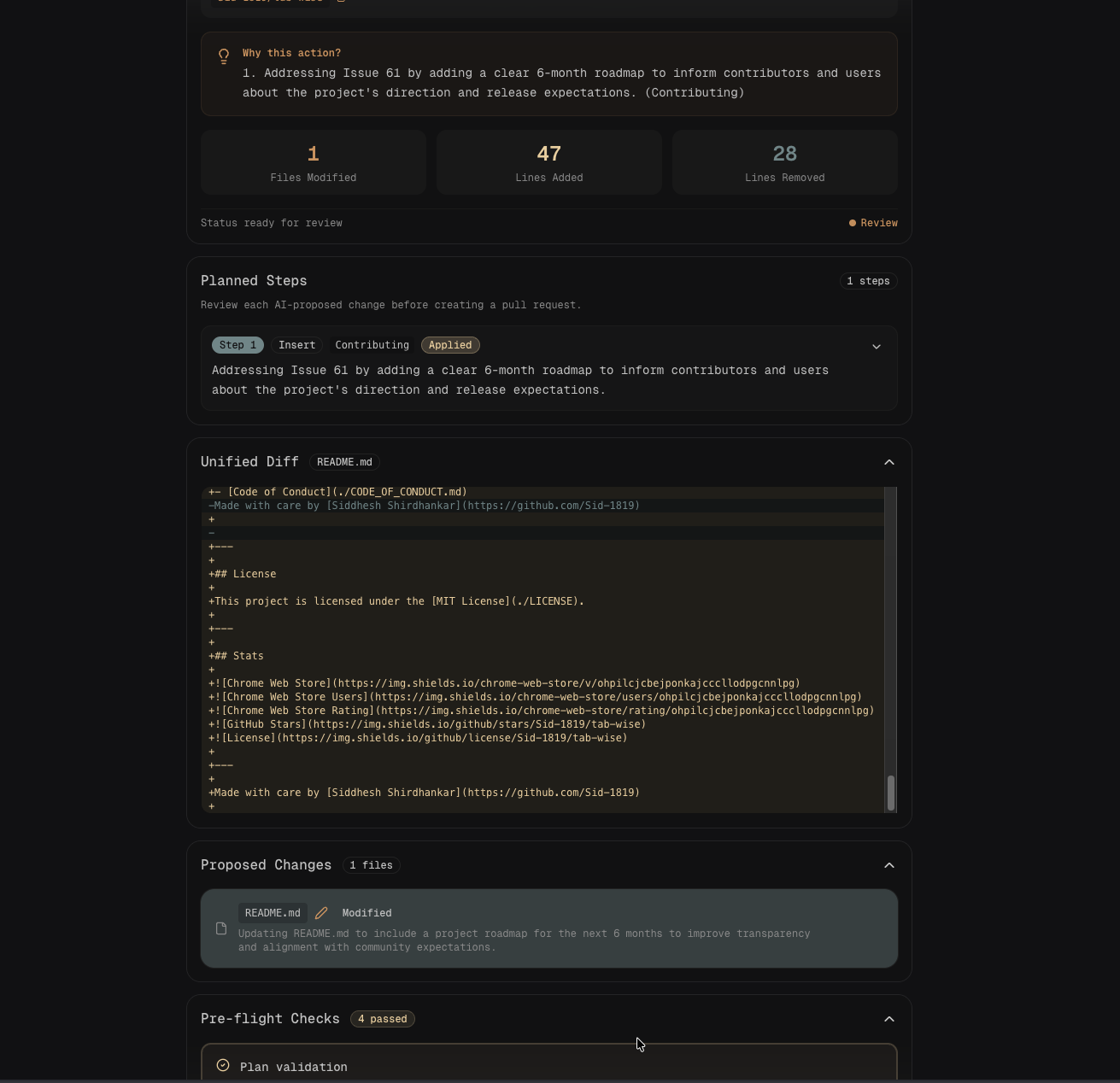
Instead of simply suggesting changes, MaintainerOS executes structured maintenance workflows. For documentation automation, it:
- Analyzes the repository
- Generates an AI execution plan
- Validates the proposed changes
- Shows a reviewable diff
- Creates a Git branch
- Commits the changes
- Opens a Pull Request automatically
- Detects when the PR has been merged
- Refreshes repository analysis
- Recommends the next best maintenance action
Maintainers remain in control throughout the entire workflow.
How we built it
MaintainerOS is built using Next.js, React, TypeScript, Tailwind CSS, and shadcn/ui, with the frontend deployed on Vercel.
For authentication and repository access, we integrated GitHub OAuth.
The AI layer is powered by the Vercel AI SDK, enabling streaming responses, provider abstraction, automatic failover, and Bring Your Own Key (BYOK) support. Instead of depending on a single provider, MaintainerOS intelligently routes requests between Gemini, Groq, and OpenRouter while allowing users to use their own API keys.
Repository state, execution history, workspace data, and user settings are stored in AWS Aurora PostgreSQL, satisfying the persistence requirements while enabling future collaboration and analytics features.
To safely automate repository changes, we designed a modular Action Engine that separates every workflow into four stages:
- Planner
- Validator
- Executor
- Reporter
This architecture ensures AI-generated changes are validated before execution and always presented for maintainer review before a Pull Request is created.
Challenges we ran into
The biggest challenge was making AI-generated changes safe enough for production repositories. Instead of allowing the LLM to modify repositories directly, we built a validation layer that verifies generated plans before execution and re-fetches repository files immediately before committing to avoid stale updates.
Another challenge was working within the free-tier AI limits. During development we frequently hit Gemini request and token limits, which led us to redesign the AI layer using the Vercel AI SDK with intelligent provider routing, streaming, automatic failover, and BYOK support.
Designing the user experience was another interesting challenge. We eventually shifted away from a traditional analytics dashboard toward a workspace-first approach where maintainers immediately see what needs attention and what can be automated.
Accomplishments that we're proud of
- Built a complete end-to-end AI maintenance workflow that goes from repository analysis to an automatically created GitHub Pull Request.
- Designed a reusable Action Engine that can power documentation updates, issue fixes, release preparation, and future maintenance workflows.
- Implemented GitHub OAuth, automated branch creation, commits, Pull Request generation, merge detection, and repository refresh.
- Integrated the Vercel AI SDK with streaming, provider abstraction, automatic failover, and Bring Your Own Key support.
- Successfully deployed the application while using AWS Aurora PostgreSQL as the primary database.
What we learned
This project fundamentally changed how we think about AI applications. Rather than treating AI as a text-generation feature, we learned that the real value comes from building reliable workflows around AI.
We gained hands-on experience with GitHub automation, streaming AI interfaces, safe execution pipelines, AI provider abstraction, AWS Aurora PostgreSQL, and designing systems where AI becomes one component of a larger orchestration engine instead of the entire product.
What's next for MaintainerOS
MaintainerOS is just getting started.
Our roadmap includes:
- Autonomous issue fixing with AI-generated Pull Requests
- Security and vulnerability remediation workflows
- AI-assisted release preparation and changelog generation
- GitLab support alongside GitHub
- Team workspaces and collaborative maintenance
- Background monitoring using GitHub webhooks instead of manual refresh
- Repository memory that continuously learns maintainer preferences
- Enterprise deployment with organization-wide AI policies and audit trails
Our long-term vision is to make MaintainerOS the AI workspace where maintainers manage, automate, and continuously improve their repositories with confidence.
Built With
- ai
- amazon-web-services
- api
- aurora
- css
- gemini
- next.js
- oauth
- openrouter
- orm
- prisma
- react
- rest
- sdk
- shadcn/ui
- tailwind
- typescript
- zod


Log in or sign up for Devpost to join the conversation.