-
-
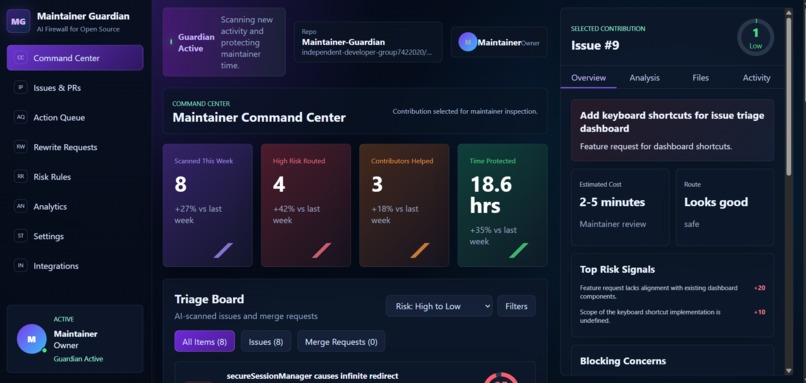
Main Page
-
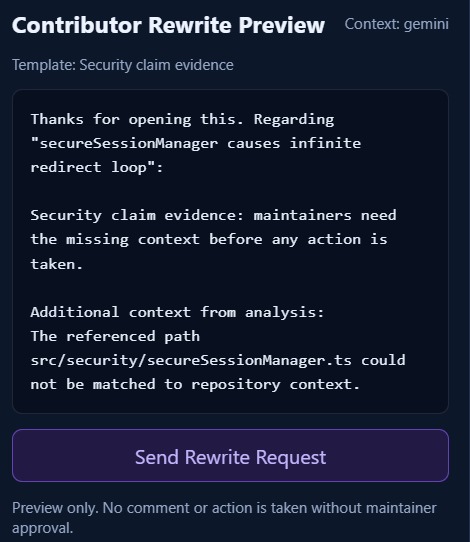
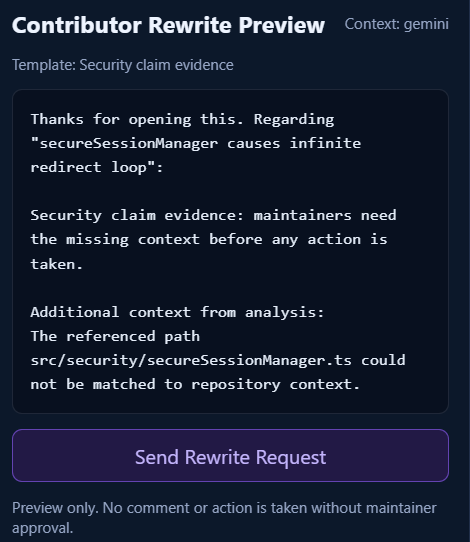
Rewrite Request
-
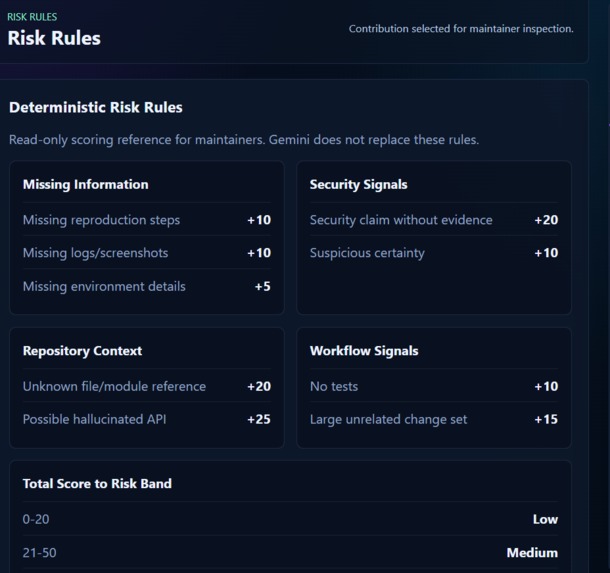
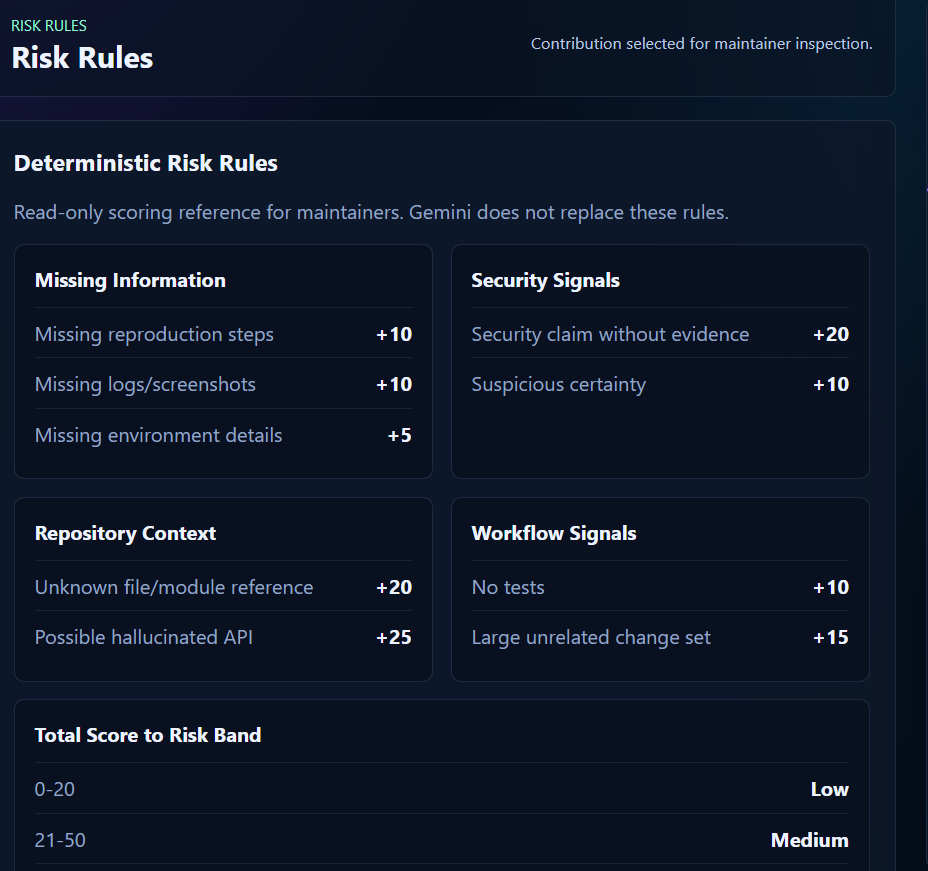
Risk Rules
-
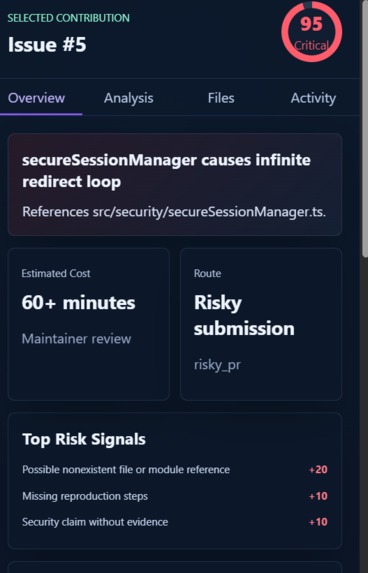
High-Risk Submission
-
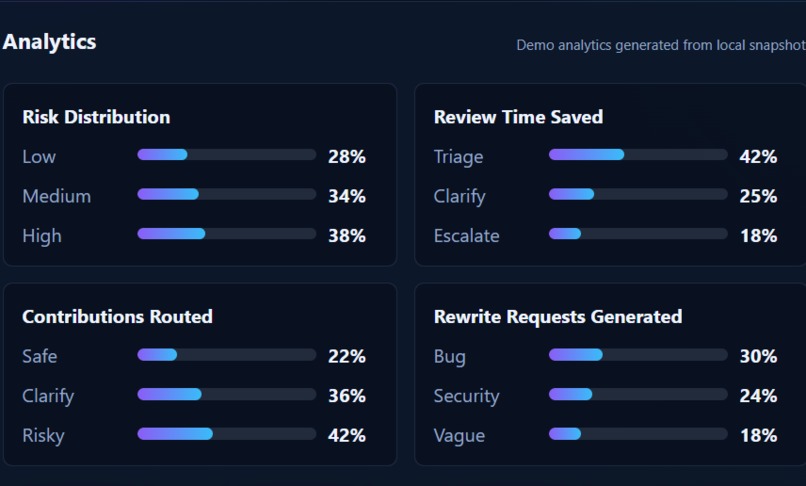
Analytics
Inspiration
Maintainer Guardian was inspired by a simple but growing problem in open source: AI coding tools are making it easier than ever to generate issues, pull requests, and contribution ideas, but maintainer attention has not scaled with that volume.
The bottleneck is no longer just writing code. The bottleneck is deciding what deserves maintainer review.
Many open-source maintainers already deal with incomplete bug reports, vague feature requests, unsupported security claims, and pull requests that touch sensitive areas without enough context. As AI-generated contributions become more common, this problem becomes even harder. Maintainers risk spending valuable time reviewing low-quality or unclear submissions instead of focusing on meaningful work.
Maintainer Guardian was built to protect that limited maintainer attention.
What it does
Maintainer Guardian is an AI-assisted triage system for open-source maintainers.
It analyzes incoming GitLab issues and contribution reports, then helps maintainers answer four key questions:
How much review effort will this likely require? What risk signals are present? What workflow route should this contribution follow? Can we ask the contributor for better information before maintainer time is wasted?
The system produces:
- Deterministic risk signals
- Repository-context validation
- Gemini-powered semantic analysis
- Review-time estimates
- Workflow routing recommendations
- Contributor rewrite previews
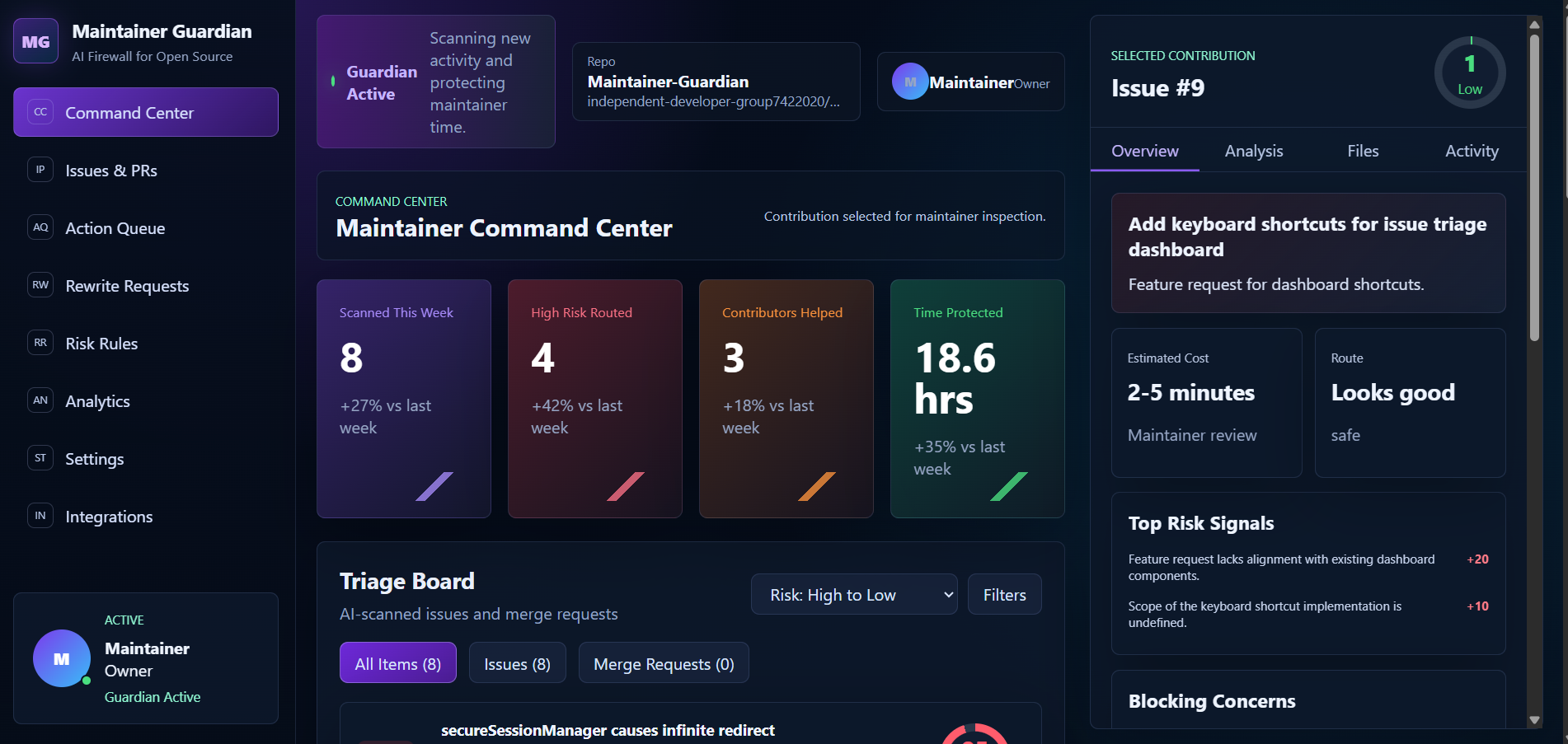
- A maintainer dashboard for triage and action
At a high level:
Issue / PR -> Repository Context Analysis -> Deterministic + Gemini Analysis -> Risk Score + Review -> Time Estimate -> Workflow Routing -> Contributor Rewrite Preview -> Maintainer Dashboard
The core idea is:
Maintainer Guardian does not replace maintainers. It protects their time.
How we built it
We built Maintainer Guardian as a multi-stage system.
1. GitLab ingestion
The backend retrieves issues from a GitLab project using the GitLab API. This gives the system real contribution data to analyze instead of relying only on static examples.
2. Repository context analysis
The system reads repository context such as:
- README files
- contributing guidelines
- issue templates
- repository file paths
- high-risk paths such as authentication, upload, security, and configuration files
This allows Maintainer Guardian to detect when an issue references a nonexistent file or makes claims about a part of the codebase that cannot be verified.
3. Deterministic scoring
We implemented deterministic rules for common maintainer-burden signals, such as:
- Missing reproduction steps
- Missing logs or screenshots
- Missing environment details
- Missing expected vs actual behavior
- Security claims without evidence
- Very short or vague descriptions
- References to nonexistent paths
The score estimates review burden and concern level, not just whether something is “AI slop.”
4. Gemini semantic analysis
We used Gemini as an advisory semantic layer. Gemini helps detect:
- Ambiguous claims
- Suspicious certainty
- Unsupported technical claims
- Possible hallucinated references
- Semantic risk reasons
The deterministic system remains the source of truth, while Gemini adds nuance and context.
5. Routing and review-time estimation
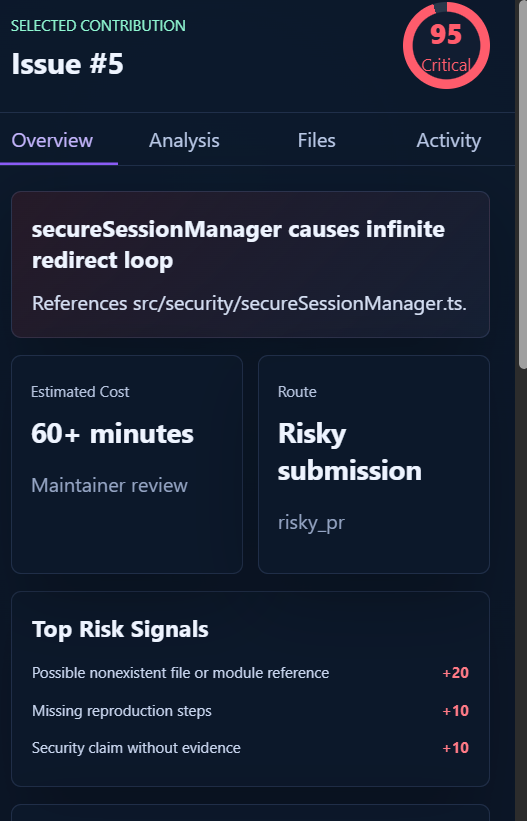
Maintainer Guardian translates analysis into workflow routes:
- safe
- needs_contributor_clarification
- risky_pr
- maintainer_review
It also estimates review time, such as:
- 2-5 minutes
- 5-15 minutes
- 15-30 minutes
- 30-60 minutes
- 60+ minutes
This helps maintainers prioritize what needs attention first.
6. Contributor rewrite previews
The system generates polite, maintainer-approved clarification drafts. These drafts ask contributors for missing context before a maintainer spends time investigating.
For example, instead of immediately reviewing a vague security claim, Maintainer Guardian can suggest a message asking for safe validation evidence, affected configuration, logs, and impact details.
Every action remains human-in-the-loop:
Preview only. No comment or action is taken without maintainer approval.
7. Dashboard frontend
Finally, we built a dark-themed dashboard inspired by cybersecurity and AI tooling. It includes:
- Incoming contribution queue
- Risk score cards
- Review-time estimates
- Selected contribution inspection panel
- Reasons flagged
- Recommended actions
- Rewrite preview panel
- Risk rules page
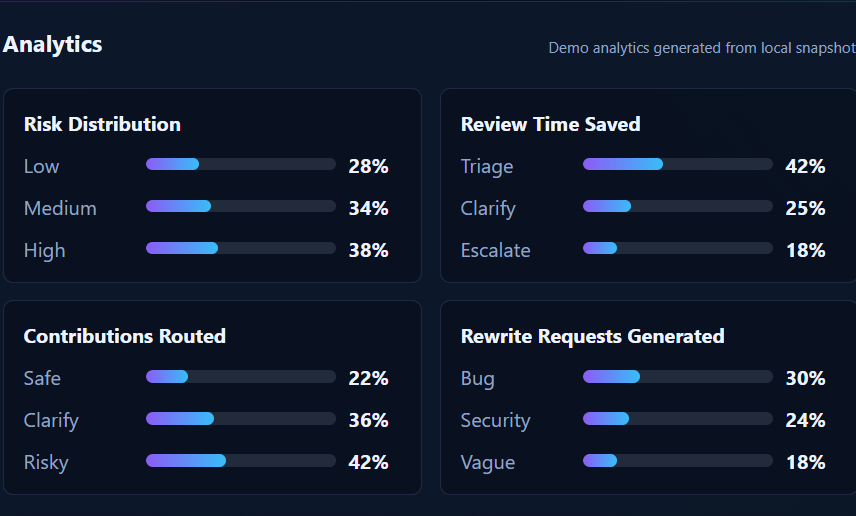
- Demo analytics page
The frontend is read-only and does not mutate GitLab data.
Challenges we ran into
One major challenge was keeping the architecture consistent as the project grew. Maintainer Guardian started as a review-cost estimator, but expanded into scoring, semantic analysis, routing, rewrite generation, and a dashboard. We had to make sure each feature still served the same core mission: protecting maintainer time.
Another challenge was balancing Gemini with deterministic logic. We wanted Gemini to provide useful context, but not become an unpredictable decision-maker. To solve this, we made Gemini advisory and kept final workflow decisions grounded in deterministic signals.
The frontend also had challenges. Building a polished dashboard required several layout fixes, especially around responsive triage cards, selected issue panels, and action flows. We eventually stabilized the interface with clear grid areas, local state, and read-only demo actions.
Accomplishments that we're proud of
We are proud that Maintainer Guardian became more than a simple “AI slop detector.” It evolved into a full maintainer-support workflow that connects repository context, deterministic scoring, Gemini analysis, routing, rewrite suggestions, and a dashboard into one coherent system.
One accomplishment we are especially proud of is the deterministic-first architecture. Instead of letting an LLM make every decision, we used deterministic rules for structure, scoring, and workflow safety, while using Gemini for semantic nuance. This made the system more explainable, testable, and safer for maintainers.
We are also proud of the contributor rewrite workflow. Maintainer Guardian does not just flag problems; it helps fix them by generating polite clarification requests that contributors can act on. This turns triage from a blocking process into a feedback loop.
Finally, we are proud of the dashboard experience. The interface makes maintainer burden visible through risk scores, review-time estimates, recommended routes, flagged reasons, rewrite previews, risk rules, and analytics. It gives maintainers a clear command center for protecting their time.
What we learned
This project taught us that useful AI systems are not just about calling an LLM.
A major lesson was that deterministic logic and AI reasoning should work together.
If Gemini controlled everything directly, the system would be harder to test and less predictable. Instead, we designed Maintainer Guardian around a safer architecture:
- Deterministic rules = structure and trust
- Gemini = semantic nuance
- Maintainer = final decision
We also learned that “risk” has multiple meanings. A contribution can be well-written but still risky if it touches authentication, security, or configuration code. So we separated:
- Risk score: estimated review burden and concern
- Route: recommended workflow path
- Review time: expected maintainer effort
This made the system more realistic.
What's next for Maintainer Guardian
The next step for Maintainer Guardian is to move from a read-only prototype into a deeper maintainer workflow tool.
First, we would add live GitLab actions with maintainer approval, such as posting rewrite requests, applying labels, and closing issues only after a human confirms the action. The human-in-the-loop model would remain central.
Second, we would expand support from issues to full merge request analysis, including changed files, test coverage, linked issues, risky file diffs, and review complexity. This would make the system much more useful for real open-source projects.
Third, we would improve customization. Different projects have different definitions of risk, so maintainers should be able to configure scoring weights, sensitive paths, required templates, and routing rules.
Fourth, we would add historical analytics. Maintainer Guardian could learn how much time was saved, which contributors improved after rewrite requests, which rules were most useful, and where maintainers were still overloaded.
Long term, Maintainer Guardian could become an intelligent maintainer firewall that sits between contribution volume and maintainer attention, helping open-source communities scale safely in the age of AI-generated software
Built With
- gitlab
- gitlab(api)
- google-cloud
- google-gemini
- json
- python
- react
- typescript
- vercel
- vite

Log in or sign up for Devpost to join the conversation.