-
-
#MailboxMind
Inspiration
Email has become an information overload problem. Important deadlines, opportunities, security warnings, and personal messages can easily disappear among newsletters, notifications, and low-value messages.
MailboxMind was inspired by the idea that an inbox should not simply show messages in chronological order—it should understand what matters to the person receiving them. We wanted to explore whether Gemini could act as an intelligent layer between a user and their inbox.
What it does
MailboxMind uses Gemini to analyze emails and evaluate them across four key dimensions: importance, relevance, urgency, and sensitivity.
It generates concise summaries, categorizes messages, recommends actions, and produces a priority score. It can also identify critical messages that should bypass normal interest-based ranking—for example, a potential API-key exposure can be surfaced even when cybersecurity is not one of the user's stated interests.
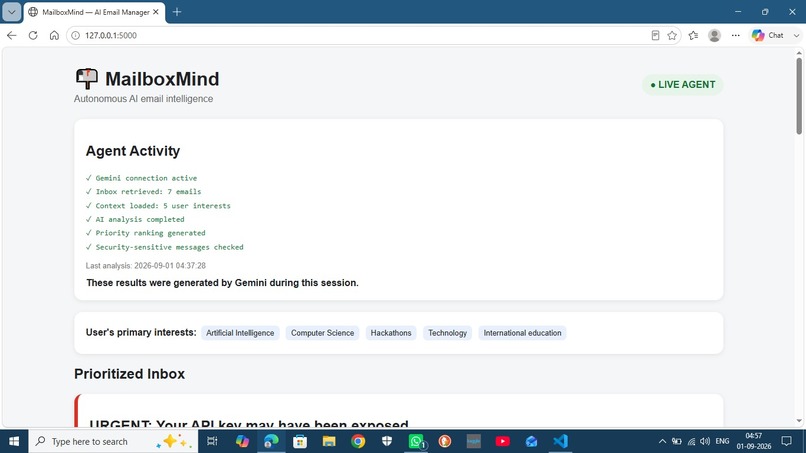
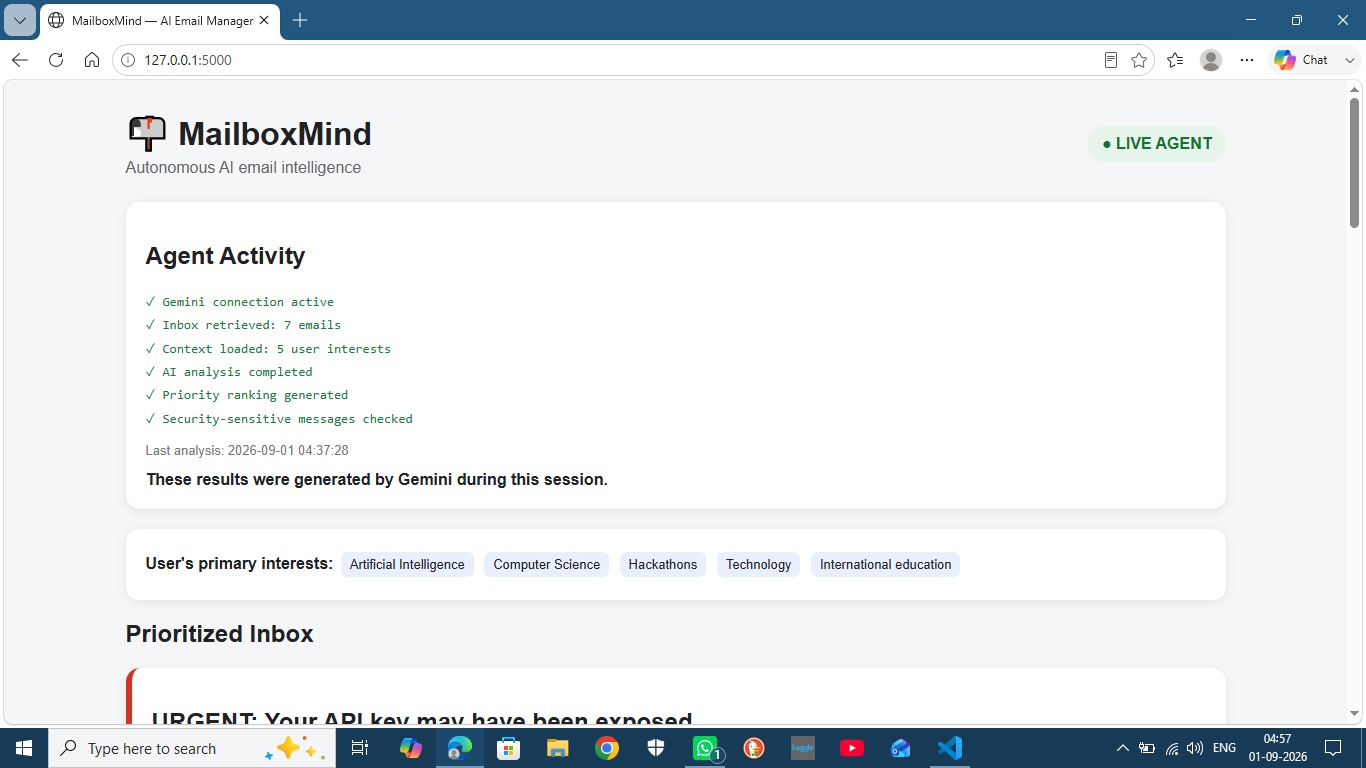
The current prototype demonstrates this workflow through a local web application using a controlled inbox dataset.
How we built it
The prototype was built with Python and a lightweight Flask interface. Gemini provides the core email-understanding and reasoning layer, while a separate analysis engine handles priority scoring and critical-message detection.
The application sends the inbox to Gemini for structured analysis and converts the results into a prioritized interface showing importance, relevance, urgency, sensitivity, summaries, and recommended actions.
The architecture was deliberately kept modular so that the current prototype can evolve into a full production system without rebuilding the intelligence layer.
Challenges we ran into
The biggest challenge was working within limited API access and infrastructure availability while building under a tight hackathon deadline. We also had to design around Gemini rate limits and avoid unnecessary API calls.
Another challenge was balancing personalization with safety. An email should not become low priority simply because it does not match a user's interests, particularly when it contains a security warning, deadline, financial risk, or another potentially consequential request.
We therefore separated relevance from importance and urgency, allowing MailboxMind to reason about messages from multiple perspectives.
Accomplishments that we're proud of
We built a functioning Gemini-powered email intelligence prototype from scratch and converted it into a live localhost web application.
We are especially proud of the prioritization model: MailboxMind does not simply search for keywords or sort by sender. It evaluates different dimensions of an email and can elevate exceptional cases such as critical security warnings.
Most importantly, we created a foundation that can be extended into a much more capable agentic email system.
What we learned
We learned that building an AI agent is not just about calling an LLM. The surrounding system needs clear responsibilities, structured outputs, safety boundaries, prioritization logic, and a useful interface.
We also learned that importance, relevance, and urgency are different concepts. Treating them separately produces a much more meaningful representation of an inbox than a single "important/not important" classification.
What's next for MailboxMind
The current prototype is only the beginning. Our long-term goal is to turn MailboxMind into a personal email operating system rather than another email client.
The next version will connect directly to Gmail and continuously learn from the user's behavior—while keeping the user in control. MailboxMind will learn which senders, topics, opportunities, deadlines, and conversations matter most without requiring the user to manually configure hundreds of rules.
We plan to build an agentic workflow capable of:
- Continuous inbox monitoring instead of one-time analysis.
- Six-hour and weekly intelligence reports highlighting important emails that remain unopened.
- Personalized priority learning based on user feedback and behavior.
- Security-first escalation for credential exposure, suspicious activity, financial risks, and other critical events.
- Actionable workflows, including drafting replies, extracting deadlines, creating reminders, and preparing follow-up actions—with explicit user approval before anything is sent or changed.
- Contextual email memory, allowing the agent to understand relationships and ongoing conversations rather than treating every email independently.
- Natural-language inbox interaction, allowing users to ask questions such as "What did I miss this week?", "Which emails require action today?", or "Show me opportunities related to AI."
- Google Cloud deployment for a scalable production architecture, with secure storage, authentication, monitoring, and reliable background agent execution.
Ultimately, MailboxMind aims to move email management from "search, read, sort, and remember" to "understand, prioritize, and assist."
The current prototype proves the core idea: Gemini can provide the intelligence needed to make that transition. The next stage is turning that intelligence into a persistent, personalized, and trustworthy email agent.

Log in or sign up for Devpost to join the conversation.