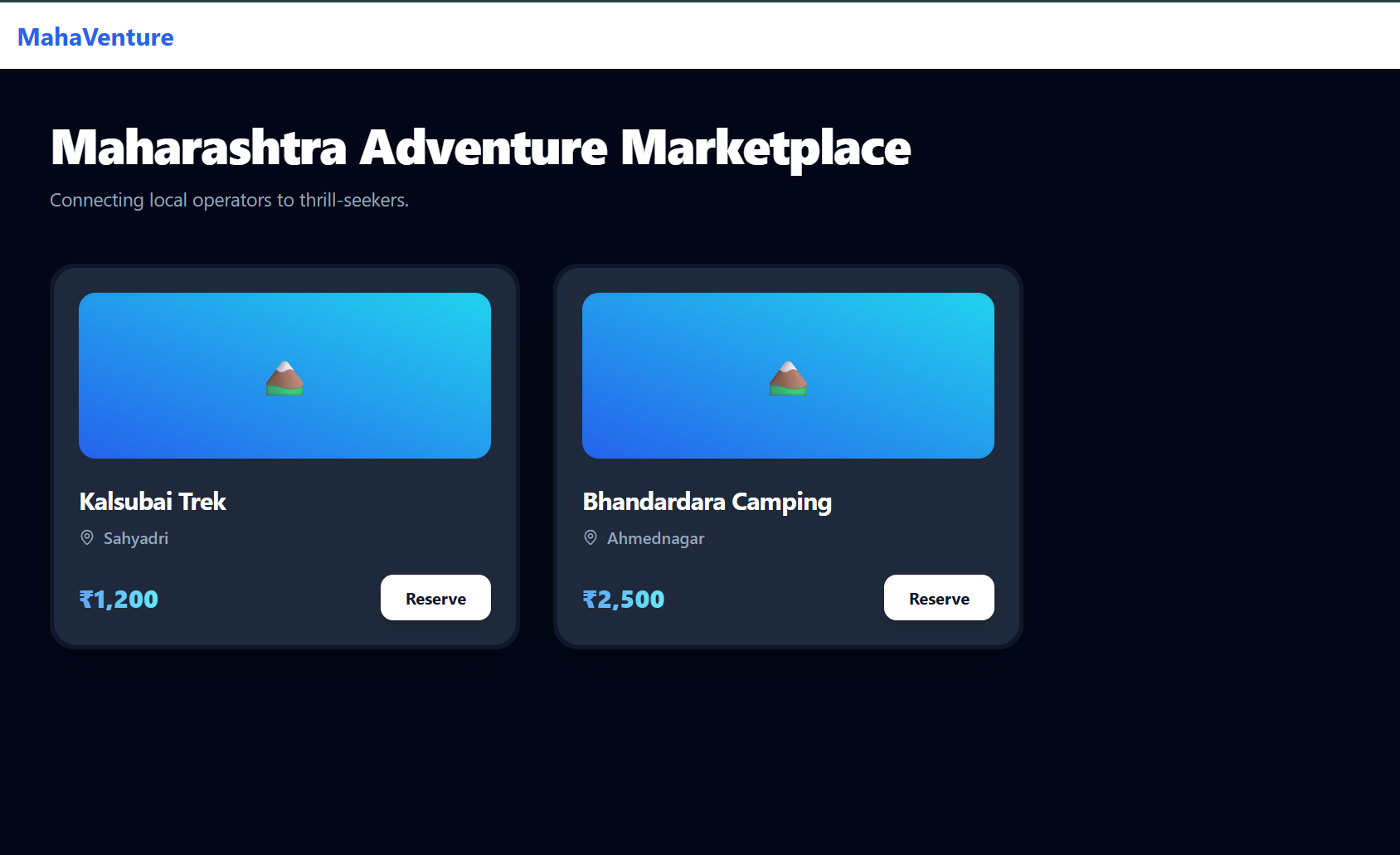
Inspiration The inspiration for MahaVenture stemmed from a simple observation: Maharashtra is home to some of the most breathtaking adventure destinations in India—from the rugged peaks of the Sahyadris to the serene backwaters of Bhandardara—yet the process of planning a weekend getaway remains frustratingly fragmented. Travelers often struggle to find verified local operators, clear pricing, and reliable itineraries in one place. We wanted to build a centralized, "founder-first" platform that bridges the gap between passionate adventure-seekers and the local experts who make these experiences possible.
How we built it We prioritized speed and scalability by leveraging a modern, high-performance tech stack:
Frontend: Built with Next.js for lightning-fast page loads and optimized for mobile responsiveness.
Styling: Utilized Tailwind CSS to create a premium, dark-themed, and glassmorphic UI that provides a professional startup aesthetic.
Deployment: The application is hosted on Vercel, ensuring global performance and reliability.
Architecture: We implemented a modular component structure, separating our discovery engine from our booking flow to ensure the platform can scale as more operators join our network.
Challenges we faced The primary challenge was balancing a feature-rich "production-ready" requirement with a tight hackathon timeline. We had to make tough decisions on scope, prioritizing a seamless, end-to-end booking flow—the core of the marketplace—over decorative features. Resolving integration issues during the build process taught us the value of clean, component-based code and rapid prototyping.
What we learned Building MahaVenture reinforced the importance of user-centric design. We learned that in a marketplace model, trust is the primary currency. By focusing on transparent operator information and a secure, intuitive booking experience, we successfully transformed a fragmented discovery process into a unified platform. Furthermore, this project deepened our understanding of the rapid development lifecycle and the importance of performance metrics in modern web applications.
Technical Note Our system architecture relies on efficient state management to handle user bookings. If we define U as the set of users and O as the set of adventure operators, the efficiency of our matchmaking can be modeled as:
Matchmaking Efficiency= ∑Total Requests ∑Successful Bookings
Our goal with MahaVenture is to keep this ratio as close to 1 as possible by optimizing the discovery and operator-matching pipeline.

Log in or sign up for Devpost to join the conversation.