-
-

Logo/Extension Icon
-
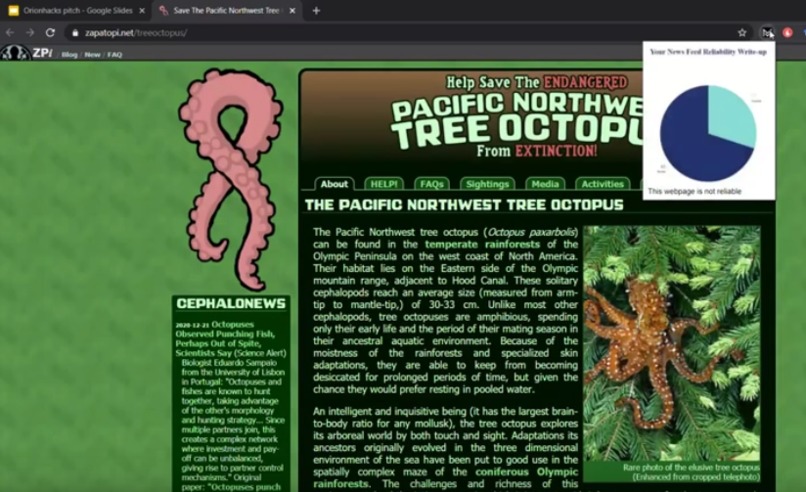
Extension in action


Inspiration
We were inspired by the worrying increase of misinformation and the hate it breeds in the world. We wanted to help stop this occurrence through stopping it where it starts: recommendations algorithms.
What it does
Magic Mirror uses a passive aggressive classifier to evaluate if a news source is reliable or not. It then stores each site checked to create a content recommendation dashboard for the user. This dashboard contains a pie chart of the reliable vs. unreliable content in a users feed, providing valuable insight into the validity of an individuals recommended content.
How we built it
We used SciKit-Learn to create the model and Kaggle to collect data for training. Passive aggressive classifiers thrive with big data, so the 20,800 labeled reliable/unreliable sites from Kaggle's fake news competition allowed our model to achieve a training accuracy of ~95.8%. We trained this model using a google colab notebook and offloaded it into our flask python web api. We then created a chrome extension that communicated with this api to evaluate if a news source is accurate or not. The remaining functions were done within the chrome extension.
Challenges we ran into
The first challenge we ran into was finding a way to process an articles text for the machine learning model. We found that using the TF-IDF vectorizer in SciKit-Learn allowed us to both get a high training score and skip tokenization due to its ability to ignore words that are extremely common throughout the training data. We also struggled with communication between the chrome extension and the python web api that we were unfortunately unable to resolve. We were able to work around this in our presentation through using the google colab notebook to evaluate the validity of the websites showcased.
Accomplishments that we're proud of
We are most proud of the extraordinarily high training accuracy of our model. Testing out real life sites in our model was very exciting and a highlight of the hackathon. We are also proud of making our first ever chrome extension for the hackathon.
What we learned
We learned a lot about using JavaScript and HTML in creating web applications. None of us had any meaningful prior experience in these languages, so it was fun to try them out and learn a thing about them. We also learned how to efficiently use Kaggle's data to create highly effective models.
What's next for Magic Mirror
The first things we plan on doing are to fix Magic Mirrors API issues and bland UI/UX. Then, we plan on publishing the extension to the chrome store and hosting the API we made on the cloud to enable the extension. After this, we plan on gradually adding quality of life fixes and some new features, such as individual site recommendation evaluations and automatic news checking,
Built With
- flask
- html5
- javascript
- kaggle
- newspaper
- python
- scikit-learn

Log in or sign up for Devpost to join the conversation.