Inspiration
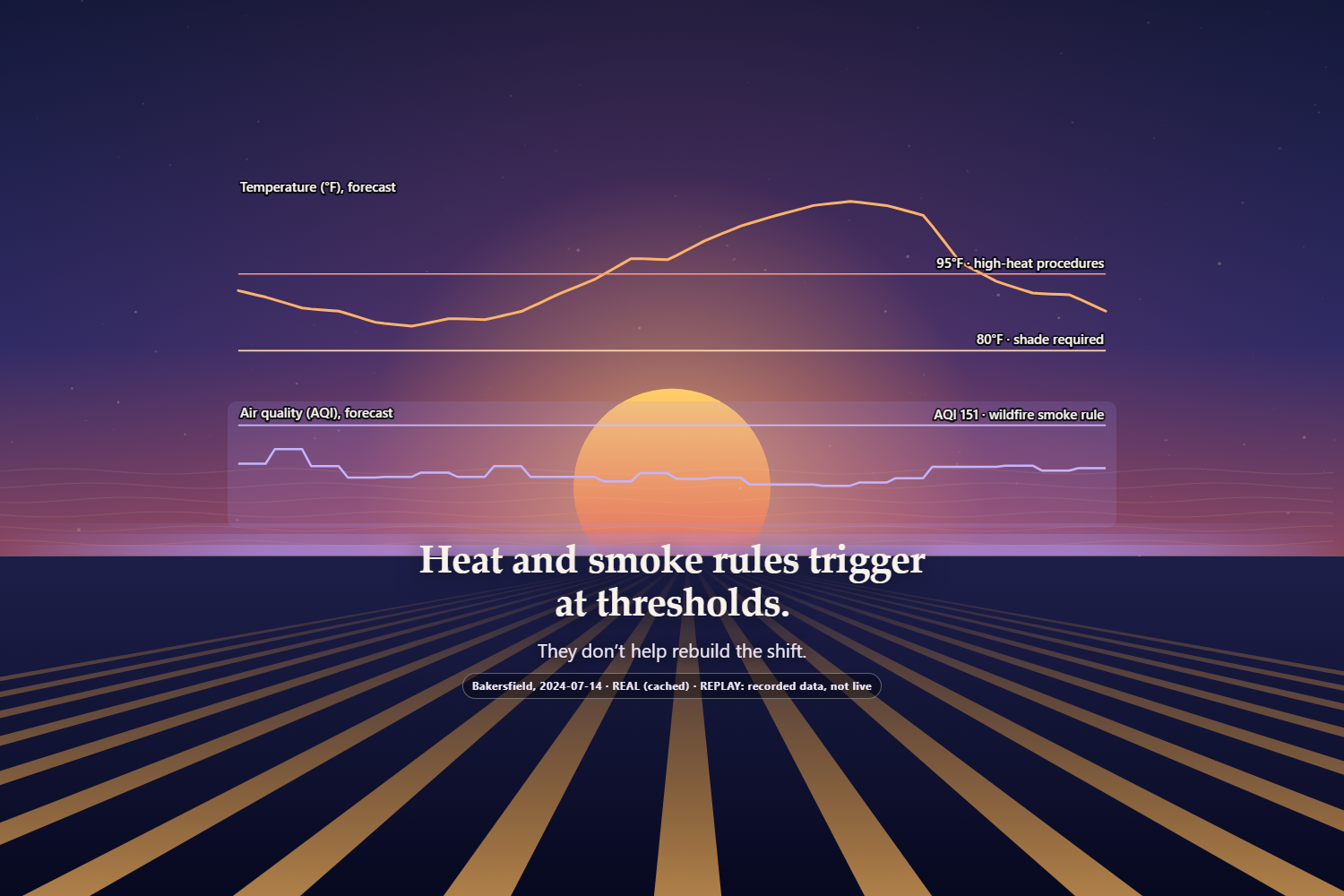
In a Central Valley summer, high heat and wildfire smoke can land on the same day, and a crew lead has to pick tomorrow's start time tonight. Cal/OSHA rules switch on at thresholds (80°F shade, 95°F high-heat procedures, AQI 151 for the wildfire smoke rule), but a threshold only tells you when you've crossed a line. It doesn't help you rebuild the shift. Madrugada is Spanish for the hours before dawn, and we wanted to know: does moving work earlier actually reduce time in the worst heat, and by how much?
What it does
Madrugada is a day briefing for crew leads, foremen and farm labor contractors:
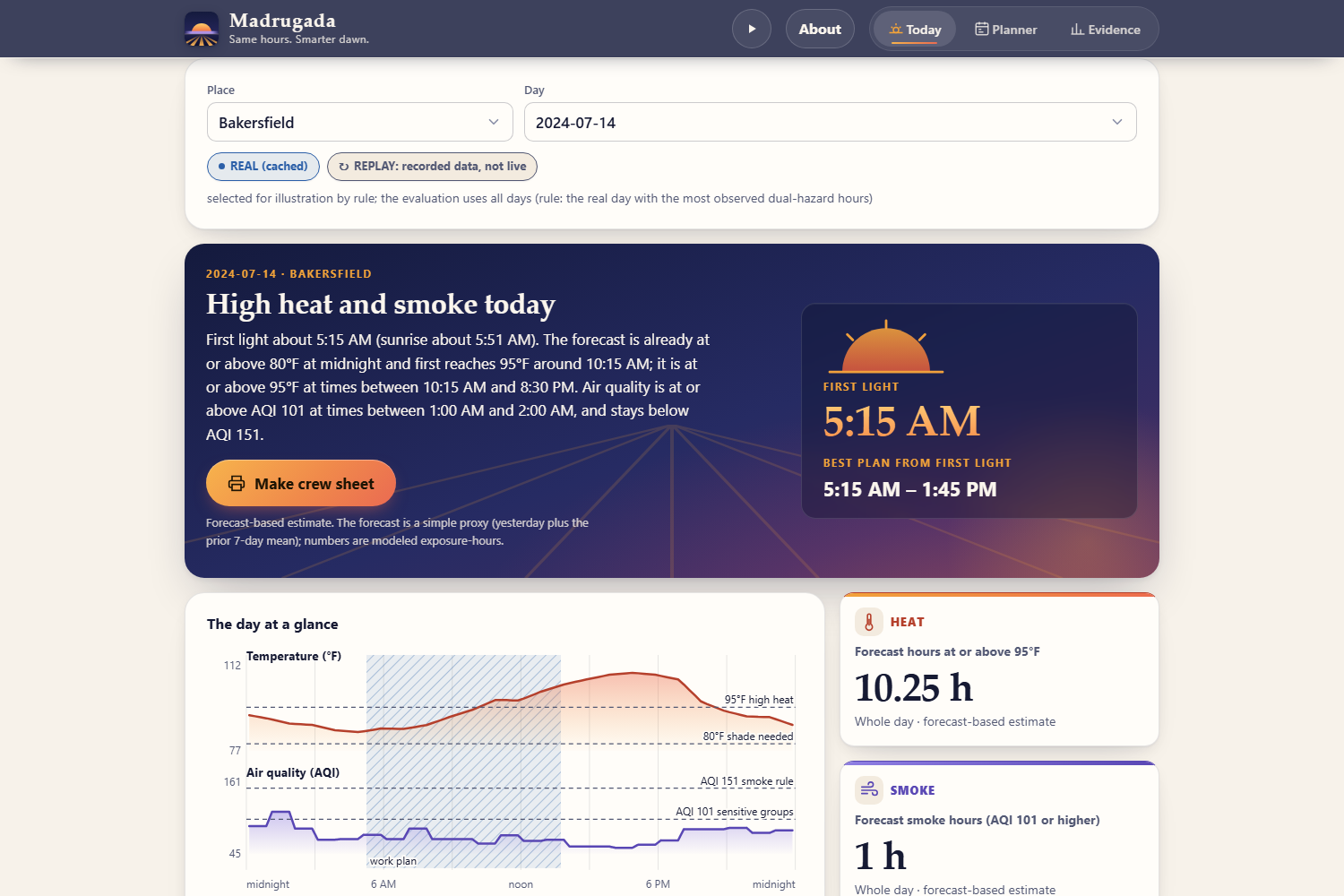
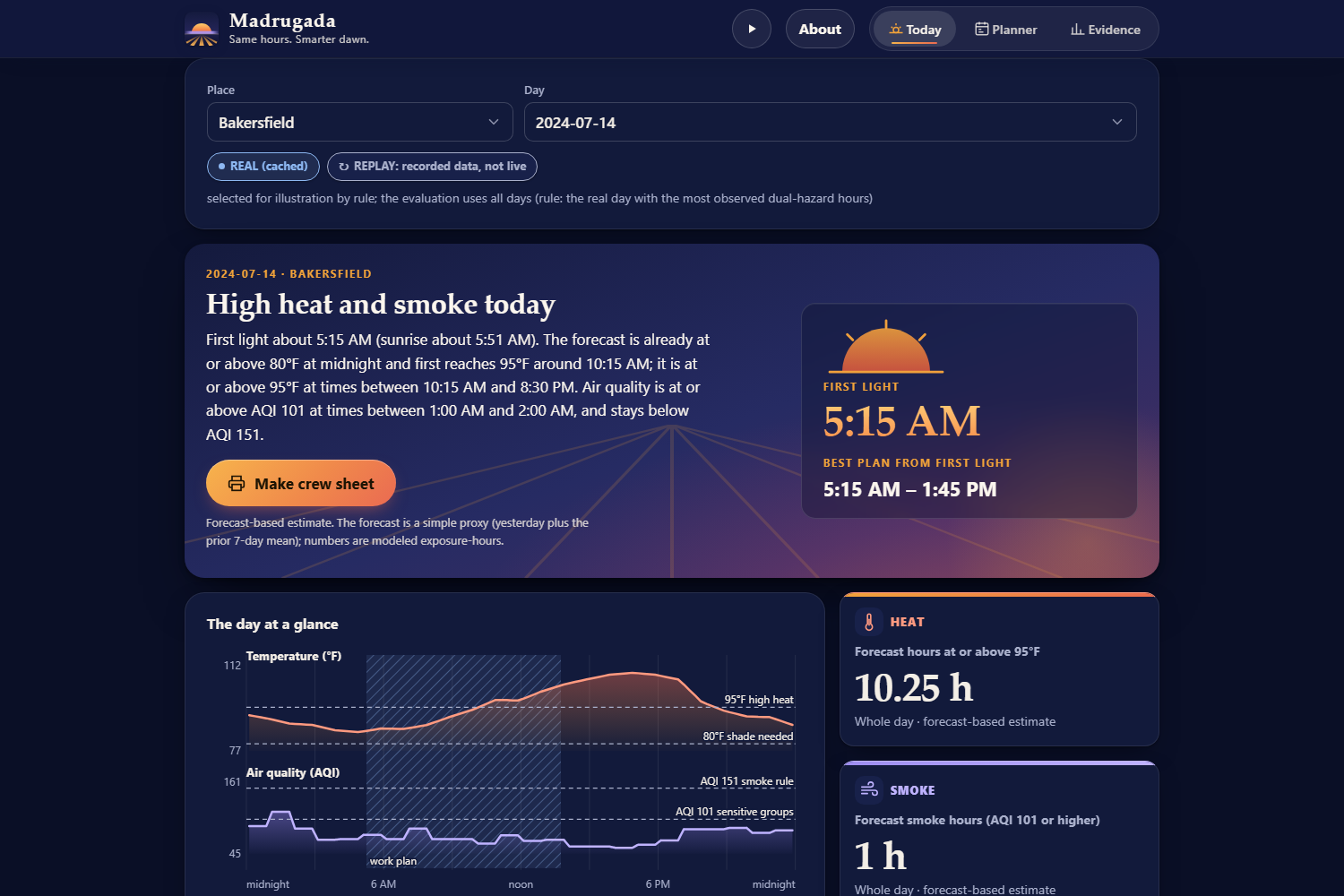
- Today: first light, the best work plan that starts no earlier than first light, and forecast temperature and air quality against the Cal/OSHA trigger lines, for a recorded real day (every day carries a REAL or SYNTHETIC badge, and a REPLAY label).
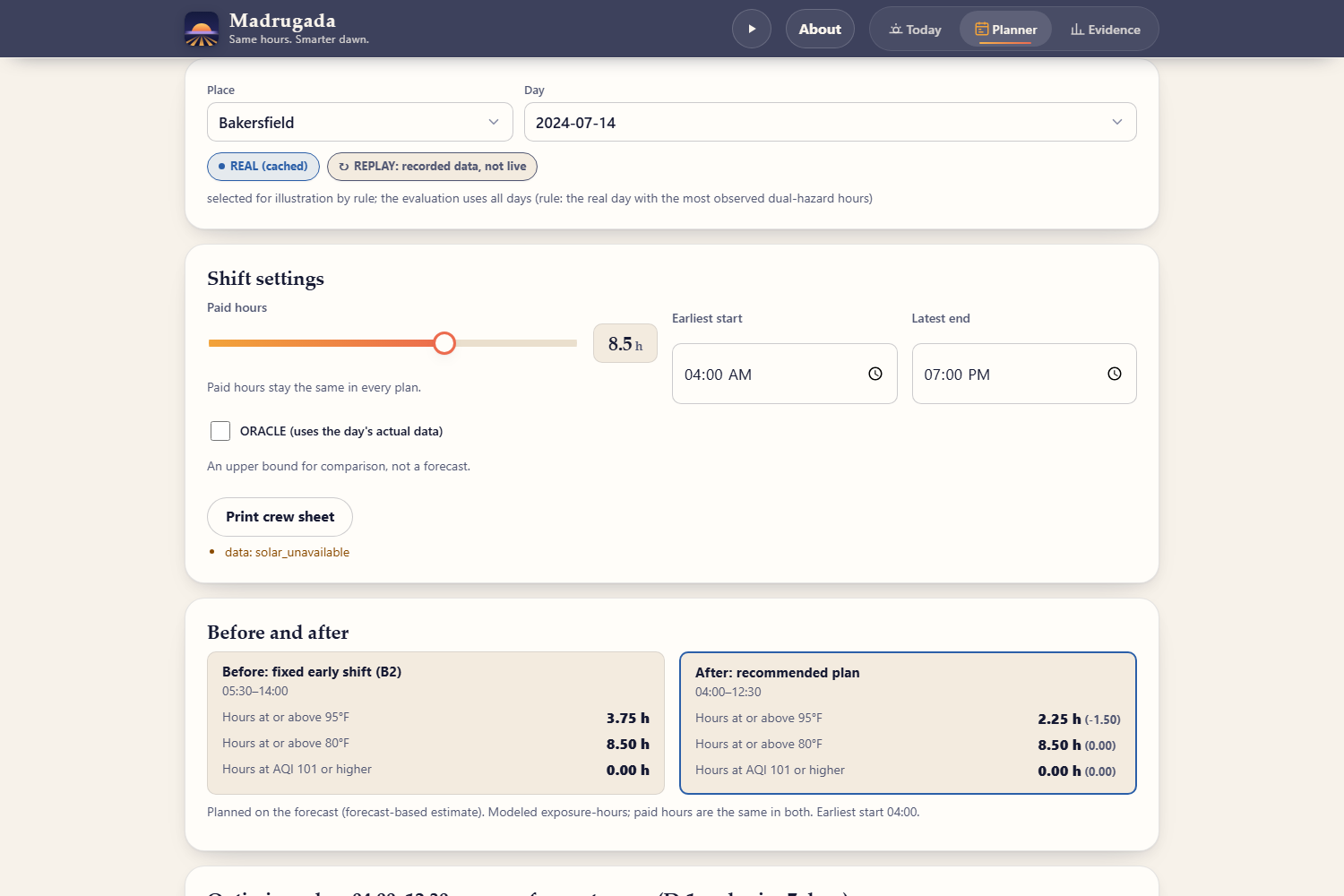
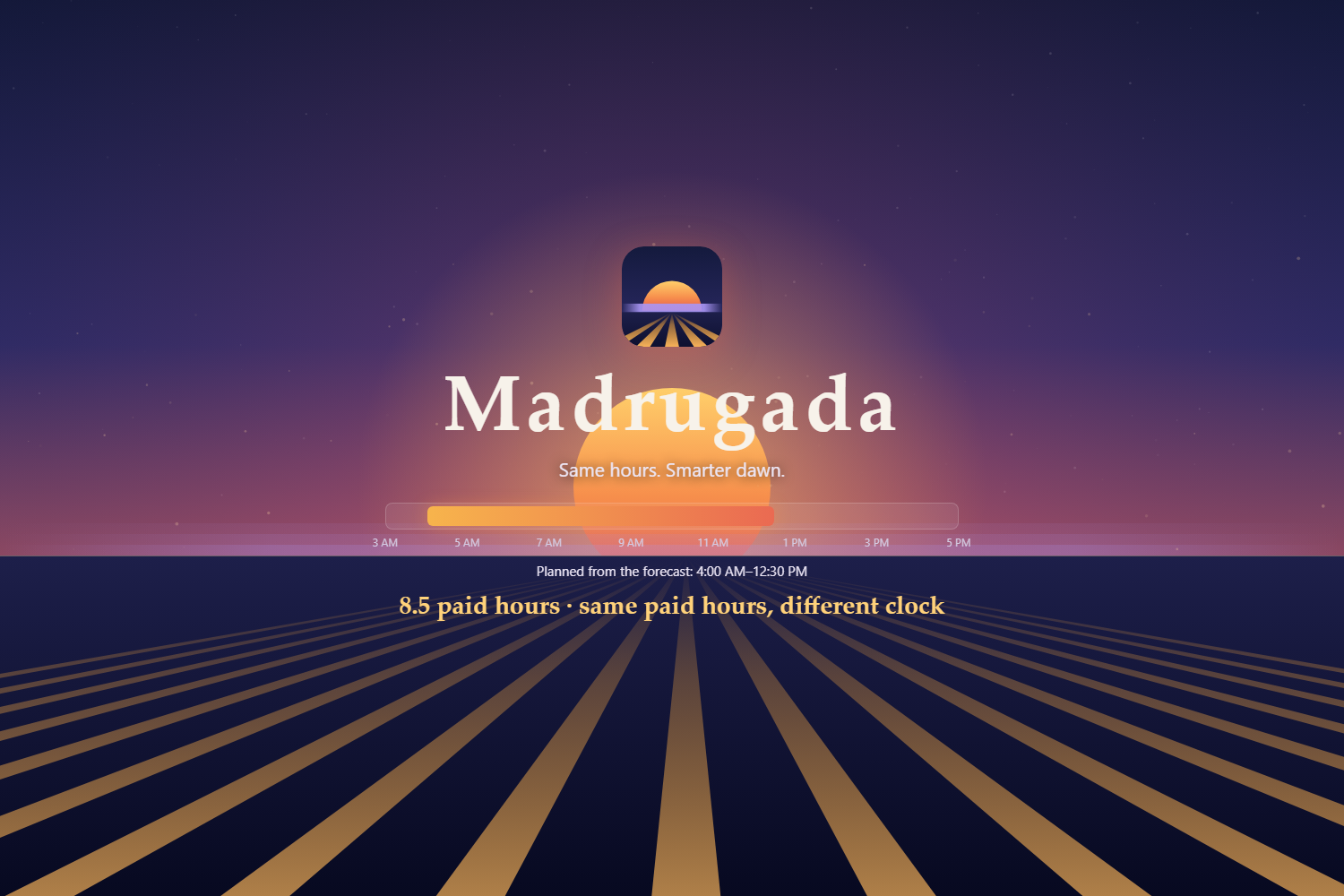
- Planner: paid hours are an input the tool holds constant. It compares our plan with a fixed 7:00 shift, a fixed 5:30 shift and a heat-only planner, in modeled exposure-hours.
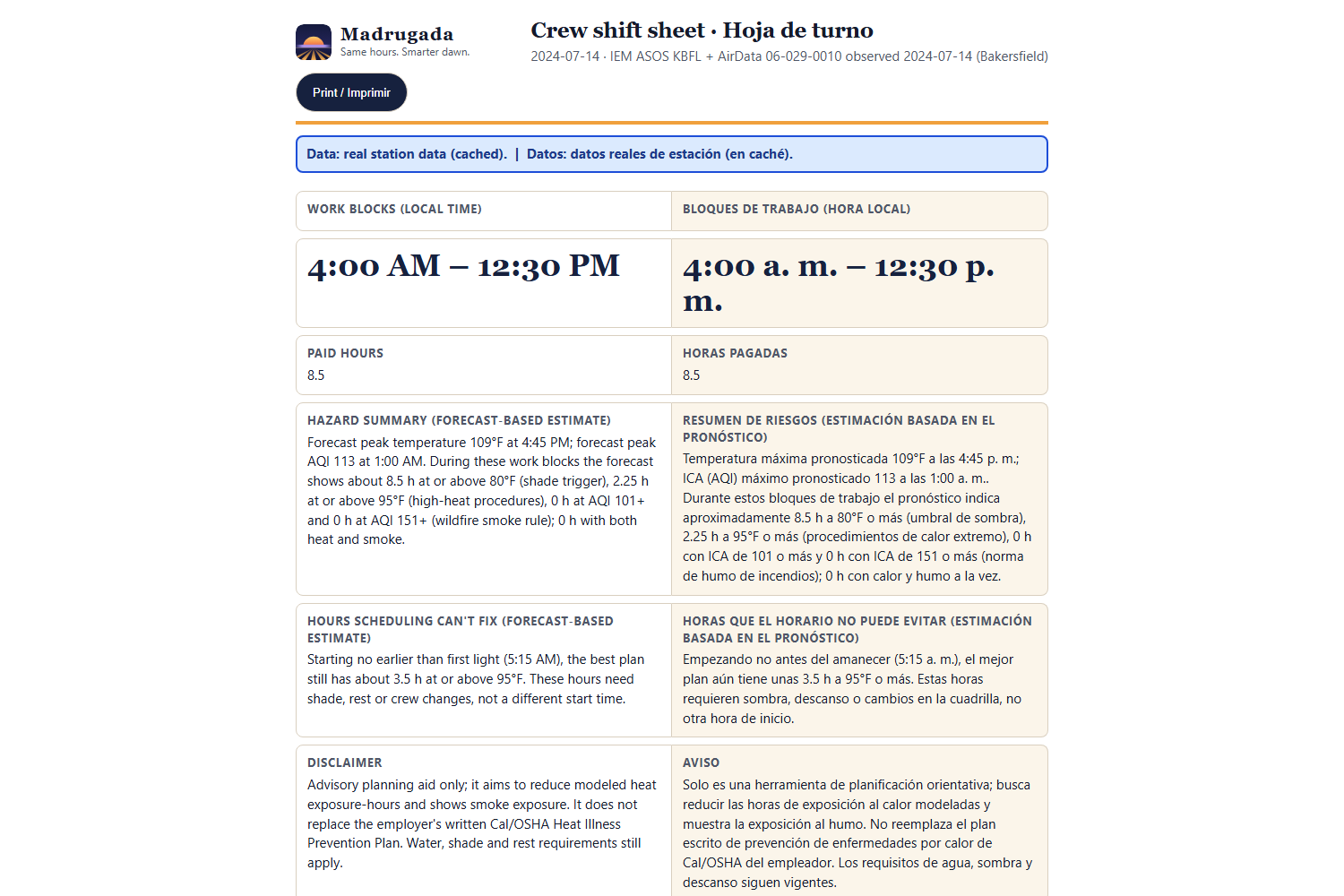
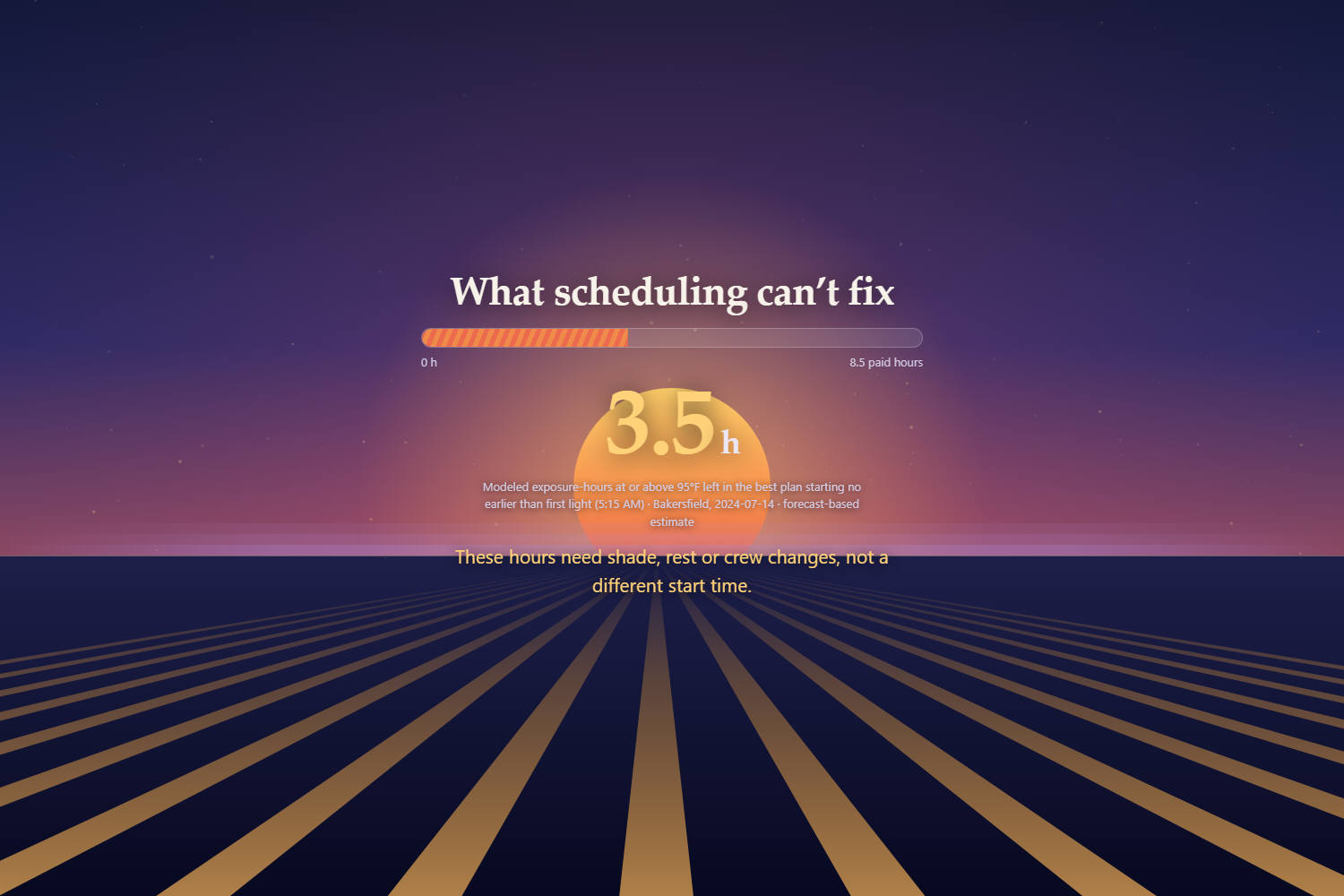
- The hours scheduling can't fix: the high-heat hours left even in the best plan from first light. On the default day that's 3.5 modeled hours at or above 95°F. Those hours need shade, rest or crew changes, not a different start time.
- Crew sheet: a one-page, English and Spanish printable sheet with the plan and that line.
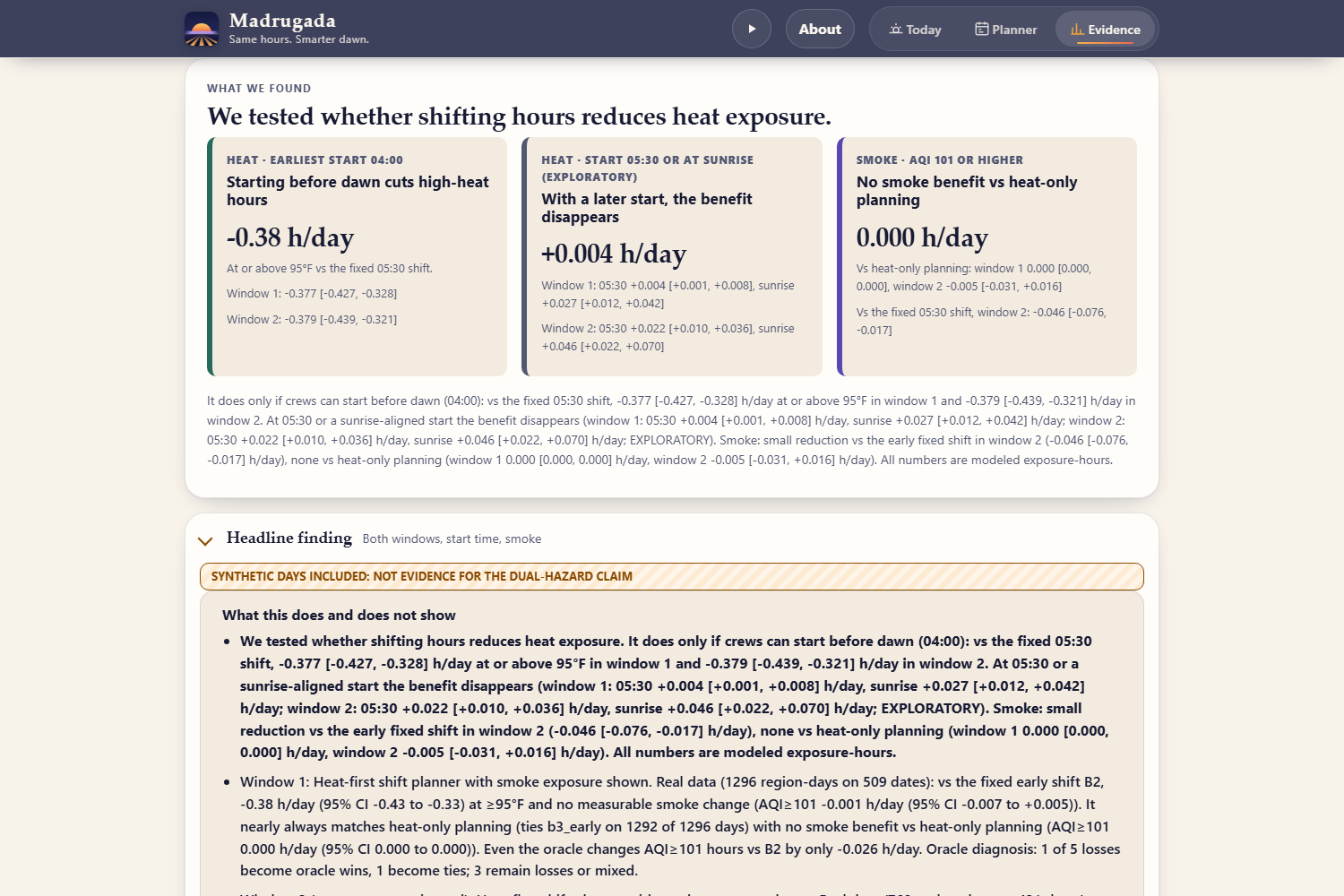
- Evidence: our preregistered results, each with its own confidence interval.
- A narrated opening sequence (with a presenter mode) tells the story with numbers read live from the result files.
It's an advisory aid in modeled exposure-hours. It isn't a compliance tool or a health prediction, it doesn't replace the employer's written Cal/OSHA Heat Illness Prevention Plan, and it tracks no individual workers.
How we built it
- Backend: Python, FastAPI and numpy. The day is a grid of 96 fifteen-minute slots. Each slot gets a cost from config-file thresholds:
$$ c_s = w_h\,h(T_s) + w_m\,m(\mathrm{AQI}_s) + w_d\,\mathbf{1}[\text{dual hazard}] $$
and the optimizer does an exhaustive search over every shift of one or two blocks using prefix sums. No solver and no machine learning, so every answer can be checked.
- Forecast without peeking: the plan for day \( D \) uses only earlier days, \( \hat{x}D = 0.5\,x{D-1} + 0.5\,\bar{x}_{D-7..D-1} \). An ORACLE mode that uses the day's own data is labeled as an upper bound everywhere.
- Real data, no API keys: IEM ASOS airport weather and EPA AirData PM2.5, converted to local clock time. PurpleAir readings can be corrected with the EPA US-wide formula \( 0.524\,\mathrm{PM}_{cf1} - 0.0862\,\mathrm{RH} + 5.75 \).
- Evaluation: two windows of real summers, 1,296 region-days (2022–2025) and 768 region-days (2018–2021). Each was preregistered with SHA-256 hashes of the code and config before it ran. Confidence intervals use a bootstrap that resamples whole dates, and the two windows are never pooled.
- Frontend: one offline HTML file with vanilla JavaScript, inline SVG charts and a canvas opening sequence. It has light and dark themes, works from phone to desktop, and needs no build step or CDN.
- Guardrails: 184 automated tests, including a claims audit that fails the build if our own text overclaims.
Challenges we ran into
- The data said no on smoke. We started out building a dual heat-and-smoke optimizer. On real data it showed no smoke benefit over heat-only planning, so we repositioned it as a heat-first planner that shows smoke, and said so.
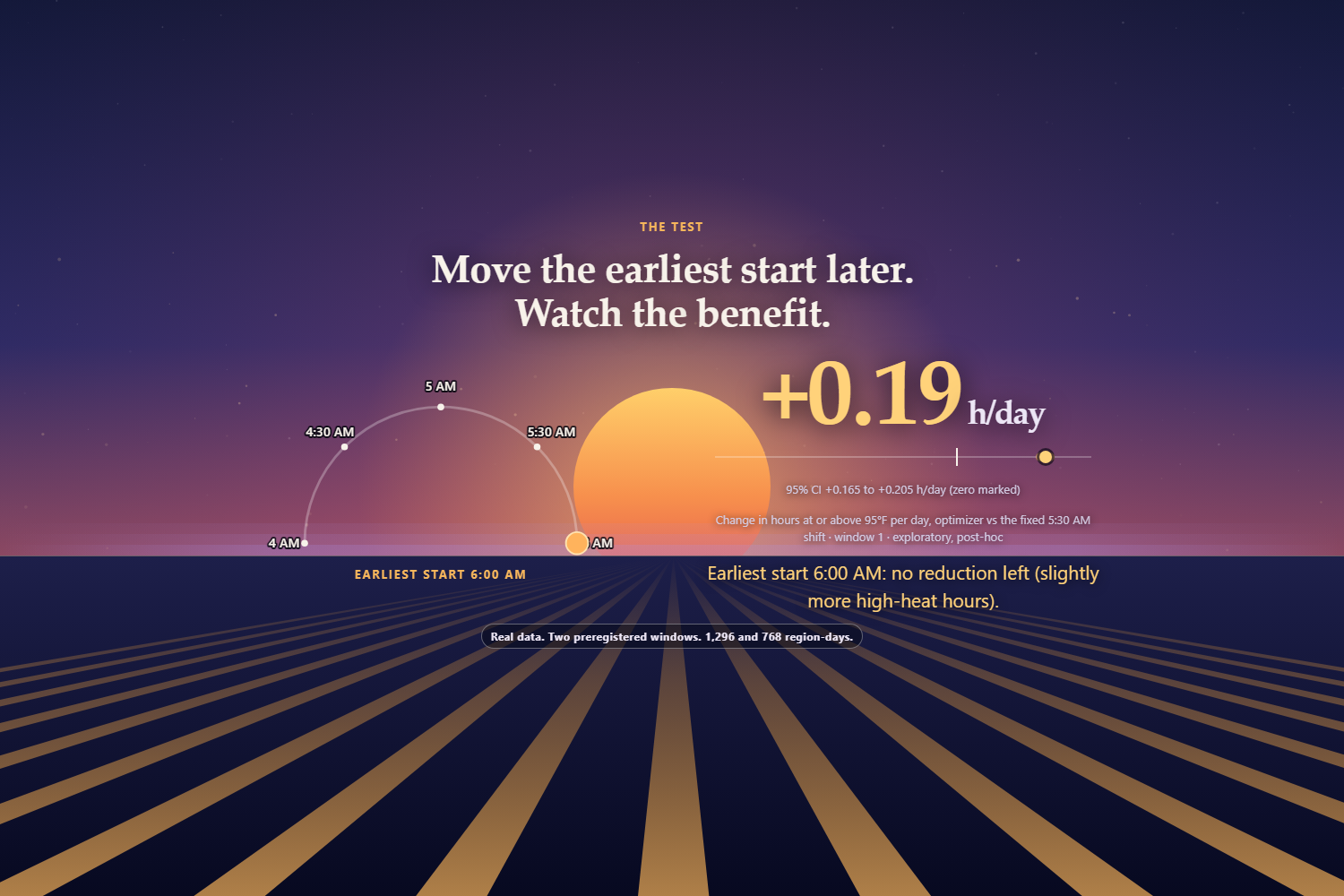
- The benefit depends on the start time. With a 4:00 AM earliest start, modeled hours at or above 95°F fell by 0.38 h/day versus a fixed 5:30 shift (window 1 CI −0.43 to −0.33; window 2 −0.38, CI −0.44 to −0.32). With a 5:30 earliest start it disappears (window 1 +0.004 h/day, CI +0.001 to +0.008). That changed the product: it now leads with the hours scheduling can't fix.
- Getting real data without keys: time zones and daylight time, monitors several kilometres from the weather stations, and missing days.
- Honesty under time pressure: we kept every number tied to a result file and wrote a test that blocks words like "guarantees".
Accomplishments that we're proud of
- Two preregistered real-data evaluations, with the result replicated in both windows.
- An honest product turn: the main readout is what scheduling can't fix.
- A polished offline app with a bilingual crew sheet and a narrated opening sequence.
- 184 passing tests, and every number on screen read from the results at runtime.
What we learned
Write the evaluation rules down before you look at the results. A negative result can make a better product. And region-days on the same date aren't independent, so the confidence intervals have to resample dates.
What's next for Madrugada
- A native-speaker review of the Spanish crew sheet.
- A week of use with real crew leads, and their input on breaks, travel and piece rates.
- Field sensors instead of airport weather.
Built during SierraHacks 2026. Weather data: Iowa Environmental Mesonet (IEM ASOS). PM2.5: U.S. EPA AirData. PurpleAir correction: Barkjohn et al. 2021 (EPA). Code written with help from Claude Code (AI coding assistant).


Log in or sign up for Devpost to join the conversation.