-
-
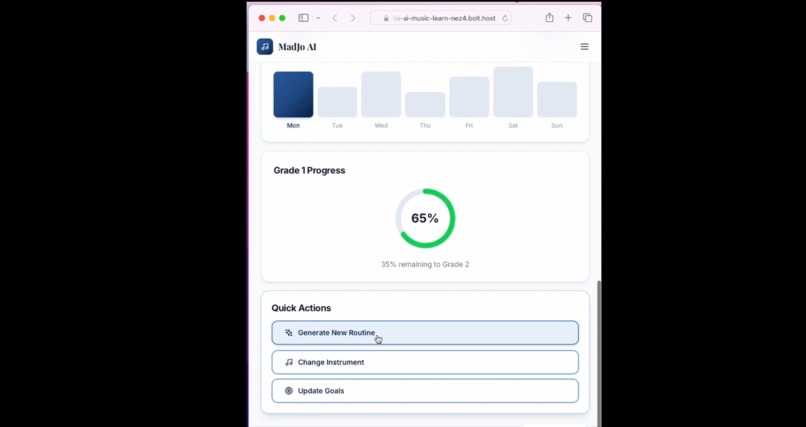
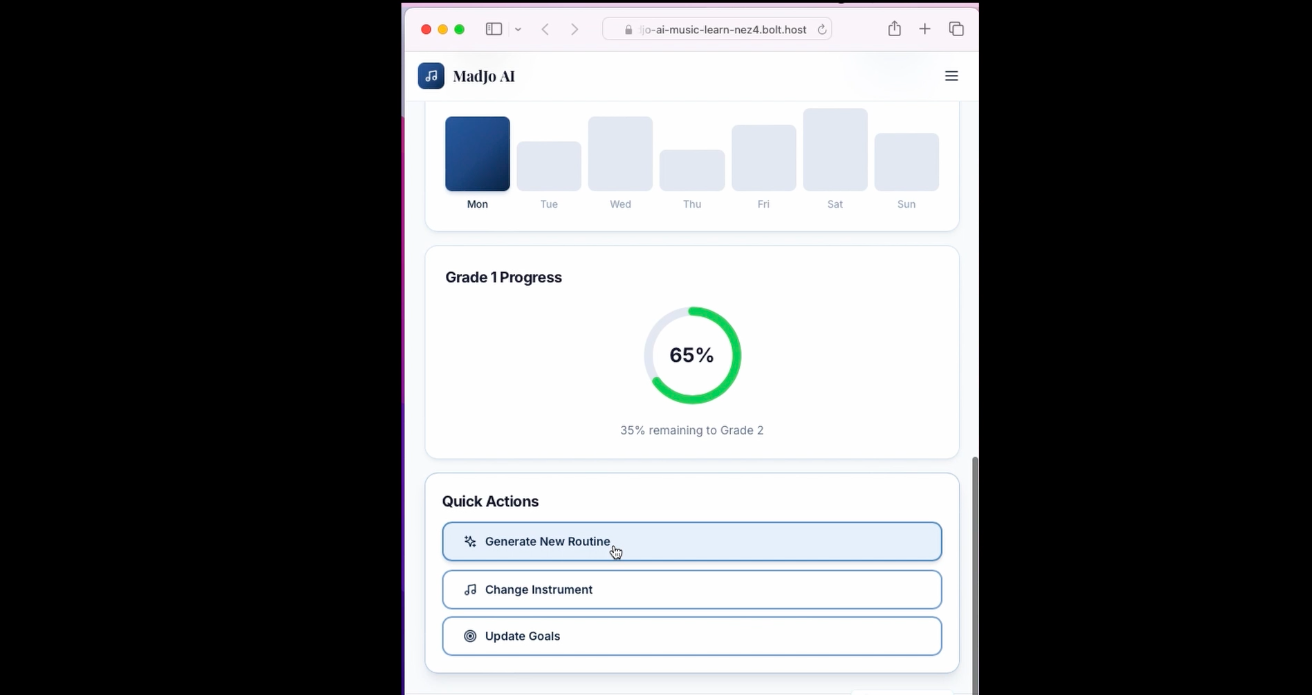
Generate New / Change Instrument/ Update Goals
-
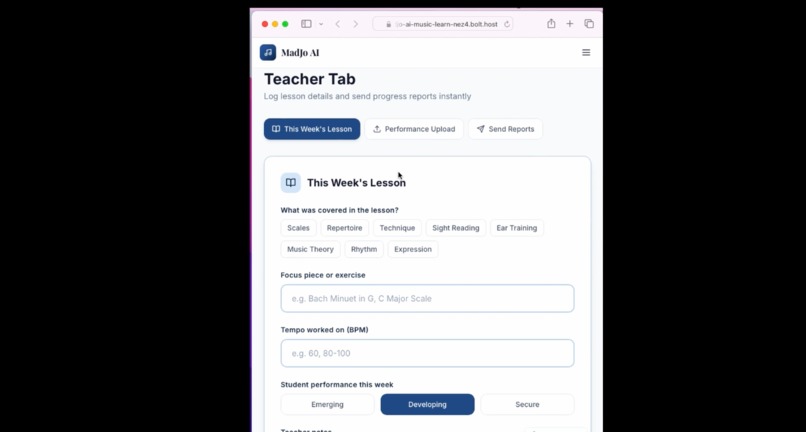
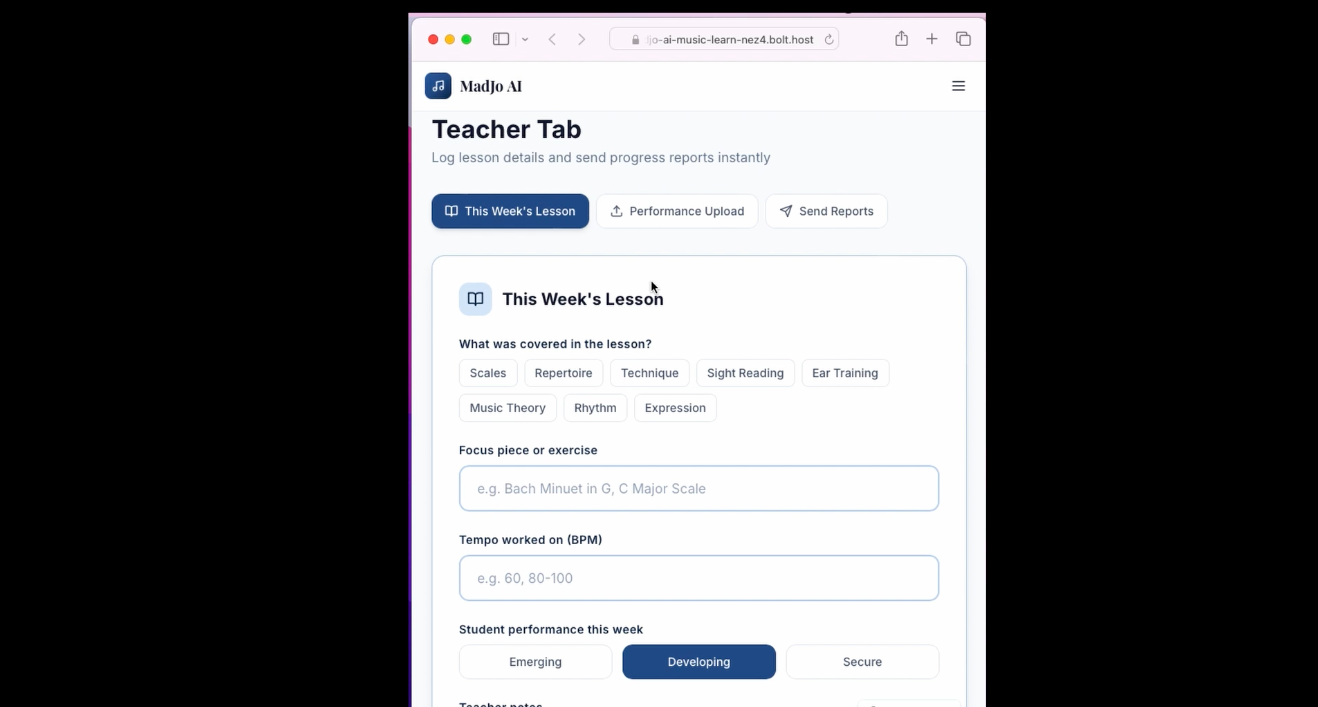
Teacher Tab
-
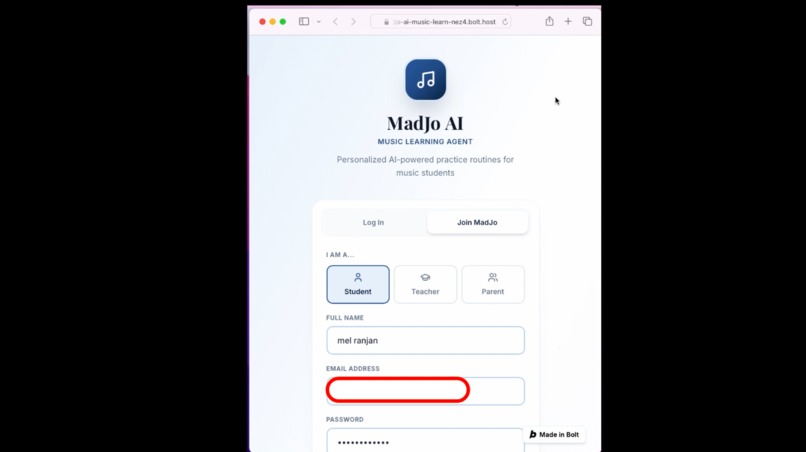
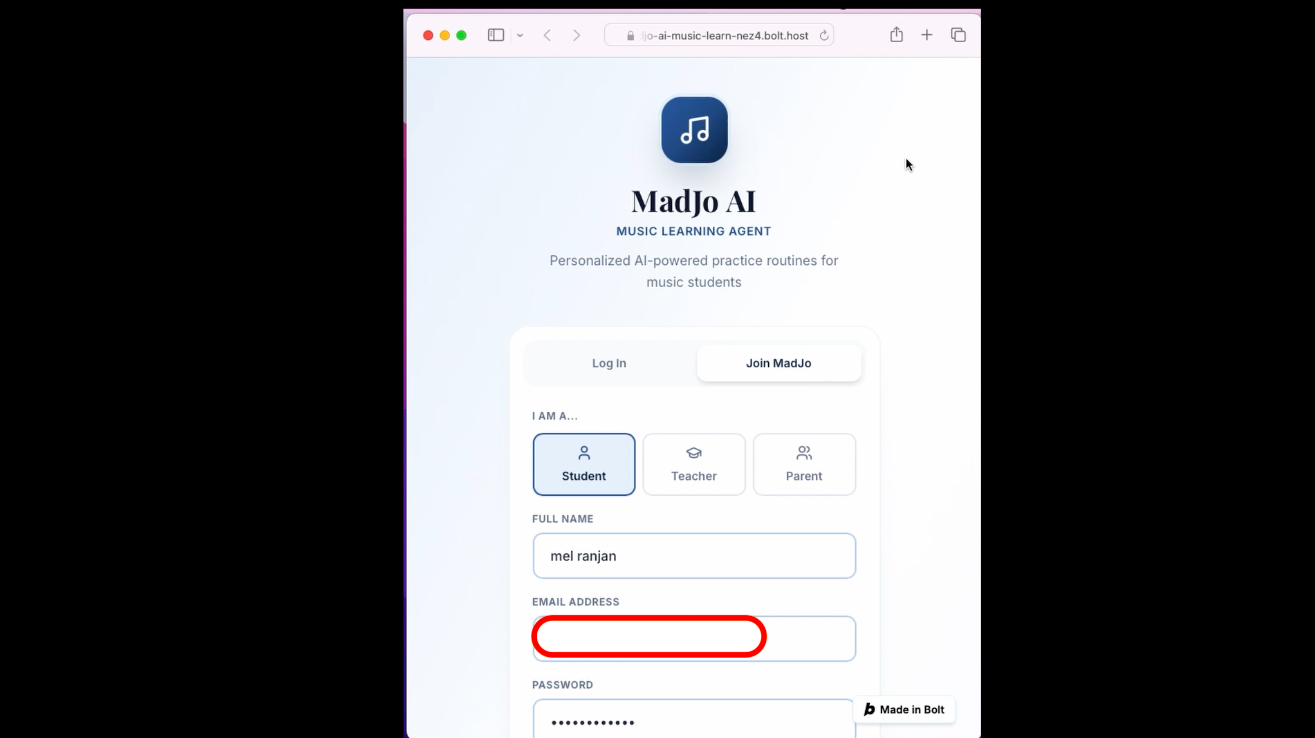
Login Page
-
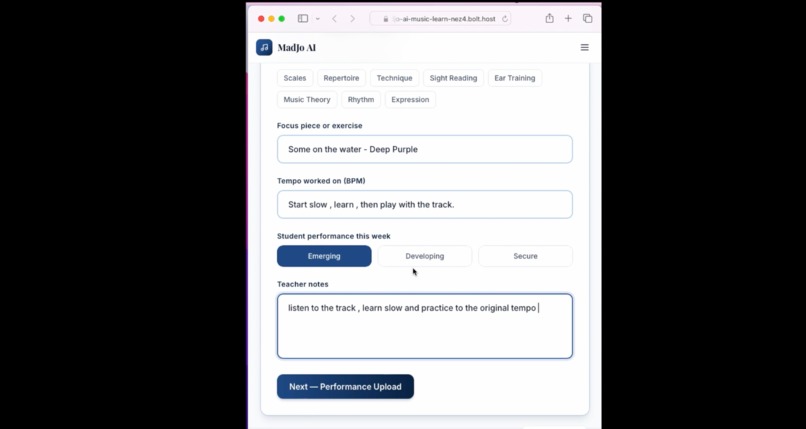
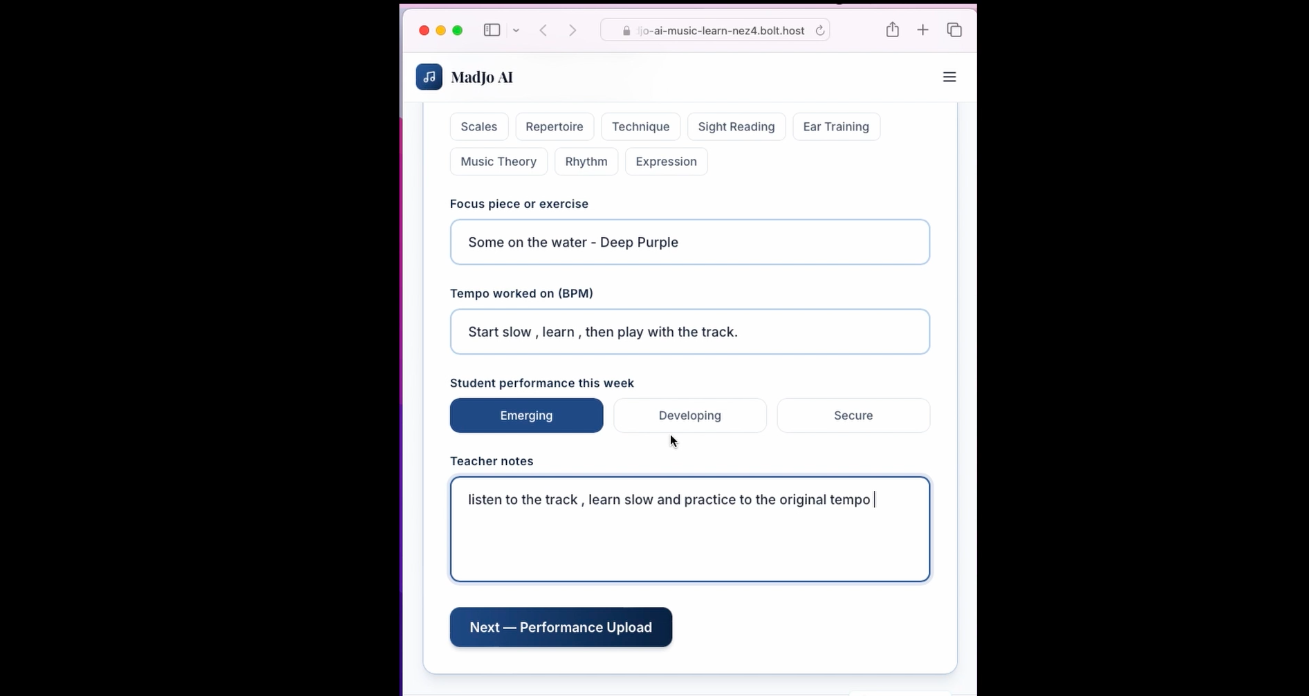
Teacher Tab - Covered Lesson / Focus Piece or EXE/ Tempo / Performance Feedback
-
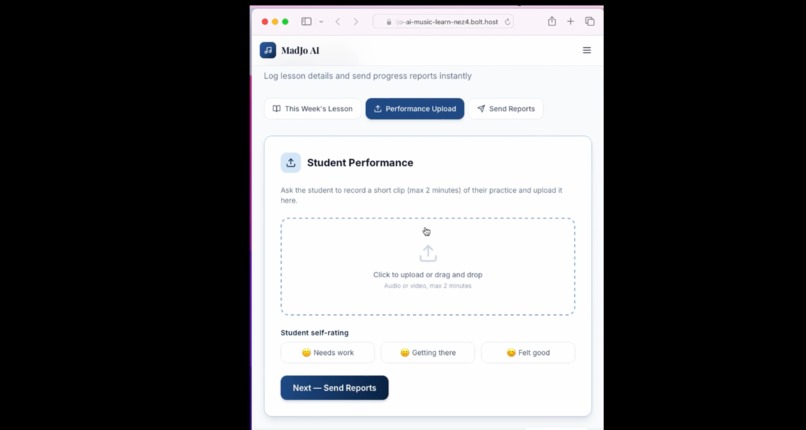
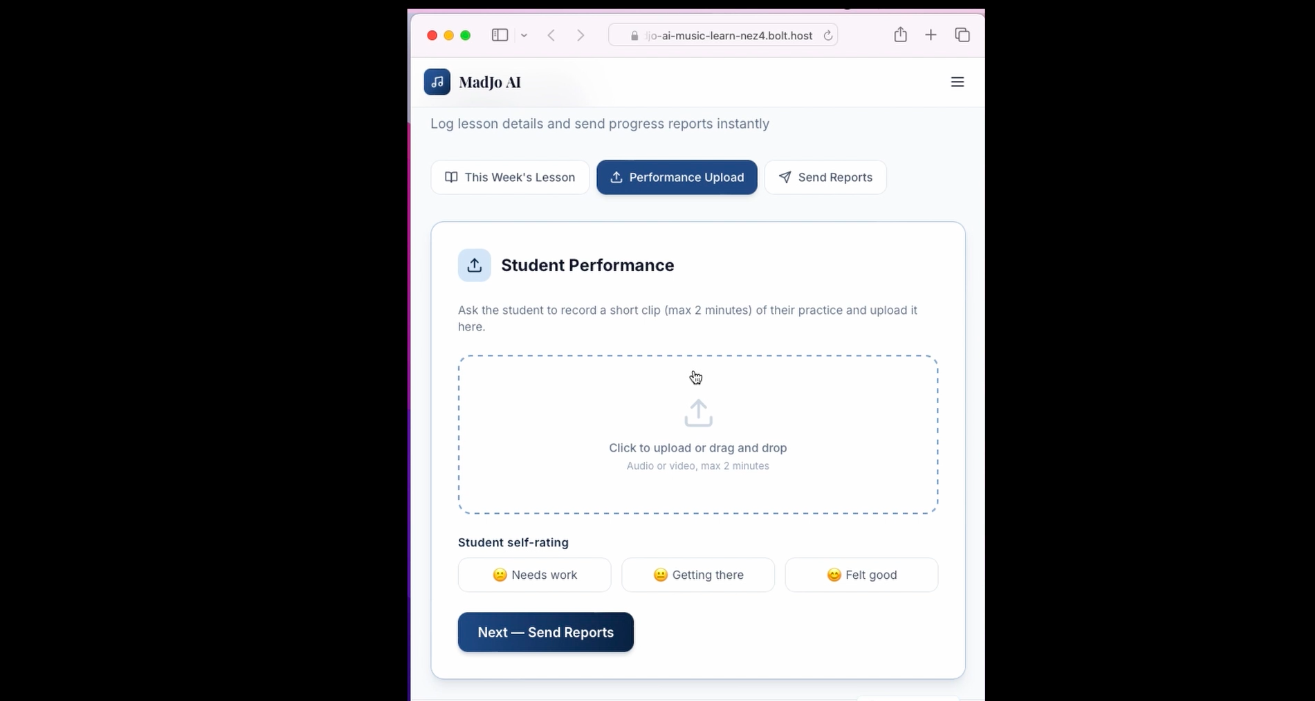
Teacher Tab - Students Performance Upload
-
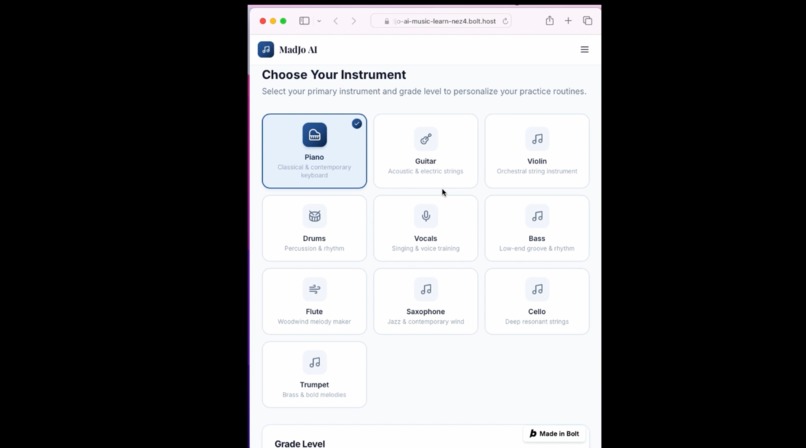
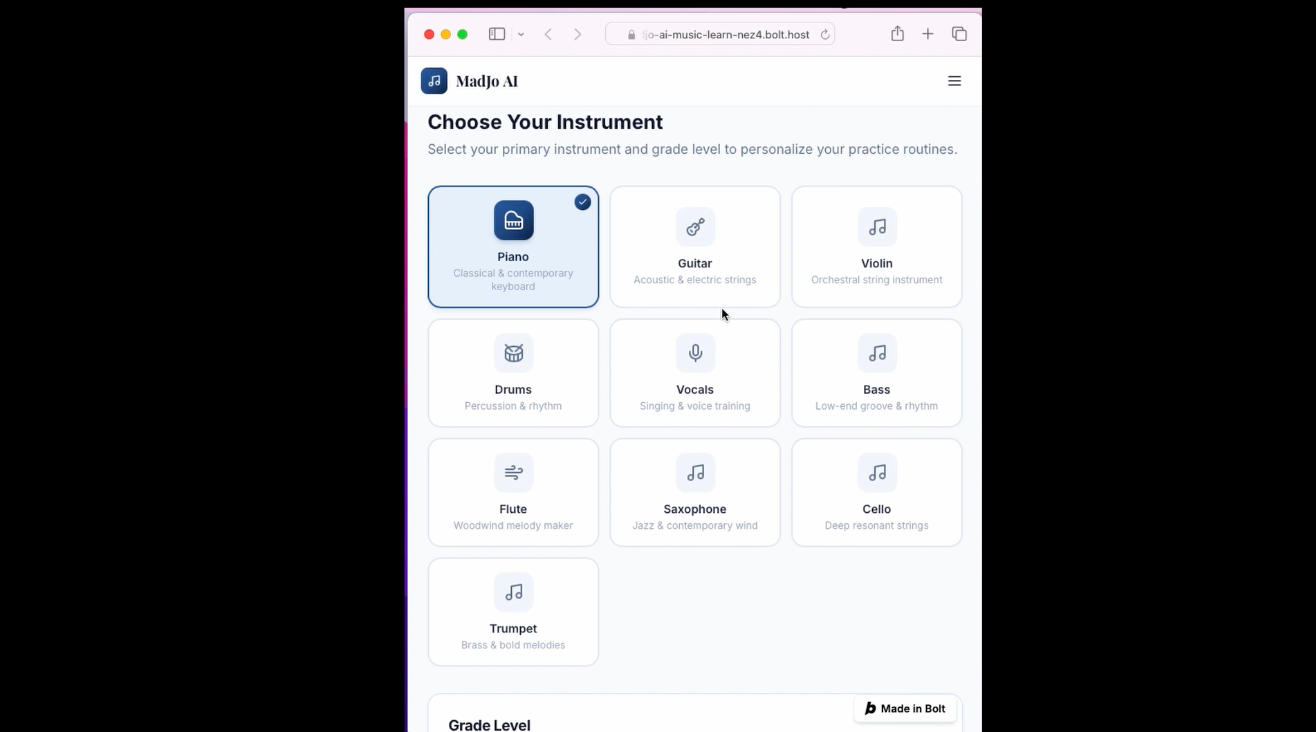
Choose Your Instrument
-
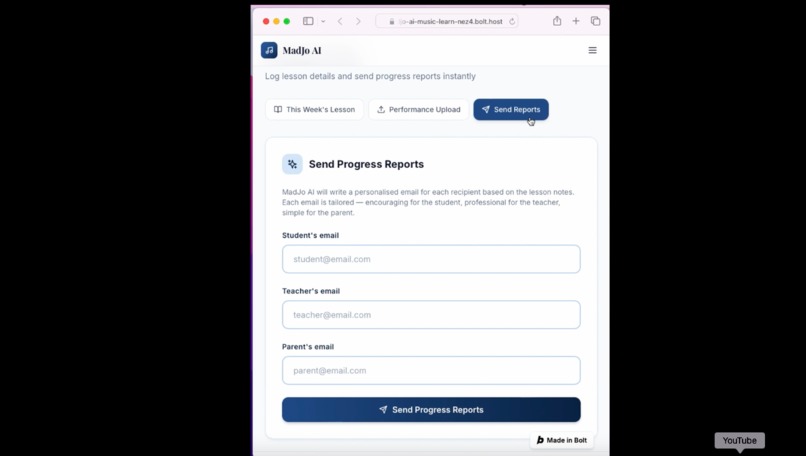
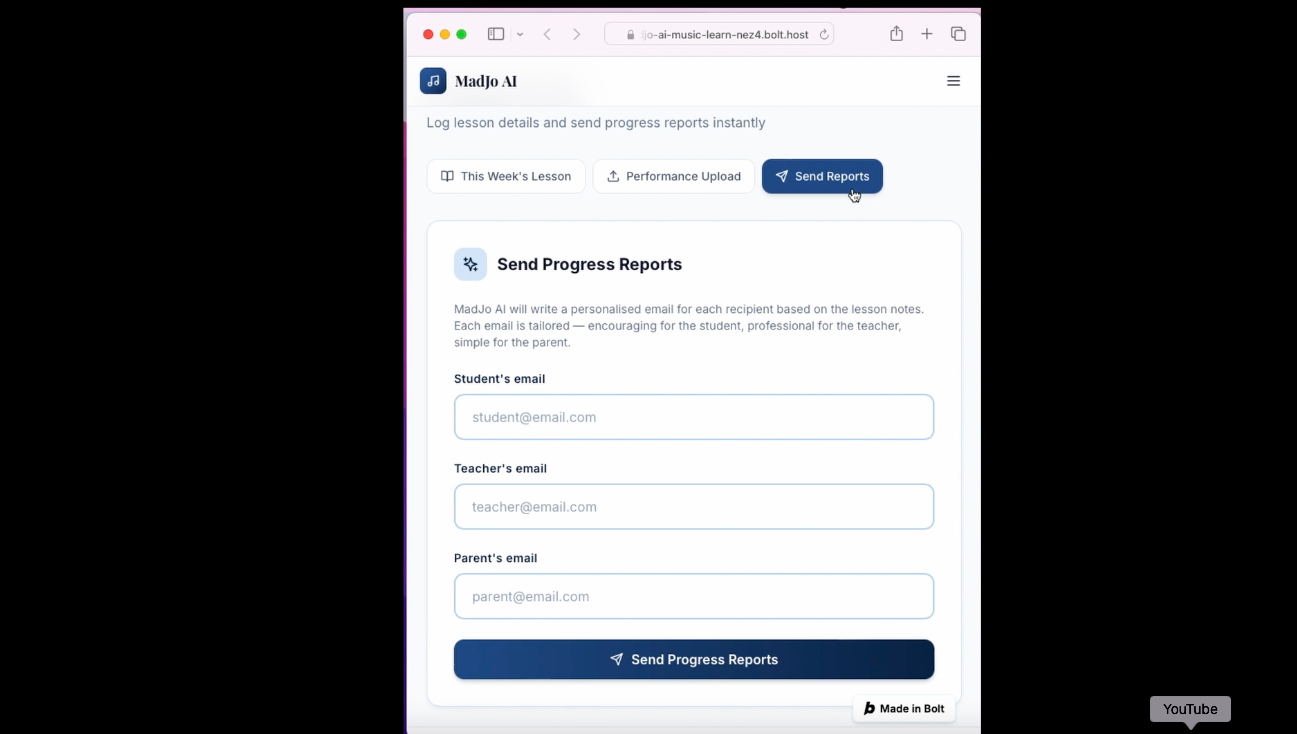
Teacher Tab - Send PRogress Report
-
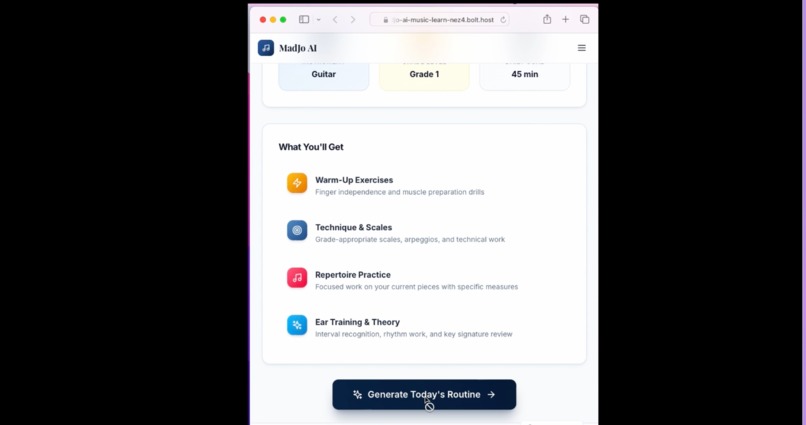
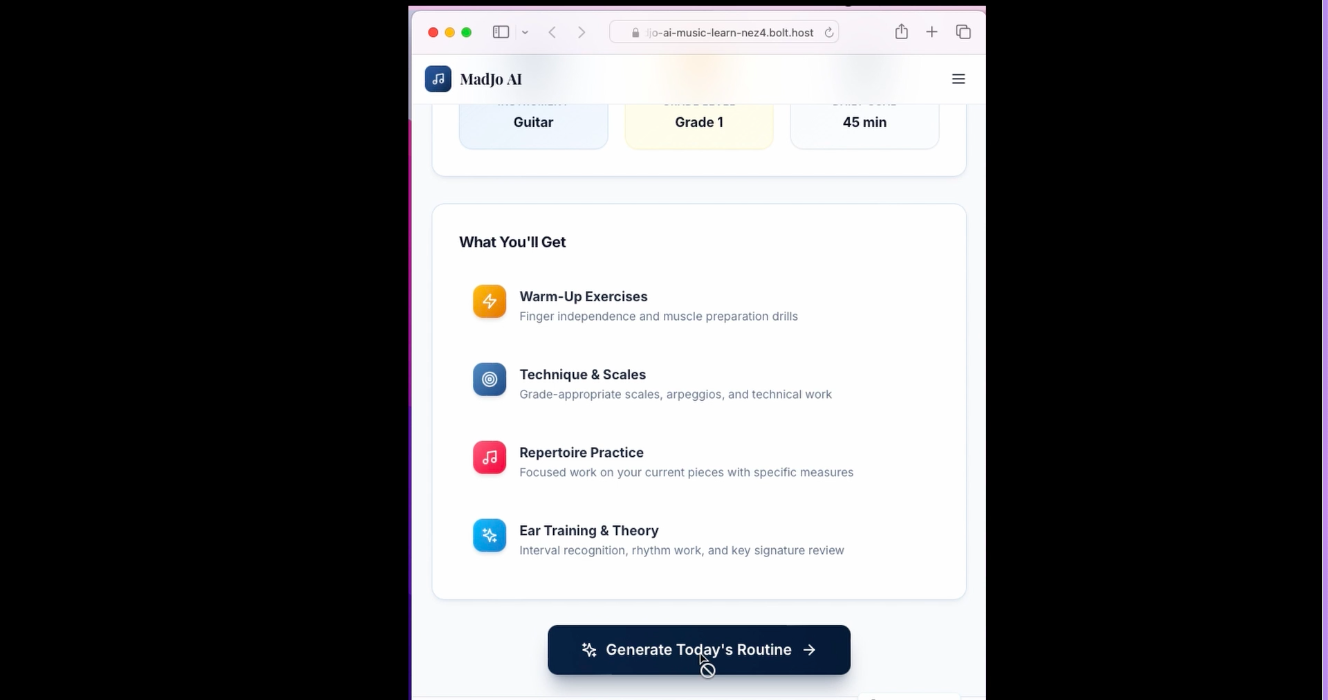
Generate Todays Routine
-
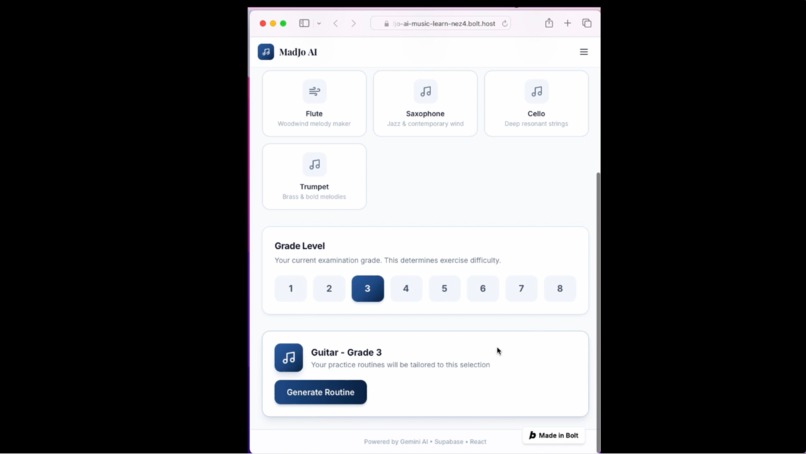
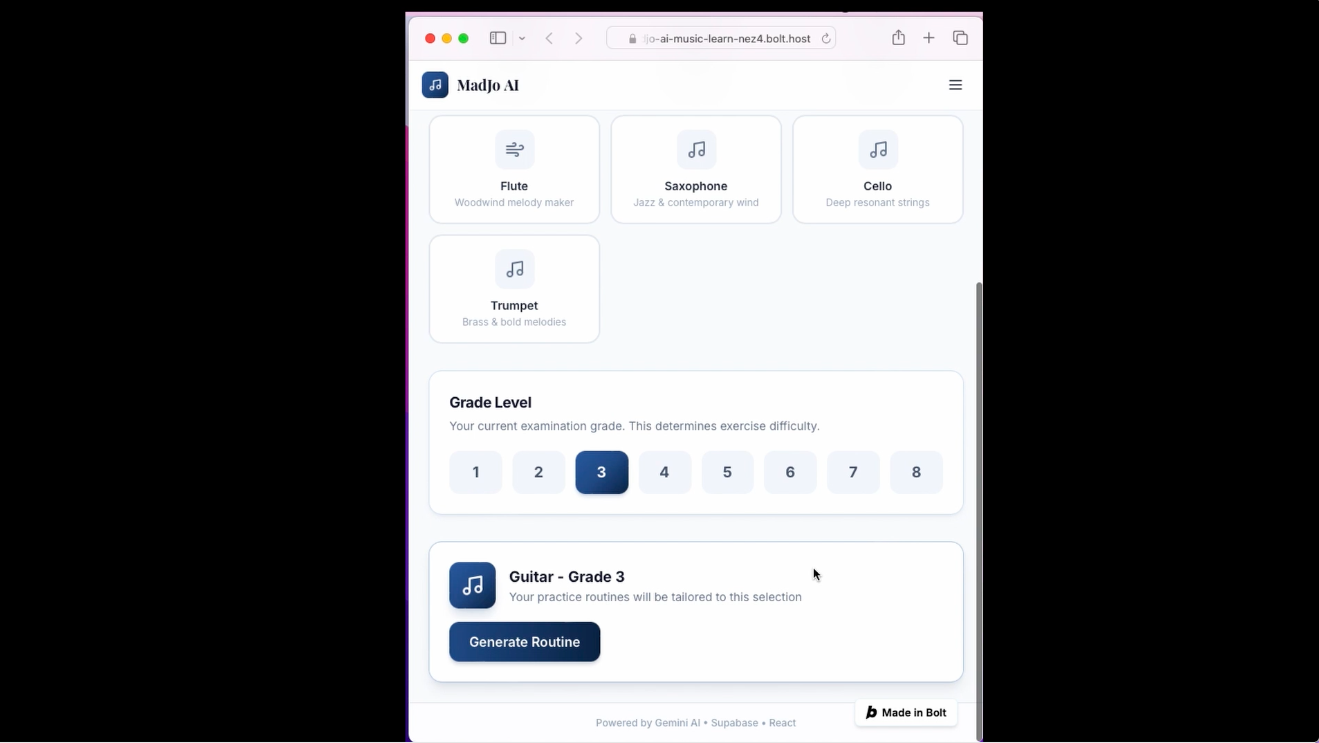
Choose Your Instrument - Grade
-
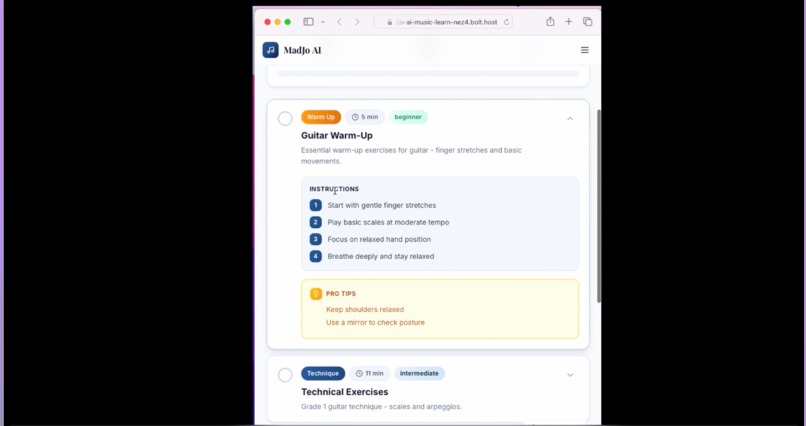
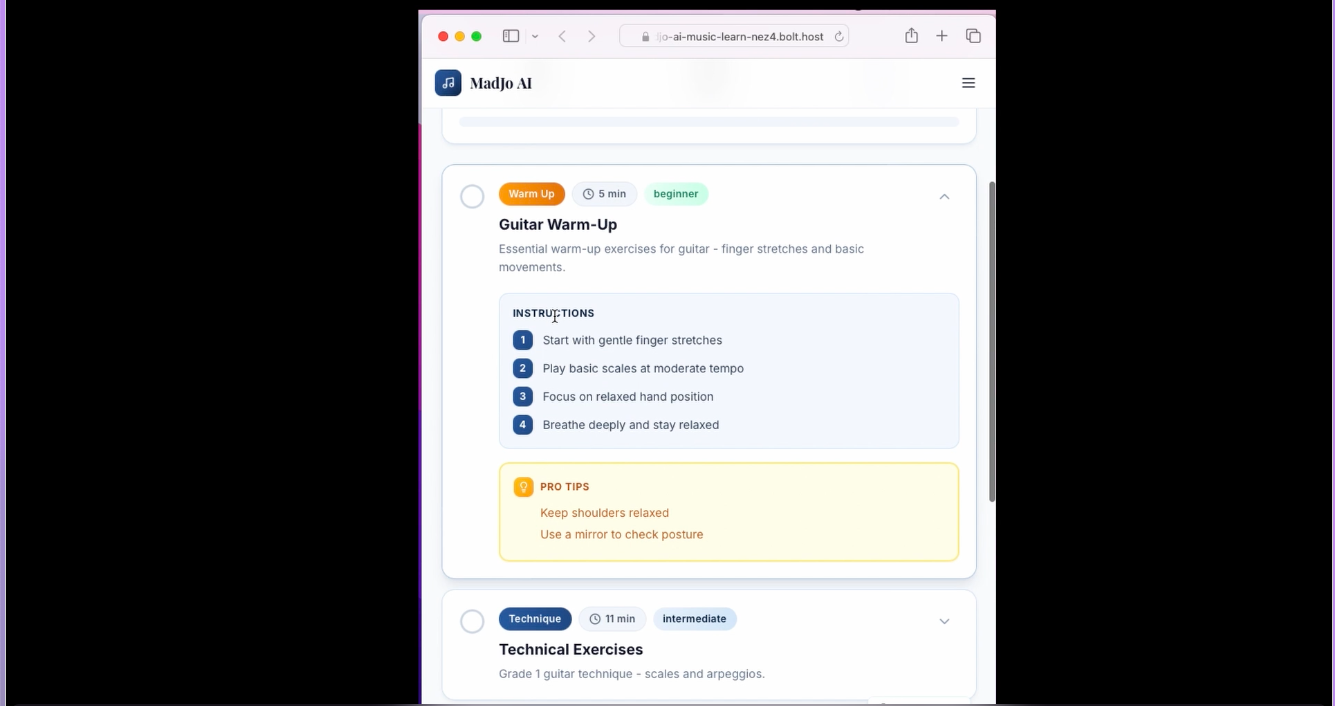
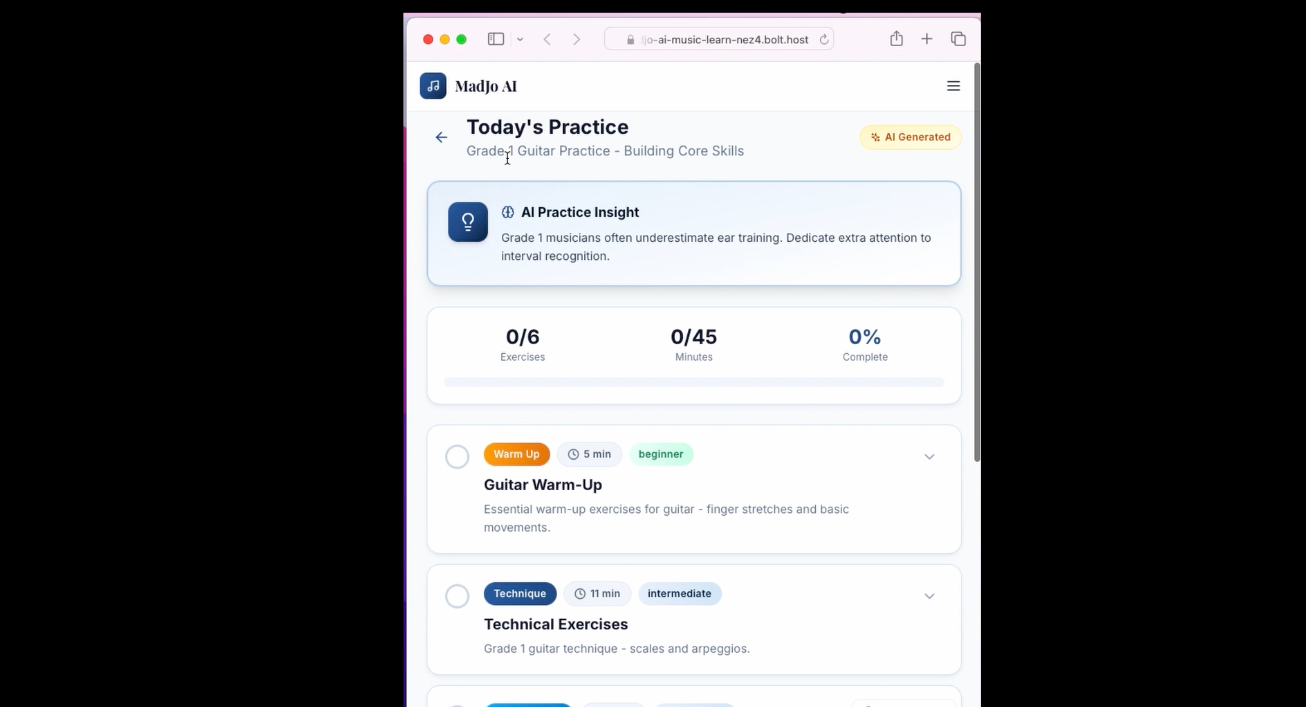
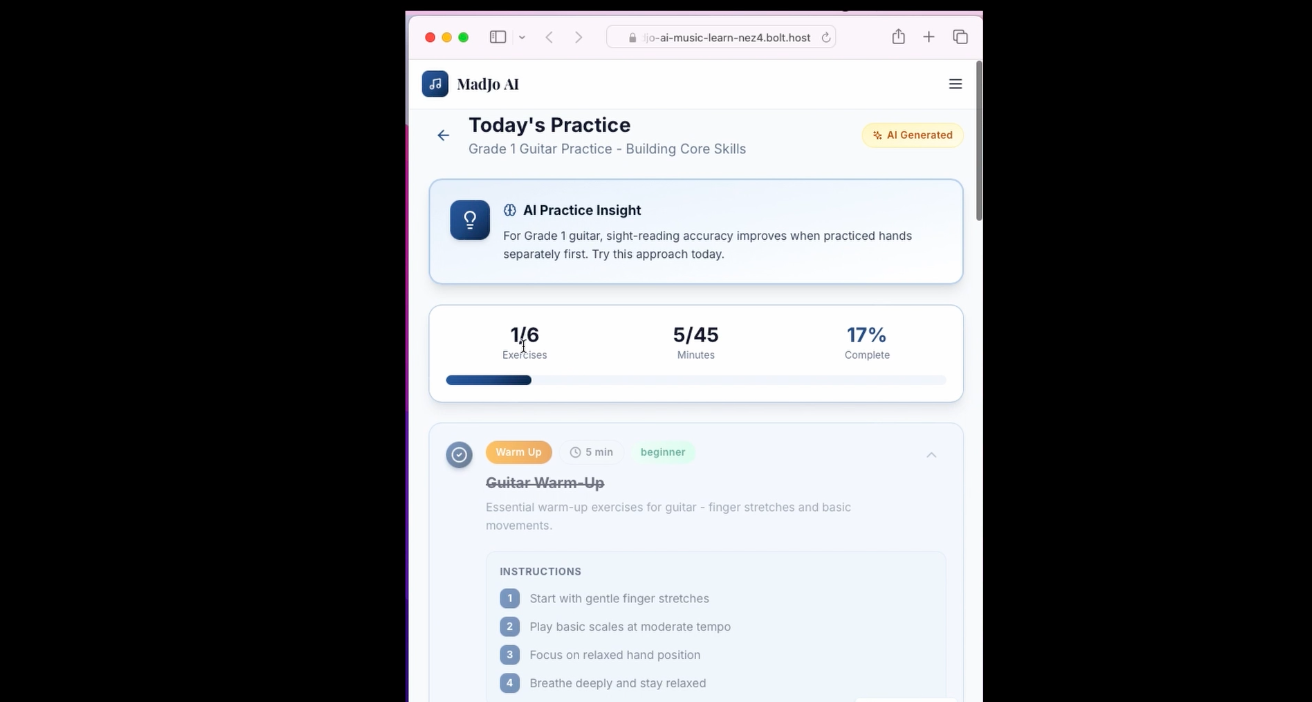
Todays Practice - Ecercise 1
-
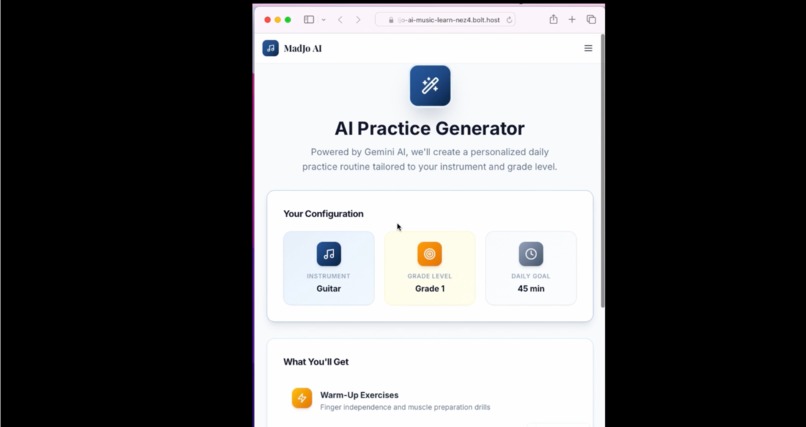
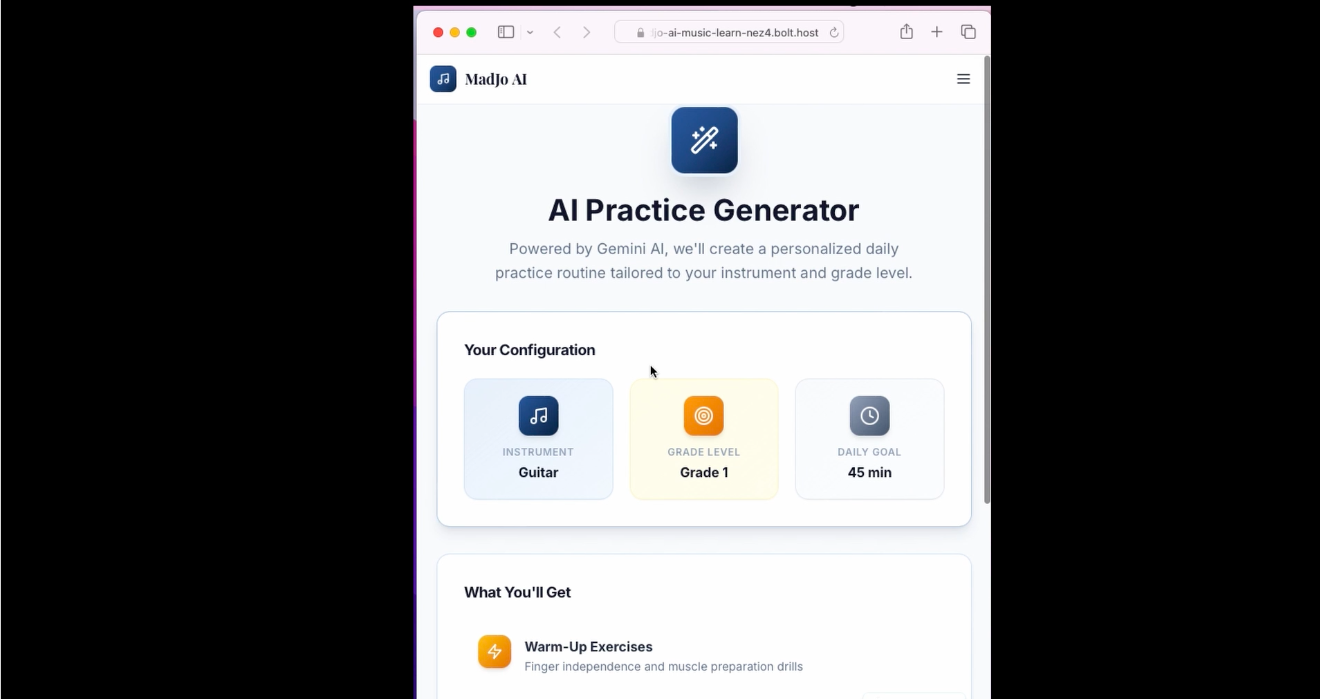
AI Practice Generator
-
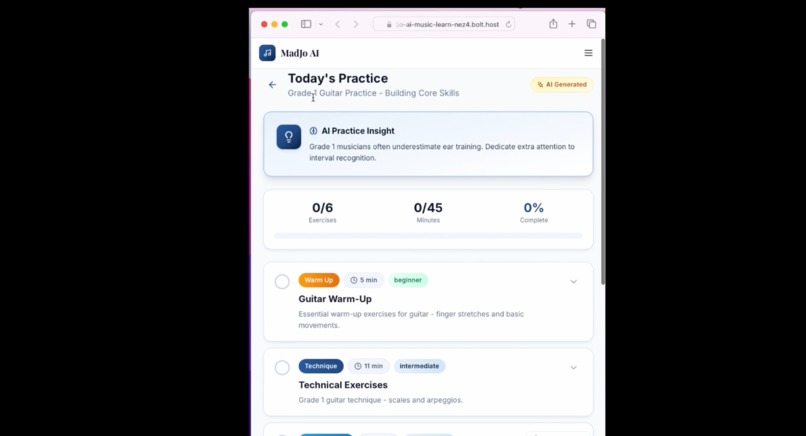
Todays Practice
-
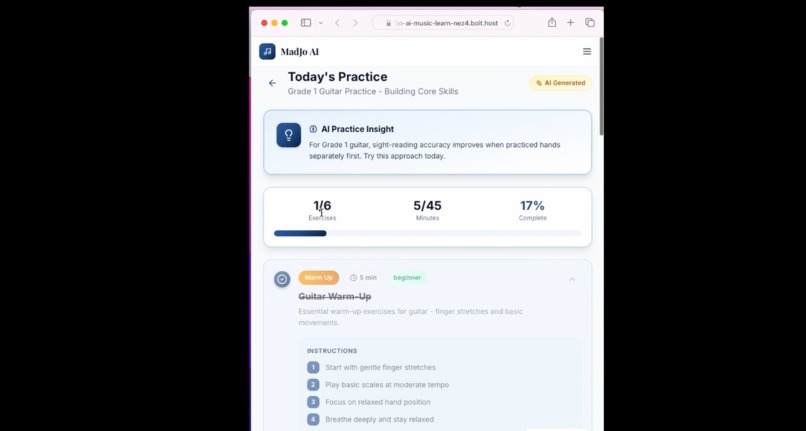
Todays Practice - Practice Update
-
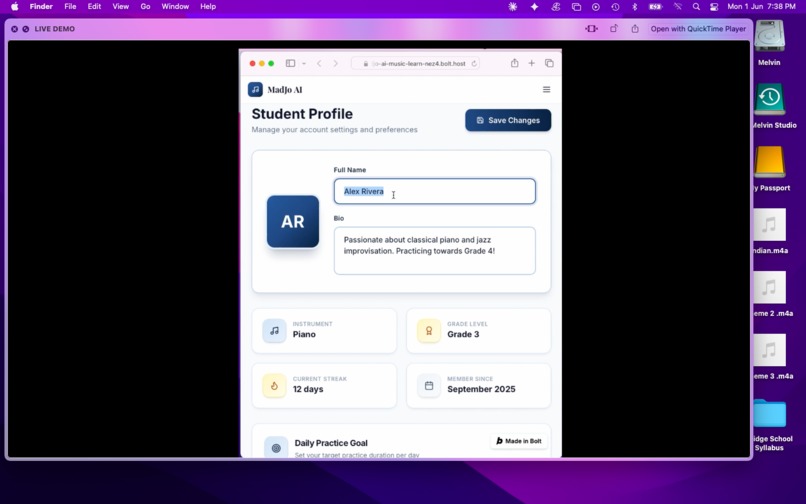
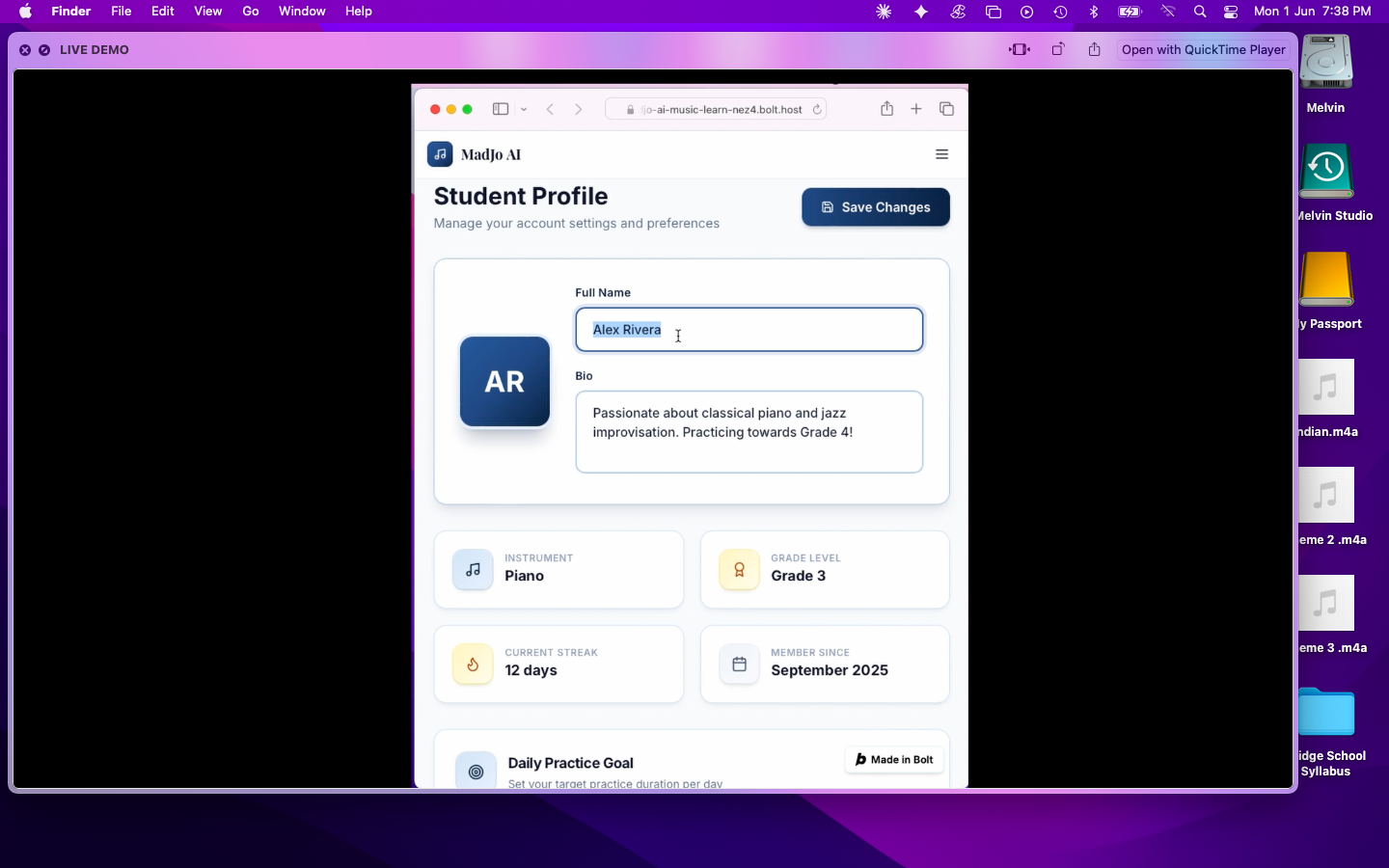
Student Profile
Inspiration
MadJo AI was born from a very real problem: music students forget what their teacher told them the moment they get home. Between weekly lessons, practice time is unguided, unfocused, and often abandoned.
MadJo AI was born from a very real problem: music students forget what their teacher told them the moment they get home. Between weekly lessons, practice time is unguided, unfocused, and often abandoned.
What it does
MadJo AI generates adaptive AI-powered music practice routines based on student level, instrument, and goals. For Example -
Day 1 Student: “I am beginner piano.” AI generates routine.
Day 7 AI remembers:
- previous routines,
- weak areas,
- progress,
- completed exercises. THAT is: agentic personalized learning. every time use generates routines - Saves :
- instrument
- level
- duration
- generated routine
- date/time
How we built it
Phase 1 — Initial Prototype
The project started with a clear educational vision: what if every music student could have a practice routine that sounded like their own teacher — personalised, culturally aware, and pedagogically sound?
Google AI was used to translate this non-technical vision into a working technical specification and initial prompts. Bolt was used to scaffold a full-stack React + TypeScript + Supabase application with: • Instrument selector, grade level picker, and practice duration goal • AI-generated practice routines via Gemini through Supabase Edge Functions • MongoDB Atlas for cloud database storage • Dashboard, profile page, and exercise tracking UI
This phase produced a working prototype — but with a critical problem. The Gemini API integration was tightly coupled to a single provider with no fallback. When credits ran out, the app stopped working entirely.
Phase 2 — Rebuild, Fix & Real Learning (Claude + Manual Code) When Gemini failed and Bolt credits ran out, everything changed. Instead of asking another AI to fix the code, the founder — a music educator who had never written a line of code — I sat down and learned to read, understand, and manually edit the source files directly.
Working file by file, three critical changes were made:
• Created src/lib/ai.ts — a custom multi-provider AI router A routing layer that tries Groq (Llama 3.1 8B) → Claude Haiku → OpenAI GPT-4o mini in sequence. If one provider fails or has no API key, the next takes over silently. The app never shows a blank screen.
• Rewrote src/context/AppContext.tsx — replaced Gemini with direct browser calls Removed the Supabase Edge Function dependency entirely. The app now calls Groq directly from the browser — faster, simpler, and free on Groq's generous free tier.
• Fixed TypeScript type errors and rebuilt the generate routine logic Added robust JSON parsing with markdown fence stripping, exercise normalization, and proper error states.
Phase 3 — Embedding the MADJO Teaching Philosophy The most important step was not technical. covering the full pedagogical framework for students aged 4 to 14. The core teaching principles, lesson structure, Indian cultural adaptations, and age-appropriate progressions were distilled into a rich AI system prompt.
The MADJO Learning Cycle embedded into every routine:
Listen → Copy → Control → Create → Perform → Reflect
Phase 4 — Authentication, Teacher Tab & Email System The final phase added the full user system: • Supabase Auth — login/register with Student / Teacher / Parent role toggle • Teacher Tab — 3-section lesson notes form (This Week's Lesson, Performance Upload, Send Reports) • AI-written progress emails — MadJo AI writes 3 tailored emails from lesson notes and sends them via Gmail to student, teacher, and parent instantly • Zero storage cost — emails go directly, no database writes needed
Challenges we ran into
The Gemini API broke at the worst moment The primary AI provider failed completely when API credits ran out mid-development. With no fallback system, the app was non-functional. This forced the most important architectural decision of the project — building a proper multi-provider router.
Bolt credits ran out before the AI could fix the code When Bolt's AI credits were exhausted, the only option was to manually edit the source files. This was intimidating for a non-developer — but it became the most valuable learning experience of the entire project. Every change was understood, intentional, and precise.
JSON reliability from AI responses AI responses occasionally returned malformed JSON with markdown code fences, extra whitespace, or inconsistent structure. Solved by adding robust parsing that strips fences, validates structure, and normalises all exercise data before rendering.
Supabase + Gmail email integration Sending emails via Gmail through Supabase Edge Functions required App Passwords, CORS configuration, and careful secret management. Each step had to be done correctly in sequence — Supabase secrets, Gmail 2FA, App Password generation.
The pivotal challenge — and how it changed everything When all the AI tools stopped working, a music educator who had never coded learned to read source files, understand TypeScript, and manually fix a production React app. That was not planned. It became the most valuable part of the entire project.
Accomplishments that we're proud of
Multi-provider resilience — the app never fails The custom AI router tries Gemini AI → Claude → OpenAI automatically. If credits run out on one provider, the next takes over with no code changes needed. This is the exact lesson learned from Phase 1 — and it makes MadJo AI production-grade reliable.
A non-developer shipped a real AI product in one day I had no coding background. Between a broken prototype and a live, working, pedagogically-powered application — the gap was closed through direct learning, manual code editing, and genuine problem solving. This is exactly the kind of democratised AI development these tools are meant to enable.
- AI-written progress reports — 3 emails, 3 audiences, instantly When a teacher submits lesson notes, MadJo AI writes three completely different emails: encouraging and motivating for the student, professional and precise for the teacher, simple and parent-friendly for the parent. All sent in seconds. Zero storage cost.
What we learned
Technical lessons • A system prompt is not just instructions — it is a teacher's voice. The difference between a generic AI routine and a MADJO routine is entirely in how you speak to the model. • Multi-provider fallback is not optional for production AI apps. Any single-provider dependency is a single point of failure. • Manual code edits are often faster and more precise than AI-generated rewrites — especially when you understand what you are changing and why. • Browser-direct API calls eliminate entire layers of backend complexity for early-stage products. • Supabase Edge Functions + Gmail App Passwords is a zero-cost email solution that requires no third-party email service.
Product lessons • The methodology is your moat. Generic AI tools can replicate features. They cannot replicate 20 years of a specific educator's teaching philosophy. • Two focused products beat one confused product. The student practice companion and the teacher delivery tool serve completely different audiences — keeping them separate makes both stronger. • Real users reveal what no prototype review can. Getting the app in front of actual students is the most valuable next step — more than any new feature.
Human lessons You don't need to be a developer to build something real. You need a clear vision, the willingness to learn, and the right tools. AI makes that possible in a way that wasn't true five years ago.
What's next for MadJo AI Music Learning Agent
MadJo AI v2 — Near Term
- Gemini API as primary provider — Google Cloud integration for the hackathon and beyond
- MongoDB Atlas MCP — persistent student memory, routine history, and progress tracking
- Practice timer — built-in countdown for each exercise using existing duration data
- Routine history — revisit past routines with completion percentages
- Completion celebration — confetti animation when a routine is finished
- Separate DashBoard for Teachers and Parents. - Teacher - Teacher Tab — log lesson notes Send progress reports via email, View each student's routine, MADJO rubric assessment Profile (name, school, email), / Parent - Parent Dashboard (child's progress), View child's current routine View lesson notes from teacher, Receive email progress reports, Profile (name, child's name, emails) have started work on that.
- Bringing in more Lesson Plans with MadJo Teaching Method and Curriculum ( Instrument specific)
- Brainstorm with other teachers and studens to know what would add value.
MadJo Ai for Music & Arts Development for Junior Originals Foundation Pathway — Second Product A separate app for parents and teachers of children aged 4–12, built entirely on the MADJO early years curriculum. Where MadJo AI is a student practice companion, Foundation Pathway is a teacher and parent delivery guide — lesson plans, activity cards, observation checklists, and cultural adaptations for Indian classrooms. The 8 PDFs of MADJO methodology become the entire product content.
Beat Bot - Third Product "Build a kid-friendly, highly visual 2D web music game using the Tone.js library for high-quality audio. The game should have a 'World Map' with different levels:
- Rhythm Realm: A rhythm matching game where users tap to the 'Groove' and 'Tempo'.
- Melody Mountain: A 'Simon Says' style game where users repeat short melodic phrases.
- Harmony Harbor: A simple puzzle where users match 'Triads' and 'Chords' to their sounds.
- Groove Garden: A drag-and-drop drum machine to create beats. Requirements: Use bright colors, large buttons, and zero complex music theory text. Instead of 'Triad,' use 'Triple Sound.' The UI must be responsive for tablets and desktops. Include a 'Win' screen with stars for each level. Deploy it as a single-page React app."
Long-Term Vision — The MADJO Suite • AI-powered practice evaluation with audio pitch and rhythm detection • Adaptive learning paths that detect weaknesses and adjust routines automatically • School and music academy integrations — teacher networks, multi-student management • Gamified learning with the MADJO reward system • Multi-language support — Tamil, Hindi, and regional language interfaces • Voice and audio feedback — real-time correction using AI audio analysis
MadJo AI is not just a music app. It is proof that a domain expert with deep knowledge, the right AI tools, and the willingness to learn can build something genuinely meaningful — even without a technical background. The MADJO Music Method has helped hundreds of children fall in love with music. MadJo AI is how that reaches thousands.
Built With
- atuoprefixer
- claude
- edgefunction
- eslint
- geminiai
- geminiflash
- gmailsmtp
- haiku-learning-management-system
- llama
- localmockdata
- lucidereact
- mongodb
- node.js
- postcss
- postgresql
- react
- supabase
- tailwind
- typescript
- vite

Log in or sign up for Devpost to join the conversation.