-
-
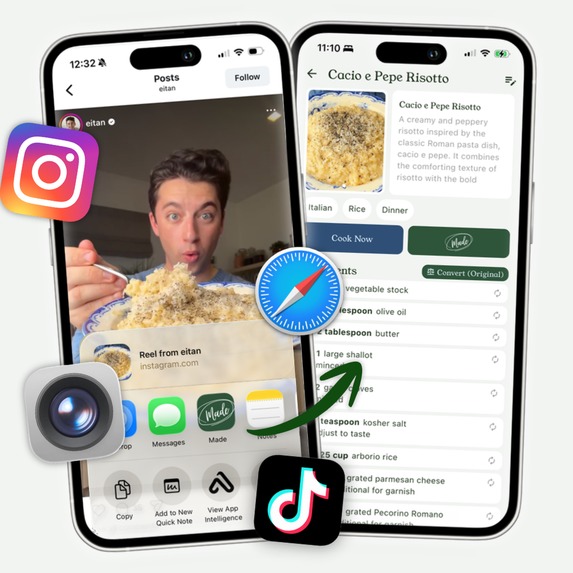
Never lose a recipe again. Save recipes from anywhere: cookbooks, websites, photos, and social media.
-
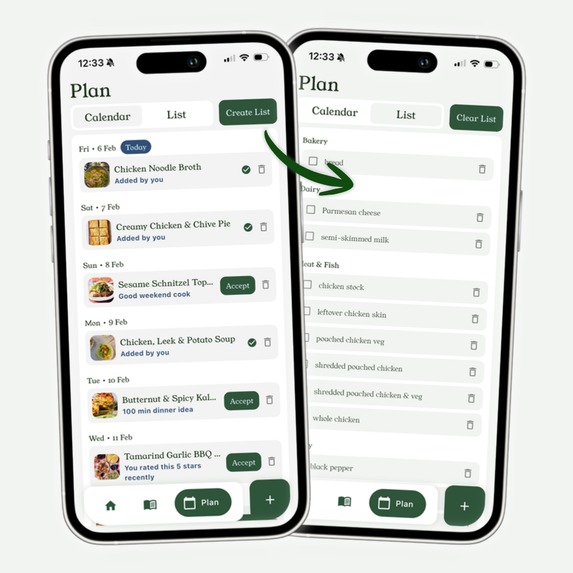
Always know what to cook. Made tell you what to cook right now, or plans the week for you.
-
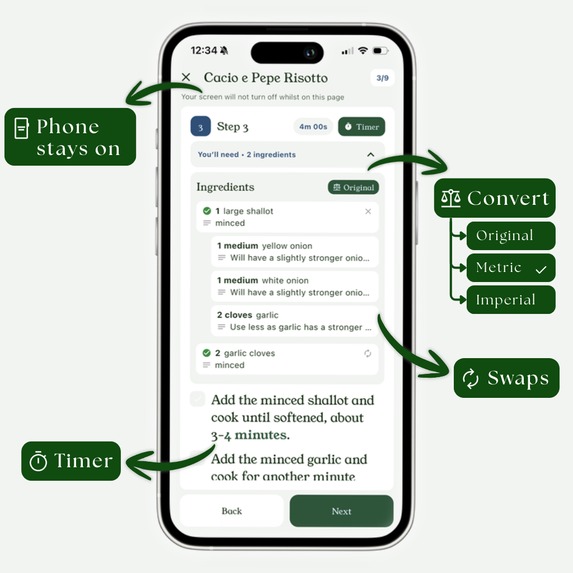
Just cook. We'll handle the rest. Step-by-step cooking with smart timers, swaps, and instant conversions.


Inspiration
Made began with a personal frustration. I related to the exact problem Eitan Bernath highlighted in his brief. I am a home cook and a full-time postgraduate student. I enjoy cooking, but like many people, I found myself saving recipes constantly from Instagram, TikTok, websites, screenshots, and cookbooks, without actually making them. My phone was full of “future meals” that never became dinners.
Instead of jumping straight into building a solution, I started with conversations.
I spoke to friends and family across generations: serious home cooks, casual cooks, cookbook loyalists, and social-media-driven recipe collectors. I called my aunt and my father-in-law who are both experienced cooks, and asked why they avoided recipe apps. I asked my peers why they disliked existing tools. I asked everyone the same question: what actually stops recipes from becoming meals?
The pattern was clear. The problem was not discovery. It was execution. If we define: $$\text{Meals Cooked} = \text{Recipes Saved} \times P(\text{Execution})$$
Most tools optimise for increasing recipes saved. Almost none increase the probability of execution.
Made is built to increase \(P(Execution)\).
Building the First Version
I spent the first week deeply understanding the brief and the behavioural problem. I deliberately ignored proposed features and rewatched the original brief repeatedly to isolate the core friction.
The first version was simple: authenticated users could add and store recipes. That initial build using Flutter frontend, Firebase authentication, Firestore database, and Firebase Storage took a few days.
From there, the complexity increased:
- Importing from photos
- Parsing recipe websites
- Handling social media posts
The most technically challenging problem was dealing with unstructured content. Recipes on social media appear in captions, comments, voiceovers, partially listed ingredients, missing measurements, or incomplete steps. Building a system that could process inconsistent formats required backend logic in Firebase Functions and careful parsing strategies.
Challenges
Technical: The hardest engineering challenge was normalising chaotic recipe formats into structured, cookable steps. Real-world recipe data is messy. Social platforms were not designed for structured culinary data, so the system had to adapt.
Personal: Balancing development with an MSc in Robotics required strict time discipline. Progress often happened late at night between coursework deadlines. The constraint forced focus and prevented feature sprawl.
Validation
To validate demand, I shared Made on LinkedIn and invited beta testers. I onboarded 20 active testers and offered a free year of Pro access to anyone who provided me with feedback. I ran the testing for 2 weeks and iteratively updated, with new builds released almost daily. Across this period the testers added 100+ recipes collectively.
Product Lessons
Two major insights reshaped the product:
Curation beats abundance: After talking with beta users, the feedback was overwhelming: they didn’t want another massive recipe library. They didn’t want to scroll through tens of thousands of options and lose the ones they actually cared about. Almost every recipe app assumes more choice is better, but that abundance creates decision fatigue. Made deliberately avoids a public recipe collection. It only contains the recipes you add yourself. The goal isn’t to maximise the number of recipes saved, but to maximise the probability of actually cooking one. Users want an app curated by them, for them - not by strangers with different tastes and skill levels.
Trust precedes payment: I initially designed a hard paywall after onboarding. The feedback was clear from my testers. They needed to experience the workflow before been convinced of its worth and committing to a subscription. I pivoted to a freemium model, whereby the Free Plan had full feature access but is limited to importing a maximum of 3 recipes. To unlock unlimited recipe importing, the Pro Plan must be purchased, but this features a 14 day free trial to allow users to test the full cooking cycle, taking into account real life time constraints: planing, shopping, and cooking before deciding.
Design Philosophy
The app icon was inspired by a conversation with my aunt. She told me she dislikes cooking apps because she prefers writing directly into her cookbooks: circling recipes, noting substitutions, recording dates and guests.
That moment shaped the identity of Made.
The app icon resembles writing “Made” into a cookbook and circling it. Because that is the ultimate goal: not saving recipes, but making them.
Built With
- apify
- dart
- firebase
- firestore
- flutter
- gemini
- google-books
- javascript
- revenuecat

Log in or sign up for Devpost to join the conversation.